
Multiple Input, Multiple Output (MIMO) Radar Antenna Market Report 2026
Global Outlook – By Type (Active Multiple Input, Multiple Output (MIMO), Passive Multiple Input, Multiple Output (MIMO), Hybrid Multiple Input, Multiple Output (MIMO)), By Frequency Band (L-Band, S-Band, C-Band, X-Band, Ku-Band, Ka-Band, Other Frequency Bands), By Application (Automotive, Aerospace And Defense, Industrial, Security And Surveillance, Other Applications), By End-User (Military, Commercial, Research, Other End-Users) – Market Size, Trends, Strategies, and Forecast to 2030
Multiple Input, Multiple Output (MIMO) Radar Antenna Market Overview
• Multiple Input, Multiple Output (MIMO) Radar Antenna market size has reached to $1.12 billion in 2025 • Expected to grow to $2 billion in 2030 at a compound annual growth rate (CAGR) of 12.2% • Growth Driver: The Growing Deployment Of 5G Networks Is Fueling The Growth Of The Market Due To The Rising Demand For High-Speed Connectivity And Advanced Antenna Systems • Market Trend: Advancements In MIMO Radar Antennas For Enhanced Uncontrolled Airspace Monitoring • North America was the largest region in 2025 and Asia-Pacific is the fastest growing region.What Is Covered Under Multiple Input, Multiple Output (MIMO) Radar Antenna Market?
A multiple-input, multiple-output (MIMO) radar antenna is an advanced sensing system that transmits and receives multiple signals simultaneously to detect and track objects with high precision. It enhances spatial resolution and target discrimination by processing diverse signal paths concurrently. This radar antenna improves accuracy and reliability in radar detection compared to conventional single-input systems. Its inherent advantage lies in efficiently managing complex signal environments to deliver superior situational awareness. The main types of multiple-input, multiple-output (MIMO) radar antennas are active multiple-input, multiple-output (MIMO), passive multiple-input, multiple-output (MIMO), and hybrid multiple-input, multiple-output (MIMO). Active multiple-input, multiple-output (MIMO) radar antennas use integrated transmit and receive modules at each antenna element to simultaneously send and receive signals, enhancing detection accuracy and spatial resolution. The frequency bands include L-band, S-band, C-band, X-band, Ku-band, Ka-band, and others and are applied across multiple sectors, such as automotive, aerospace and defense, industrial, security and surveillance, and others, and are used by several end-users, including military, commercial, research, and others.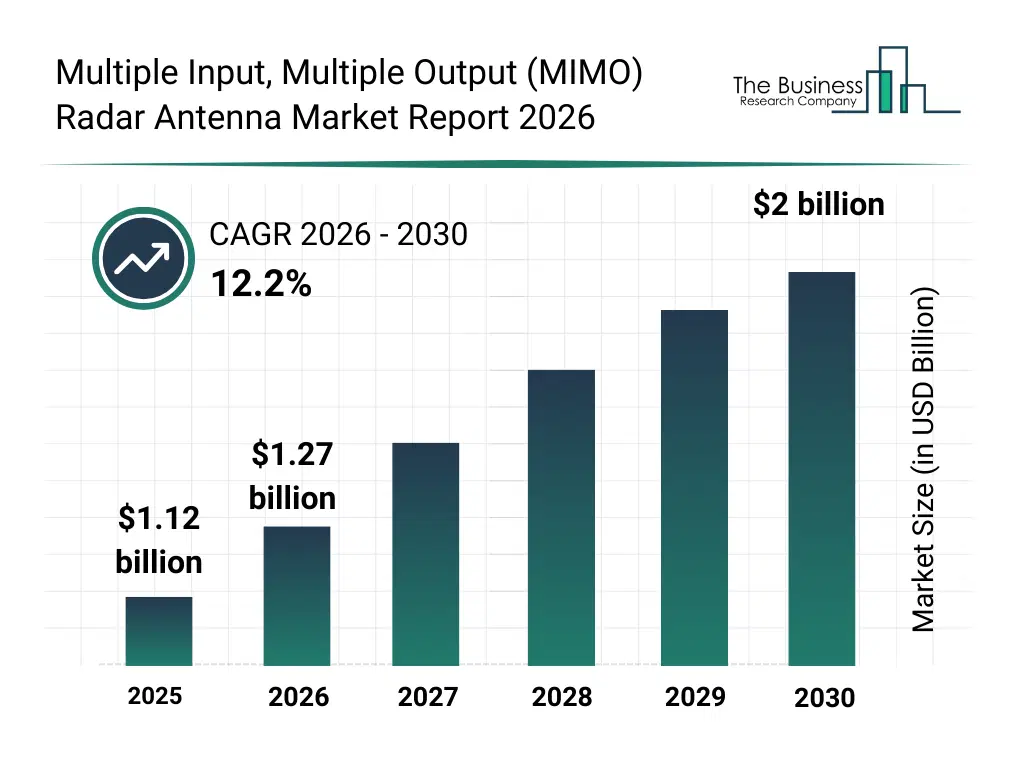
What Is The Multiple Input, Multiple Output (MIMO) Radar Antenna Market Size and Share 2026?
The multiple input, multiple output (mimo) radar antenna market size has grown rapidly in recent years. It will grow from $1.12 billion in 2025 to $1.27 billion in 2026 at a compound annual growth rate (CAGR) of 12.5%. The growth in the historic period can be attributed to initial adoption of mimo technology in military radar systems, advancements in phased array antenna design, improvements in low-noise amplifier and signal processing capabilities, increased demand for high-resolution target tracking, deployment in air and maritime surveillance systems.What Is The Multiple Input, Multiple Output (MIMO) Radar Antenna Market Growth Forecast?
The multiple input, multiple output (mimo) radar antenna market size is expected to see rapid growth in the next few years. It will grow to $2 billion in 2030 at a compound annual growth rate (CAGR) of 12.2%. The growth in the forecast period can be attributed to integration with AI-driven target detection and classification, development of wideband and adaptive radar capabilities, expansion in networked and distributed radar systems, enhancements in power efficiency and compact form factors, deployment in next-generation autonomous defense platforms. Major trends in the forecast period include advancements in high-frequency phased array architectures, growing adoption of digital beamforming for improved target tracking, rising integration of low-noise and power-efficient rf components, increased demand for compact multi-band radar antenna designs, development of enhanced radar signal processing algorithms,.
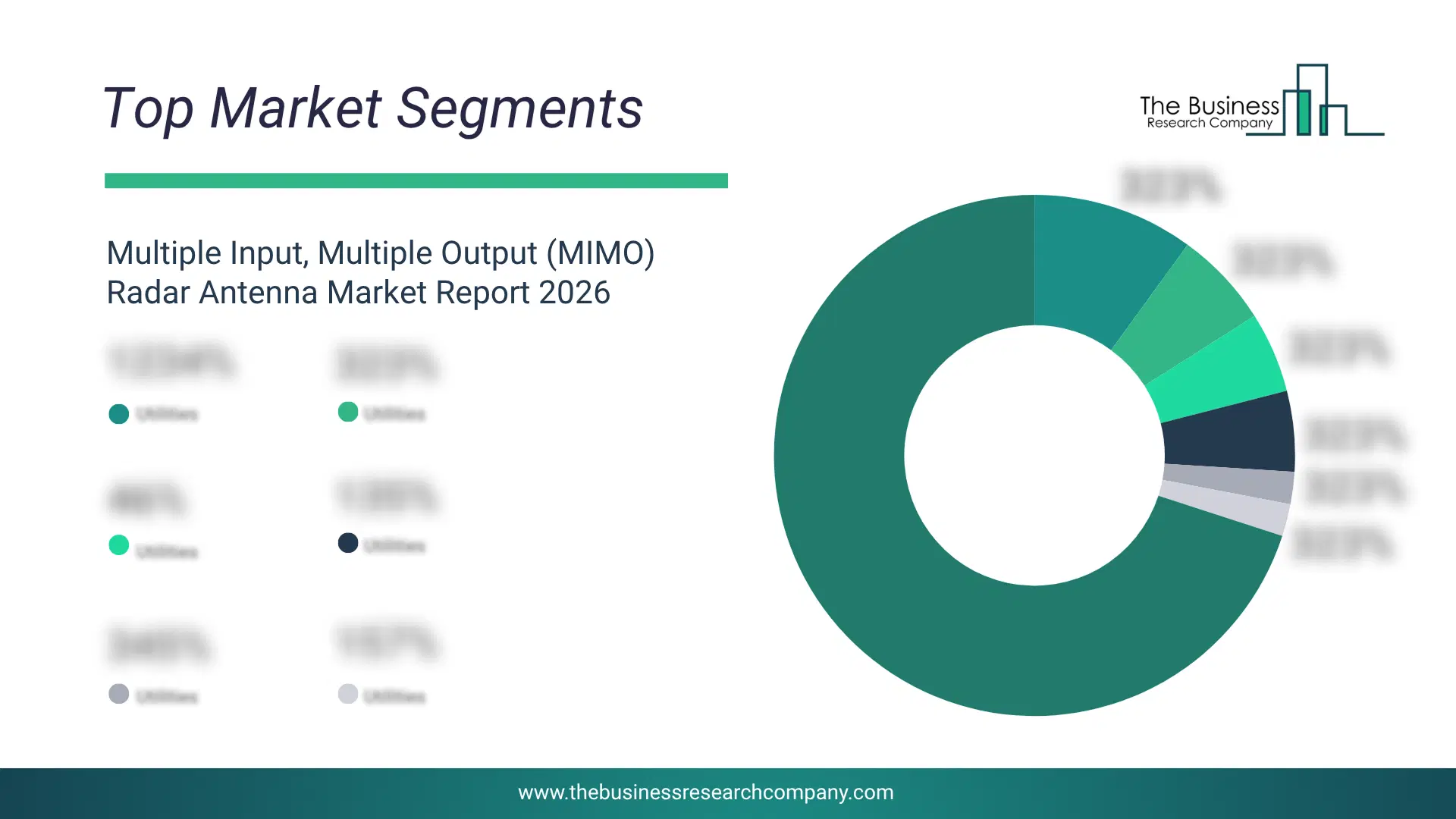
Global Multiple Input, Multiple Output (MIMO) Radar Antenna Market Segmentation
1) By Type: Active Multiple Input, Multiple Output (MIMO), Passive Multiple Input, Multiple Output (MIMO), Hybrid Multiple Input, Multiple Output (MIMO) 2) By Frequency Band: L-Band, S-Band, C-Band, X-Band, Ku-Band, Ka-Band, Other Frequency Bands 3) By Application: Automotive, Aerospace And Defense, Industrial, Security And Surveillance, Other Applications 4) By End-User: Military, Commercial, Research, Other End-Users Subsegments: 1) By Active Multiple Input, Multiple Output (MIMO): Active Electronically Scanned Array (AESA) Radar, Phased Array Radar, Digital Beamforming Radar, Solid-State Radar 2) By Passive Multiple Input, Multiple Output (MIMO): Passive Electronically Scanned Array (PESA) Radar, Reflector Antenna Systems, Passive Beamforming Antenna Systems, Metamaterial-Based Antennas 3) By Hybrid Multiple Input, Multiple Output (MIMO): Hybrid Active-Passive Antenna Systems, Reconfigurable Intelligent Surface (RIS) Enabled Antennas, Adaptive Beamforming Hybrid Systems, Multi-Band Hybrid Radar AntennasWhat Is Driver Of The Multiple Input, Multiple Output (MIMO) Radar Antenna Market?
The growing deployment of 5G networks is expected to propel the growth of the multiple input, multiple output (MIMO) radar antenna market going forward. 5G networks are fifth-generation wireless technology systems that provide enhanced mobile connectivity with significantly higher data speeds, lower latency, and greater capacity compared to previous network generations. The rapid expansion of 5G networks is driven by the increasing demand for high-speed wireless connectivity in smart cities, autonomous vehicles, and IoT applications, requiring advanced infrastructure that can support massive data transmission and ultra-reliable low-latency communications. The deployment of 5G networks increases demand for MIMO radar antennas, as these systems require sophisticated antenna arrays to enable beamforming capabilities and spatial multiplexing essential for 5G's advanced performance characteristics. For instance, in May 2025, according to Ericsson, a Sweden-based telecommunications company, 5G mobile subscriptions are projected to grow from 1.62 billion in 2023 to 6.29 billion by 2030. Therefore, the growing deployment of 5G networks is driving the growth of the multiple input, multiple output (MIMO) radar antenna industry.Key Players In The Global Multiple Input, Multiple Output (MIMO) Radar Antenna Market
Major companies operating in the multiple input, multiple output (mimo) radar antenna market are Huawei Technologies Co Ltd, RTX Corporation, Lockheed Martin Corporation, Qualcomm Incorporated, Ericsson, Nokia Corporation, Keysight Technologies, Skyworks Solutions Inc, Qorvo Inc, Analog Devices Inc, Rohde & Schwarz GmbH & Co KG, General Atomics, Bharat Electronics Limited, HUBER+SUHNER AG, Rogers Corporation, Anritsu Corporation, Terma Group, Radio Frequency Systems, 2J Antennas, TMY Technology Inc.
This chart is for illustrative purposes; the full report includes a detailed competitor analysis and comprehensive overview of the top 10 companies in the market.
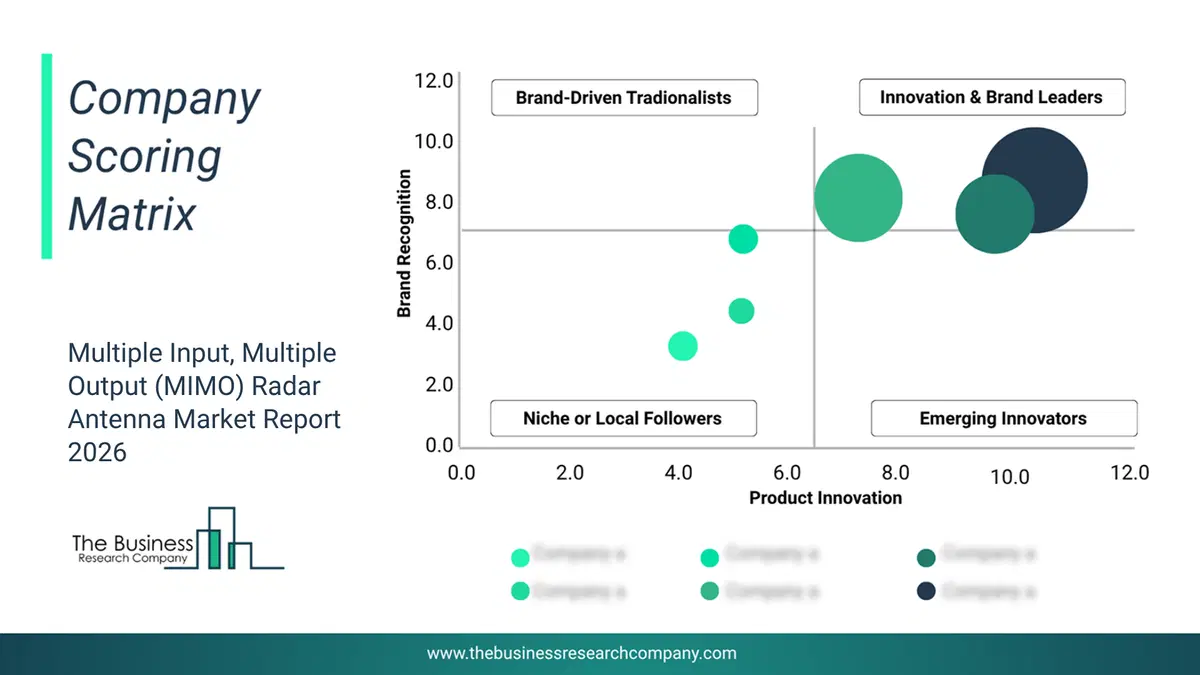
This chart maps companies by product innovation and brand strength, with bubble size indicating relative revenue, helping identify market leaders, challengers, and niche players. This is an illustrative chart; the full report provides a complete and accurate competitive analysis.
Global Multiple Input, Multiple Output (MIMO) Radar Antenna Market Trends and Insights
Major companies operating in the multiple-input, multiple-output (MIMO) radar antenna market are focusing on developing advanced products, such as uncontrolled airspace monitoring radar systems, to strengthen situational awareness for both defense and commercial applications. An uncontrolled airspace monitoring radar system detects and tracks aircraft and drones in areas without formal air traffic control, enhancing situational awareness and preventing unauthorized airspace incursions. For instance, in September 2024, HENSOLDT, a Germany-based manufacturer of sensor technologies for defense and security applications, developed a compact, interference-resistant MIMO radar system for monitoring uncontrolled airspace, particularly urban areas, as part of the MIMO Air project. This radar system, validated through flight tests involving drones and a research helicopter conducted by the German Aerospace Center (DLR) in August 2024, offers reliable detection of small drones and aircraft in uncontrolled airspace, aiding navigation, obstacle warning, and landing assistance using AI to adapt to environmental conditions. The project was led by HENSOLDT with multiple partners and funded by the Federal Ministry of Economics and Climate Protection (BMWK).What Are Latest Mergers And Acquisitions In The Multiple Input, Multiple Output (MIMO) Radar Antenna Market? Qorvo Inc. Acquired Anokiwave Inc. To Boost mmWave MIMO Radar And Advanced Connectivity Solutions
In February 2024, Qorvo Inc., a US-based provider of connectivity and power semiconductor solutions, acquired Anokiwave Inc. for $94 million. With this acquisition, Qorvo aims to strengthen its technological expertise by incorporating Anokiwave’s high-frequency beamforming and IF-to-RF conversion integrated circuits (ICs). This deal allows Qorvo to offer advanced, highly integrated system-in-package solutions across defense, aerospace, SATCOM, and 5G markets. Anokiwave Inc. is a US-based manufacturer of millimeter-wave (mmWave) integrated circuits (ICs) that enable high-performance MIMO radar systems.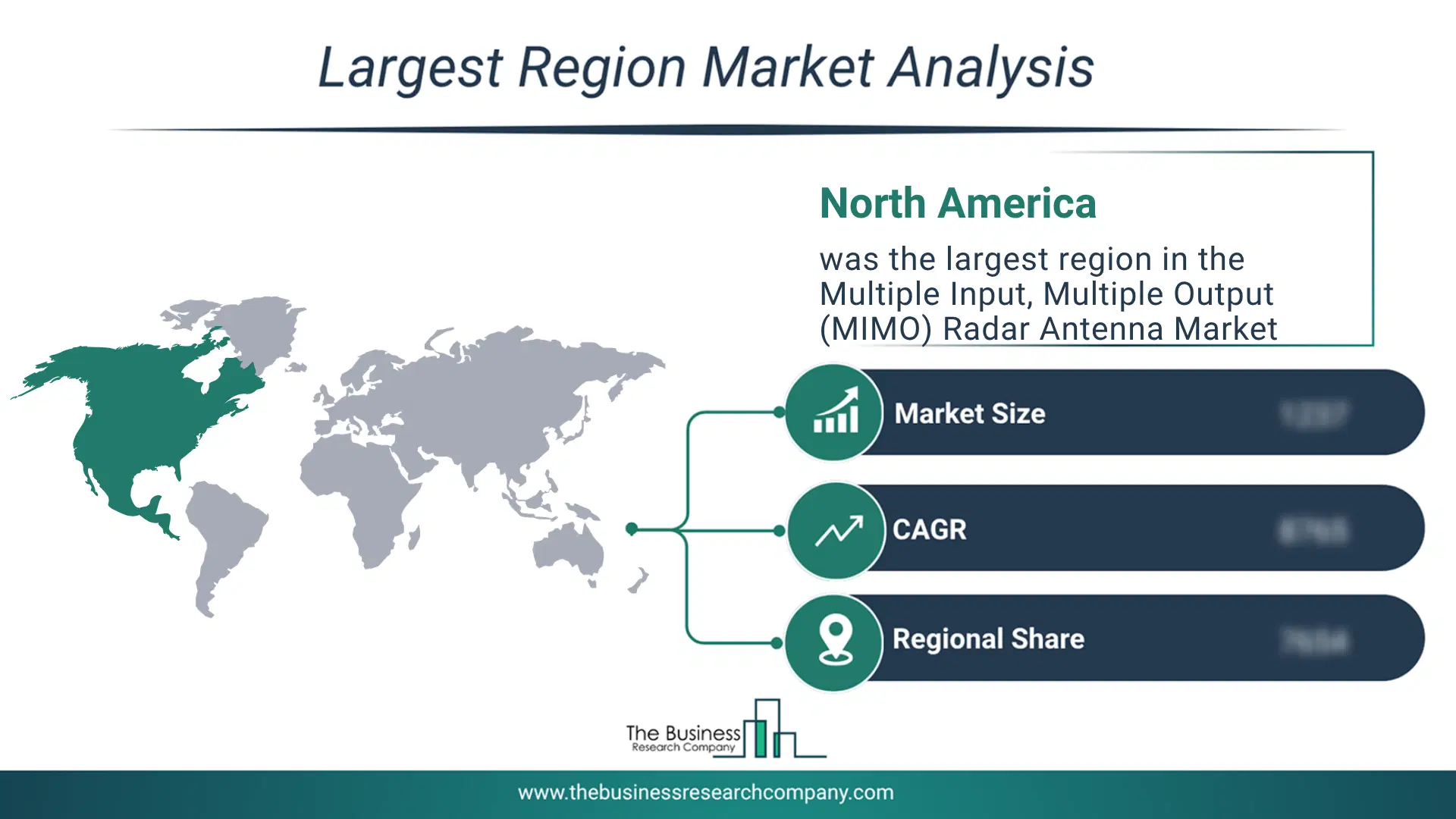
Regional Insights
North America was the largest region in the multiple-input, multiple-output (MIMO) radar antenna market in 2025. Asia-Pacific is expected to be the fastest-growing region in the forecast period. The regions covered in this market report are Asia-Pacific, South East Asia, Western Europe, Eastern Europe, North America, South America, Middle East, Africa. The countries covered in this market report are Australia, Brazil, China, France, Germany, India, Indonesia, Japan, Taiwan, Russia, South Korea, UK, USA, Canada, Italy, SpainWhat Defines the Multiple Input, Multiple Output (MIMO) Radar Antenna Market?
The multiple-input, multiple-output (MIMO) radar antenna market consists of sales of radar transceivers, phased array antennas, signal processors, low-noise amplifiers (LNA), and power amplifiers (PA). Values in this market are ‘factory gate’ values, that is, the value of goods sold by the manufacturers or creators of the goods, whether to other entities (including downstream manufacturers, wholesalers, distributors, and retailers) or directly to end customers. The value of goods in this market includes related services sold by the creators of the goods.How is Market Value Defined and Measured?
The market value is defined as the revenues that enterprises gain from the sale of goods and/or services within the specified market and geography through sales, grants, or donations in terms of the currency (in USD unless otherwise specified). The revenues for a specified geography are consumption values that are revenues generated by organizations in the specified geography within the market, irrespective of where they are produced. It does not include revenues from resales along the supply chain, either further along the supply chain or as part of other products.
This chart presents market attractiveness based on a quantitative evaluation of growth, competition, strategic alignment, and risk, offering a clear view of opportunity areas for decision-making. This chart is for illustrative purposes; the full report contains the complete analysis.

This chart highlights the Total Addressable Market (TAM) by estimating the maximum revenue opportunity using an assumption-driven approach, supporting strategic planning and opportunity sizing across markets. The chart is illustrative; the full report provides a more comprehensive analysis.
What Key Data and Analysis Are Included in the Multiple Input, Multiple Output (MIMO) Radar Antenna Market Report 2026?
The multiple input, multiple output (mimo) radar antenna market research report is one of a series of new reports from The Business Research Company that provides market statistics, including industry global market size, regional shares, competitors with the market share, detailed market segments, market trends and opportunities, and any further data you may need to thrive in the multiple input, multiple output (mimo) radar antenna industry. The market research report delivers a complete perspective of everything you need, with an in-depth analysis of the current and future state of the industry.Multiple Input, Multiple Output (MIMO) Radar Antenna Market Report Forecast Analysis
| Report Attribute | Details |
|---|---|
| Market Size Value In 2026 | $1.27 billion |
| Revenue Forecast In 2030 | $2 billion |
| Growth Rate | CAGR of 12.2% from 2026 to 2030 |
| Base Year For Estimation | 2025 |
| Actual Estimates/Historical Data | 2020-2025 |
| Forecast Period | 2026 - 2030 |
| Market Representation | Revenue in USD Billion and CAGR from 2026 to 2030 |
| Segments Covered | Type, Frequency Band, Application, End-User |
| Regional Scope | Asia-Pacific, Western Europe, Eastern Europe, North America, South America, Middle East, Africa |
| Country Scope | The countries covered in the multiple input, multiple output (mimo) radar antenna market report are Australia, Brazil, China, France, Germany, India, Indonesia, Japan, Taiwan, Russia, South Korea, UK, USA, Canada, Italy, Spain |
| Key Companies Profiled | Huawei Technologies Co Ltd, RTX Corporation, Lockheed Martin Corporation, Qualcomm Incorporated, Ericsson, Nokia Corporation, Keysight Technologies, Skyworks Solutions Inc, Qorvo Inc, Analog Devices Inc, Rohde & Schwarz GmbH & Co KG, General Atomics, Bharat Electronics Limited, HUBER+SUHNER AG, Rogers Corporation, Anritsu Corporation, Terma Group, Radio Frequency Systems, 2J Antennas, TMY Technology Inc. |
| Customization Scope | Request for Customization |
| Pricing And Purchase Options | Explore Purchase Options |