
n-Butanol Market Report 2026
Global Outlook – By Grade (Industrial Grade n-Butanol, Chemical Intermediate Grade n-Butanol, Pharmaceutical Grade n-Butanol, Bio-Based n-Butanol), By Production Process (Oxo Process, Bio-Fermentation Process, Other Emerging Processes), By Application (Butyl Acrylate Production, Butyl Acetate Production, Glycol Ether Production, Direct Solvent Applications, Plasticizer Production, Other Chemical Intermediates), By End-Use Industry (Paints and Coatings, Chemicals and Petrochemicals, Adhesives and Sealants, Plastics and Polymers, Textiles, Pharmaceutical Manufacturing, Agriculture Chemicals) – Market Size, Trends, Strategies, and Forecast to 2030
n-Butanol Market Overview
• n-Butanol market size has reached to $3.72 billion in 2025 • Expected to grow to $4.7 billion in 2030 at a compound annual growth rate (CAGR) of 4.7% • Growth Driver: Construction Industry Growth Fuels The n-butanol Market Expansion Via Infrastructure Demand • Market Trend: Innovative Co-Production Processes In The N-Butanol Market • Asia-Pacific was the largest region and fastest growing region.What Is Covered Under n-Butanol Market?
n-Butanol refers to a type of alcohol with the chemical formula C4H9OH. It is a four-carbon straight-chain alcohol colorless liquid with a characteristic smell. n-Butanol is an industrial solvent and an intermediate in producing other chemicals, including butyl acrylate, butyl acetate, and glycol ethers. The main grades of n-butanol are pharmaceuticals, industrial, and chemicals. The pharmaceuticals segment refers to the specific grade of n-butanol used to produce medicines, drugs, and pharmaceutical products. The production process includes the oxyhydrogenation of propylene, butane oxidation, and fermentation of biomass to produce butyl acrylate, butyl acetate, glycol ethers, direct solvents, plasticizers, and other applications. These applications span various end-use industries such as paints and coatings, chemicals and petrochemicals, textiles, agriculture, buildings and construction, food and beverages, transportation, and pharmaceuticals.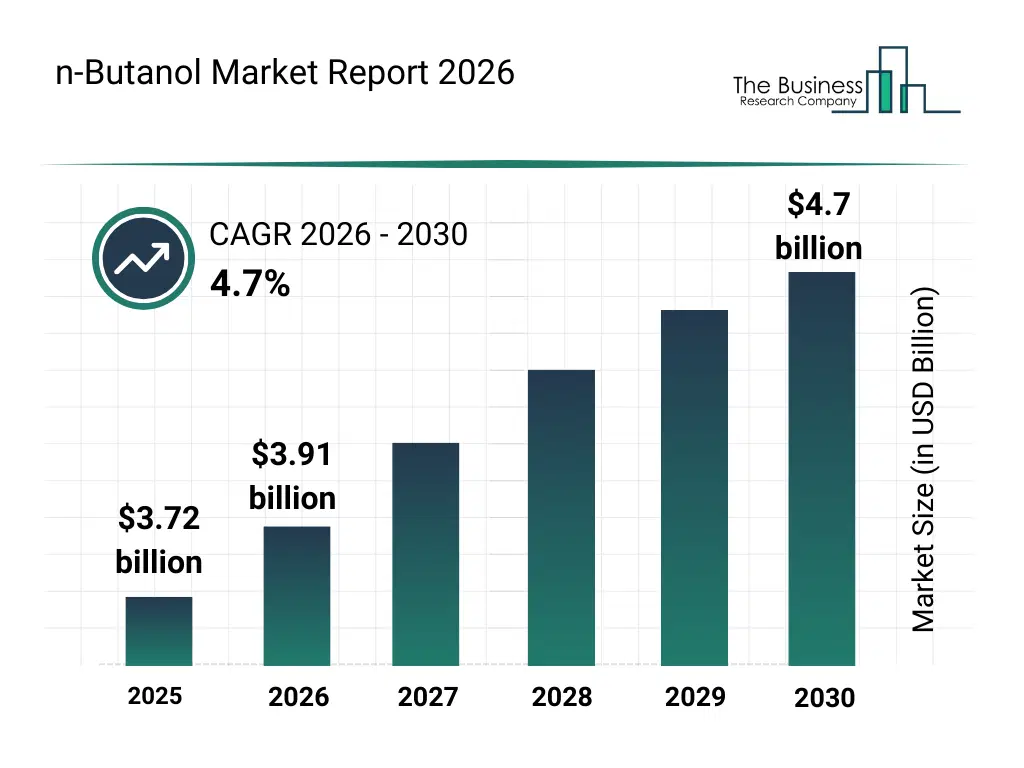
What Is The n-Butanol Market Size and Share 2026?
The n-butanol market size has grown strongly in recent years. It will grow from $3.72 billion in 2025 to $3.91 billion in 2026 at a compound annual growth rate (CAGR) of 5.3%. The growth in the historic period can be attributed to growth of petrochemical industry, expansion of paints and coatings sector, increased use of solvent based formulations, rising demand for chemical intermediates, availability of propylene based production processes.What Is The n-Butanol Market Growth Forecast?
The n-butanol market size is expected to see steady growth in the next few years. It will grow to $4.7 billion in 2030 at a compound annual growth rate (CAGR) of 4.7%. The growth in the forecast period can be attributed to shift toward bio based butanol production, increasing demand for lightweight automotive coatings, growth in construction activities, rising use in pharmaceutical formulations, advancements in fermentation technologies. Major trends in the forecast period include rising demand for industrial solvents, growing use in acrylic and coating intermediates, increasing adoption in bio based chemical production, expansion of butanol based plasticizer applications, higher consumption in paints and coatings manufacturing.
Global n-Butanol Market Segmentation
1) By Grade: Industrial Grade n-Butanol, Chemical Intermediate Grade n-Butanol, Pharmaceutical Grade n-Butanol, Bio-Based n-Butanol 2) By Production Process: Oxo Process, Bio-Fermentation Process, Other Emerging Processes 3) By Application: Butyl Acrylate Production, Butyl Acetate Production, Glycol Ether Production, Direct Solvent Applications, Plasticizer Production, Other Chemical Intermediates 4) By End-Use Industry: Paints and Coatings, Chemicals and Petrochemicals, Adhesives and Sealants, Plastics and Polymers, Textiles, Pharmaceutical Manufacturing, Agriculture Chemicals Subsegments: 1) By Industrial Grade n-Butanol: Industrial Grade n-Butanol, Paints and Coatings Solvent Grade, Adhesives and Sealants Solvent Grade, Printing Inks Solvent Grade, Cleaning and Degreasing Solvent Grade, General Industrial Solvent Grade 2) By Chemical Intermediate Grade n-Butanol: Chemical Intermediate Grade n-Butanol, Butyl Acrylate Feedstock Grade, Butyl Acetate Feedstock Grade, Glycol Ether Feedstock Grade, Plasticizer Feedstock Grade, Other Chemical Derivative Feedstock Grades 3) By Pharmaceutical Grade n-Butanol: Pharmaceutical Grade n-Butanol, Drug Formulation Solvent Grade, Process Solvent for API Manufacturing, Pharmaceutical Cleaning and Processing Grade 4) By Bio-Based n-Butanol: Bio-Based n-Butanol, Industrial Bio-Butanol (solvents and coatings), Chemical Intermediate Bio-Butanol (bio-acrylates, bio-esters), Fuel-Blend Bio-Butanol (transportation fuels, niche), Low-Carbon or Sustainable Bio-ButanolWhat Is The Driver Of The n-Butanol Market?
The growing demand in the construction industry is expected to drive the n-butanol market going forward. The construction industry encompasses all activities related to planning, designing, building, and maintaining infrastructure and buildings. The increasing demand in the construction sector can be attributed to population expansion, urban development, infrastructural advancements, and governmental funding in construction endeavors. n-Butanol plays a significant role in the construction industry by enhancing the performance and sustainability of materials and processes. Its use as a solvent in coatings and adhesives, as an intermediate in chemical synthesis, and as a sustainable fuel for construction equipment makes it a valuable resource for improving construction activities' efficiency and environmental impact. For instance, in May 2024, according to the report published by the Bureau of the Census, a US-based principal agency of the Federal Statistical System, construction spending during March 2024 was estimated at an annual rate of $2,083.9 billion, representing a 9.6% increase compared to March 2023, while during the first three months of 2024, spending amounted to $461.0 billion, showing a 10.6% increase over the same period in 2023. Hence, the growing demand in the construction industry propels the n-butanol industry.Key Players In The Global n-Butanol Market
Major companies operating in the n-butanol market are BASF SE, Dow Inc., Saudi Basic Industries Corporation, Ineos Group Limited, Sasol Limited, Eastman Chemical Company, Mitsubishi Chemical Corporation, Arkema S.A., PETRONAS Chemicals Group Berhad, OQ Chemicals GmbH, KH Neochem Co. Ltd., China National Petroleum Corporation, Anhui Shuguang Chemical Group, Jiangsu Huachang Chemical Industry Co. Ltd., Andhra Petrochemicals Ltd., Texmark Chemicals Inc., Grupa Azoty, Chang Chun Group, Nanjing Chemical Fiber Co. Ltd., Zibo Qixiang Tengda Chemical Co. Ltd.
This chart is for illustrative purposes; the full report includes a detailed competitor analysis and comprehensive overview of the top 10 companies in the market.
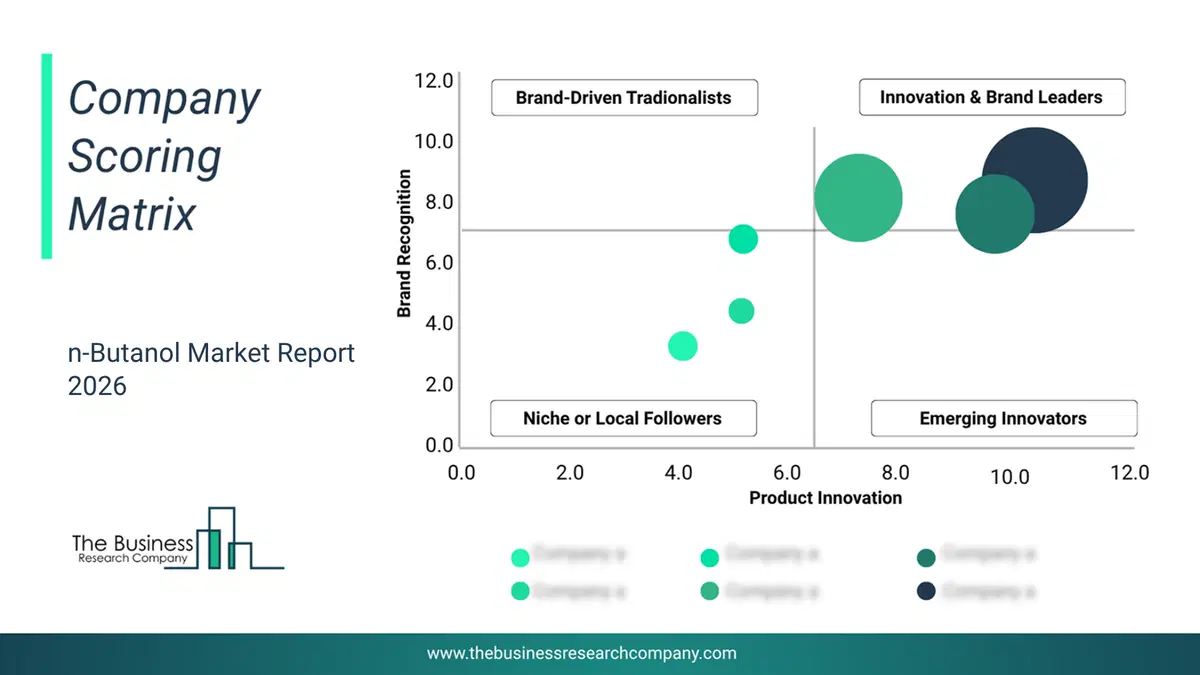
This chart maps companies by product innovation and brand strength, with bubble size indicating relative revenue, helping identify market leaders, challengers, and niche players. This is an illustrative chart; the full report provides a complete and accurate competitive analysis.
Global n-Butanol Market Trends and Insights
Major companies operating in the market are focusing of developing advanced process such as the PO/TBA production processes, to gain a competitive edge. PO/TBA production processes this process is particularly efficient and economically advantageous, as it produces two valuable products that serve a wide array of industrial applications. For instance, in March 2023, Lyondell Basell Industries N.V., a US-based petrochemical company, launched the world's largest propylene oxide (PO) and tertiary butyl alcohol (TBA) unit, which specializes in producing key chemicals used across various industrial and consumer applications. Propylene oxide (PO) is primarily used to manufacture polyurethane foam, found in products like mattresses, car seat cushions, and insulation, which enhances energy efficiency. Tertiary butyl alcohol (TBA) is converted into fuel additives such as methyl tertiary butyl ether (MTBE) and ethyl tertiary butyl ether (ETBE), which improve gasoline combustion, helping reduce vehicle emissions.What Are Latest Mergers And Acquisitions In The n-Butanol Market?
In November 2023, BASF-YPC, a China–based producer of oxo-alcohols and intermediates including normal butanol (n-butanol), partnered with SINOPEC to expand their integrated petrochemical Verbund site in Nanjing increasing capacity of their C4 chemicals, including n-butanol. Through this collaboration, the companies aim to boost n-butanol production volume and strengthen supply capabilities in the global n-butanol market. This agreement underscores the chemical industry’s ongoing focus on scaling n-butanol production capacity to meet rising demand. SINOPEC is a China-based petrochemical company.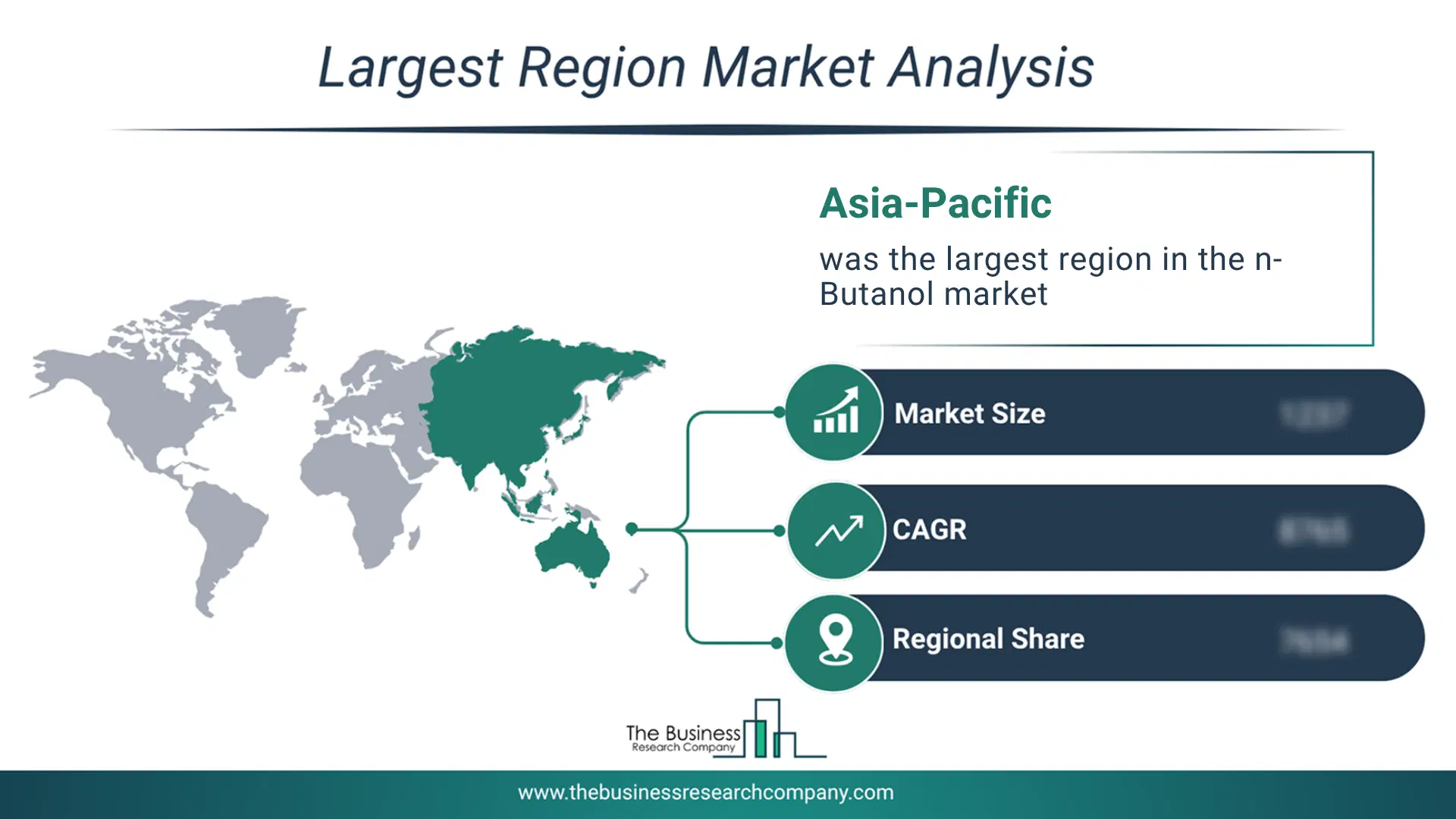
Regional Insights
Asia-Pacific was the largest region in the n-butanol market in 2025. North America is expected to be the fastest-growing region in the forecast period. The regions covered in this market report are Asia-Pacific, South East Asia, Western Europe, Eastern Europe, North America, South America, Middle East, Africa The countries covered in this market report are Australia, Brazil, China, France, Germany, India, Indonesia, Japan, Taiwan, Russia, South Korea, UK, USA, Canada, Italy, SpainWhat Defines the n-Butanol Market?
The n-butanol market consists of sales of adhesives, sealants, lubricants, printing inks, and cosmetics. Values in this market are ‘factory gate’ values, that is the value of goods sold by the manufacturers or creators of the goods, whether to other entities (including downstream manufacturers, wholesalers, distributors and retailers) or directly to end customers. The value of goods in this market includes related services sold by the creators of the goods.How is Market Value Defined and Measured?
The market value is defined as the revenues that enterprises gain from the sale of goods and/or services within the specified market and geography through sales, grants, or donations in terms of the currency (in USD unless otherwise specified). The revenues for a specified geography are consumption values that are revenues generated by organizations in the specified geography within the market, irrespective of where they are produced. It does not include revenues from resales along the supply chain, either further along the supply chain or as part of other products.
This chart presents market attractiveness based on a quantitative evaluation of growth, competition, strategic alignment, and risk, offering a clear view of opportunity areas for decision-making. This chart is for illustrative purposes; the full report contains the complete analysis.

This chart highlights the Total Addressable Market (TAM) by estimating the maximum revenue opportunity using an assumption-driven approach, supporting strategic planning and opportunity sizing across markets. The chart is illustrative; the full report provides a more comprehensive analysis.
What Key Data and Analysis Are Included in the n-Butanol Market Report 2026?
The n-butanol market research report is one of a series of new reports from The Business Research Company that provides market statistics, including industry global market size, regional shares, competitors with the market share, detailed market segments, market trends and opportunities, and any further data you may need to thrive in the n-butanol industry. The market research report delivers a complete perspective of everything you need, with an in-depth analysis of the current and future state of the industry.n Butanol Market Report Forecast Analysis
| Report Attribute | Details |
|---|---|
| Market Size Value In 2026 | $3.91 billion |
| Revenue Forecast In 2030 | $4.7 billion |
| Growth Rate | CAGR of 5.3% from 2026 to 2030 |
| Base Year For Estimation | 2025 |
| Actual Estimates/Historical Data | 2020-2025 |
| Forecast Period | 2026 - 2030 |
| Market Representation | Revenue in USD Billion and CAGR from 2026 to 2030 |
| Segments Covered | Grade, Production Process, Application, End-Use Industry |
| Regional Scope | Asia-Pacific, Western Europe, Eastern Europe, North America, South America, Middle East, Africa |
| Country Scope | The countries covered in this market report are Australia, Brazil, China, France, Germany, India, Indonesia, Japan, Taiwan, Russia, South Korea, UK, USA, Canada, Italy, Spain |
| Key Companies Profiled | BASF SE, Dow Inc., Saudi Basic Industries Corporation, Ineos Group Limited, Sasol Limited, Eastman Chemical Company, Mitsubishi Chemical Corporation, Arkema S.A., PETRONAS Chemicals Group Berhad, OQ Chemicals GmbH, KH Neochem Co. Ltd., China National Petroleum Corporation, Anhui Shuguang Chemical Group, Jiangsu Huachang Chemical Industry Co. Ltd., Andhra Petrochemicals Ltd., Texmark Chemicals Inc., Grupa Azoty, Chang Chun Group, Nanjing Chemical Fiber Co. Ltd., Zibo Qixiang Tengda Chemical Co. Ltd. |
| Customization Scope | Request for Customization |
| Pricing And Purchase Options | Explore Purchase Options |