
N-(n-propyl) Thiophosphoric Triamide (NTTP) Urease Inhibitor Market Report 2026
Global Outlook – By Product Type (Granular, Liquid, Powder), By Crop Type (Cereals And Grains, Oilseeds And Pulses, Fruits And Vegetables, Other Crop Types), By Distribution Channel (Direct Sales, Distributors, Online Retail, Other Distribution Channels), By Application (Agriculture, Horticulture, Turf And Ornamental, Other Applications), By End User (Farmers, Agrochemical Companies, Fertilizer Manufacturers) – Market Size, Trends, Strategies, and Forecast to 2035
N-(n-propyl) Thiophosphoric Triamide (NTTP) Urease Inhibitor Market Overview
• N-(n-propyl) Thiophosphoric Triamide (NTTP) Urease Inhibitor market size has reached to $1.39 billion in 2025 • Expected to grow to $12.24 billion in 2030 at a compound annual growth rate (CAGR) of 54.6% • Growth Driver: Expanding Global Agricultural Productivity Driving The Growth Of The Market Due To Increasing Demand For Efficient Nitrogen Management And Enhanced Crop Yield Solutions • Market Trend: Developing Innovative High-Efficiency Urease Inhibitor Formulations To Enable Emission Reduction And Support Sustainable Agricultural Practices • North America was the largest region in 2025 and Asia-Pacific is the fastest growing region.What Is Covered Under N-(n-propyl) Thiophosphoric Triamide (NTTP) Urease Inhibitor Market?
N-(n-propyl) Thiophosphoric Triamide (NTTP) urease inhibitors refer to a nitrogen stabilizer used in agricultural fertilizers, particularly urea-based formulations, that works by inhibiting the urease enzyme activity in soil. This inhibition slows down the hydrolysis of urea into ammonia, thereby reducing nitrogen losses through volatilization and improving nitrogen use efficiency in crops. The main product types of N-(n-propyl) thiophosphoric triamide (NTTP) urease inhibitor include granular, liquid, and powder. Granular refer to fertilizer additive formulations designed to reduce nitrogen loss and improve nitrogen use efficiency in agricultural applications. These products are used for crop types including cereals and grains, oilseeds and pulses, fruits and vegetables, and other crop types and are distributed through direct sales, distributors, online retail, and other distribution channels. The various applications involved are agriculture, horticulture, turf and ornamental, and others, and they are used by several end users such as farmers, agrochemical companies, and fertilizer manufacturers.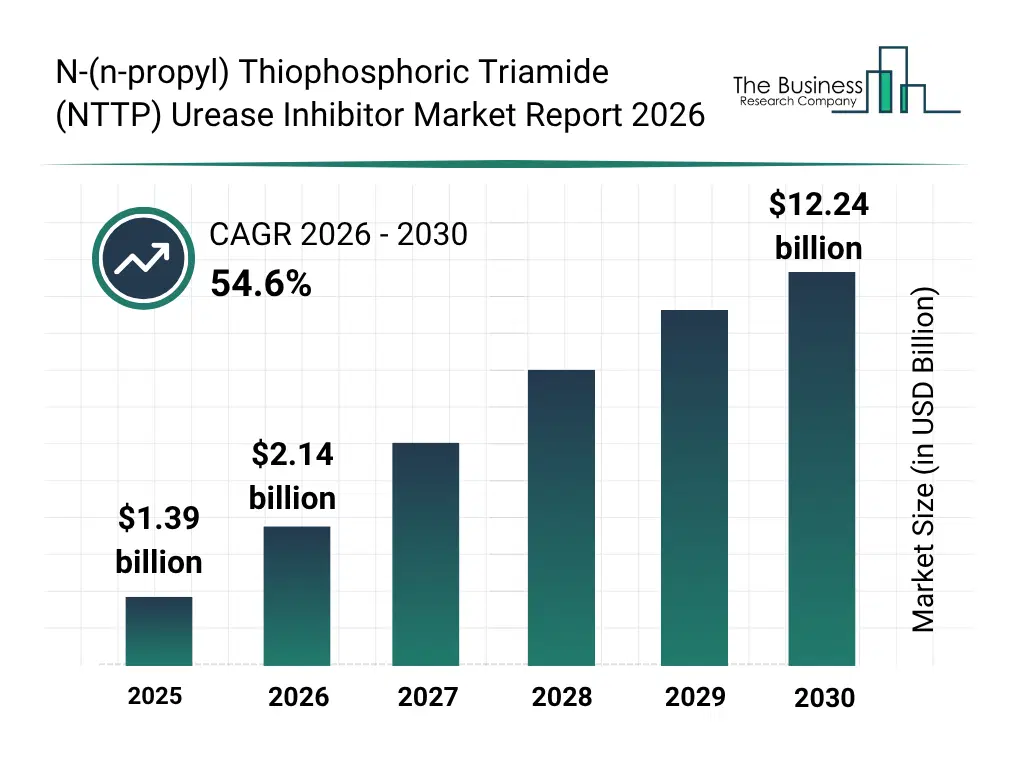
What Is The N-(n-propyl) Thiophosphoric Triamide (NTTP) Urease Inhibitor Market Size and Share 2026?
The n-(n-propyl) thiophosphoric triamide (NTTP) urease inhibitor market size has grown exponentially in recent years. It will grow from $1.39 billion in 2025 to $2.14 billion in 2026 at a compound annual growth rate (CAGR) of 54.4%. The growth in the historic period can be attributed to rising global fertilizer consumption in intensive agriculture, increasing awareness of nitrogen loss in soil systems, expansion of urea-based fertilizer usage, growing adoption of conventional nitrogen stabilizers in developed markets, early regulatory pressure on agricultural emissions control.What Is The N-(n-propyl) Thiophosphoric Triamide (NTTP) Urease Inhibitor Market Growth Forecast?
The n-(n-propyl) thiophosphoric triamide (NTTP) urease inhibitor market size is expected to see exponential growth in the next few years. It will grow to $12.24 billion in 2030 at a compound annual growth rate (CAGR) of 54.6%. The growth in the forecast period can be attributed to tightening environmental regulations on nitrogen emissions and ammonia volatilization, rising demand for high nitrogen use efficiency fertilizers, growth in precision agriculture and soil health optimization practices, increasing adoption of advanced urease inhibitor technologies in emerging markets, expanding need for sustainable and climate-smart farming inputs. Major trends in the forecast period include increasing adoption of nitrogen stabilizers to improve fertilizer efficiency and reduce environmental nitrogen losses, rising demand for urease inhibitor enhanced fertilizers to support sustainable agriculture practices, growth in precision nutrient management solutions for optimized crop yield and soil health, expanding use of controlled release and stabilized nitrogen fertilizer formulations in large-scale farming, increasing focus on emission reduction and regulatory compliance in nitrogen fertilizer application.
Global N-(n-propyl) Thiophosphoric Triamide (NTTP) Urease Inhibitor Market Segmentation
1) By Product Type: Granular, Liquid, Powder 2) By Crop Type: Cereals And Grains, Oilseeds And Pulses, Fruits And Vegetables, Other Crop Types 3) By Distribution Channel: Direct Sales, Distributors, Online Retail, Other Distribution Channels 4) By Application: Agriculture, Horticulture, Turf And Ornamental, Other Applications 5) By End User: Farmers, Agrochemical Companies, Fertilizer Manufacturers Subsegments: 1) By Granular: Coated Granular NPPT Urease Inhibitor, Slow Release Granular NPPT Urease Inhibitor, Blended Granular Fertilizer Formulations, Controlled Release Granular Fertilizer Products 2) By Liquid: Emulsifiable Liquid NPPT Urease Inhibitor, Suspension Concentrate Liquid Formulation, Aqueous Solution Based Inhibitor, Liquid Fertilizer Additive Blends 3) By Powder: Dry Powder NPPT Urease Inhibitor, Water Soluble Powder Formulation, Blended Powder Fertilizer Additives, Micro Fine Powder Stabilizer FormulationWhat Is The Driver Of The N-(n-propyl) Thiophosphoric Triamide (NTTP) Urease Inhibitor Market?
The expanding global agricultural productivity is expected to propel the growth of the N-(n-propyl) thiophosphoric triamide (NPPT) urease inhibitor market going forward. Agricultural productivity is the measure of crop or livestock output produced per unit of land, labor, or resources used in farming. The surge in agricultural productivity is rising due to the growing adoption of advanced farming technologies that enhance efficiency and increase yield per unit of land. N-(n-propyl) thiophosphoric triamide (NPPT) urease inhibitors are used in fertilizer applications to reduce nitrogen loss through ammonia volatilization, improving nitrogen use efficiency and ensuring better nutrient availability for crops, thereby enhancing overall farm productivity. For instance, in April 2024, according to the State Council of the People's Republic of China, a China-based chief administrative authority, China’s grain production reached 695 million tonnes in 2023, reflecting a 1.3% year-on-year increase. Therefore, expanding global agricultural productivity is driving the growth of the N-(n-propyl) thiophosphoric triamide (NPPT) urease inhibitor market.Key Players In The Global N-(n-propyl) Thiophosphoric Triamide (NTTP) Urease Inhibitor Market
Major companies operating in the n-(n-propyl) thiophosphoric triamide (nttp) urease inhibitor market are BASF SE, Nutrien Ltd., Corteva Agriscience, EuroChem Group AG, ICL Group Ltd., CF Industries Holdings Inc., Incitec Pivot Fertilisers, UPL Limited, Nufarm Limited, Timac Agro International, Coromandel International Limited, Yara International ASA, Gujarat State Fertilizers & Chemicals Limited (GSFC), Helm AG, Uralchem JSC, Haifa Group, Loveland Products Inc., Luxi Group Co. Ltd., Koch Fertilizer LLC, Jiangsu Jinma Chemical Co. Ltd.Global N-(n-propyl) Thiophosphoric Triamide (NTTP) Urease Inhibitor Market Trends and Insights
Major companies operating in the N-(n-propyl) thiophosphoric triamide (NPPT) urease inhibitor market are focusing on innovation in high-efficiency urease inhibitor formulations, such as climate-smart inhibitor-integrated fertilizers, to enable measurable emission reductions and support sustainability targets. Climate-smart inhibitor-integrated fertilizers are formulations combined with monitoring systems that quantify reductions in greenhouse gas emissions and improve nitrogen use efficiency during fertilizer application. For instance, in October 2023, BASF SE, a Germany-based chemical company, launched a climate-smart fertilizer program using Limus urease inhibitor technology in collaboration with Yuntianhua. This fertilizer solution is designed to reduce ammonia and nitrous oxide emissions during application while improving nitrogen availability for crops under field conditions. It also supports independent verification of emission reductions, aligning agricultural practices with sustainability metrics and carbon reporting standards. This launch represents a significant technological advancement by integrating urease inhibition with emissions monitoring, bridging traditional fertilizer use with climate-smart agricultural practices. It offers a scalable, efficient solution for reducing environmental impact, enhancing nutrient efficiency, and supporting global sustainability and carbon reduction initiatives in agriculture.What Are Latest Mergers And Acquisitions In The N-(n-propyl) Thiophosphoric Triamide (NTTP) Urease Inhibitor Market?
In November 2023, BASF SE, a Germany-based chemical company that provides NPPT-based urease inhibitor solutions, partnered with First Climate to support the development and monitoring of climate-smart agriculture projects utilizing urease inhibitor technologies. Through this partnership, BASF and First Climate aim to quantify and verify reductions in greenhouse gas emissions achieved through the use of stabilized fertilizers, thereby promoting sustainable farming practices and enabling carbon credit generation. First Climate is a Germany-based carbon management company specializing in climate project development and environmental impact assessment.Regional Outlook/Insights
North America was the largest region in the N-(n-propyl) thiophosphoric triamide (NPPT) urease inhibitor market in 2025. Asia-Pacific is expected to be the fastest-growing region in the forecast period. The regions covered in this market report are Asia-Pacific, South East Asia, Western Europe, Eastern Europe, North America, South America, Middle East, Africa. The countries covered in this market report are Australia, Brazil, China, France, Germany, India, Indonesia, Japan, Taiwan, Russia, South Korea, UK, USA, Canada, Italy, Spain.What Defines the N-(n-propyl) Thiophosphoric Triamide (NTTP) Urease Inhibitor Market?
The N-(n-propyl) thiophosphoric triamide (NPPT) urease inhibitor market consists of sales of NPPT-coated urea fertilizer, NPPT-blended fertilizer, nitrogen stabilizer formulations, urease inhibitor additives, enhanced efficiency fertilizers, fertilizer coating agents, and slow-release urea products. Values in this market are ‘factory gate’ values, that is, the value of goods sold by the manufacturers or creators of the goods, whether to other entities (including downstream manufacturers, wholesalers, distributors, and retailers) or directly to end customers. The value of goods in this market includes related services sold by the creators of the goods.How is Market Value Defined and Measured?
The market value is defined as the revenues that enterprises gain from the sale of goods and/or services within the specified market and geography through sales, grants, or donations in terms of the currency (in USD unless otherwise specified). The revenues for a specified geography are consumption values that are revenues generated by organizations in the specified geography within the market, irrespective of where they are produced. It does not include revenues from resales along the supply chain, either further along the supply chain or as part of other products.What Key Data and Analysis Are Included in the N-(n-propyl) Thiophosphoric Triamide (NTTP) Urease Inhibitor Market Report 2026?
The n-(n-propyl) thiophosphoric triamide (nttp) urease inhibitor market research report is one of a series of new reports from The Business Research Company that provides market statistics, including industry global market size, regional shares, competitors with the market share, detailed market segments, market trends and opportunities, and any further data you may need to thrive in the n-(n-propyl) thiophosphoric triamide (nttp) urease inhibitor industry. The market research report delivers a complete perspective of everything you need, with an in-depth analysis of the current and future state of the industry.N-(n-propyl) Thiophosphoric Triamide (NTTP) Urease Inhibitor Market Report Forecast Analysis
| Report Attribute | Details |
|---|---|
| Market Size Value In 2026 | $2.14 billion |
| Revenue Forecast In 2035 | $12.24 billion |
| Growth Rate | CAGR of 54.6% from 2026 to 2035 |
| Base Year For Estimation | 2025 |
| Actual Estimates/Historical Data | 2020-2025 |
| Forecast Period | 2026 - 2030 - 2035 |
| Market Representation | Revenue in USD Billion and CAGR from 2026 to 2035 |
| Segments Covered | Product Type, Crop Type, Distribution Channel, Application, End User |
| Regional Scope | Asia-Pacific, Western Europe, Eastern Europe, North America, South America, Middle East, Africa |
| Country Scope | The countries covered in the report are Australia, Brazil, China, France, Germany, India, Indonesia, Japan, Taiwan, Russia, South Korea, UK, USA, Canada, Italy, Spain. |
| Key Companies Profiled | BASF SE, Nutrien Ltd., Corteva Agriscience, EuroChem Group AG, ICL Group Ltd., CF Industries Holdings Inc., Incitec Pivot Fertilisers, UPL Limited, Nufarm Limited, Timac Agro International, Coromandel International Limited, Yara International ASA, Gujarat State Fertilizers & Chemicals Limited (GSFC), Helm AG, Uralchem JSC, Haifa Group, Loveland Products Inc., Luxi Group Co. Ltd., Koch Fertilizer LLC, Jiangsu Jinma Chemical Co. Ltd. |
| Customization Scope | Request for Customization |
| Pricing And Purchase Options | Explore Purchase Options |