
Named Entity Linking Artificial Intelligence (AI) Market Report 2026
Global Outlook – By Component (Software, Services ), By Technology Integration (Machine Learning-Based Entity Linking, Deep Learning-Based Entity Linking, Knowledge Graph-Driven Entity Linking, Hybrid Artificial Intelligence Models ), By Deployment Mode (On-Premises, Cloud ), By Application (Information Extraction, Content Recommendation, Knowledge Graph Construction, Sentiment Analysis, Other Applications ), By End-User (Banking, Financial Services, And Insurance, Healthcare, Retail And E-Commerce, Media And Entertainment, Information And Telecommunications, Government, Other End-Users ) – Market Size, Trends, Strategies, and Forecast to 2035
Named Entity Linking Artificial Intelligence (AI) Market Overview
• Named Entity Linking Artificial Intelligence (AI) market size has reached to $2.32 billion in 2025 • Expected to grow to $6.02 billion in 2030 at a compound annual growth rate (CAGR) of 21.1% • Growth Driver: Rising Data Volumes Driving Growth Of The Market Due To Increasing Unstructured Data Generation And The Need For Efficient Entity Organization • Market Trend: Automatic Fact-Checking And Link Detection Improve Data Quality • North America was the largest region in 2025 and Asia-Pacific is the fastest growing region.What Is Covered Under Named Entity Linking Artificial Intelligence (AI) Market?
Named entity linking artificial intelligence (AI) is a technology that automatically identifies entities such as people, organizations, locations, or products in text and links them to a structured knowledge base for clear identification. It helps to improve data organization, search accuracy, and context understanding by resolving ambiguities in entity references. This artificial intelligence (AI) leverages natural language processing (NLP) and machine learning to disambiguate similar or identical names and connect them to the correct real-world entities. The main components of named entity linking artificial intelligence (AI) include software and services. Software refers to platforms that identify, disambiguate, and link entities from unstructured data to structured knowledge bases, enabling improved data analysis and contextual understanding. The various technology integrations include machine learning-based entity linking, deep learning-based entity linking, knowledge graph-driven entity linking, and hybrid artificial intelligence models and are deployed through on-premises and cloud models based on scalability and data security requirements. They find application in information extraction, content recommendation, knowledge graph construction, sentiment analysis, and other applications, serving end users including banking, financial services, and insurance, healthcare, retail and e-commerce, media and entertainment, information and telecommunications, government, and other end-users.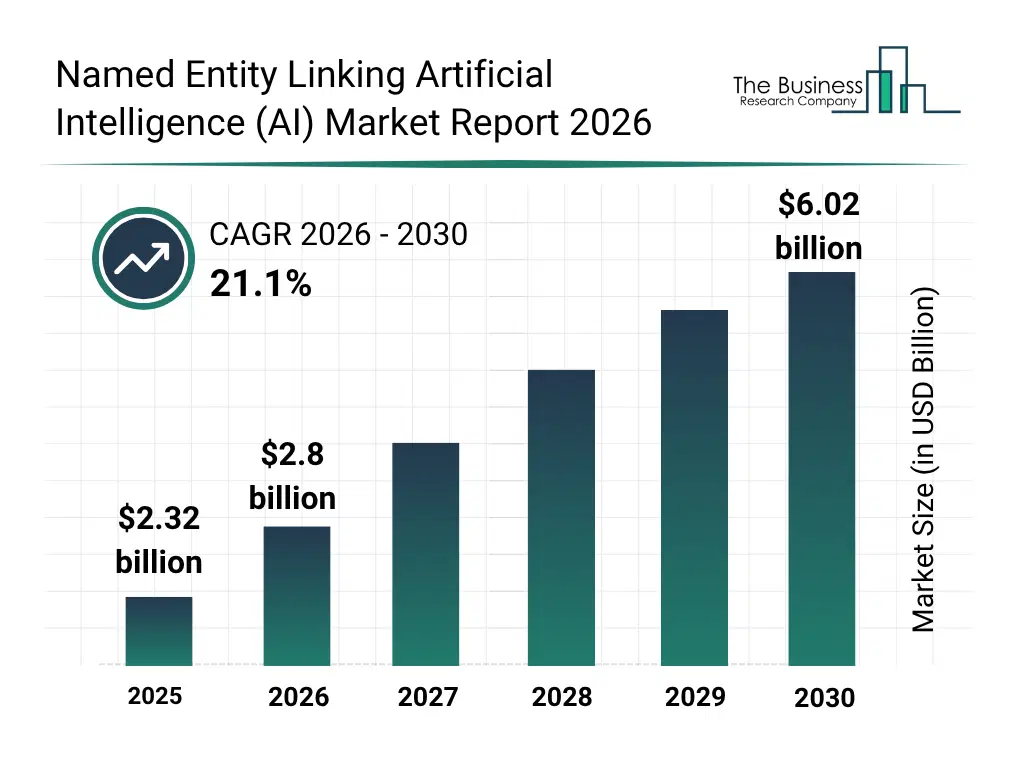
What Is The Named Entity Linking Artificial Intelligence (AI) Market Size and Share 2026?
The named entity linking artificial intelligence (AI) market size has grown exponentially in recent years. It will grow from $2.32 billion in 2025 to $2.8 billion in 2026 at a compound annual growth rate (CAGR) of 20.9%. The growth in the historic period can be attributed to rise in big data generation, growing adoption of nlp technologies, increasing demand for structured knowledge management, expansion of ai research in enterprises, need for disambiguation in large text datasets.What Is The Named Entity Linking Artificial Intelligence (AI) Market Growth Forecast?
The named entity linking artificial intelligence (AI) market size is expected to see exponential growth in the next few years. It will grow to $6.02 billion by 2030 at a compound annual growth rate (CAGR) of 21.1%. The growth in the forecast period can be attributed to increasing adoption of hybrid ai models, growth in cloud-based entity linking deployments, rising demand for automated content recommendation, expansion of ai-driven knowledge graph construction, integration of ai entity linking in fintech and healthcare sectors. Major trends in the forecast period include increasing adoption of cloud-based entity linking platforms, rising integration of knowledge graphs with entity linking solutions, growing demand for real-time semantic processing and text analytics, expansion of machine learning and deep learning-based entity linking tools, increasing focus on cross-industry ai-driven information extraction.
Global Named Entity Linking Artificial Intelligence (AI) Market Segmentation
1) By Component: Software, Services 2) By Technology Integration: Machine Learning-Based Entity Linking, Deep Learning-Based Entity Linking, Knowledge Graph-Driven Entity Linking, Hybrid Artificial Intelligence Models 3) By Deployment Mode: On-Premises, Cloud 4) By Application: Information Extraction, Content Recommendation, Knowledge Graph Construction, Sentiment Analysis, Other Applications 5) By End-User: Banking, Financial Services, And Insurance, Healthcare, Retail And E-Commerce, Media And Entertainment, Information And Telecommunications, Government, Other End-Users Subsegments: 1) By Software: Cloud Based Entity Linking Platforms, On Premises Entity Linking Solutions, Application Programming Interface Based Entity Linking Tools, Knowledge Graph Integration Software, Text Analytics And Semantic Processing Software 2) By Services: Consulting And Advisory Services, System Integration Services, Deployment And Implementation Services, Training And Support Services, Maintenance And Managed ServicesWhat Is The Driver Of The Named Entity Linking Artificial Intelligence (AI) Market?
The growing data volume is expected to propel the growth of the named entity linking artificial intelligence (AI) market going forward. Data volume is the measure of how much data exists or is handled within a system or process. Data volume is increasing due to the rapid expansion of digital content as more users generate and share information through social media, e‑commerce, and connected devices. Namedlinking artificial intelligence (AI) helps handle growing data volumes by organizing and linking entities across large datasets, enabling faster extraction of meaningful insights from vast unstructured data. For instance, in March 2024, according to the Edge Delta, a US-based software company, the data generated worldwide reached around 120 zettabytes (ZB) in 2023, equating to approximately 337,080 petabytes (PB) produced daily. Therefore, the growing data volume is driving the growth of the named entity linking artificial intelligence (AI) industry.Key Players In The Global Named Entity Linking Artificial Intelligence (AI) Market
Major companies operating in the named entity linking artificial intelligence (AI) market are Apple Inc., Microsoft Corporation, Meta Platforms Inc., Amazon Web Services Inc., IBM Corporation, Oracle Corporation, SAP SE, Hewlett Packard Enterprise (HPE), Thomson Reuters Corporation, SAS Institute Inc., Elastic N.V., Explosion AI GmbH, KNIME AG, Hugging Face Inc., Expert.ai S.p.A., Sinequa Corporation, Babel Street Inc., Lymba Corporation, Diffbot Technologies Corp., PoolParty Semantic Suite GmbH, TextRazor Ltd.Global Named Entity Linking Artificial Intelligence (AI) Market Trends and Insights
Major companies operating in the named entity linking artificial intelligence market are focusing on developing advanced solutions, such as AI scanner technology, to automatically identify, disambiguate, and link entities across large datasets for faster and more accurate data insights. AI scanner technology refers to an AI system that automatically scans and analyzes data to identify, extract, and link entities for structured insights. For instance, in March 2025, InLinks Optimization Ltd., a UK-based software company, launched Waikay, an innovative AI scanner technology. It is a new technology platform featuring a patented approach that interrogates LLMs such as Google's Gemini and ChatGPT to build a picture of their knowledge about any brand. It includes automatic fact-checking with a check, flag, or delete workflow, broken link detection for AI-generated citations, and consistent comparison against two competitor brands. It also incorporates scheduled reporting and a flexible pricing model with a free option, enabling businesses of all sizes to monitor and improve their brand's representation in AI-generated content.What Are Latest Mergers And Acquisitions In The Named Entity Linking Artificial Intelligence (AI) Market?
In October 2024, Semantic Web Company, an Austria-based technology company, merged with Ontotext to create Graphwise, a unified platform offering semantic AI and knowledge graph solutions for enterprise data and AI applications. This partnership aims to enhance enterprise AI capabilities by combining semantic AI, knowledge graph technology, and advanced data analytics for more intelligent and connected business insights. Ontotext is a Bulgaria-based technology company that specializes in graph databases, text mining, and knowledge graphs.Regional Insights
North America was the largest region in the named entity linking artificial intelligence (AI) market in 2025. Asia-Pacific is expected to be the fastest-growing region in the forecast period. The regions covered in this market report are Asia-Pacific, South East Asia, Western Europe, Eastern Europe, North America, South America, Middle East, Africa. The countries covered in this market report are Australia, Brazil, China, France, Germany, India, Indonesia, Japan, Taiwan, Russia, South Korea, UK, USA, Canada, Italy, Spain.What Defines the Named Entity Linking Artificial Intelligence (AI) Market?
The named entity linking artificial intelligence (AI) market consists of revenues earned by entities by providing services such as entity recognition and disambiguation, knowledge graph creation, data annotation and labeling, semantic analysis, and API integration for text and data processing. The market value includes the value of related goods sold by the service provider or included within the service offering. The named entity linking artificial intelligence (AI) market also includes sales of knowledge graph integration tools, enterprise search and information retrieval systems, AI-powered text analytics tools, and natural language processing (NLP) toolkits. Values in this market are ‘factory gate’ values, that is, the value of goods sold by the manufacturers or creators of the goods, whether to other entities (including downstream manufacturers, wholesalers, distributors, and retailers) or directly to end customers. The value of goods in this market includes related services sold by the creators of the goods.How is Market Value Defined and Measured?
The market value is defined as the revenues that enterprises gain from the sale of goods and/or services within the specified market and geography through sales, grants, or donations in terms of the currency (in USD unless otherwise specified). The revenues for a specified geography are consumption values that are revenues generated by organizations in the specified geography within the market, irrespective of where they are produced. It does not include revenues from resales along the supply chain, either further along the supply chain or as part of other products.What Key Data and Analysis Are Included in the Named Entity Linking Artificial Intelligence (AI) Market Report 2026?
The named entity linking artificial intelligence (ai) market research report is one of a series of new reports from The Business Research Company that provides market statistics, including industry global market size, regional shares, competitors with the market share, detailed market segments, market trends and opportunities, and any further data you may need to thrive in the named entity linking artificial intelligence (ai) industry. The market research report delivers a complete perspective of everything you need, with an in-depth analysis of the current and future state of the industry.Named Entity Linking Artificial Intelligence (AI) Market Report Forecast Analysis
| Report Attribute | Details |
|---|---|
| Market Size Value In 2026 | $2.8 billion |
| Revenue Forecast In 2035 | $6.02 billion |
| Growth Rate | CAGR of 20.9% from 2026 to 2035 |
| Base Year For Estimation | 2025 |
| Actual Estimates/Historical Data | 2020-2025 |
| Forecast Period | 2026 - 2030 - 2035 |
| Market Representation | Revenue in USD Billion and CAGR from 2026 to 2035 |
| Segments Covered | Component, Technology Integration, Deployment Mode, Application, End-User |
| Regional Scope | Asia-Pacific, Western Europe, Eastern Europe, North America, South America, Middle East, Africa |
| Country Scope | The countries covered in the report are Australia, Brazil, China, France, Germany, India, ... |
| Key Companies Profiled | Apple Inc., Microsoft Corporation, Meta Platforms Inc., Amazon Web Services Inc., IBM Corporation, Oracle Corporation, SAP SE, Hewlett Packard Enterprise (HPE), Thomson Reuters Corporation, SAS Institute Inc., Elastic N.V., Explosion AI GmbH, KNIME AG, Hugging Face Inc., Expert.ai S.p.A., Sinequa Corporation, Babel Street Inc., Lymba Corporation, Diffbot Technologies Corp., PoolParty Semantic Suite GmbH, TextRazor Ltd. |
| Customization Scope | Request for Customization |
| Pricing And Purchase Options | Explore Purchase Options |