
Nanosatellite And Microsatellite Market Report 2026
Global Outlook – By Component (Launch Services, Hardware, Software And Data Processing, Space Services), By Mass (Nanosatellites (1 kg- 10kg), Microsatellites (11kg- 100 kg)), By Application (Communication, Reconnaissance, Scientific Research, Earth Observation And Remote Sensing, Biological Experiments, Academic Training, Technology Demonstration And Verification, Mapping And Navigation), By Vertical (Government, Defense, Maritime And Transportation, Civil, Commercial, Energy And Infrastructure ) – Market Size, Trends, Strategies, and Forecast to 2030
Nanosatellite And Microsatellite Market Overview
• Nanosatellite And Microsatellite market size has reached to $3.51 billion in 2025 • Expected to grow to $7.6 billion in 2030 at a compound annual growth rate (CAGR) of 16.4% • Growth Driver: The Surging Growth Of Nanosatellite And Microsatellite Market Fueled By Escalating Space Exploration Missions • Market Trend: Increasing Focus On Product Innovations To Provide Reliable Services To Their Customers • North America was the largest region in 2025.What Is Covered Under Nanosatellite And Microsatellite Market?
Nanosatellites and microsatellites (NaM) refer to miniaturized artificial satellites that weigh between 1 and 100 kilograms. They circle the earth in a polar (circular or elliptical) orbit and are usually launched at low altitudes. These satellites travel at high speeds and offer optimum solutions for communications, remote sensing, and earth observations. The main components of nanosatellites and microsatellites are launch services, hardware, software and data processing, and space services. Launching services refer to the process of placing satellites into proper orbit. Launch services are critical during the early stages of nanosatellite and microsatellite launches into space. It has nanosatellites weigh between 1 kg and 10 kg, and microsatellites weigh between 11 kg and 100 kg, applied for communication, reconnaissance, scientific research, earth observation and remote sensing, biological experiments, academic training, technology demonstration and verification, mapping, and navigation. It is used by major verticals such as government, defense, maritime and transportation, civil, commercial, energy, and infrastructure.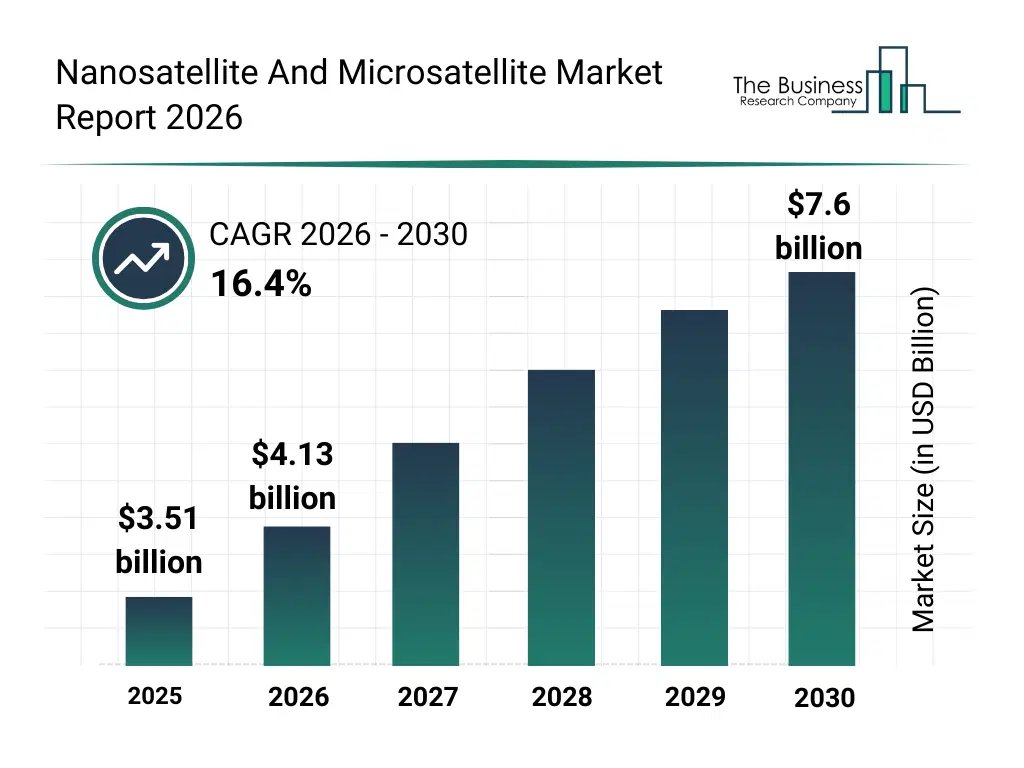
What Is The Nanosatellite And Microsatellite Market Size and Share 2026?
The nanosatellite and microsatellite market size has grown rapidly in recent years. It will grow from $3.51 billion in 2025 to $4.13 billion in 2026 at a compound annual growth rate (CAGR) of 17.7%. The growth in the historic period can be attributed to increasing adoption of low-cost small satellites for earth observation missions, growth in university and research institution satellite programs driving early deployment, advancements in miniaturized onboard computers and power subsystems enabling reliable small-sat operations, rising demand for rapid-deployment communication satellites, expansion of commercial remote sensing applications utilizing nanosatellite and microsatellite constellations.What Is The Nanosatellite And Microsatellite Market Growth Forecast?
The nanosatellite and microsatellite market size is expected to see rapid growth in the next few years. It will grow to $7.6 billion in 2030 at a compound annual growth rate (CAGR) of 16.4%. The growth in the forecast period can be attributed to growing investment in large small-satellite constellations for global connectivity services, increasing demand for enhanced imaging and sensing capabilities in compact satellite platforms, advancement in modular and scalable satellite subsystems improving mission flexibility, rising use of nanosatellites and microsatellites for defense and national security applications, expansion of commercial launch services reducing deployment cost and enabling higher satellite volume. Major trends in the forecast period include increasing demand for low-earth-orbit (leo) remote sensing constellations, growing adoption of miniaturized satellite components for cost-efficient deployment, expansion of commercial launch services for small satellites, rise in academic and research-oriented nanosatellite missions, increasing use of nanosatellites for real-time earth observation data service.
Global Nanosatellite And Microsatellite Market Segmentation
1) By Component: Launch Services, Hardware, Software And Data Processing, Space Services 2) By Mass: Nanosatellites (1 kg- 10kg), Microsatellites (11kg- 100 kg) 3) By Application: Communication, Reconnaissance, Scientific Research, Earth Observation And Remote Sensing, Biological Experiments, Academic Training, Technology Demonstration And Verification, Mapping And Navigation 4) By Vertical: Government, Defense, Maritime And Transportation, Civil, Commercial, Energy And Infrastructure Subsegments: 1) By Launch Services: Dedicated Launch Vehicles, Ride-Share Launch Services 2) By Hardware: Payloads, Communication Systems, Power Systems, On-Board Computers, Structure And Mechanisms 3) By Software And Data Processing: Satellite Control Software, Data Analysis Software, Ground Station Software 4) By Space Services: Satellite Operations And Maintenance, Ground Station Services, Data Distribution ServicesWhat Is Driver Of The Nanosatellite And Microsatellite Market?
The increase in space exploration missions is significantly driving the growth of the nanosatellite and microsatellite market. Space exploration missions refer to projects that involve exploring the realms of the cosmos beyond Earth's atmosphere using crewed and uncrewed spacecraft. Nanosatellites and microsatellites are utilized for extremely specialized tasks, including Earth observation, telecommunications, and meteorology. Various governments around the world are expanding their space missions, and small satellites are assisting them in completing those missions. For instance, in June 2024, according to SpaceNews, a US-based non-governmental organization, in 2023, U.S. manufacturers accounted for approximately 85% of commercially procured satellites, with satellite manufacturing revenue rising by 9% to $17.2 billion, fueled by flexible software-defined payloads and advanced small satellites. A record 190 commercially procured launches took place, marking an 18% increase from 2022. These launches deployed 2,781 commercial satellites, up 20% year-over-year, largely driven by SpaceX. Therefore, the increase in space exploration missions is driving the growth of the nanosatellite and microsatellite industry.Key Players In The Global Nanosatellite And Microsatellite Market
Major companies operating in the nanosatellite and microsatellite market are Dauria Aerospace, GomSpace Group AB, Innovative Solutions In Space (ISIS), Sierra Nevada Corporation, Spire Global Inc., SpaceQuest Ltd., Survey Satellite Technology Limited, Tyvak Nano-Satellite Systems Inc., AAC Clyde Space AB, Lockheed Martin Corporation, Planet Labs PBC, L3Harris Technologies Inc., Axelspace Corporation, Astro Digital Inc., Berlin Space Technologies, Northrop Grumman Corporation, Raytheon Technologies Corporation, Dynetics Inc., RUAG Group, Swarm Technologies Inc., Blue Canyon Technologies Inc., China Aerospace Science and Technology Corporation, Spaceflight Industries Inc., ECM Space Technologies GmbH, TriSept Corporation, SpaceWorks Enterprises Inc., NanoAvionics Inc., Kepler Communications Inc., Pumpkin Inc., Nanoracks LLC
This chart is for illustrative purposes; the full report includes a detailed competitor analysis and comprehensive overview of the top 10 companies in the market.
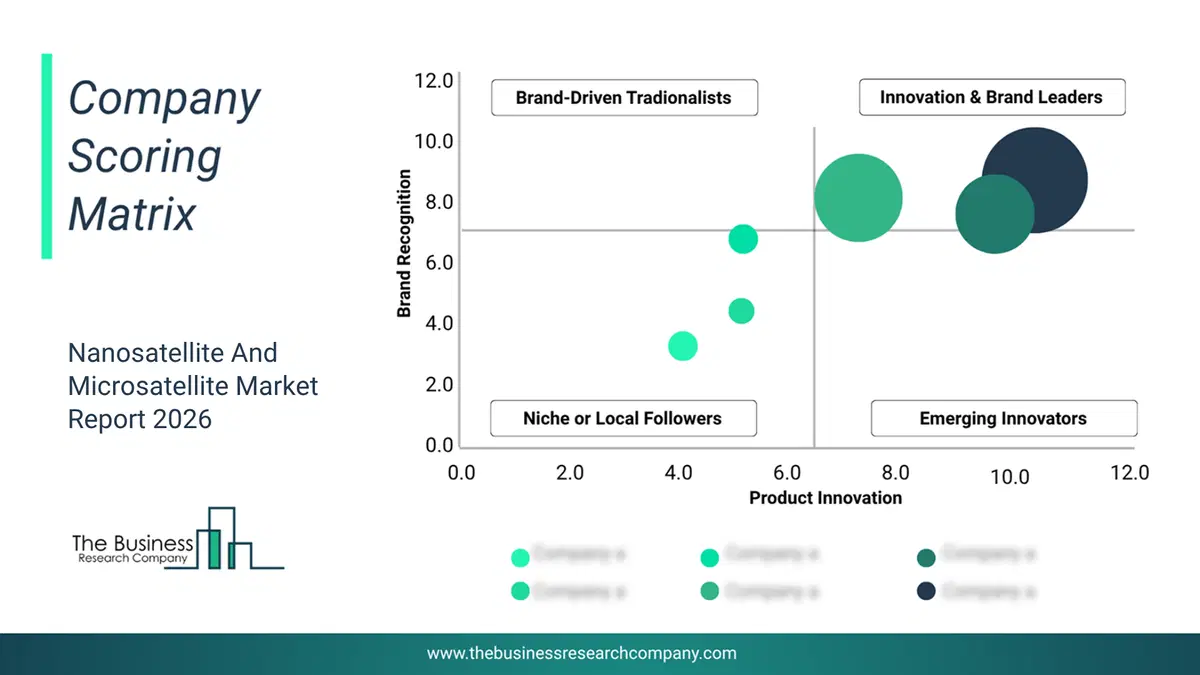
This chart maps companies by product innovation and brand strength, with bubble size indicating relative revenue, helping identify market leaders, challengers, and niche players. This is an illustrative chart; the full report provides a complete and accurate competitive analysis.
Global Nanosatellite And Microsatellite Market Trends and Insights
Major companies operating in the nanosatellites and microsatellites market are focusing on innovative products, such as tiny satellites, to drive revenues in their market. Tiny satellites can be constructed with off-the-shelf technologies and are intended to be inexpensive and lightweight. For instance, in April 2024, Planet Labs, a US-based technology company focused on capturing and analyzing satellite imagery to deliver geospatial data and insights for environmental and commercial applications, launched Pelican-1, the first satellite in its next-generation Pelican constellation, designed for high-resolution Earth imaging. This small satellite serves as a technology demonstrator, validating the hardware and software components of Planet’s Smallsat Platform. The Pelican constellation is aimed at providing enhanced image resolution and faster revisit times, supporting real-time monitoring applications in sectors such as agriculture, urban planning, and disaster response. This launch marks a significant step forward in Planet’s efforts to improve satellite imaging capabilities for global monitoring.What Are Latest Mergers And Acquisitions In The Nanosatellite And Microsatellite Market? Lockheed Martin Strengthens Satellite Technology Portfolio With Terran Orbital Acquisition
In August 2024, Lockheed Martin, a US-based aerospace and defense company, acquired Terran Orbital for $450 million. Through this acquisition, Lockheed Martin aims to expand its growing space portfolio. Terran Orbital is recognized for its high throughput robotic manufacturing capacity and advanced modular space vehicle designs, enhancing Lockheed Martin's capabilities in the small satellite sector. This acquisition is expected to significantly bolster Lockheed's offerings in satellite technology and manufacturing. Terran Orbital is a US-based aerospace and defense company focused on developing innovative nanosatellites and microsatellites for commercial and governmental uses.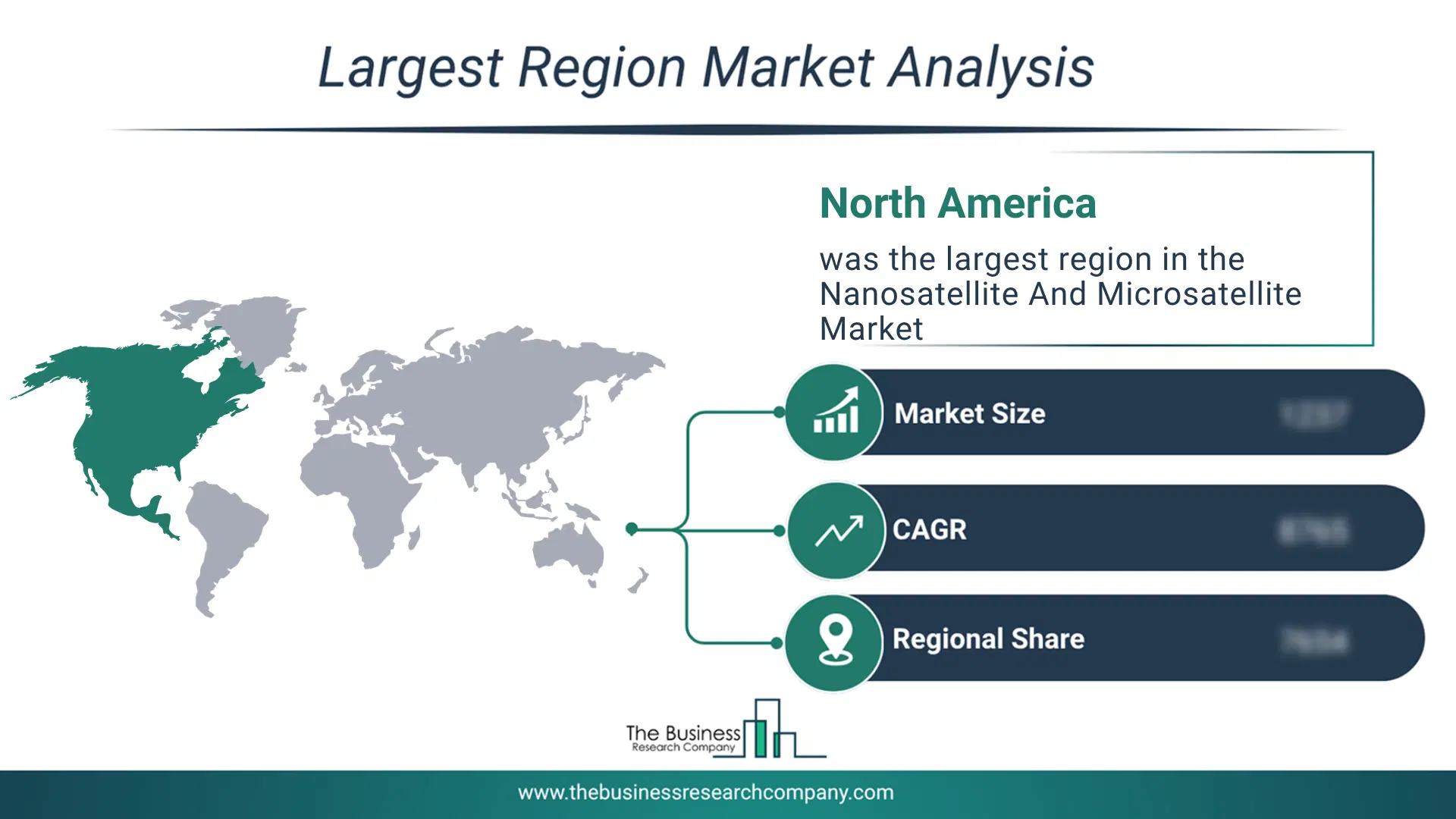
Regional Insights
North America was the largest region in the nanosatellite and microsatellite market in 2025. The regions covered in this market report are Asia-Pacific, South East Asia, Western Europe, Eastern Europe, North America, South America, Middle East, Africa. The countries covered in this market report are Australia, Brazil, China, France, Germany, India, Indonesia, Japan, Taiwan, Russia, South Korea, UK, USA, Canada, Italy, SpainWhat Defines the Nanosatellite And Microsatellite Market?
The nanosatellite and microsatellite market consists of sales of on-board computer (OBC), electrical power subsystem (EPS), and communication subsystem. Values in this market are ‘factory gate’ values, that is the value of goods sold by the manufacturers or creators of the goods, whether to other entities (including downstream manufacturers, wholesalers, distributors, and retailers) or directly to end customers. The value of goods in this market includes related services sold by the creators of the goods.How is Market Value Defined and Measured?
The market value is defined as the revenues that enterprises gain from the sale of goods and/or services within the specified market and geography through sales, grants, or donations in terms of the currency (in USD unless otherwise specified). The revenues for a specified geography are consumption values that are revenues generated by organizations in the specified geography within the market, irrespective of where they are produced. It does not include revenues from resales along the supply chain, either further along the supply chain or as part of other products.
This chart presents market attractiveness based on a quantitative evaluation of growth, competition, strategic alignment, and risk, offering a clear view of opportunity areas for decision-making. This chart is for illustrative purposes; the full report contains the complete analysis.

This chart highlights the Total Addressable Market (TAM) by estimating the maximum revenue opportunity using an assumption-driven approach, supporting strategic planning and opportunity sizing across markets. The chart is illustrative; the full report provides a more comprehensive analysis.
What Key Data and Analysis Are Included in the Nanosatellite And Microsatellite Market Report 2026?
The nanosatellite and microsatellite market research report is one of a series of new reports from The Business Research Company that provides market statistics, including industry global market size, regional shares, competitors with the market share, detailed market segments, market trends and opportunities, and any further data you may need to thrive in the nanosatellite and microsatellite industry. The market research report delivers a complete perspective of everything you need, with an in-depth analysis of the current and future state of the industry.Nanosatellite And Microsatellite Market Report Forecast Analysis
| Report Attribute | Details |
|---|---|
| Market Size Value In 2026 | $4.13 billion |
| Revenue Forecast In 2030 | $7.6 billion |
| Growth Rate | CAGR of 16.4% from 2026 to 2030 |
| Base Year For Estimation | 2025 |
| Actual Estimates/Historical Data | 2020-2025 |
| Forecast Period | 2026 - 2030 |
| Market Representation | Revenue in USD Billion and CAGR from 2026 to 2030 |
| Segments Covered | Component, Mass, Application, Vertical |
| Regional Scope | Asia-Pacific, Western Europe, Eastern Europe, North America, South America, Middle East, Africa |
| Country Scope | The countries covered in the nanosatellite and microsatellite market report are Australia, Brazil, China, France, Germany, India, Indonesia, Japan, Taiwan, Russia, South Korea, UK, USA, Canada, Italy, Spain |
| Key Companies Profiled | Dauria Aerospace, GomSpace Group AB, Innovative Solutions In Space (ISIS), Sierra Nevada Corporation, Spire Global Inc., SpaceQuest Ltd., Survey Satellite Technology Limited, Tyvak Nano-Satellite Systems Inc., AAC Clyde Space AB, Lockheed Martin Corporation, Planet Labs PBC, L3Harris Technologies Inc., Axelspace Corporation, Astro Digital Inc., Berlin Space Technologies, Northrop Grumman Corporation, Raytheon Technologies Corporation, Dynetics Inc., RUAG Group, Swarm Technologies Inc., Blue Canyon Technologies Inc., China Aerospace Science and Technology Corporation, Spaceflight Industries Inc., ECM Space Technologies GmbH, TriSept Corporation, SpaceWorks Enterprises Inc., NanoAvionics Inc., Kepler Communications Inc., Pumpkin Inc., Nanoracks LLC |
| Customization Scope | Request for Customization |
| Pricing And Purchase Options | Explore Purchase Options |