
Narrow Band Internet Of Things (IoT) Market Report 2026
Global Outlook – By Type (In Band, Stand Alone, Guard Band), By Component (Network, Module), By Deployment Type (Public Network Deployment, Private Network Deployment, Hybrid Network Deployment), By Application (Alarm And Detector, Smart Parking, Smart Meter, Smart Lighting, Asset Tracking), By End Use (Automotive, Agriculture, Infrastructure, Healthcare, Energy And Utilities, Manufacturing, Consumer Electronics, Other End Users) – Market Size, Trends, Strategies, and Forecast to 2030
Narrow Band Internet Of Things (IoT) Market Overview
• Narrow Band Internet Of Things (IoT) market size has reached to $3.6 billion in 2025 • Expected to grow to $13.04 billion in 2030 at a compound annual growth rate (CAGR) of 29.3% • Growth Driver: Rising Adoption Of Connected Devices Is Fueling The Growth Of The Market Due To Increasing Demand For Low-Power Connectivity • Market Trend: Multi-Orbit IoT Roaming Innovations Enhance Global Narrow-Band IoT Connectivity • North America was the largest region in 2025 and Asia-Pacific is the fastest growing region.What Is Covered Under Narrow Band Internet Of Things (IoT) Market?
Narrowband Internet of Things (IoT) is a low-power wide-area network technology that connects large numbers of low-bandwidth devices and sensors through cellular networks. It enables reliable data transmission with wide coverage, low energy consumption, and strong connectivity in remote or challenging environments. Narrowband Internet of Things supports efficient machine-to-machine communication by using licensed spectrum and optimized network resources for long-term device operation. The main types of narrow band Internet of Things (IoT) include in band, stand alone, and guard band. In band refers to a narrow band Internet of Things deployment that operates within an existing long term evolution carrier spectrum to provide efficient connectivity for low power connected devices. These systems use network and module components and are deployed through public network deployment, private network deployment, and hybrid network deployment. The key applications include alarm and detector, smart parking, smart meter, smart lighting, tracker, wearables, and others, while the end-uses include automotive, agriculture, infrastructure, healthcare, energy and utilities, manufacturing, consumer electronics, and others.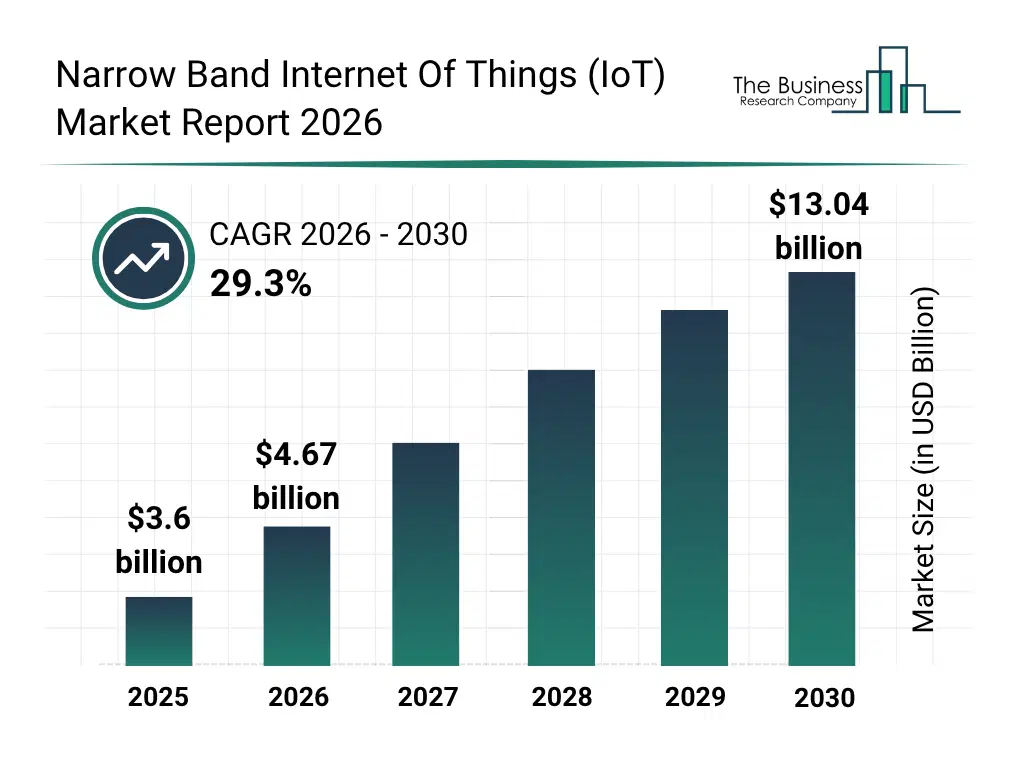
What Is The Narrow Band Internet Of Things (IoT) Market Size and Share 2026?
The narrow band internet of things (iot) market size has grown exponentially in recent years. It will grow from $3.6 billion in 2025 to $4.67 billion in 2026 at a compound annual growth rate (CAGR) of 29.7%. The growth in the historic period can be attributed to growing demand for low-power connectivity, increasing cellular network coverage, rising adoption of smart metering, expansion of machine-to-machine communication, growing deployment of connected tracking devices.What Is The Narrow Band Internet Of Things (IoT) Market Growth Forecast?
The narrow band internet of things (iot) market size is expected to see exponential growth in the next few years. It will grow to $13.04 billion in 2030 at a compound annual growth rate (CAGR) of 29.3%. The growth in the forecast period can be attributed to increasing deployment of smart city infrastructure, rising demand for remote asset monitoring, expansion of connected agricultural applications, growing adoption of connected healthcare devices, increasing demand for long-duration IoT connectivity. Major trends in the forecast period include expansion of LTE-M and NB-IoT network coexistence, increasing deployment of standalone NB-IoT networks, growth of low-power wide-area cellular connectivity, increasing use of licensed-spectrum narrowband connectivity, expansion of long-life battery-powered IoT devices.Tariff Impact On Narrow Band Internet Of Things (IoT) Market
Tariffs are impacting the narrow band Internet of Things (IoT) market by increasing the cost of imported cellular modules, communication chipsets, network equipment, antennas, and electronic components required for NB-IoT devices and infrastructure. This is slowing the rollout of connected devices, particularly in regions dependent on imported telecommunications and electronics equipment such as Asia-Pacific and Latin America. Hardware-intensive segments such as network modules and network equipment are most affected due to global supply chain dependencies. However, tariffs are also encouraging local electronics manufacturing, regional supplier diversification, and increased investment in domestic IoT component production, creating long-term resilience in the Narrowband Internet of Things (IoT) market.
Global Narrow Band Internet Of Things IoT Market Segmentation
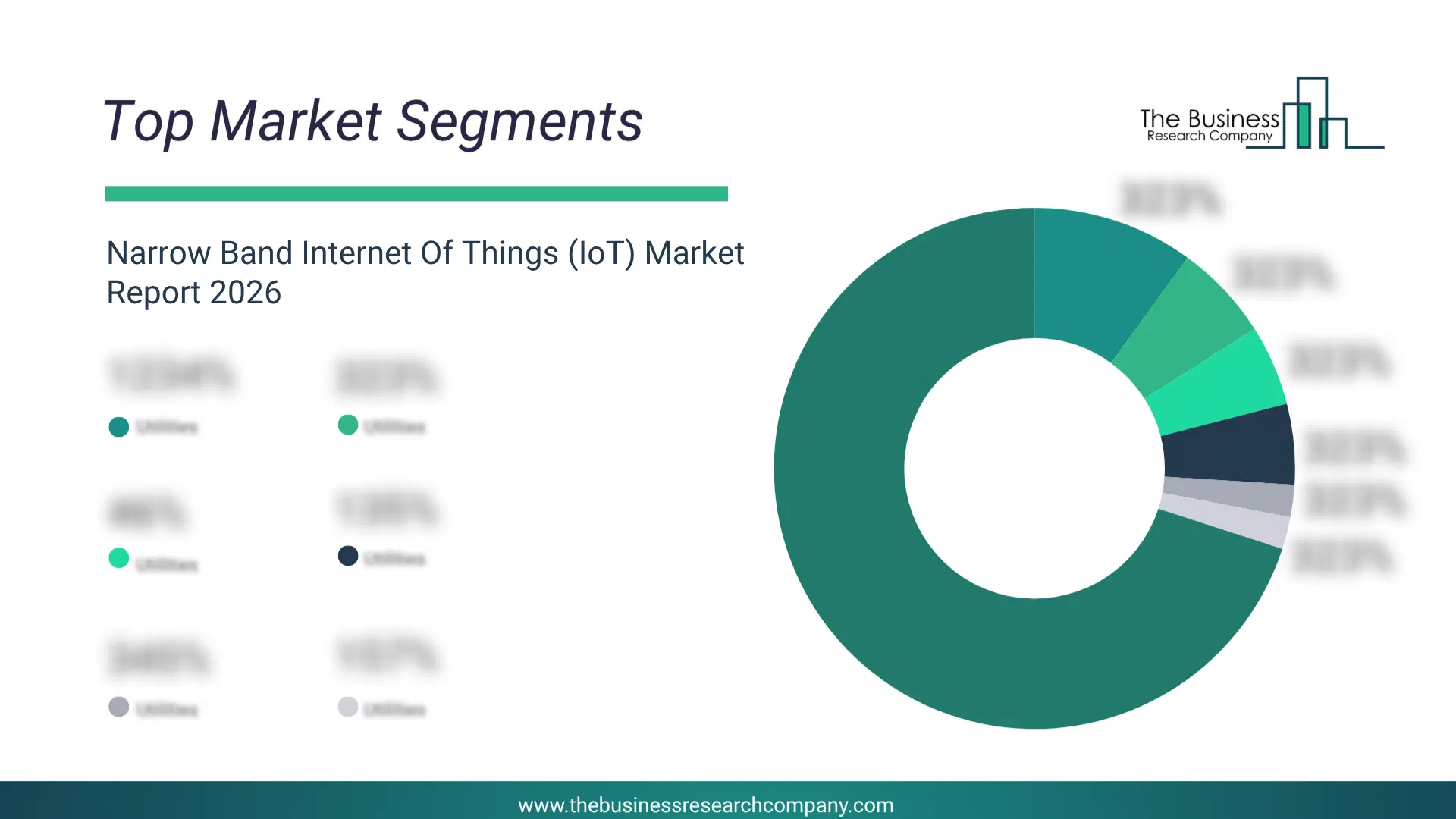
1) By Type: In Band, Stand Alone, Guard Band 2) By Component: Network, Module 3) By Deployment Type: Public Network Deployment, Private Network Deployment, Hybrid Network Deployment 4) By Application: Alarm And Detector, Smart Parking, Smart Meter, Smart Lighting, Asset Tracking 5) By End Use: Automotive, Agriculture, Infrastructure, Healthcare, Energy And Utilities, Manufacturing, Consumer Electronics, Other End Users Subsegments: 1) By In Band: Long Term Evolution Machine Type Communications Coexistence, Long Term Evolution Narrowband Internet Of Things Coexistence 2) By Stand Alone: Dedicated Narrowband Internet Of Things Carrier, Global System For Mobile Communications Refarming 3) By Guard Band: Long Term Evolution Guard Band Deployment, Narrowband Internet Of Things Guard Band DeploymentWhat Is The Driver Of The Narrow Band Internet Of Things (IoT) Market?
The increasing adoption of connected devices is expected to propel the growth of the narrow band internet of things (NB-IoT) market going forward. Connected devices are physical objects equipped with sensors, software, and communication technologies that enable them to collect, exchange, and transmit data over networks. The adoption of connected devices is increasing due to the growing use of smart home devices, industrial equipment, connected healthcare devices, smart meters, and other applications that enable remote monitoring, automation, and real-time data exchange. Rising adoption of connected devices drives demand for narrow band internet of things (NB-IoT) solutions by increasing the need for reliable, low-power, wide-area connectivity that can support large numbers of connected devices while providing extended battery life, broad coverage, and cost-effective data transmission. For instance, in June 2026, according to the Institute of Internet Economics, a US-based research organization, the global connected IoT device base was projected to reach approximately 24.1 billion devices in 2026, up from 21.1 billion in 2025. Therefore, the increasing adoption of connected devices is driving the growth of the narrow band internet of things (NB-IoT) market.Key Players In The Global Narrow Band Internet Of Things (IoT) Market
Major companies operating in the narrow band internet of things (iot) market are China Mobile Limited, Deutsche Telekom AG, Huawei Technologies Co. Ltd., Cisco Systems Inc., Orange S.A., Vodafone Group Plc, Qualcomm Incorporated, Telefonaktiebolaget LM Ericsson, Nokia Corporation, Bharti Airtel Limited, ZTE Corporation, MediaTek Inc., Reliance Jio Infocomm Limited, Tata Communications Limited, Quectel Wireless Solutions Co. Ltd., Fibocom Wireless Inc., Nordic Semiconductor ASA, China Telecom Corporation Limited, China Unicom (Hong Kong) Limited, Sequans Communications S.A., Telit Cinterion, Murata Manufacturing Co. Ltd.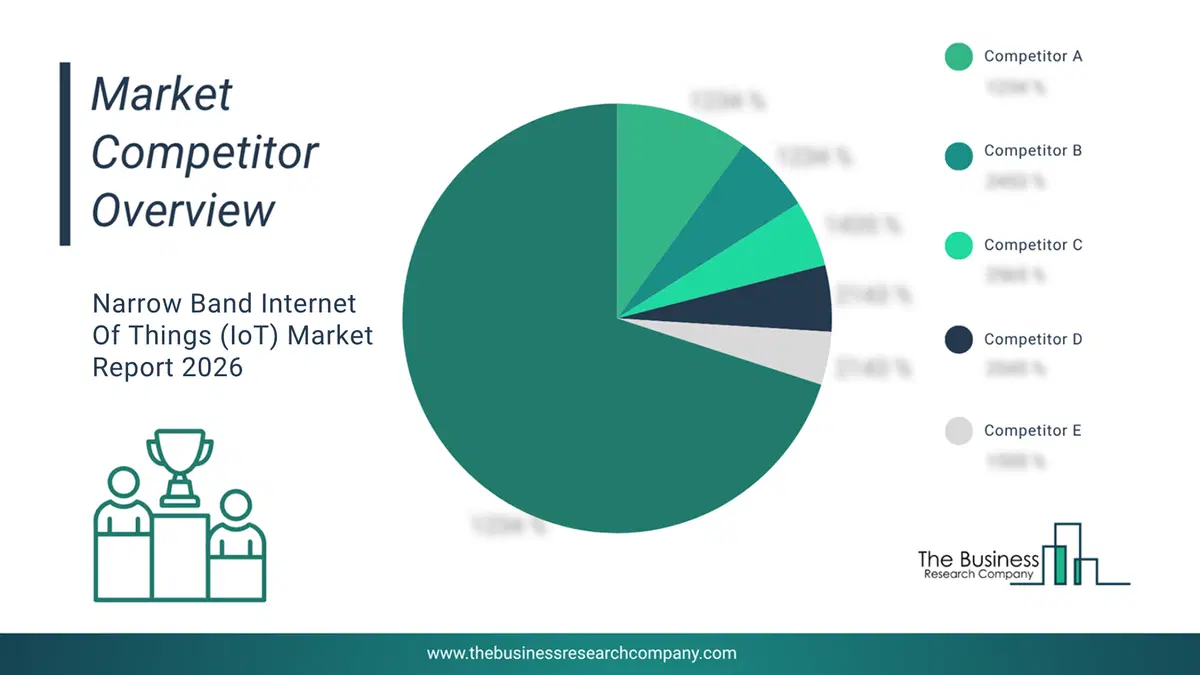
This chart is for illustrative purposes; the full report includes a detailed competitor analysis and comprehensive overview of the top 10 companies in the market.
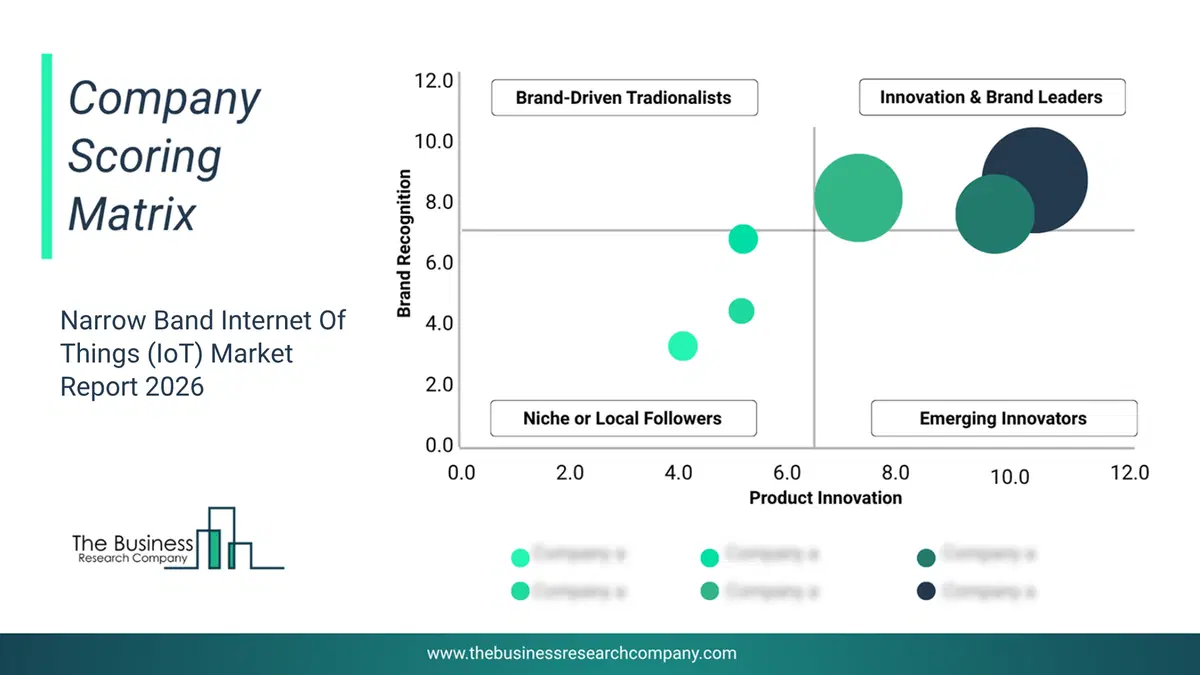
This chart maps companies by product innovation and brand strength, with bubble size indicating relative revenue, helping identify market leaders, challengers, and niche players. This is an illustrative chart; the full report provides a complete and accurate competitive analysis.
Global Narrow Band Internet Of Things (IoT) Market Trends and Insights
Major companies operating in the narrow band internet of things (IoT) market are focusing on developing advanced connectivity solutions, such as multi-orbit IoT roaming, to enhance coverage, reliability, and connectivity for IoT devices in remote and underserved regions. Multi-orbit IoT roaming refers to a connectivity solution that enables NB-IoT devices to seamlessly switch between terrestrial mobile networks and satellite networks across geostationary Earth orbit (GEO) and low Earth orbit (LEO). For instance, in February 2026, Deutsche Telekom AG, a Germany-based telecommunications company, launched the world’s first multi-orbit IoT roaming solution, enabling seamless NB-IoT connectivity across terrestrial mobile networks and GEO and LEO satellite networks. The solution was demonstrated using a commercial NB-IoT device and integrates Deutsche Telekom’s global NB-IoT network with satellite services from Skylo, Sateliot, and OQ Technology. It enables reliable NB-IoT data transmission across remote and underserved regions through terrestrial and satellite networks. The solution supports applications including critical infrastructure monitoring, maritime tracking, and autonomous sensor systems.What Are Latest Mergers And Acquisitions In The Narrow Band Internet Of Things (IoT) Market?
In January 2026, Skylo Technologies, a US-based non-terrestrial network service provider, partnered with Vodafone IoT to trial and launch a global hybrid connectivity service based on Non-Terrestrial Network (NTN) Narrowband Internet of Things (NB-IoT) satellite connectivity. Through this partnership, the companies aim to expand IoT connectivity by integrating satellite and cellular networks through a single SIM, enabling seamless connectivity for applications such as asset tracking, energy services, environmental monitoring, and fleet management. Vodafone IoT is a UK-based provider of narrowband Internet of Things (NB-IoT) services.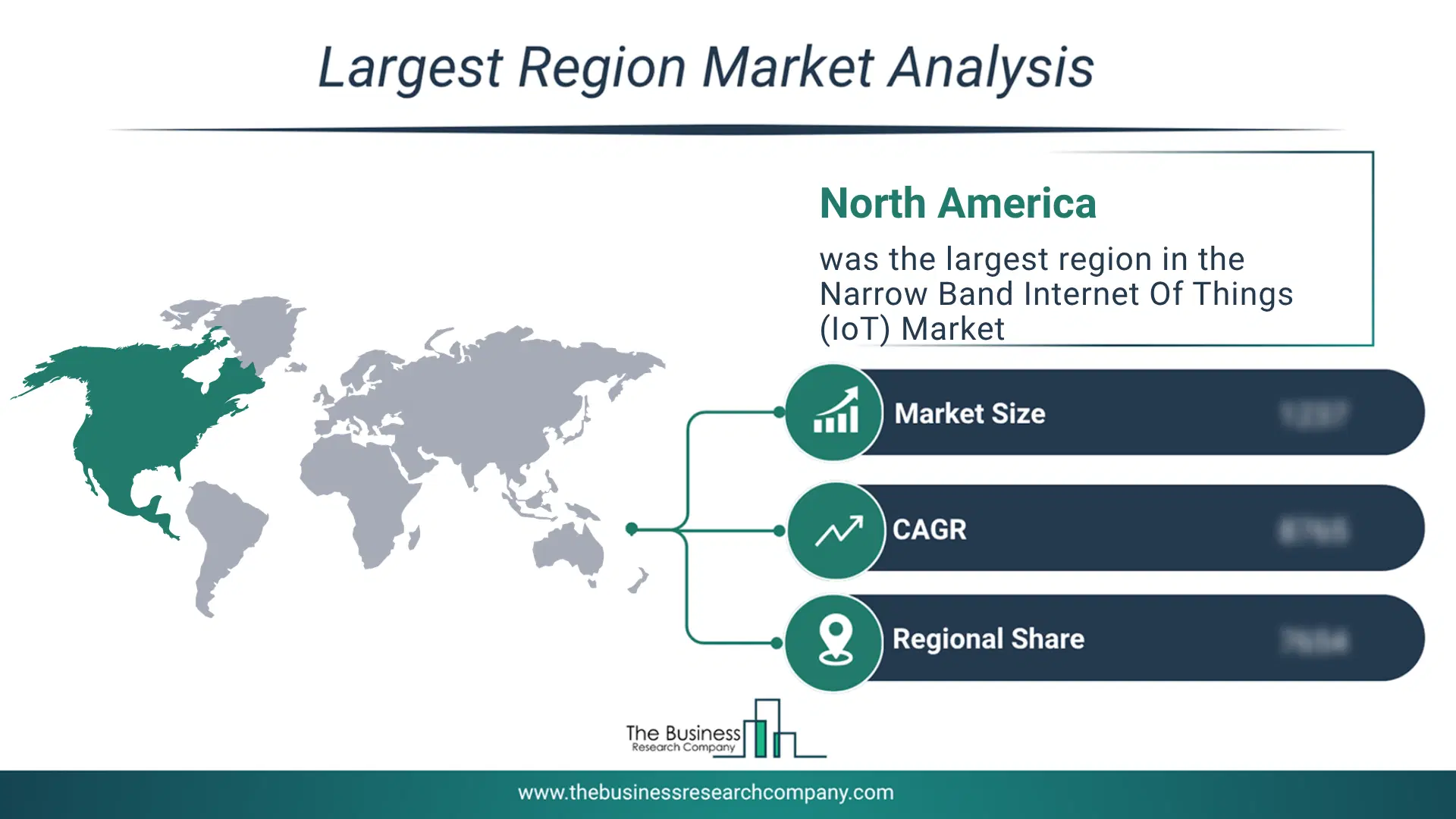
Regional Outlook
North America was the largest region in the narrow band internet of things (iot) market in 2025. Asia-Pacific is expected to be the fastest-growing region in the forecast period. The regions covered in this market report are Asia-Pacific, South East Asia, Western Europe, Eastern Europe, North America, South America, Middle East, Africa. The countries covered in this market report are Australia, Brazil, China, France, Germany, India, Indonesia, Japan, Taiwan, Russia, South Korea, UK, USA, Canada, Italy, Spain.What Defines the Narrow Band Internet Of Things (IoT) Market?
The narrowband Internet of Things (IoT) market consists of revenues earned by entities by providing services such as device provisioning and management, security and authentication, and IoT platform and data management. The market value includes the value of related goods sold by the service provider or included within the service offering. The narrowband Internet of Things (IoT) market includes sales of data acquisition units, edge devices, electronic modules, and hardware terminals. Values in this market are ‘factory gate’ values, that is, the value of goods sold by the manufacturers or creators of the goods, whether to other entities (including downstream manufacturers, wholesalers, distributors, and retailers) or directly to end customers. The value of goods in this market includes related services sold by the creators of the goods.How is Market Value Defined and Measured?
The market value is defined as the revenues that enterprises gain from the sale of goods and/or services within the specified market and geography through sales, grants, or donations in terms of the currency (in USD unless otherwise specified). The revenues for a specified geography are consumption values that are revenues generated by organizations in the specified geography within the market, irrespective of where they are produced. It does not include revenues from resales along the supply chain, either further along the supply chain or as part of other products.
This chart presents market attractiveness based on a quantitative evaluation of growth, competition, strategic alignment, and risk, offering a clear view of opportunity areas for decision-making. This chart is for illustrative purposes; the full report contains the complete analysis.

This chart highlights the Total Addressable Market (TAM) by estimating the maximum revenue opportunity using an assumption-driven approach, supporting strategic planning and opportunity sizing across markets. The chart is illustrative; the full report provides a more comprehensive analysis.
What Key Data and Analysis Are Included in the Narrow Band Internet Of Things (IoT) Market Report 2026?
The narrow band internet of things (iot) market research report is one of a series of new reports from The Business Research Company that provides market statistics, including industry global market size, regional shares, competitors with the market share, detailed market segments, market trends and opportunities, and any further data you may need to thrive in the narrow band internet of things (iot) industry. The market research report delivers a complete perspective of everything you need, with an in-depth analysis of the current and future state of the industry.Narrow Band Internet Of Things (IoT) Market Report Forecast Analysis
| Report Attribute | Details |
|---|---|
| Market Size Value In 2026 | $4.67 billion |
| Revenue Forecast In 2030 | $13.04 billion |
| Growth Rate | CAGR of 29.3% from 2026 to 2030 |
| Base Year For Estimation | 2025 |
| Actual Estimates/Historical Data | 2020-2025 |
| Forecast Period | 2026 - 2030 |
| Market Representation | Revenue in USD Billion and CAGR from 2026 to 2030 |
| Segments Covered | Type, Component, Deployment Type, Application, End Use |
| Regional Scope | Asia-Pacific, Western Europe, Eastern Europe, North America, South America, Middle East, Africa |
| Country Scope | The countries covered in the report are Australia, Brazil, China, France, Germany, India, Indonesia, Japan, Taiwan, Russia, South Korea, UK, USA, Canada, Italy, Spain. |
| Key Companies Profiled | China Mobile Limited, Deutsche Telekom AG, Huawei Technologies Co. Ltd., Cisco Systems Inc., Orange S.A., Vodafone Group Plc, Qualcomm Incorporated, Telefonaktiebolaget LM Ericsson, Nokia Corporation, Bharti Airtel Limited, ZTE Corporation, MediaTek Inc., Reliance Jio Infocomm Limited, Tata Communications Limited, Quectel Wireless Solutions Co. Ltd., Fibocom Wireless Inc., Nordic Semiconductor ASA, China Telecom Corporation Limited, China Unicom (Hong Kong) Limited, Sequans Communications S.A., Telit Cinterion, Murata Manufacturing Co. Ltd. |
| Customization Scope | Request for Customization |
| Pricing And Purchase Options | Explore Purchase Options |