
Natural Gas Fired Electricity Generation Market Report 2026
Global Outlook – By Technology (Combined Cycle, Open Cycle, Cogeneration), By Power Output (Less Than 100 MW, 100-500 MW, 500-1000 MW, Above 1000 MW), By Fuel Source (Conventional Natural Gas, Liquefied Natural Gas, Compressed Natural Gas, Biogas), By Application (Base Load Generation, Peak Load Generation, Mid Load Generation, Backup Power Generation), By End-Use (Distributed And Micro Generation, Commercial, Industrial) – Market Size, Trends, Strategies, and Forecast to 2030
Natural Gas Fired Electricity Generation Market Overview
• Natural Gas Fired Electricity Generation market size has reached to $49.83 billion in 2025 • Expected to grow to $67.48 billion in 2030 at a compound annual growth rate (CAGR) of 6.2% • Growth Driver: Increasing Demand For Cleaner Energy Sources Fueling The Growth Of The Market Due To Rising Environmental Concerns And The Need For Low-Emission Alternatives • Market Trend: Innovative Power Solutions Aim To Cut Emissions And Fuel Use • North America was the largest region in 2025.Market Gains By 2030 – Top Opportunities By Segment
Market Gain identifies the most promising market opportunities by highlighting the segments or products expected to generate the highest incremental revenue growth over the next five years.
What Is Covered Under Natural Gas Fired Electricity Generation Market?
Natural gas fired electricity generation is the process of producing electricity by burning natural gas in turbines or engines. Its main goal is to generate reliable and efficient power with lower carbon emissions compared to coal or oil. This method supports grid stability and meets fluctuating energy demands. The main technologies of natural gas fired electricity generation include combined cycle, open cycle, and cogeneration. Combined cycle technology refers to a power generation method that combines both gas and steam turbines to produce electricity more efficiently. They offer a range of power outputs from less than 100 MW to above 1000 MW and utilize various fuel sources,including conventional natural gas, liquefied natural gas (LNG), compressed natural gas (CNG), and biogas. They are suited for different load profiles such as base, mid, peak, and backup power, catering to residential, commercial, and industrial end-users.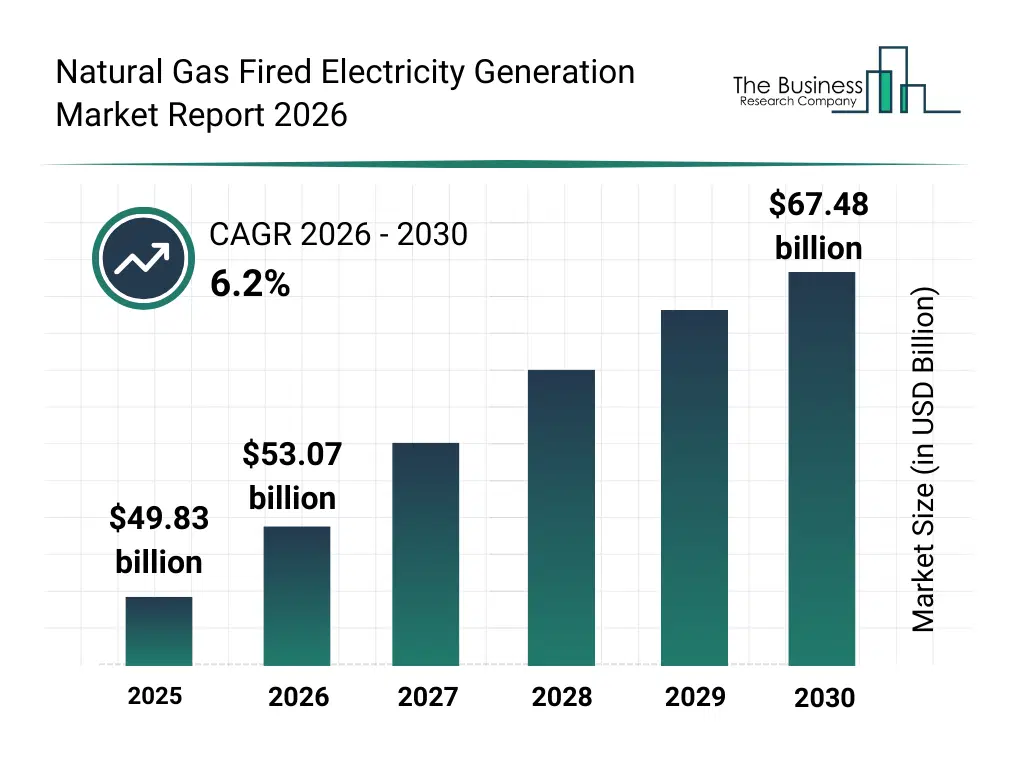
What Is The Natural Gas Fired Electricity Generation Market Size and Share 2026?
The natural gas fired electricity generation market size has grown strongly in recent years. It will grow from $49.83 billion in 2025 to $53.07 billion in 2026 at a compound annual growth rate (CAGR) of 6.5%. The growth in the historic period can be attributed to availability of natural gas supply, demand for reliable power generation, lower emissions compared to coal, expansion of gas turbine technology, grid stability needs.What Is The Natural Gas Fired Electricity Generation Market Growth Forecast?
The natural gas fired electricity generation market size is expected to see strong growth in the next few years. It will grow to $67.48 billion in 2030 at a compound annual growth rate (CAGR) of 6.2%. The growth in the forecast period can be attributed to renewable energy intermittency, investments in flexible power plants, retirement of coal plants, demand for low carbon electricity, advancements in turbine efficiency. Major trends in the forecast period include expansion of combined cycle power plants, growing role in grid balancing, rising use as transition fuel, increased deployment for peak load generation, integration with renewable energy systems.
Global Natural Gas Fired Electricity Generation Market Segmentation
1) By Technology: Combined Cycle, Open Cycle, Cogeneration 2) By Power Output: Less Than 100 MW, 100-500 MW, 500-1000 MW, Above 1000 MW 3) By Fuel Source: Conventional Natural Gas, Liquefied Natural Gas, Compressed Natural Gas, Biogas 4) By Application: Base Load Generation, Peak Load Generation, Mid Load Generation, Backup Power Generation 5) By End-Use: Distributed And Micro Generation, Commercial, Industrial Subsegments: 1) By Combined Cycle: Single-Shaft Combined Cycle, Multi-Shaft Combined Cycle, Combined Heat And Power (CHP) Combined Cycle, Advanced Combined Cycle With H-Class Turbines 2) By Open Cycle: Simple Gas Turbine (SGT), Aeroderivative Gas Turbine, Heavy-Duty Gas Turbine 3) By Cogeneration: Industrial Cogeneration, District Heating With Combined Heat And Power, Residential Micro-Combined Heat And Power, Trigeneration The top segments in the natural gas fired electricity generation market will be: • Combined Cycle will reach $44.71 Billion by 2030. • Open Cycle will reach $19.27 Billion by 2030. • Cogeneration will reach $4.08 Billion by 2030.What Is The Driver Of The Natural Gas Fired Electricity Generation Market?
The increasing demand for cleaner energy sources is expected to propel the growth of the natural gas-fired electricity generation market going forward. Cleaner energy sources refer to energy generated from renewable or low-emission sources, such as solar, wind, and hydropower, that have minimal environmental impact compared to fossil fuels. The increasing demand for cleaner energy sources is due to growing environmental concerns, which drive the need to reduce carbon emissions and combat climate change. Natural gas-fired electricity generation aids cleaner energy sources by providing a lower-emission alternative to coal and oil, supporting the transition to a more sustainable energy mix. It offers a flexible and efficient power supply, helping to balance renewable energy integration and enhance grid reliability. For instance, in March 2025, according to the International Renewable Energy Agency (IRENA), a UAE-based intergovernmental organization, the global renewable energy capacity grew from 3,862,881 megawatts (MW) in 2023 to 4,448,051 megawatts (MW) in 2024. Therefore, the increasing demand for cleaner energy sources is driving the growth of the natural gas-fired electricity generation market.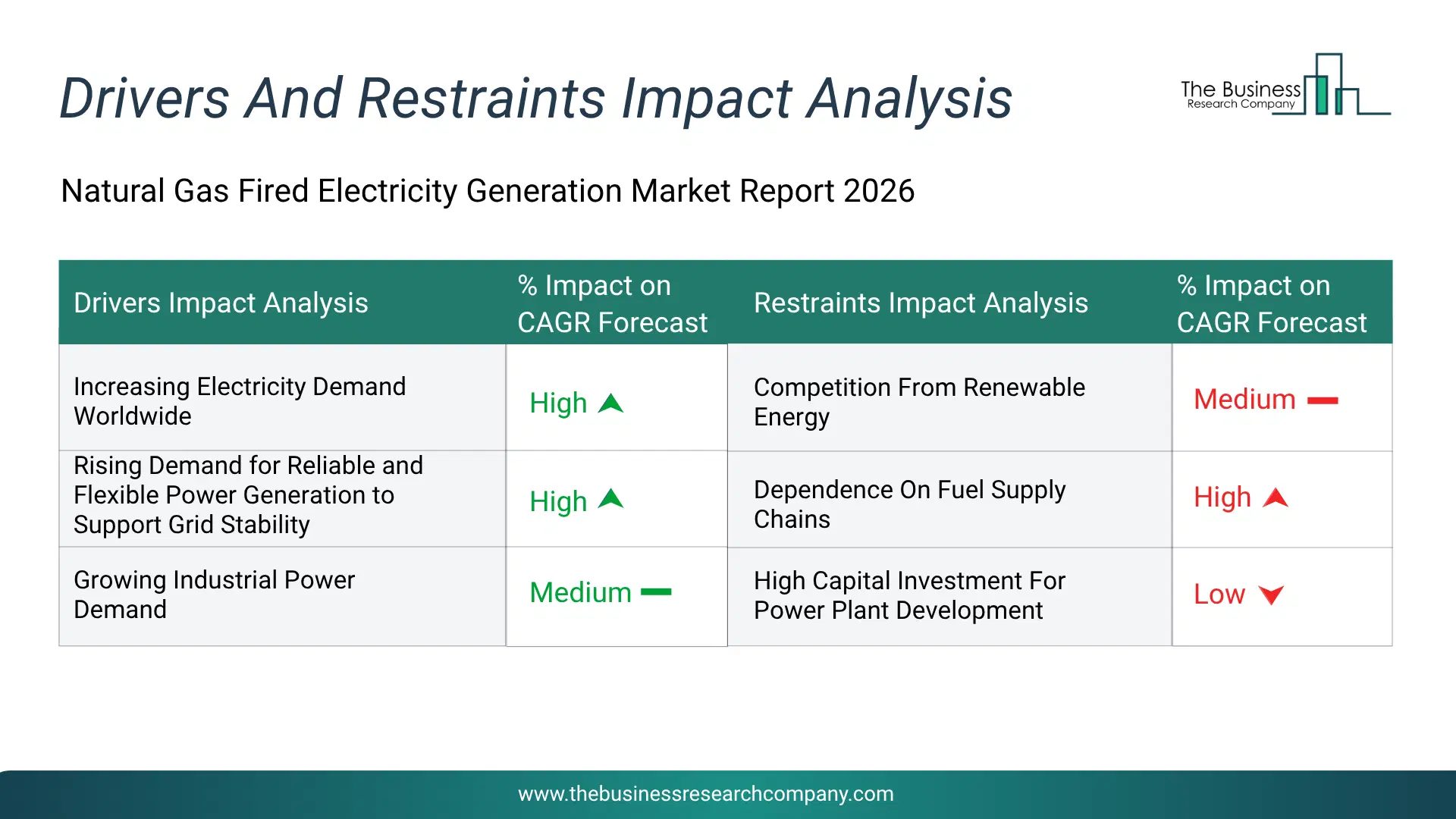
Infographic Chart Showing Key Market Drivers Analysis And Restraints For Natural Gas Fired Electricity Generation Market
The chart presents an impact analysis of key drivers and restraints, quantifying their relative influence on the market's growth rate and helping assess the balance between growth enablers and limiting factors. This chart offers a high-level perspective; the full report contains more detailed insights.
How Will The Drivers Impact Growth In The Global Natural Gas Fired Electricity Generation Market?
• Increasing Electricity Demand Worldwide (High) – During the forecast period, the increasing electricity demand worldwide is expected to become a key growth driver for the natural gas fired electricity generation market by 2030. Increasing electricity demand worldwide acts as a major driver for the natural gas fired electricity generation market because rising population growth, urbanization, and expanding economic activities are significantly increasing global power consumption. Utilities and power producers require dependable generation sources to meet this growing demand without compromising supply reliability. Natural gas-fired plants can be deployed relatively quickly and provide large-scale electricity output, making them attractive for capacity expansion. Their ability to operate continuously or respond to changing load requirements supports both base-load and peak-load generation needs. Developing economies are particularly investing in gas-fired infrastructure to address electricity shortages and support industrial development. In addition, natural gas plants often complement renewable energy installations by ensuring stable power availability. • Rising Demand for Reliable and Flexible Power Generation to Support Grid Stability (High) – During the forecast period, the rising demand for reliable and flexible power generation to support grid stability is expected to emerge as a major factor driving the expansion of the natural gas fired electricity generation market by 2030. Rising demand for reliable and flexible power generation to support grid stability is a significant driver for the Natural Gas Fired Electricity Generation market because modern power grids require generation sources that can quickly respond to fluctuations in electricity demand and renewable energy output. Natural gas power plants offer rapid start-up and ramping capabilities compared to many conventional generation technologies. This flexibility helps grid operators maintain frequency control and system reliability during periods of variable solar and wind generation. Gas-fired facilities can efficiently balance intermittent renewable resources while minimizing power disruptions. Their operational adaptability supports stable electricity delivery during peak consumption periods and emergency situations. As countries increase renewable energy integration, the need for flexible backup generation continues to grow. • Growing Industrial Power Demand (Medium) – During the forecast period, the growing industrial power demand is expected to act as a key growth catalyst for the natural gas fired electricity generation market by 2030. Growing industrial power demand serves as an important driver for the natural gas fired electricity generation market as industries require consistent and high-quality electricity to maintain production efficiency and operational continuity. Manufacturing facilities, chemical plants, refineries, mining operations, and processing industries are expanding in many regions, creating substantial power requirements. Natural gas-fired power plants provide reliable electricity that supports energy-intensive industrial activities without significant interruptions. Many industrial users also favor gas-based generation due to its operational efficiency and comparatively lower emissions profile. In several regions, industries are investing in captive and dedicated gas-fired power facilities to secure dependable energy supplies. The growing industrialization of emerging economies further strengthens demand for gas-based electricity generation.How Will The Restraints Impact Growth In The Global Natural Gas Fired Electricity Generation Market?
• Competition From Renewable Energy (High) – During the forecast period, the competition from renewable energy acts as a major restraint for the natural gas fired electricity generation market because the rapid expansion of solar, wind, hydro, and other renewable energy sources is reducing the dependence on fossil-fuel-based power generation. Governments across the world are implementing policies, incentives, and clean energy targets that encourage renewable energy investments. The declining cost of solar panels and wind turbines has made renewable electricity increasingly competitive compared to natural gas generation. Many utilities are prioritizing renewable capacity additions to meet sustainability and carbon reduction goals. Financial institutions are also directing more funding toward clean energy projects, limiting investments in conventional gas-fired plants. As renewable technologies continue to improve in efficiency and storage capabilities, their market share expands further. This growing competition can slow the development of new natural gas-fired power generation projects and restrain market growth. • Dependence On Fuel Supply Chains (High) – During the forecast period, the dependence on fuel supply chains serves as a significant restraint for the natural gas fired electricity generation market because power plants rely heavily on continuous and stable natural gas availability for efficient operations. Any disruption in gas production, transportation, storage, or distribution infrastructure can affect electricity generation reliability. Geopolitical tensions, pipeline constraints, extreme weather events, and supply shortages can lead to fuel availability challenges. Fluctuations in natural gas prices also increase operating costs and create uncertainty for power producers. Regions with limited domestic gas resources may face greater dependence on imports, exposing them to international market volatility. Supply chain disruptions can reduce plant utilization rates and negatively impact profitability. As a result, concerns regarding fuel security and supply stability can limit investment and expansion within the natural gas-fired electricity generation market. • High Capital Investment For Power Plant Development (Medium) – During the forecast period, the high capital investment for power plant development acts as a significant restraint for the natural gas fired electricity generation market because constructing new gas-fired power plants requires substantial spending on turbines, generators, transmission infrastructure, grid interconnections, and environmental control systems. Project developers must also invest in permitting, engineering, and construction activities before commercial operations can begin. Long development timelines and financing challenges increase investment risks, particularly in regions with uncertain energy policies or fluctuating electricity demand. These high upfront costs can discourage new capacity additions and slow the expansion of the natural gas fired electricity generation market.Key Players In The Global Natural Gas Fired Electricity Generation Market
Major companies operating in the natural gas fired electricity generation market are TotalEnergies SE, Petróleo Brasileiro S.A., RWE AG, Siemens Energy AG, NRG Energy Inc., Duke Energy Corp., NextEra Energy Inc., Exelon Corp., Dominion Energy Inc., S.N.G.N Romgaz S.A, China Resources Holdings Co. Ltd., CLP Holdings Limited, Sembcorp Industries Ltd., Centrais Eletricas Brasileiras SA, Central Puerto S.A., Calpine Corporation, Mesa Natural Gas Solutions LLC, Engie SA, AES Corporation, E.ON SE, EDF SA, Uniper SE, PPL Corporation, Southern Company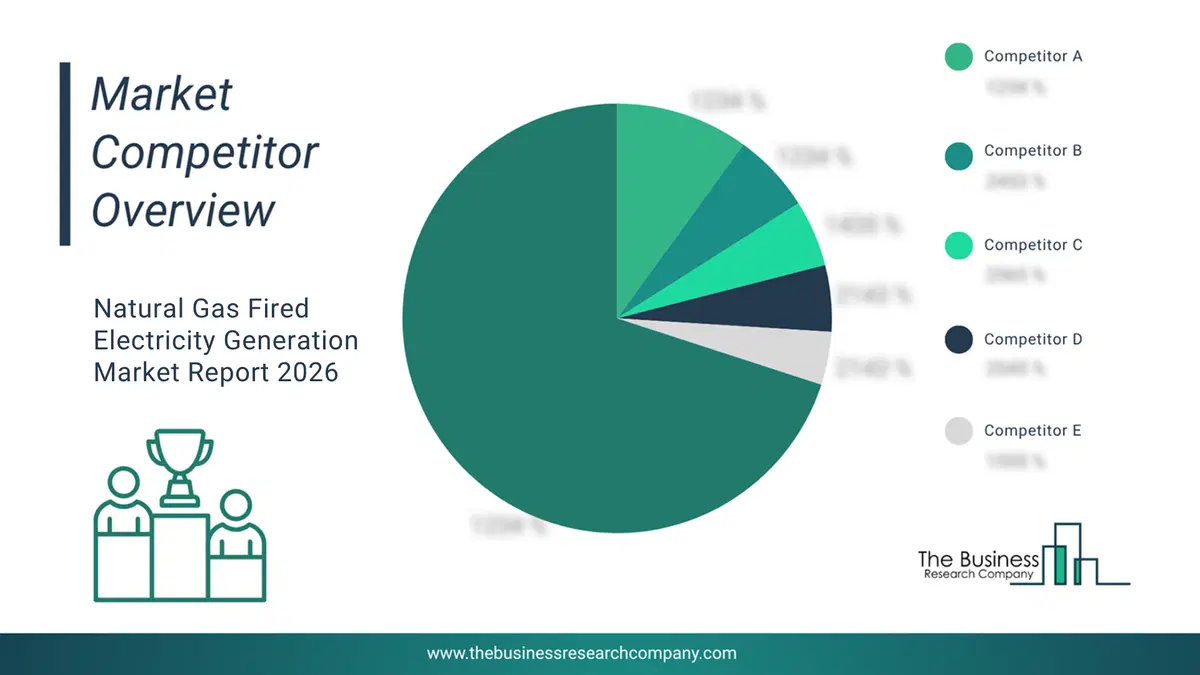
This chart is for illustrative purposes; the full report includes a detailed competitor analysis and comprehensive overview of the top 10 companies in the market.
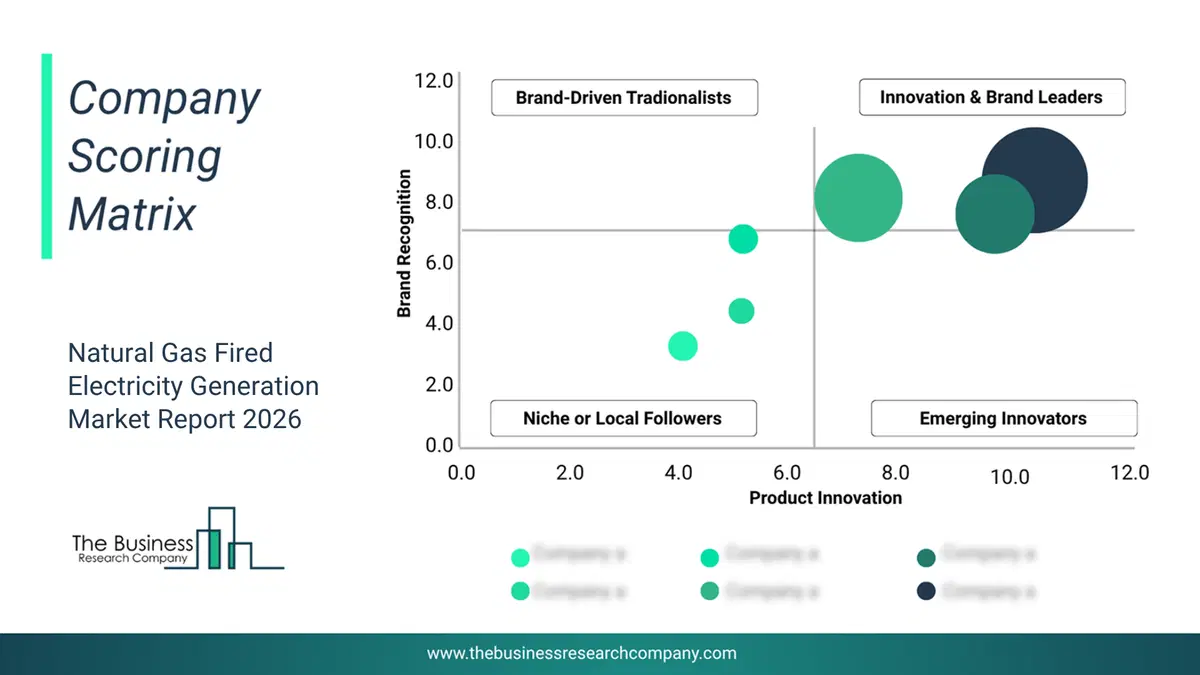
This chart maps companies by product innovation and brand strength, with bubble size indicating relative revenue, helping identify market leaders, challengers, and niche players. This is an illustrative chart; the full report provides a complete and accurate competitive analysis.
Global Natural Gas Fired Electricity Generation Market Trends and Insights
Major companies operating in the natural gas-fired electricity generation market are focusing on developing innovative solutions, such as high-efficiency combined cycle plants, to enhance energy output while reducing fuel consumption and emissions. High-efficiency combined cycle plants refer to power generation facilities that use both gas and steam turbines in a single cycle to maximize energy output from fuel, typically natural gas. For instance, in August 2024, LS Power Development, LLC, a US-based manufacturing company, launched Lightning Power, an independent power producer with 11 GW of high-efficiency natural gas-fired generation, leveraging advanced combined cycle and combustion turbine technologies to improve energy efficiency. Lightning Power’s portfolio includes 18 natural gas-fired power projects, featuring baseload combined cycle plants and flexible peakers, aimed at ensuring grid stability and delivering reliable, affordable power for diverse energy needs.What Are Latest Mergers And Acquisitions In The Natural Gas Fired Electricity Generation Market?
In January 2025, Shell plc, a UK-based oil industry company, acquired RISEC Holdings LLC for an undisclosed amount. With this acquisition, Shell plc aims to secure a long-term, reliable power supply and strengthen its strategic position in the growing ISO New England market, supporting its energy transition goals and enhancing trading opportunities. RISEC Holdings LLC is a US-based energy company that operates a natural gas-fired electricity generation facility.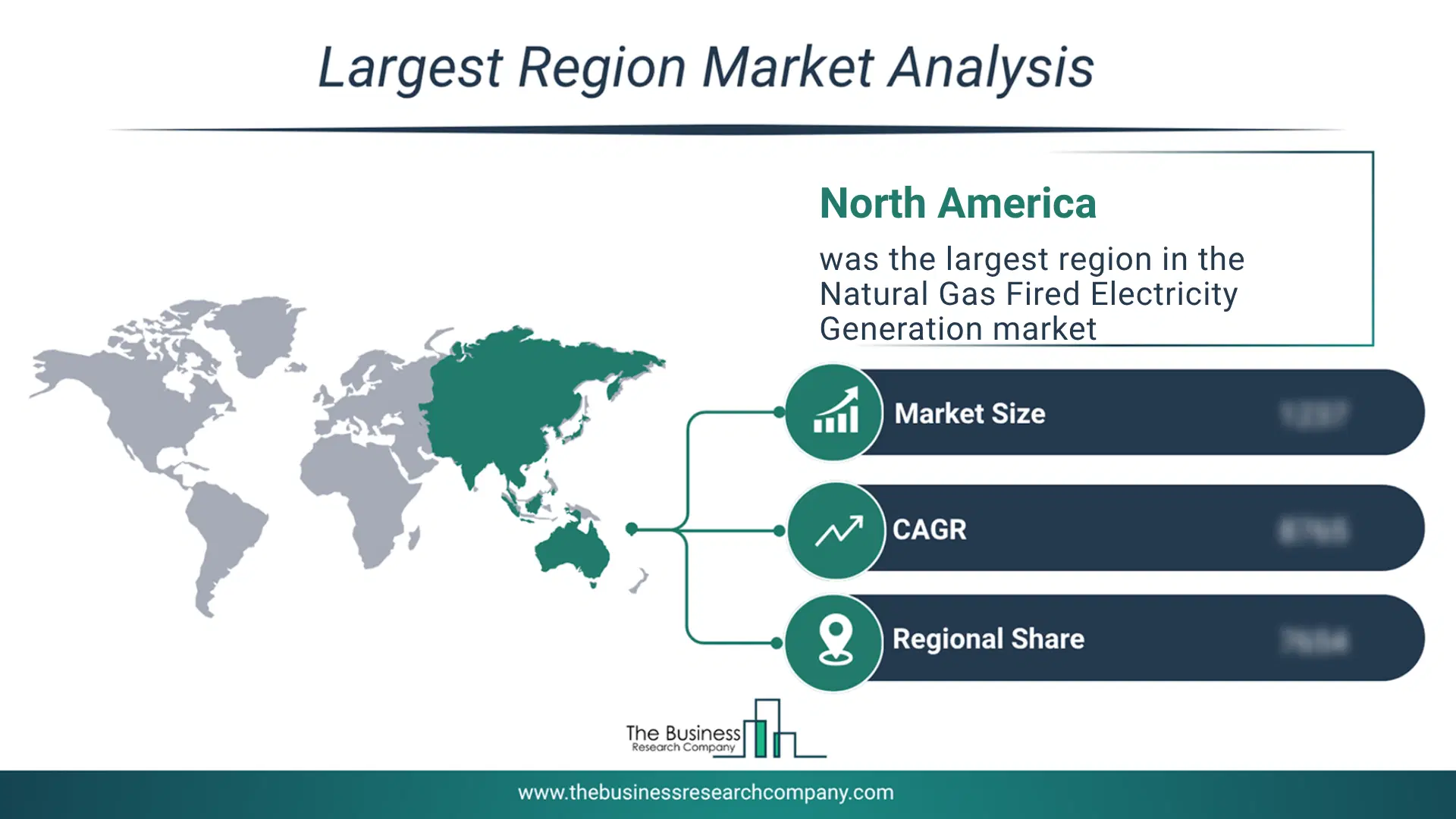
Regional Outlook
North America was the largest region in the natural gas fired electricity generation market in 2025. The regions covered in this market report are Asia-Pacific, South East Asia, Western Europe, Eastern Europe, North America, South America, Middle East, Africa. The countries covered in this market report are Australia, Brazil, China, France, Germany, India, Indonesia, Japan, Taiwan, Russia, South Korea, UK, USA, Canada, Italy, SpainWhat Defines the Natural Gas Fired Electricity Generation Market?
The natural gas fired electricity generation market consists of revenues earned by entities by providing services such as base load power, backup for renewable energy, grid stability, and ancillary services. The market value includes the value of related goods sold by the service provider or included within the service offering. The natural gas-fired electricity generation market also includes sales of gas turbines, gas-fired generators, heat recovery steam generators, and control and monitoring systems. Values in this market are ‘factory gate’ values, that is, the value of goods sold by the manufacturers or creators of the goods, whether to other entities (including downstream manufacturers, wholesalers, distributors, and retailers) or directly to end customers. The value of goods in this market includes related services sold by the creators of the goods.How is Market Value Defined and Measured?
The market value is defined as the revenues that enterprises gain from the sale of goods and/or services within the specified market and geography through sales, grants, or donations in terms of the currency (in USD unless otherwise specified). The revenues for a specified geography are consumption values that are revenues generated by organizations in the specified geography within the market, irrespective of where they are produced. It does not include revenues from resales along the supply chain, either further along the supply chain or as part of other products.
This chart presents market attractiveness based on a quantitative evaluation of growth, competition, strategic alignment, and risk, offering a clear view of opportunity areas for decision-making. This chart is for illustrative purposes; the full report contains the complete analysis.

This chart highlights the Total Addressable Market (TAM) by estimating the maximum revenue opportunity using an assumption-driven approach, supporting strategic planning and opportunity sizing across markets. The chart is illustrative; the full report provides a more comprehensive analysis.
What Key Data and Analysis Are Included in the Natural Gas Fired Electricity Generation Market Report 2026?
The natural gas fired electricity generation market research report is one of a series of new reports from The Business Research Company that provides market statistics, including industry global market size, regional shares, competitors with the market share, detailed market segments, market trends and opportunities, and any further data you may need to thrive in the natural gas fired electricity generation industry. The market research report delivers a complete perspective of everything you need, with an in-depth analysis of the current and future state of the industry.Natural Gas Fired Electricity Generation Market Report Forecast Analysis
| Report Attribute | Details |
|---|---|
| Market Size Value In 2026 | $53.07 billion |
| Revenue Forecast In 2030 | $67.48 billion |
| Growth Rate | CAGR of 6.2% from 2026 to 2030 |
| Base Year For Estimation | 2025 |
| Actual Estimates/Historical Data | 2020-2025 |
| Forecast Period | 2026 - 2030 |
| Market Representation | Revenue in USD Billion and CAGR from 2026 to 2030 |
| Segments Covered | Technology, Power Output, Fuel Source, Application, End-Use |
| Regional Scope | Asia-Pacific, Western Europe, Eastern Europe, North America, South America, Middle East, Africa |
| Country Scope | The countries covered in the report are Australia, Brazil, China, France, Germany, India, ... |
| Key Companies Profiled | TotalEnergies SE, Petróleo Brasileiro S.A., RWE AG, Siemens Energy AG, NRG Energy Inc., Duke Energy Corp., NextEra Energy Inc., Exelon Corp., Dominion Energy Inc., S.N.G.N Romgaz S.A, China Resources Holdings Co. Ltd., CLP Holdings Limited, Sembcorp Industries Ltd., Centrais Eletricas Brasileiras SA, Central Puerto S.A., Calpine Corporation, Mesa Natural Gas Solutions LLC, Engie SA, AES Corporation, E.ON SE, EDF SA, Uniper SE, PPL Corporation, Southern Company |
| Customization Scope | Request for Customization |
| Pricing And Purchase Options | Explore Purchase Options |