
Natural Rubber Market Report 2026
Global Outlook – By Product Type (Ribbed Smoked Sheet (RSS), Technically Specified Rubber (TSR), Latex, Other Product Types), By Processing Method (Dry Process, Wet Process), By Distribution Channel (Direct Sales, Indirect Sales), By Application (Automotive, Industrial Goods, Footwear, Consumer Goods, Medical, Other Applications), By End-User (Tire Industry, Non-Tire Industry) – Market Size, Trends, Strategies, and Forecast to 2030
Natural Rubber Market Overview
• Natural Rubber market size has reached to $30.32 billion in 2025 • Expected to grow to $41.99 billion in 2030 at a compound annual growth rate (CAGR) of 6.6% • Growth Driver: Growing Adoption Of Electric Vehicles (EVs) Fueling The Growth Of The Market Due To Rising Demand For High-performance Tires And Rubber Components • Market Trend: Advancement In Genetic Analysis Of Para Rubber Trees Enhances Natural Rubber Productivity And Supply Stability • Asia-Pacific was the largest region and fastest growing region.What Is Covered Under Natural Rubber Market?
Natural rubber is a natural elastomer obtained from the latex of the Hevea brasiliensis rubber tree through tapping and processing. It is valued for its high elasticity, tensile strength, abrasion resistance, and flexibility, making it suitable for demanding industrial applications. Its primary use is in the manufacture of tires and tire components for passenger, commercial, and off-road vehicles. The main product types of natural rubber include ribbed smoked sheet (RSS), technically specified rubber (TSR), latex, and others. Ribbed smoked sheet (RSS) refers to natural rubber produced by coagulating and processing rubber latex into ribbed sheets that are smoked and dried to improve preservation and provide consistent physical properties for downstream applications. These products are processed using dry process and wet process methods, and are sold through distribution channels such as direct sales and indirect sales for applications such as automotive, industrial goods, footwear, consumer goods, medical, and others, and are used by end users such as the tire industry and non-tire industry.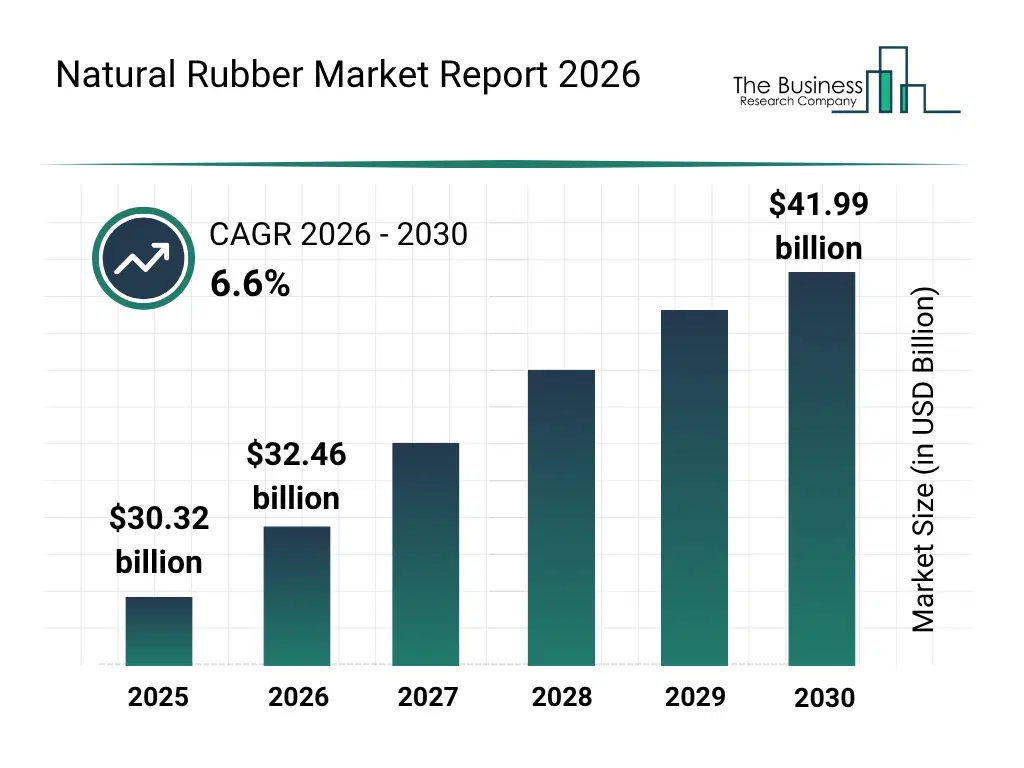
What Is The Natural Rubber Market Size and Share 2026?
The natural rubber market size has grown strongly in recent years. It will grow from $30.32 billion in 2025 to $32.46 billion in 2026 at a compound annual growth rate (CAGR) of 7.1%. The growth in the historic period can be attributed to growth in global vehicle production, expansion of tire manufacturing capacity, increasing demand for industrial rubber products, growth in automotive replacement tire demand, rising consumption of rubber gloves and medical products.What Is The Natural Rubber Market Growth Forecast?
The natural rubber market size is expected to see strong growth in the next few years. It will grow to $41.99 billion in 2030 at a compound annual growth rate (CAGR) of 6.6%. The growth in the forecast period can be attributed to expansion of electric vehicle tire production, increasing demand for sustainable rubber materials, growth in emerging-market automotive industries, increasing adoption of high-performance natural rubber compounds, rising demand for natural rubber in infrastructure and construction applications. Major trends in the forecast period include development of low-protein and deproteinized natural rubber, increasing adoption of specialty natural rubber grades, expansion of sustainable rubber processing technologies, growth in natural rubber compound development, increasing use of high-performance natural rubber formulations.Tariff Impact On Natural Rubber Market
Tariffs are impacting the natural rubber market by increasing the cost of imported natural rubber, rubber compounds, processing equipment, and tire manufacturing inputs, creating pressure on manufacturers and downstream users. Tire manufacturing and industrial rubber applications are most affected, while import-dependent regions such as North America, Europe, and Asia-Pacific face greater cost and supply-chain pressures. However, tariffs are also encouraging manufacturers to diversify sourcing, strengthen domestic rubber processing capacity, develop regional supply chains, and increase the use of locally sourced natural rubber, creating long-term resilience in the market.
Global Natural Rubber Market Segmentation
1) By Product Type: Ribbed Smoked Sheet (RSS), Technically Specified Rubber (TSR), Latex, Other Product Types 2) By Processing Method: Dry Process, Wet Process 3) By Distribution Channel: Direct Sales, Indirect Sales 4) By Application: Automotive, Industrial Goods, Footwear, Consumer Goods, Medical, Other Applications 5) By End-User: Tire Industry, Non-Tire Industry Subsegments: 1) By Ribbed Smoked Sheet (RSS): Ribbed Smoked Sheet (RSS) 1, Ribbed Smoked Sheet (RSS) 2, Ribbed Smoked Sheet (RSS) 3, Ribbed Smoked Sheet (RSS) 4, Ribbed Smoked Sheet (RSS) 5 2) By Technically Specified Rubber (TSR): Technically Specified Rubber (TSR) 5, Technically Specified Rubber (TSR) 10, Technically Specified Rubber (TSR) 20, Technically Specified Rubber (TSR) 50 3) By Latex: Centrifuged Latex, Prevulcanized Latex, High Ammonia Latex, Low Ammonia Latex 4) By Other Product Types: Crepe Rubber, Air Dried Sheet Rubber, Skim Rubber, Cup Lump Rubber, Field Coagulum Rubber, Natural Rubber CompoundsWhat Is The Driver Of The Natural Rubber Market?
The growing adoption of electric vehicles (EVs) is expected to propel the growth of the natural rubber market going forward. Electric vehicles are automobiles powered by electric motors and rechargeable batteries, requiring specialized components that provide durability, grip, and energy efficiency. The adoption of electric vehicles (EVs) is increasing due to increasingly stringent government regulations on vehicle emissions, which encourage consumers and manufacturers to transition toward cleaner transportation technologies. The rising adoption of electric vehicles (EVs) increases demand for natural rubber, as EVs require high-performance tires and rubber components that use natural rubber for durability, traction, vibration damping, and load-bearing performance. For instance, in May 2025, according to the International Energy Agency (IEA), a France-based intergovernmental organization, global electric car sales exceeded 17 million in 2024, while electric car sales in the first quarter of 2025 grew by 35% year over year, with annual sales expected to surpass 20 million in 2025. Therefore, the growing adoption of electric vehicles (EVs) is driving the growth of the natural rubber industry.Key Players In The Global Natural Rubber Market
Major companies operating in the natural rubber market are Hainan Natural Rubber Industry Group Co. Ltd., Vietnam Rubber Group, Sinochem International Corporation, Sri Trang Agro-Industry Public Company Limited, Kuala Lumpur Kepong Berhad, SD Guthrie Berhad, Southland Rubber Co. Ltd., Von Bundit Co. Ltd., Thai Rubber Latex Group Public Company Limited, North East Rubber Public Company Limited, Seng Fong Holdings Berhad, Rubberflex Sdn. Bhd., Felcra Berhad, PT Perkebunan Nusantara I, Harrisons Malayalam Limited, Thaibinh Rubber Joint Stock Company, Longtex Rubber Industry Co. Ltd., Edathala Polymers Private Limited
This chart is for illustrative purposes; the full report includes a detailed competitor analysis and comprehensive overview of the top 10 companies in the market.
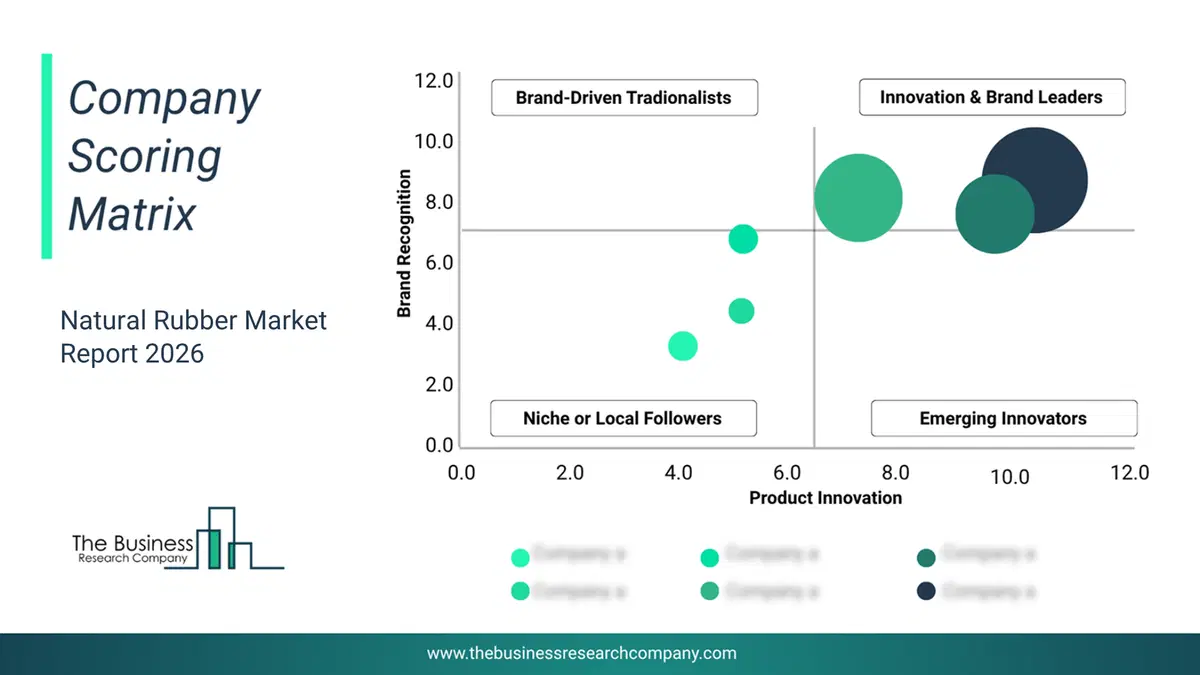
This chart maps companies by product innovation and brand strength, with bubble size indicating relative revenue, helping identify market leaders, challengers, and niche players. This is an illustrative chart; the full report provides a complete and accurate competitive analysis.
Global Natural Rubber Market Trends and Insights
Major companies operating in the natural rubber market are focusing on advancing genetic analysis and marker-assisted selection technologies for para rubber trees to improve natural rubber productivity, stabilize yields, and support sustainable supply without expanding cultivated land. Marker-assisted selection uses genetic markers to identify high-yielding and stable-performing trees at an early stage, helping accelerate conventional breeding and improve the productivity of natural rubber plantations. For instance, in April 2026, Bridgestone Corporation, a Japan-based tire and rubber products company, launched a joint research project with Universitas Indonesia, Yokohama City University, and Maebashi Institute of Technology to conduct genetic analysis of para rubber trees using latex samples and genetic information from Bridgestone’s natural rubber farm in Indonesia. The project aims to establish marker-assisted selection technology for high-precision and rapid identification of elite trees, with the long-term objective of improving productivity and stabilizing natural rubber yields within finite land resources.What Are Latest Mergers And Acquisitions In The Natural Rubber Market?
In August 2026, Olam Agri, a Singapore-based agricultural products company, acquired Asia Africa Rubber Industry S.A. (ASAF) for an undisclosed amount. With this acquisition, Olam Agri aimed to strengthen its natural rubber processing capabilities, nearly double its processing capacity in Côte d’Ivoire, improve supply reliability and operational efficiency, enhance access to international rubber customers, and expand its supply of traceable and responsibly sourced natural rubber. Asia Africa Rubber Industry S.A. is a Côte d’Ivoire-based natural rubber processing company that specializes in processing natural rubber for international customers and supports the supply of technically specified rubber.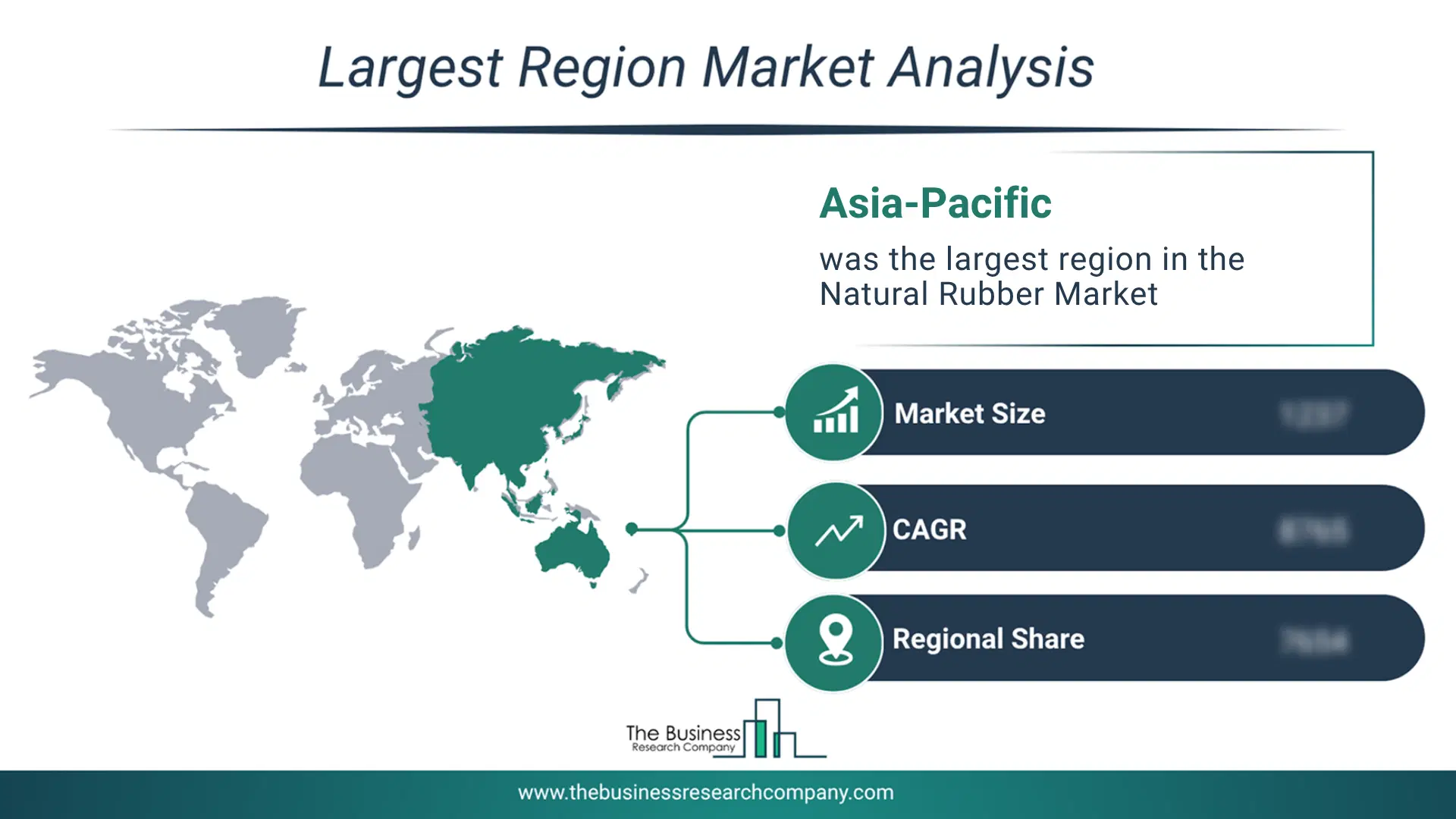
Regional Outlook
Asia-Pacific was the largest region in the natural rubber market in 2025. Asia-Pacific is expected to be the fastest-growing region in the forecast period. The regions covered in this market report are Asia-Pacific, South East Asia, Western Europe, Eastern Europe, North America, South America, Middle East, Africa. The countries covered in this market report are Australia, Brazil, China, France, Germany, India, Indonesia, Japan, Taiwan, Russia, South Korea, UK, USA, Canada, Italy, Spain.What Defines the Natural Rubber Market?
The natural rubber market consists of sales of solid block rubber, skim rubber, crepe rubber, pale crepe rubber, air-dried sheet (ADS) rubber, cup lump rubber, field coagulum rubber, and natural rubber compounds. Values in this market are ‘factory gate’ values, that is the value of goods sold by the manufacturers or creators of the goods, whether to other entities (including downstream manufacturers, wholesalers, distributors and retailers) or directly to end customers. The value of goods in this market includes related services sold by the creators of the goods.How is Market Value Defined and Measured?
The market value is defined as the revenues that enterprises gain from the sale of goods and/or services within the specified market and geography through sales, grants, or donations in terms of the currency (in USD unless otherwise specified). The revenues for a specified geography are consumption values that are revenues generated by organizations in the specified geography within the market, irrespective of where they are produced. It does not include revenues from resales along the supply chain, either further along the supply chain or as part of other products.
This chart presents market attractiveness based on a quantitative evaluation of growth, competition, strategic alignment, and risk, offering a clear view of opportunity areas for decision-making. This chart is for illustrative purposes; the full report contains the complete analysis.

This chart highlights the Total Addressable Market (TAM) by estimating the maximum revenue opportunity using an assumption-driven approach, supporting strategic planning and opportunity sizing across markets. The chart is illustrative; the full report provides a more comprehensive analysis.
What Key Data and Analysis Are Included in the Natural Rubber Market Report 2026?
The natural rubber market research report is one of a series of new reports from The Business Research Company that provides market statistics, including industry global market size, regional shares, competitors with the market share, detailed market segments, market trends and opportunities, and any further data you may need to thrive in the natural rubber industry. The market research report delivers a complete perspective of everything you need, with an in-depth analysis of the current and future state of the industry.Natural Rubber Market Report Forecast Analysis
| Report Attribute | Details |
|---|---|
| Market Size Value In 2026 | $32.46 billion |
| Revenue Forecast In 2030 | $41.99 billion |
| Growth Rate | CAGR of 6.6% from 2026 to 2030 |
| Base Year For Estimation | 2025 |
| Actual Estimates/Historical Data | 2020-2025 |
| Forecast Period | 2026 - 2030 |
| Market Representation | Revenue in USD Billion and CAGR from 2026 to 2030 |
| Segments Covered | Product Type, Processing Method, Distribution Channel, Application, End-User |
| Regional Scope | Asia-Pacific, Western Europe, Eastern Europe, North America, South America, Middle East, Africa |
| Country Scope | The countries covered in the report are Australia, Brazil, China, France, Germany, India, Indonesia, Japan, Taiwan, Russia, South Korea, UK, USA, Canada, Italy, Spain. |
| Key Companies Profiled | Hainan Natural Rubber Industry Group Co. Ltd., Vietnam Rubber Group, Sinochem International Corporation, Sri Trang Agro-Industry Public Company Limited, Kuala Lumpur Kepong Berhad, SD Guthrie Berhad, Southland Rubber Co. Ltd., Von Bundit Co. Ltd., Thai Rubber Latex Group Public Company Limited, North East Rubber Public Company Limited, Seng Fong Holdings Berhad, Rubberflex Sdn. Bhd., Felcra Berhad, PT Perkebunan Nusantara I, Harrisons Malayalam Limited, Thaibinh Rubber Joint Stock Company, Longtex Rubber Industry Co. Ltd., Edathala Polymers Private Limited |
| Customization Scope | Request for Customization |
| Pricing And Purchase Options | Explore Purchase Options |