
Navigation Satellite System Market Report 2026
Global Outlook – By Component (Devices, Services), By Satellite Technology (Constellations, Satellite-Based Augmentation Systems (SBAS), GPS, GLONASS, Galileo, BeiDou), By Application (Location Based Services (LBS), Automotive And Road, Surveying, Rail, Aviation, Agriculture, Other Applications) – Market Size, Trends, Strategies, and Forecast to 2030
Navigation Satellite System Market Overview
• Navigation Satellite System market size has reached to $270.03 billion in 2025 • Expected to grow to $421.15 billion in 2030 at a compound annual growth rate (CAGR) of 9.2% • Growth Driver: Autonomous Vehicle Adoption Driving Growth In Navigation Satellite System Market • Market Trend: Innovative Products and Advancements in Navigation Satellite Systems Market • Asia-Pacific was the largest region in 2025.What Is Covered Under Navigation Satellite System Market?
A navigation satellite system is a system of satellites and ground-based infrastructure designed to provide users with accurate and reliable positioning, navigation, and timing information on or near the Earth's surface. They are used to determine their precise location, calculate the speed, and synchronize the time reference with high accuracy for satellites in specific orbits. The main components of the navigation satellite system are devices and services. Devices refer to physical or electronic instruments, tools, machines, or gadgets designed and used for specific purposes. The various satellite technologies include constellations, satellite-based augmentation systems (Sbas), global positioning system (GPS), global navigation satellite system (GLONASS), Galileo, and Beidou, which are used in various applications such as location-based services (lbs), automotive and road, surveying, rail, aviation, agriculture, and others.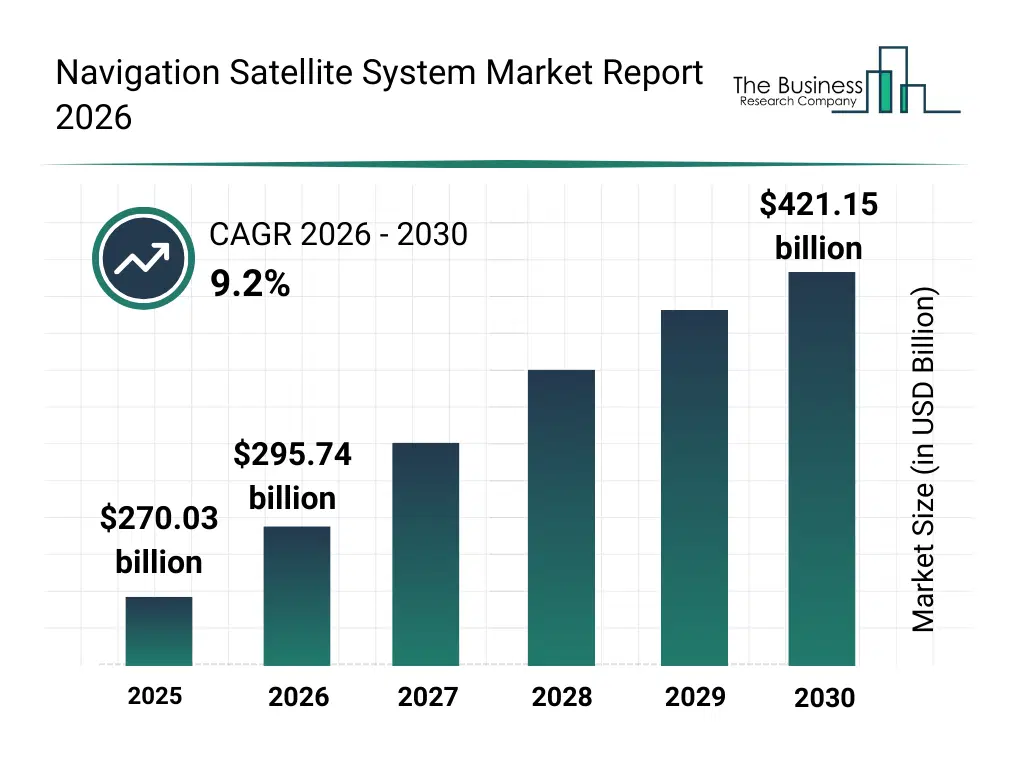
What Is The Navigation Satellite System Market Size and Share 2026?
The navigation satellite system market size has grown strongly in recent years. It will grow from $270.03 billion in 2025 to $295.74 billion in 2026 at a compound annual growth rate (CAGR) of 9.5%. The growth in the historic period can be attributed to expansion of gps and gnss infrastructure, growth in geodetic surveying activities, rising adoption of portable navigation devices, increased demand for mobile mapping systems, development of ground-based augmentation systems.What Is The Navigation Satellite System Market Growth Forecast?
The navigation satellite system market size is expected to see strong growth in the next few years. It will grow to $421.15 billion in 2030 at a compound annual growth rate (CAGR) of 9.2%. The growth in the forecast period can be attributed to integration with autonomous vehicles, growth in location-based emergency services, advancements in satellite timing and synchronization technologies, expansion of private satellite constellations, increased adoption in precision agriculture and logistics. Major trends in the forecast period include adoption of multi-constellation gnss receivers for enhanced accuracy, integration of navigation satellite systems with automotive and rail applications, increasing use of portable navigation devices (pnds) in surveying and mapping, expansion of location-based services (lbs) for consumer and enterprise applications, growth in satellite-based augmentation systems (sbas) for precision agriculture and emergency services.
Global Navigation Satellite System Market Segmentation
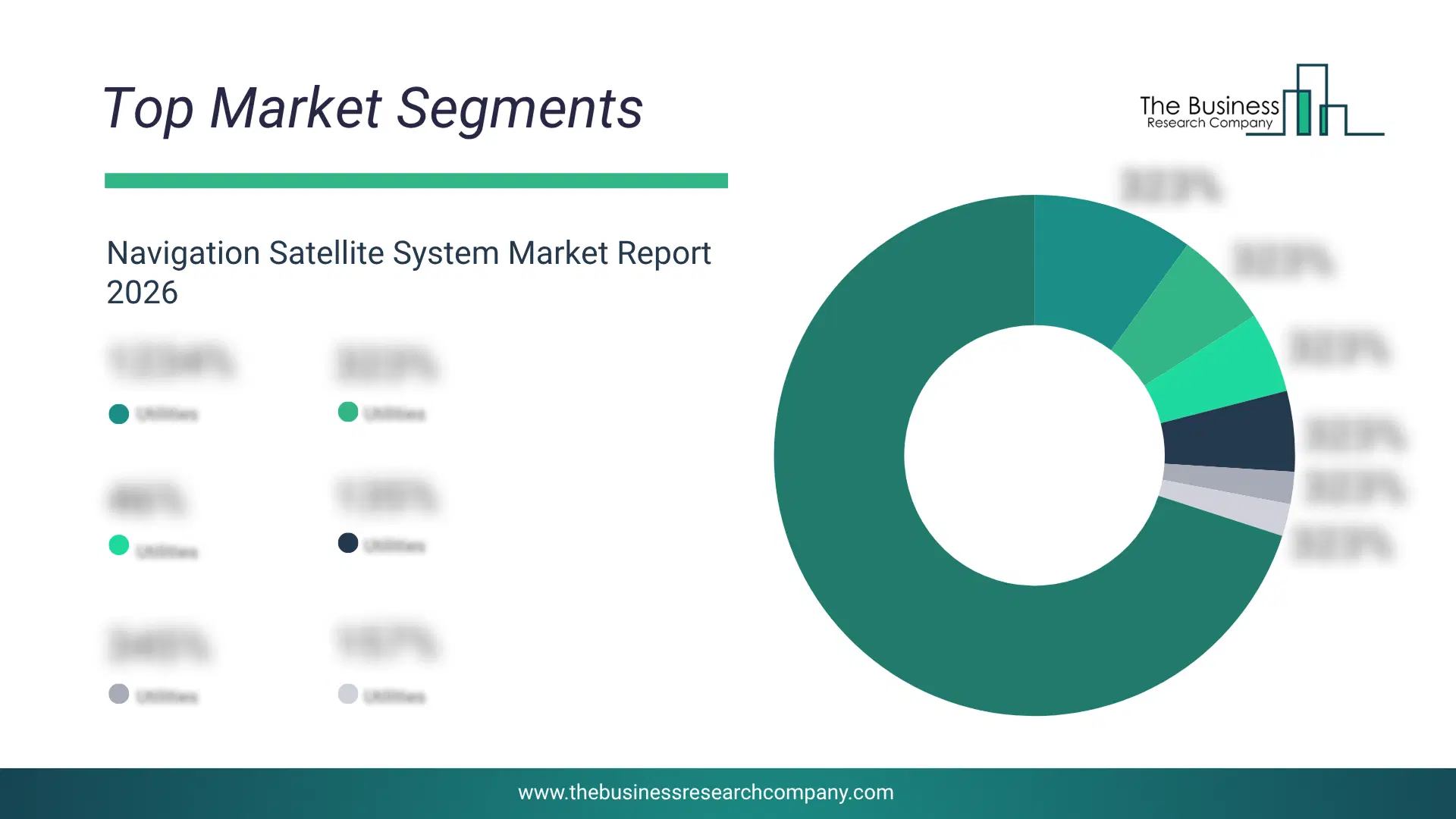
1) By Component: Devices, Services 2) By Satellite Technology: Constellations, Satellite-Based Augmentation Systems (SBAS), GPS, GLONASS, Galileo, BeiDou 3) By Application: Location Based Services (LBS), Automotive And Road, Surveying, Rail, Aviation, Agriculture, Other Applications Subsegments: 1) By Devices: GPS Receivers, GNSS Receivers, Navigation Instruments, Satellite Antennas, Onboard navigation systems 2) By Services: Positioning Services, Navigation Services, Timing Services, Location-Based Services (LBS), Satellite Communication ServicesWhat Is Driver Of The Navigation Satellite System Market?
The adoption of autonomous vehicles is expected to propel the growth of the navigation satellite system market going forward. Autonomous vehicles, also referred to as self-driving or driverless vehicles, are automobiles equipped with advanced technology and systems that enable them to operate and navigate without direct human input or intervention. The growth of autonomous vehicles is fueled by advances in AI and sensor technology, enabling safer, more efficient navigation and minimizing human errors to enhance transportation efficiency. Navigation satellite systems are helpful for autonomous vehicles by providing accurate and reliable positioning, navigation, and timing information, which can improve safety and efficiency and reduce environmental impact. For instance, in March 2025, according to the European Parliament, a France-based governmental body, autonomous vehicles (AVs) as a key technology are expected to generate a global added value for the sector of EUR 400 billion ($466.2 billion) by 2035. Therefore, the adoption of autonomous vehicles is driving the growth of the navigation satellite system industry.Key Players In The Global Navigation Satellite System Market
Major companies operating in the navigation satellite system market are RTX Corporation, Qualcomm Technologies Inc., General Dynamics Corporation, Texas Instruments Inc., Intel Corporation, MediaTek Inc., L3Harris Technologies Inc., STMicroelectronics N.V., Hexagon AB, Garmin Ltd., Trimble Inc., Quectel Wireless Solutions Co. Ltd., Viasat Inc., Topcon Corporation, Iridium Communications Inc., u-blox, Furuno Electric Co. Ltd., Spirent Communications plc, TomTom N.V., SkyTraq Technology Inc., Globalstar Inc., Thuraya Telecommunications Company, Javad GNSS Inc., Tersus GNSS Inc., ComNav Technology Ltd., Hemisphere GNSS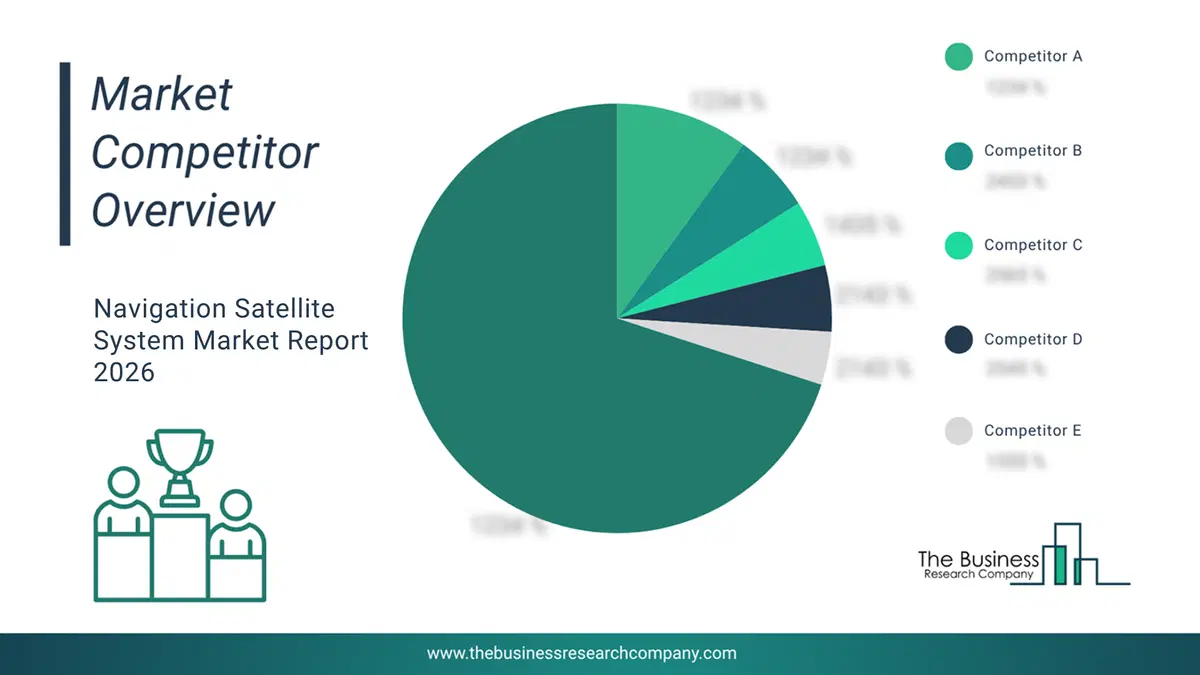
This chart is for illustrative purposes; the full report includes a detailed competitor analysis and comprehensive overview of the top 10 companies in the market.
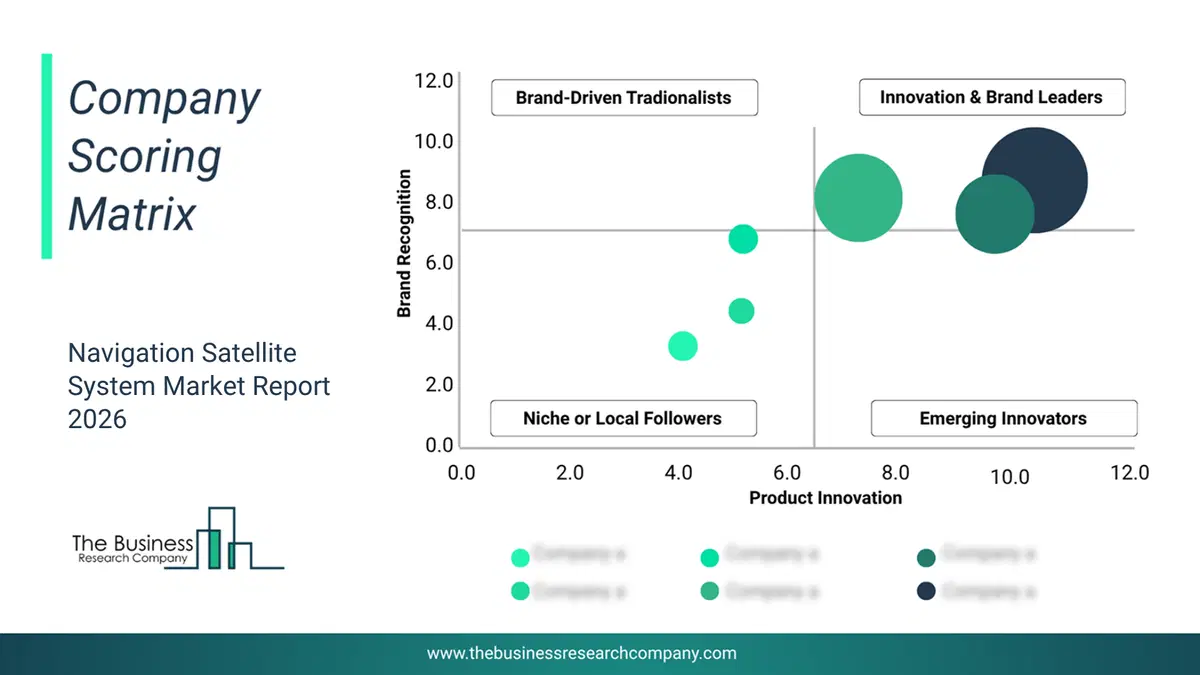
This chart maps companies by product innovation and brand strength, with bubble size indicating relative revenue, helping identify market leaders, challengers, and niche players. This is an illustrative chart; the full report provides a complete and accurate competitive analysis.
Global Navigation Satellite System Market Trends and Insights
Major companies operating in the navigation satellite system market are developing innovative products such as the Global Positioning System GPS III-6 Space Vehicle (SV06) navigation satellite to gain a competitive edge in the market. The Global Positioning System (GPS) III Space Vehicle 06 (SV06) navigation satellite is a new generation of global navigation satellite systems. For instance, in January 2023, SpaceX, a US-based spacecraft manufacturer and satellite communications company, launched the sixth spacecraft, the Global Positioning System (GPS) III Space Vehicle 06 (SV06) navigation satellite. The latest generation of GPS satellites is the most powerful, resilient GPS satellite ever built, with three times improved accuracy and eight times better jam-proofing. It also has a military channel that is more dependable and jam-proof, as well as improved civilian transmissions, compatibility with other navigation systems, and stronger search and rescue capabilities.What Are Latest Mergers And Acquisitions In The Navigation Satellite System Market? Iridium Communications Inc. Acquires Satelles Inc. To Strengthen Its Global Alternative PNT Service Capabilities
In April 2024, Iridium Communications Inc., a US-based provider of voice and data satellite communications, acquired Satelles, Inc. for an undisclosed amount. With this acquisition, Iridium aims to enhance its technological capability in positioning, navigation, and timing (PNT) services by integrating Satelles’ resilient time-and-location platform into its satellite network. Satelles, Inc. is a US-based provider of satellite-based time and location signal services designed to complement GPS and other GNSS systems.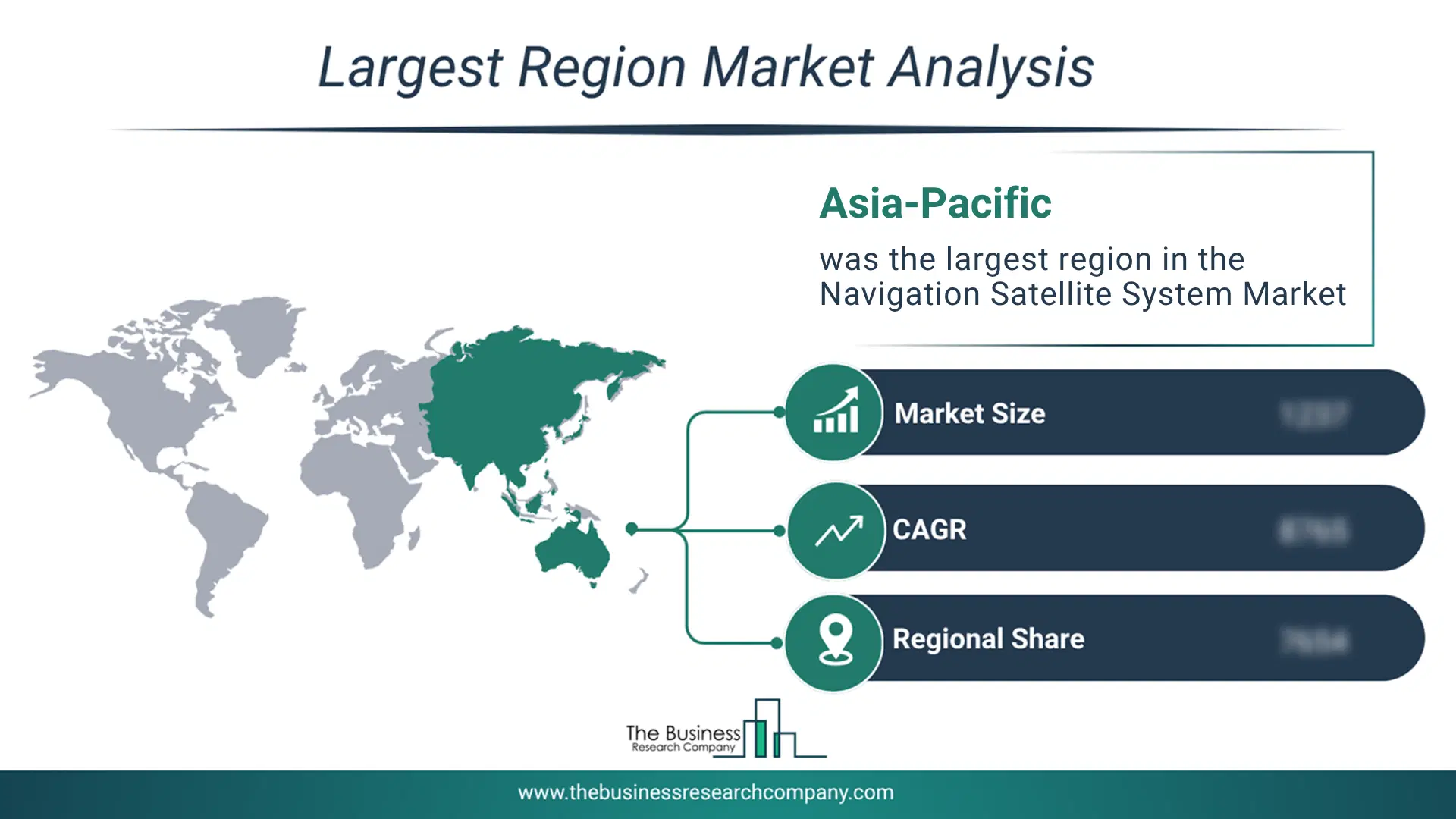
Regional Insights
Asia-Pacific was the largest region in the navigation satellite system market in 2025. The regions covered in this market report are Asia-Pacific, South East Asia, Western Europe, Eastern Europe, North America, South America, Middle East, Africa. The countries covered in this market report are Australia, Brazil, China, France, Germany, India, Indonesia, Japan, Taiwan, Russia, South Korea, UK, USA, Canada, Italy, SpainWhat Defines the Navigation Satellite System Market?
The navigation satellite system market includes revenues earned by entities by providing services such as emergency warning services, geodetic surveys, and synchronization services. The market value includes the value of related goods sold by the service provider or included within the service offering. Only goods and services traded between entities or sold to end consumers are included. The navigation satellite system market also includes sales of simulation tools, portable navigation devices (PNDs), and mobile mapping systems. Values in this market are ‘factory gate’ values, that is the value of goods sold by the manufacturers or creators of the goods, whether to other entities (including downstream manufacturers, wholesalers, distributors and retailers) or directly to end customers. The value of goods in this market includes related services sold by the creators of the goods.How is Market Value Defined and Measured?
The market value is defined as the revenues that enterprises gain from the sale of goods and/or services within the specified market and geography through sales, grants, or donations in terms of the currency (in USD unless otherwise specified). The revenues for a specified geography are consumption values that are revenues generated by organizations in the specified geography within the market, irrespective of where they are produced. It does not include revenues from resales along the supply chain, either further along the supply chain or as part of other products.
This chart presents market attractiveness based on a quantitative evaluation of growth, competition, strategic alignment, and risk, offering a clear view of opportunity areas for decision-making. This chart is for illustrative purposes; the full report contains the complete analysis.

This chart highlights the Total Addressable Market (TAM) by estimating the maximum revenue opportunity using an assumption-driven approach, supporting strategic planning and opportunity sizing across markets. The chart is illustrative; the full report provides a more comprehensive analysis.
What Key Data and Analysis Are Included in the Navigation Satellite System Market Report 2026?
The navigation satellite system market research report is one of a series of new reports from The Business Research Company that provides market statistics, including industry global market size, regional shares, competitors with the market share, detailed market segments, market trends and opportunities, and any further data you may need to thrive in the navigation satellite system industry. The market research report delivers a complete perspective of everything you need, with an in-depth analysis of the current and future state of the industry.Navigation Satellite System Market Report Forecast Analysis
| Report Attribute | Details |
|---|---|
| Market Size Value In 2026 | $295.74 billion |
| Revenue Forecast In 2030 | $421.15 billion |
| Growth Rate | CAGR of 9.2% from 2026 to 2030 |
| Base Year For Estimation | 2025 |
| Actual Estimates/Historical Data | 2020-2025 |
| Forecast Period | 2026 - 2030 |
| Market Representation | Revenue in USD Billion and CAGR from 2026 to 2030 |
| Segments Covered | Component, Satellite Technology, Application |
| Regional Scope | Asia-Pacific, Western Europe, Eastern Europe, North America, South America, Middle East, Africa |
| Country Scope | The countries covered in the navigation satellite system market report are Australia, Brazil, China, France, Germany, India, Indonesia, Japan, Taiwan, Russia, South Korea, UK, USA, Canada, Italy, Spain |
| Key Companies Profiled | RTX Corporation, Qualcomm Technologies Inc., General Dynamics Corporation, Texas Instruments Inc., Intel Corporation, MediaTek Inc., L3Harris Technologies Inc., STMicroelectronics N.V., Hexagon AB, Garmin Ltd., Trimble Inc., Quectel Wireless Solutions Co. Ltd., Viasat Inc., Topcon Corporation, Iridium Communications Inc., u-blox, Furuno Electric Co. Ltd., Spirent Communications plc, TomTom N.V., SkyTraq Technology Inc., Globalstar Inc., Thuraya Telecommunications Company, Javad GNSS Inc., Tersus GNSS Inc., ComNav Technology Ltd., Hemisphere GNSS |
| Customization Scope | Request for Customization |
| Pricing And Purchase Options | Explore Purchase Options |