
Near-Eye Display Market Report 2026
Global Outlook – By Component (Image Generators, Optical Combiners, Imaging Optics), By Technology (Liquid Crystal Display, Organic Light Emitting Diode, Micro Light Emitting Diode, Digital Light Processing), By Form Factor (Wearable, Head-Mounted Display, Smart Glasses), By Application (Augmented Reality, Virtual Reality, Mixed Reality), By End Use (Consumer Electronics, Healthcare, Military, Aerospace) – Market Size, Trends, Strategies, and Forecast to 2035
Near-Eye Display Market Overview
• Near-Eye Display market size has reached to $2.87 billion in 2025 • Expected to grow to $7.8 billion in 2030 at a compound annual growth rate (CAGR) of 22.2% • Growth Driver: Rising Demand For Interactive Entertainment Driving The Market Growth Due To Increasing Adoption Of Immersive Display Technologies • Market Trend: Advancements in High-Brightness, Power-Efficient Single-Junction OLED Microdisplays Driving Near-Eye Display Innovation • North America was the largest region in 2025 and Asia-Pacific is the fastest growing region.What Is Covered Under Near-Eye Display Market?
A near-eye display is a small, lightweight display positioned close to the eyes and commonly built into devices such as smart glasses. It delivers digital visuals directly into the user’s line of sight, enabling immersive or augmented viewing experiences. The purpose of a near-eye display (NED) is to provide real-time access to digital information while ensuring ease of use, mobility, and interactive engagement. The main components of near-eye display include image generators, optical combiners, and imaging optics. Image generators refer to systems that produce digital images for close-to-eye visualization, enabling immersive visual output in wearable display devices. They utilize technologies such as liquid crystal display, organic light emitting diode, micro light emitting diode, and digital light processing and they are categorized by form factor such as wearable devices, head-mounted display systems, and smart glasses. The key applications involved are augmented reality, virtual reality, and mixed reality, while the end-use includes consumer electronics, healthcare, military, and aerospace.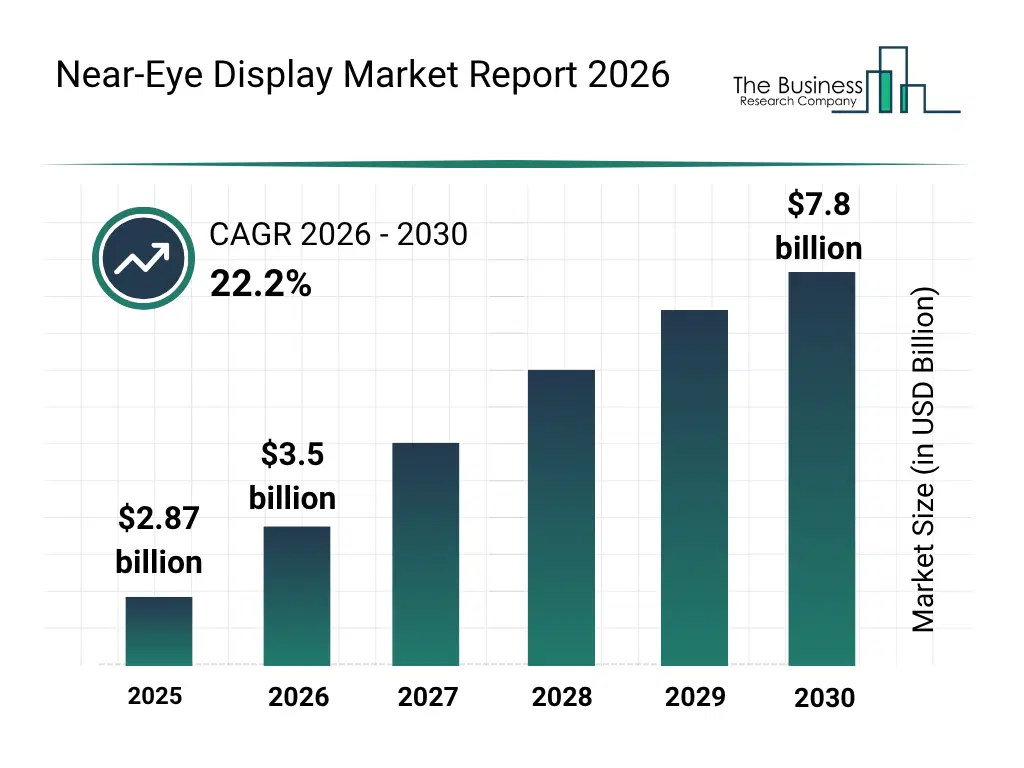
What Is The Near-Eye Display Market Size and Share 2026?
The near-eye display market size has grown exponentially in recent years.It will grow from $2.87 billion in 2025 to $3.5 billion in 2026 at a compound annual growth rate (CAGR) of 22.0%. The growth in the historic period can be attributed to high dependency on imported optical and networking hardware, limited fiber broadband penetration in rural regions, high cost of telecom infrastructure deployment, fragmented telecom infrastructure ecosystems across regions, early-stage 4G network expansion constraints.What Is The Near-Eye Display Market Growth Forecast?
The near-eye display market size is expected to see exponential growth in the next few years.It will grow to $7.8 billion by 2030 at a compound annual growth rate (CAGR) of 22.2%. The growth in the forecast period can be attributed to accelerated 5G and fiber-to-the-home deployment programs, rising demand for high-speed low-latency connectivity, expansion of edge computing and data-intensive applications, government-led digital infrastructure investment initiatives, increasing adoption of locally manufactured telecom equipment.Major trends in the forecast period include advanced waveguide-based near-eye optical integration for ultra-light smart glasses, miniaturization of microdisplay engines enabling high-resolution immersive visuals, rise of energy-efficient low-power near-eye display architectures for extended wearable usage, integration of context-aware spatial computing interfaces in wearable optics, expansion of cloud-linked remote rendering for real-time AR/VR content delivery.
Global Near-Eye Display Market Segmentation
1) By Component: Image Generators, Optical Combiners, Imaging Optics 2) By Technology: Liquid Crystal Display, Organic Light Emitting Diode, Micro Light Emitting Diode, Digital Light Processing 3) By Form Factor: Wearable, Head-Mounted Display, Smart Glasses 4) By Application: Augmented Reality, Virtual Reality, Mixed Reality 5) By End Use: Consumer Electronics, Healthcare, Military, Aerospace Subsegments: 1) By Image Generators: Liquid Crystal On Silicon, Digital Light Processing, Organic Light Emitting Diode Microdisplay, Micro Light Emitting Diode Display, Laser Beam Scanning Display 2) By Optical Combiners: Freeform Optical Combiner, Waveguide Optical Combiner, Birdbath Optical Combiner, Holographic Optical Combiner, Reflective Optical Combiner 3) By Imaging Optics: Aspheric Lens Optics, Pancake Lens Optics, Diffractive Optical Elements, Refractive Optical Elements, Hybrid Optical SystemsWhat Is The Driver Of The Near-Eye Display Market?
The rising demand for interactive entertainment is expected to propel the growth of the near-eye display industry going forward.Interactive entertainment refers to digital content and experiences that engage users through real-time participation and immersive visual interfaces.The growing appetite for interactive entertainment is largely driven by the widespread proliferation of gaming platforms and connected devices, which has expanded the accessibility of immersive content across diverse age groups and demographics, fueling sustained engagement with high-performance visual technologies.This rising interactive entertainment demand directly accelerates the need for advanced near-eye display devices, as these systems serve as the primary hardware interface for delivering high-resolution, immersive visual experiences in gaming and VR/AR environments.For instance, in July 2024, according to the Entertainment Software Association, a US-based video game industry company, overall consumer spending on video games in the United States totaled $57.2 billion in 2023, which increased from $56.6 billion in 2022.Therefore, the rising demand for interactive entertainment is driving the growth of the near-eye display industry.Key Players In The Global Near-Eye Display Market
Major companies operating in the near-eye display market are Samsung Electronics Co. Ltd., Sony Group Corporation, BOE Technology Group Co. Ltd., Seiko Epson Corporation, Innolux Corporation, Himax Technologies Inc., Jade Bird Display (Shanghai) Co. Ltd. (JBD), VueReal Inc., SeeYA Technology Co. Ltd., Kopin Corporation, DigiLens Inc., Lumus Ltd., MICROOLED Technologies SAS, Avegant Corporation, Syndiant Inc., Creal SA, Optinvent S. A., Porotech Ltd., SiTan Technology Co. Ltd., INT Tech Co. Ltd.Global Near-Eye Display Market Trends and Insights
Major companies operating in the near-eye display market are focusing on technological advancements such as single-junction organic light-emitting diode structures to allow for high-efficiency light emission and reduced power consumption. A single-junction organic light-emitting diode structure refers to an organic light-emitting diode design in which each subpixel contains a single organic emissive layer that generates light when electrically driven rather than stacking multiple emissive layers as in tandem organic light-emitting diodes. For instance, in April 2025, INT Tech Co., Ltd., a Taiwan-based display technology innovator, unveiled its 60,000 nits full-color native RGB (Red, Green, Blue) single-junction organic light-emitting diode microdisplay, a high-brightness and high-efficiency near-eye display solution featuring a native RGB direct emission architecture without color filters or micro-lens arrays and low power consumption to support advanced augmented reality, virtual reality, and extended reality headsets where optical systems greatly diminish perceived brightness. Additionally, it also offers high pixel density for sharp near-eye imaging.What Are Latest Mergers And Acquisitions In The Near-Eye Display Market?
In June 2025, TDK Corporation, a Japan-based electronics company, acquired SoftEye, Inc. for an undisclosed amount. Through this acquisition, TDK aims to expand its artificial intelligence ecosystem business and accelerate the development of smart wearable devices by leveraging SoftEye’s expertise in eye-intent hardware, artificial intelligence algorithms, and sensing systems, enabling innovative human-machine interface solutions for next-generation augmented reality (AR) and virtual reality (VR) applications. SoftEye, Inc. is a US-based systems solution company developing custom chips, cameras, software, and algorithms for use in smart glasses.Regional Insights
North America was the largest region in the near-eye display market in 2025. Asia-Pacific is expected to be the fastest-growing region in the forecast period. The regions covered in this market report are Asia-Pacific, South East Asia, Western Europe, Eastern Europe, North America, South America, Middle East and Africa. The countries covered in this market report are Australia, Brazil, China, France, Germany, India, Indonesia, Japan, Taiwan, Russia, South Korea, UK, USA, Canada, Italy, Spain.What Defines the Near-Eye Display Market?
The near-eye display market consists of revenues earned by entities by providing services such as remote collaboration assistance, hands-free workflow guidance, real-time language translation, and biometric and environmental monitoring. The market value includes the value of related goods sold by the service provider or included within the service offering. The near-eye display market also includes sales of retinal projection displays, wearable heads-up display units, and microdisplay optical engines. Values in this market are ‘factory gate’ values, that is, the value of goods sold by the manufacturers or creators of the goods, whether to other entities (including downstream manufacturers, wholesalers, distributors, and retailers) or directly to end customers. The value of goods in this market includes related services sold by the creators of the goods.What is the Market Assessment and Strategic Outlook for the Near-Eye Display Industry?
The near-eye display market research report is one of a series of new reports from The Business Research Company that provides market statistics, including industry global market size, regional shares, competitors with the market share, detailed market segments, market trends and opportunities, and any further data you may need to thrive in the near-eye display industry. The market research report delivers a complete perspective of everything you need, with an in-depth analysis of the current and future state of the industry.What is the Market Assessment and Strategic Outlook for the Near-Eye Display Market Report 2026?
The near-eye display market research report is one of a series of new reports from The Business Research Company that provides near-eye display market statistics, including near-eye display industry global market size, regional shares, competitors with a near-eye display market share, detailed near-eye display market segments, market trends and opportunities, and any further data you may need to thrive in the near-eye display industry. This near-eye display market research report delivers a complete perspective of everything you need, with an in-depth analysis of the current and future scenario of the industry.Near-Eye Display Market Report Forecast Analysis
| Report Attribute | Details |
|---|---|
| Market Size Value In 2026 | $3.5 billion |
| Revenue Forecast In 2035 | $7.8 billion |
| Growth Rate | CAGR of 22.2% from 2026 to 2035 |
| Base Year For Estimation | 2025 |
| Actual Estimates/Historical Data | 2020-2025 |
| Forecast Period | 2026 - 2030 - 2035 |
| Market Representation | Revenue in USD Billion and CAGR from 2026 to 2035 |
| Segments Covered | Component, Technology, Form Factor, Application, End Use |
| Regional Scope | Asia-Pacific, Western Europe, Eastern Europe, North America, South America, Middle East, Africa |
| Country Scope | The countries covered in the report are Australia, Brazil, China, France, Germany, India, Indonesia, Japan, Taiwan, Russia, South Korea, UK, USA, Canada, Italy, Spain. |
| Key Companies Profiled | Samsung Electronics Co. Ltd., Sony Group Corporation, BOE Technology Group Co. Ltd., Seiko Epson Corporation, Innolux Corporation, Himax Technologies Inc., Jade Bird Display (Shanghai) Co. Ltd. (JBD), VueReal Inc., SeeYA Technology Co. Ltd., Kopin Corporation, DigiLens Inc., Lumus Ltd., MICROOLED Technologies SAS, Avegant Corporation, Syndiant Inc., Creal SA, Optinvent S. A., Porotech Ltd., SiTan Technology Co. Ltd., INT Tech Co. Ltd. |
| Customization Scope | Request for Customization |
| Pricing And Purchase Options | Explore Purchase Options |