
Network Centric Warfare Market Report 2026
Global Outlook – By Architecture (Hardware, Software), By Mission Type (Tactical, Strategic), By Platform (Land-Based, Naval Based, Air Based, Unmanned), By Communication Network (Wired, Wireless), By Application (Intelligence, Surveillance, and Reconnaissance (ISR) Operations, Communications, Computers, Combat, Cyber, Command And Control, Electronic Warfare) – Market Size, Trends, Strategies, and Forecast to 2030
Network Centric Warfare Market Overview
• Network Centric Warfare market size has reached to $62.35 billion in 2025 • Expected to grow to $83.41 billion in 2030 at a compound annual growth rate (CAGR) of 6.1% • Growth Driver: Addressing Rising Military Cyber Threats Drives Growth In The Network-Centric Warfare Market • Market Trend: Advancements In Network-Centric Warfare With Cloud-Based electronic warfare Planning Software • North America was the largest region in 2025 and Asia-Pacific is the fastest growing region.What Is Covered Under Network Centric Warfare Market?
Network-centric warfare refers to a military philosophy or doctrine of war that uses computer networking of scattered forces to convert an information advantage, which is in part made possible by information technology, into a competitive advantage. The main types of network-centric warfare are segmented by architecture such as hardware and software. Software is a collection of computer programs along with supporting files and information assisting in developing new advantages for armor and infantry such as guided munition systems, explosive and rocket defense systems for tanks or APCs, sophisticated biosensors for troops, 3D-printed weapons, and other obvious developments in soldier technology. The mission types include tactical and strategic. The various platforms include land-based, naval-based, air-based, and unmanned. The various communication network includes wired, and wireless, which are used in various applications such as Intelligence, Surveillance, and Reconnaissance (ISR) Operations, communications, computers, combat, cyber, command and control, and electronic warfare.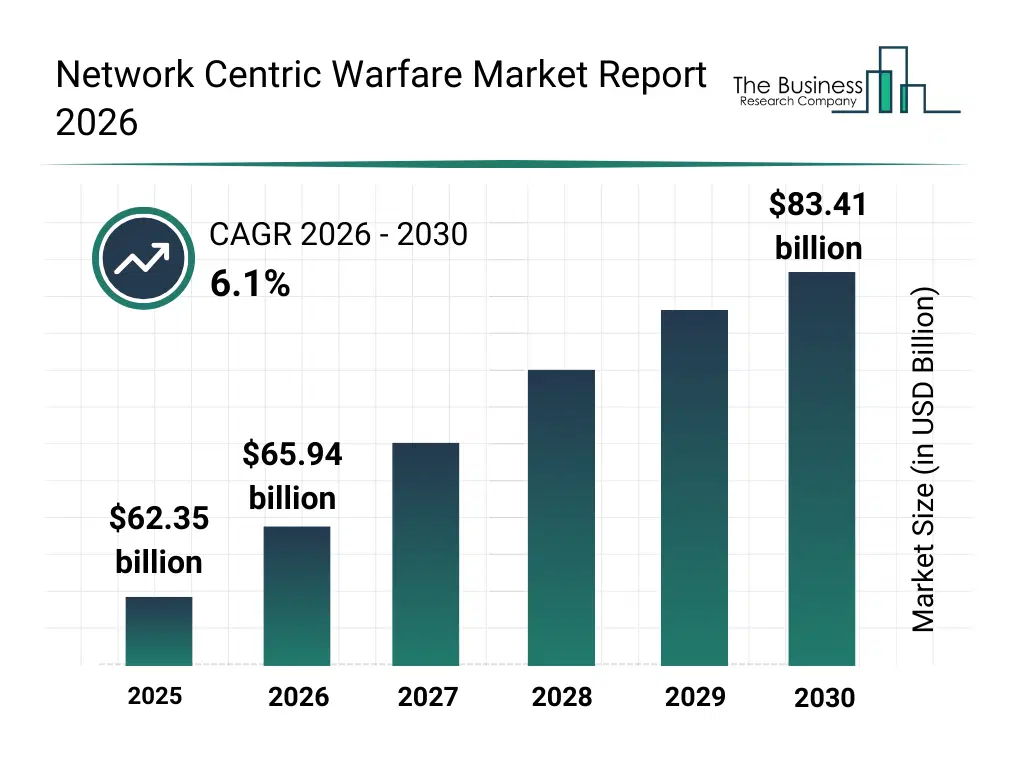
What Is The Network Centric Warfare Market Size and Share 2026?
The network centric warfare market size has grown strongly in recent years. It will grow from $62.35 billion in 2025 to $65.94 billion in 2026 at a compound annual growth rate (CAGR) of 5.7%. The growth in the historic period can be attributed to military digitization programs, communication network modernization, early battlefield management systems, surveillance technology growth, defense budget expansion.What Is The Network Centric Warfare Market Growth Forecast?
The network centric warfare market size is expected to see strong growth in the next few years. It will grow to $83.41 billion in 2030 at a compound annual growth rate (CAGR) of 6.1%. The growth in the forecast period can be attributed to AI driven defense systems, cyber warfare preparedness, unmanned systems integration, joint force interoperability, data centric military strategies. Major trends in the forecast period include integrated battlefield networks, real time situational awareness, secure military communications, AI enabled command systems, multi domain operations integration.
Global Network Centric Warfare Market Segmentation
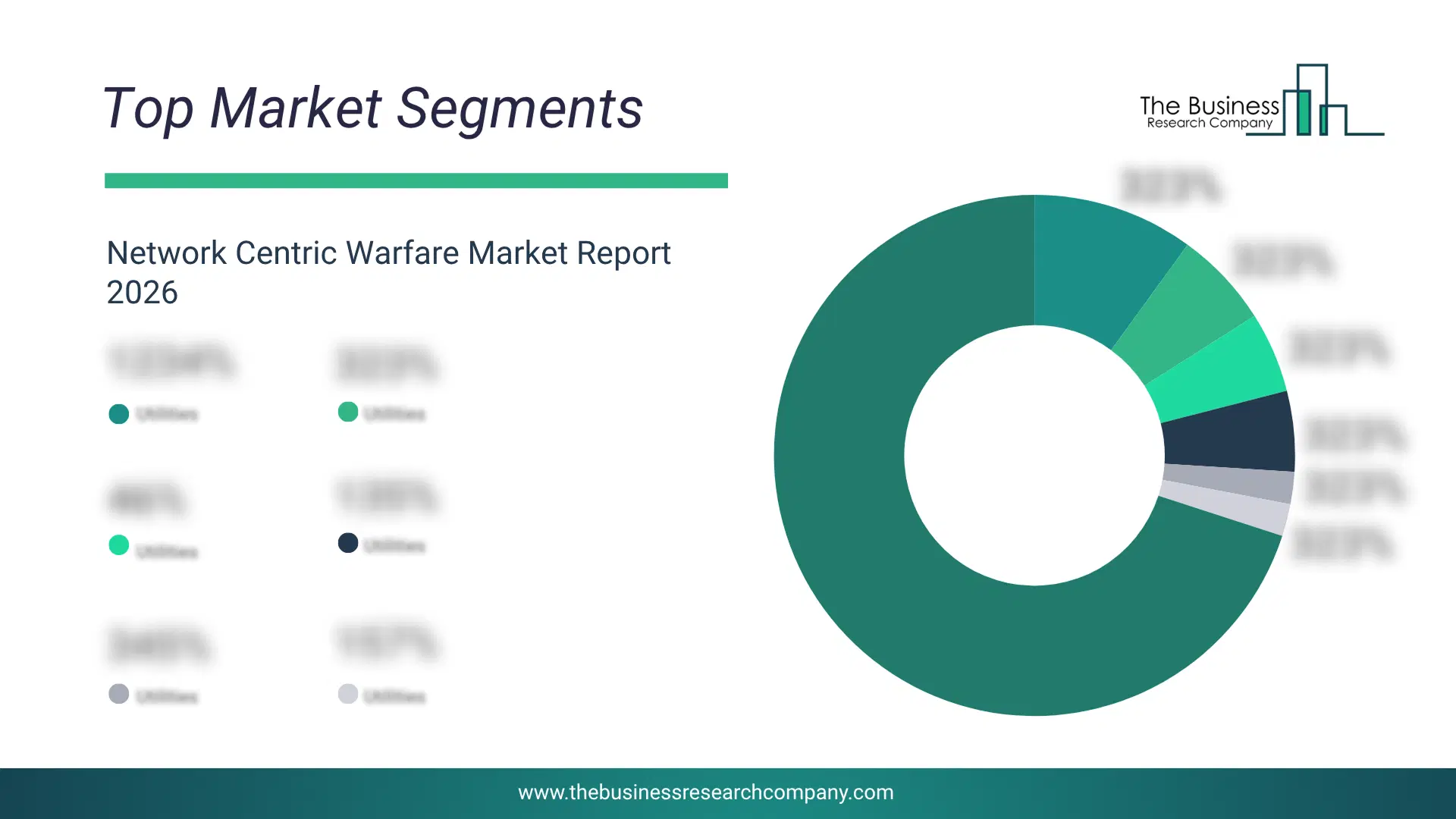
1) By Architecture: Hardware, Software 2) By Mission Type: Tactical, Strategic 3) By Platform: Land-Based, Naval Based, Air Based, Unmanned 4) By Communication Network: Wired, Wireless 5) By Application: Intelligence, Surveillance, and Reconnaissance (ISR) Operations, Communications, Computers, Combat, Cyber, Command And Control, Electronic Warfare Subsegments: 1) By Hardware: Communication Systems, Sensors, Computers And Processing Units, Network Infrastructure, Surveillance Systems 2) By Software: Command And Control Software, Data Analytics Software, Cybersecurity Software, Simulation Software, Network Management SoftwareWhat Is The Driver Of The Network Centric Warfare Market?
The rising military cyber threats are expected to propel the growth of the network-centric warfare market going forward. Military cyber threats encompass deliberate and state-sponsored cyber activities targeting the information systems and digital infrastructure of nations or military entities, aiming for objectives such as espionage, disruption, or sabotage. With the increasing reliance on digital communication and data sharing, there is a growing need for robust cybersecurity solutions to protect military networks and ensure the integrity of information in network-centric warfare environments. For instance, in July 2024, according to Check Point Research, an Israel-based threat intelligence and cybersecurity analysis division of Check Point Software Technologies, in Q2 2024, Check Point Research saw a 30% YoY increase in cyberattacks globally, reaching 1,636 attacks per organization per week. Cyberattacks are increasing worldwide, with a 30% increase in weekly attacks on corporate networks in Q2 2024 compared to Q2 2023 and a 25% rise compared to Q1 2024. With an average of 1,636 attacks per organization per week. Therefore, rising cyber threats will drive the network-centric warfare market.Key Players In The Global Network Centric Warfare Market
Major companies operating in the network centric warfare market are Cisco Systems Inc.; Lockheed Martin Corporation; BAE Systems PLC; Northrop Grumman Corporation; Thales Group; General Dynamics Corporation; Elbit Systems Ltd.; Airbus Group N.V.; Rockwell Collins Inc.; Scalable Network Technologies Inc.; Raytheon Technologies Corporation; L3Harris Technologies Inc.; Leonardo S.p.A.; Svenska Aeroplan Aktiebolaget; Rheinmetall AG; The Boeing Company; Cubic Corporation; Kratos Defense & Security Solutions Inc.; CACI International Inc.; Leidos Holdings Inc.; Science Applications International Corporation (SAIC); ManTech International Corporation; Engility Holdings Inc.; Viasat Inc.; Mercury Systems Inc.; Ultra Electronics Holdings plc; QinetiQ Group plc; Cobham plc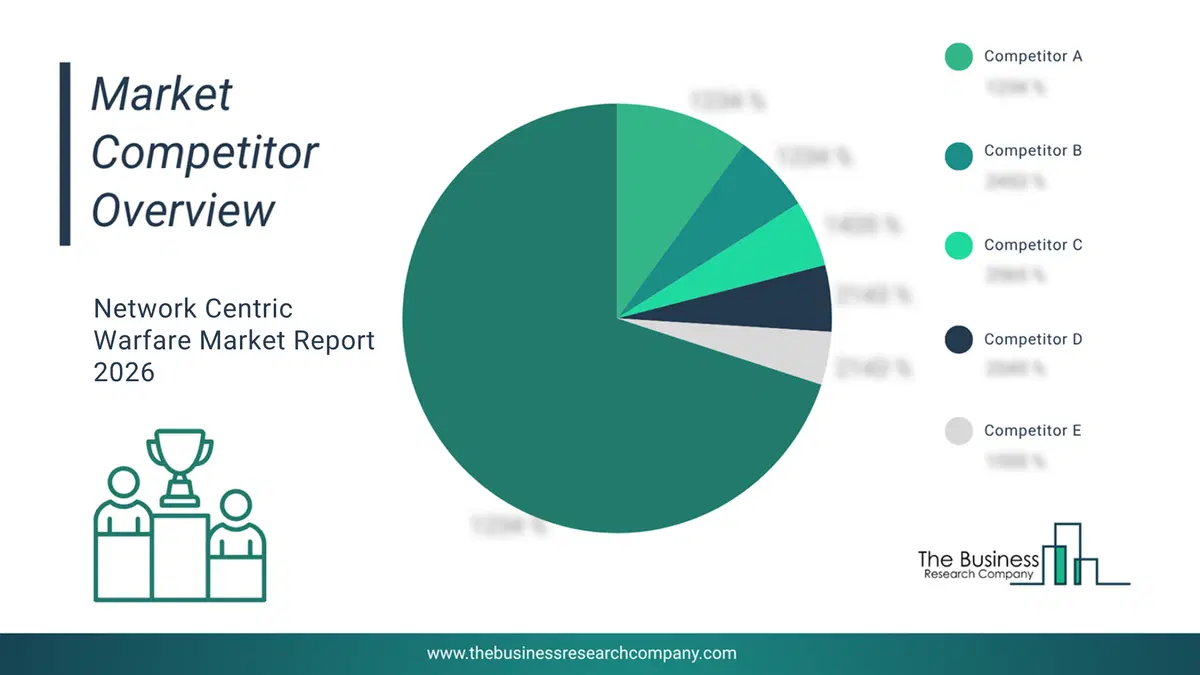
This chart is for illustrative purposes; the full report includes a detailed competitor analysis and comprehensive overview of the top 10 companies in the market.
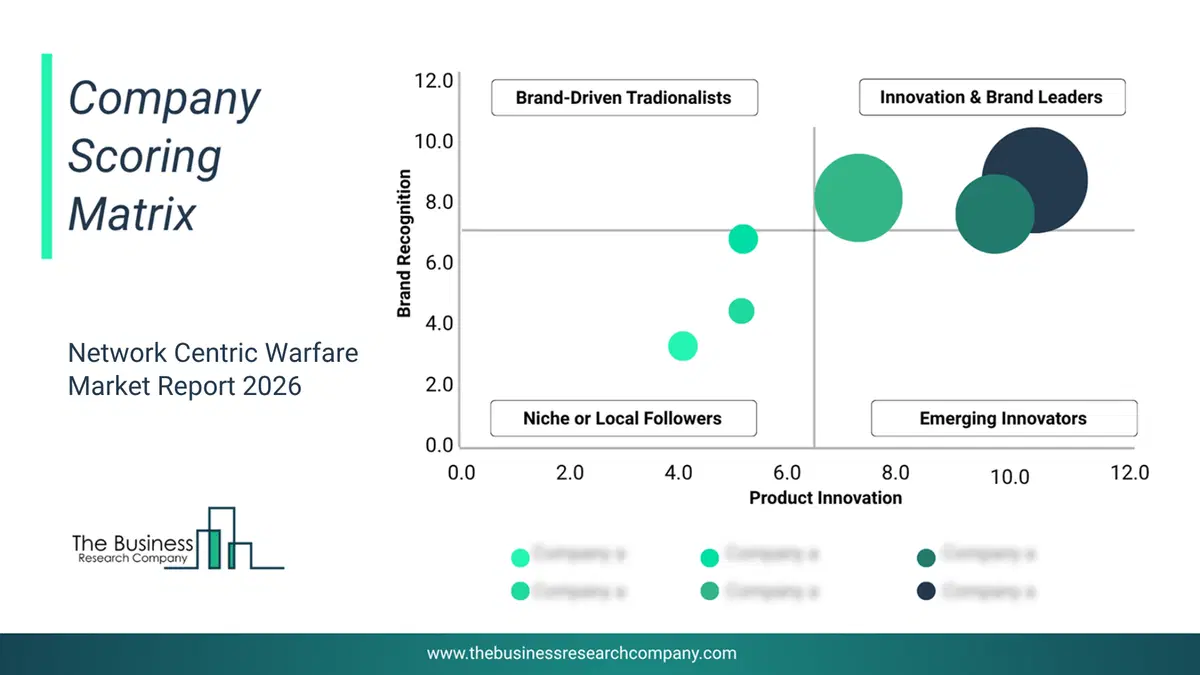
This chart maps companies by product innovation and brand strength, with bubble size indicating relative revenue, helping identify market leaders, challengers, and niche players. This is an illustrative chart; the full report provides a complete and accurate competitive analysis.
Global Network Centric Warfare Market Trends and Insights
Major companies operating in the network-centric warfare market are focused on developing innovative products such as cloud-based electronic warfare planning software to gain a competitive advantage and meet the growing need to curb emerging threats. Cloud-based electronic warfare planning software refers to software applications and tools designed for electronic warfare planning that are hosted and operated in cloud computing environments. For instance, in December 2023, the Defense Information Systems Agency, a US-based government agency, launched cloud-based electronic warfare planning software vital for organizing and executing electronic warfare operations throughout the U.S. military. Known as Electromagnetic Battle Management-Joint (EMBM-J), this tool consolidates diverse data streams into a unified interface, enhancing situational awareness and coordination among commanders in its initial phase, with planned future upgrades incorporating additional applications.What Are Latest Mergers And Acquisitions In The Network Centric Warfare Market?
In April 2025, Lockheed Martin Corporation, a U.S.-based provider of aerospace, defense, security, and advanced mission systems, acquired Amentum Corporation’s Rapid Solutions business for $360 million. With this acquisition, Lockheed Martin aims to integrate Rapid Solutions’ space and airborne ISR, advanced communications, and tactical systems expertise into its portfolio, thereby enhancing its network-centric warfare offerings across multi-domain operations. Amentum’s Rapid Solutions business is a U.S.-based provider of airborne/space intelligence-surveillance-reconnaissance (ISR) technologies, advanced communications, and tactical systems supporting national security missions.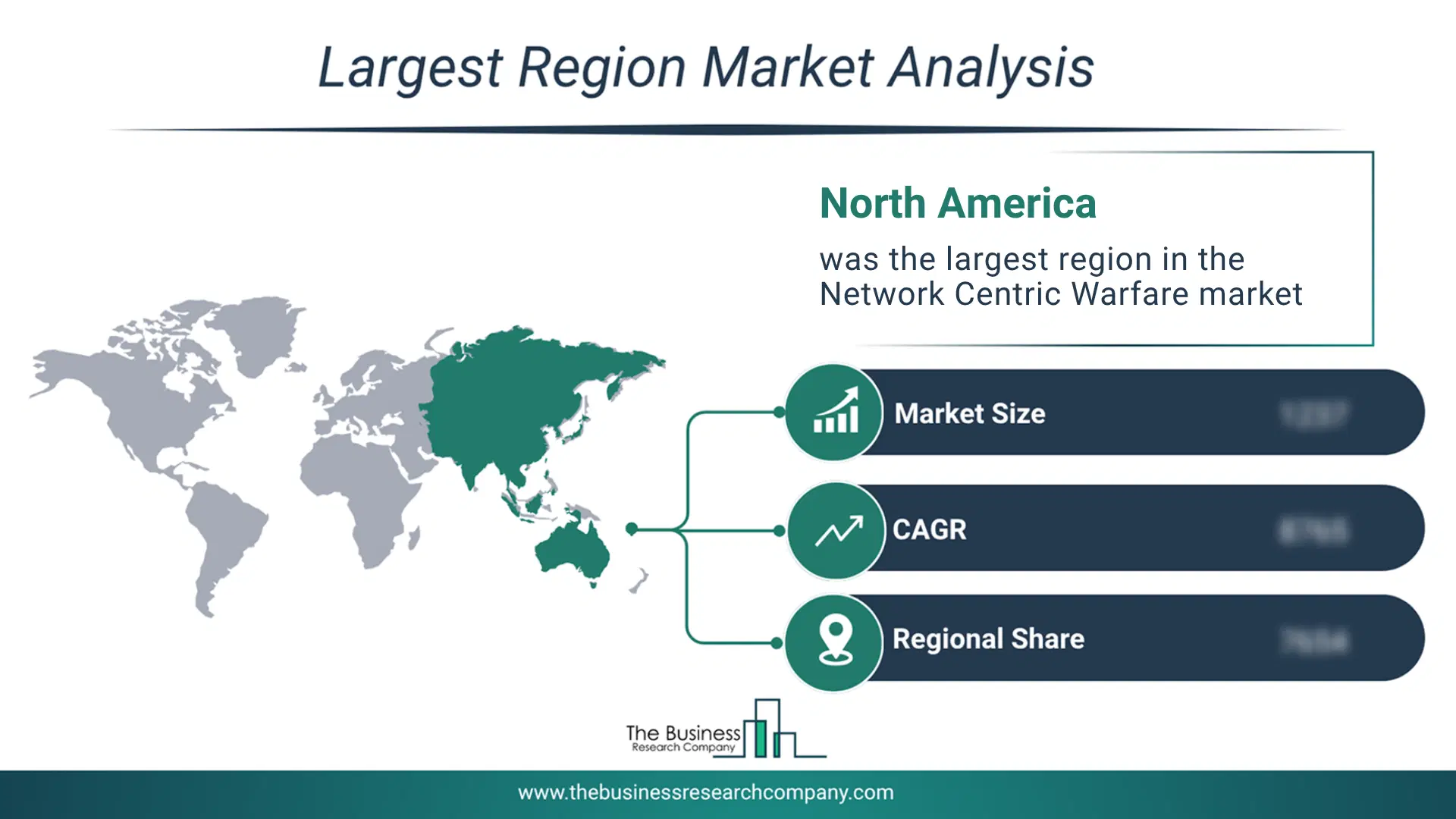
Regional Insights
North America was the largest region in the network-centric warfare market in 2025.Asia-Pacific is expected to be the fastest-growing region in the global network-centric warfare market report during the forecast period. The regions covered in this market report are Asia-Pacific, South East Asia, Western Europe, Eastern Europe, North America, South America, Middle East, Africa. The countries covered in this market report are Australia, Brazil, China, France, Germany, India, Indonesia, Japan, Taiwan, Russia, South Korea, UK, USA, Canada, Italy, SpainWhat Defines the Network Centric Warfare Market?
The network-centric welfare market consists of revenues earned by entities by collaborating to improve resource management and deliver improved information as a member of a complex community of individuals, devices, information, and services connected through a communications network.How is Market Value Defined and Measured?
The market value is defined as the revenues that enterprises gain from the sale of goods and/or services within the specified market and geography through sales, grants, or donations in terms of the currency (in USD unless otherwise specified). The revenues for a specified geography are consumption values that are revenues generated by organizations in the specified geography within the market, irrespective of where they are produced. It does not include revenues from resales along the supply chain, either further along the supply chain or as part of other products.
This chart presents market attractiveness based on a quantitative evaluation of growth, competition, strategic alignment, and risk, offering a clear view of opportunity areas for decision-making. This chart is for illustrative purposes; the full report contains the complete analysis.

This chart highlights the Total Addressable Market (TAM) by estimating the maximum revenue opportunity using an assumption-driven approach, supporting strategic planning and opportunity sizing across markets. The chart is illustrative; the full report provides a more comprehensive analysis.
What Key Data and Analysis Are Included in the Network Centric Warfare Market Report 2026?
The network centric warfare market research report is one of a series of new reports from The Business Research Company that provides market statistics, including industry global market size, regional shares, competitors with the market share, detailed market segments, market trends and opportunities, and any further data you may need to thrive in the network centric warfare industry. The market research report delivers a complete perspective of everything you need, with an in-depth analysis of the current and future state of the industry.Network Centric Warfare Market Report Forecast Analysis
| Report Attribute | Details |
|---|---|
| Market Size Value In 2026 | $65.94 billion |
| Revenue Forecast In 2030 | $83.41 billion |
| Growth Rate | CAGR of 6.1% from 2026 to 2030 |
| Base Year For Estimation | 2025 |
| Actual Estimates/Historical Data | 2020-2025 |
| Forecast Period | 2026 - 2030 |
| Market Representation | Revenue in USD Billion and CAGR from 2026 to 2030 |
| Segments Covered | Architecture, Mission Type, Platform, Communication Network, Application |
| Regional Scope | Asia-Pacific, Western Europe, Eastern Europe, North America, South America, Middle East, Africa |
| Country Scope | The Countries Covered In This Market Report Are Australia, Brazil, China, France, Germany, India, Indonesia, Japan, Taiwan, Russia, South Korea, Uk, Usa, Canada, Italy, Spain. |
| Key Companies Profiled | Cisco Systems Inc., Lockheed Martin Corporation, BAE Systems PLC, Northrop Grumman Corporation, Thales Group, General Dynamics Corporation, Elbit Systems Ltd., Airbus Group N.V., Rockwell Collins Inc., Scalable Network Technologies Inc., Raytheon Technologies Corporation, L3Harris Technologies Inc., Leonardo S.p.A., Svenska Aeroplan Aktiebolaget, Rheinmetall AG, The Boeing Company, Cubic Corporation, Kratos Defense & Security Solutions Inc., CACI International Inc., Leidos Holdings Inc., Science Applications International Corporation (SAIC), ManTech International Corporation, Engility Holdings Inc., Viasat Inc., Mercury Systems Inc., Ultra Electronics Holdings plc, QinetiQ Group plc, Cobham plc |
| Customization Scope | Request for Customization |
| Pricing And Purchase Options | Explore Purchase Options |