
Network Management System Market Report 2026
Global Outlook – By Component (Platform, Solutions, Services), By Organization (Large Enterprises, Small and Medium Enterprises), By Deployment (On-Premise, Cloud), By End-User (Banking, Financial Services, And Insurance, Information Technology And Telecom, Healthcare, Media And Communication, Retail, Other End-Users) – Market Size, Trends, Strategies, and Forecast to 2030
Network Management System Market Overview
• Network Management System market size has reached to $12.92 billion in 2025 • Expected to grow to $20.26 billion in 2030 at a compound annual growth rate (CAGR) of 9.5% • Growth Driver: IoT-Linked Devices Propel Network Management System Market Growth • Market Trend: Transformative Innovations In The Network Management System Market • North America was the largest region in 2025 and Asia-Pacific is the fastest growing region.Market Gains By 2030 – Top Opportunities By Segment
Market Gain identifies the most promising market opportunities by highlighting the segments or products expected to generate the highest incremental revenue growth over the next five years.
What Is Covered Under Network Management System Market?
A network management system (NMS) refers to a set of applications that allow network engineers to manage a network's independent components inside a bigger network management framework and perform several key functions. A network management system oversees all business operations from a single computer. The network management system is used by organizations to manage every aspect of the office, such as device monitoring and management and performance analysis. It provides intelligent notifications and alerts, which save time and money and help increase productivity. The main types of components in a network management system are platform, solution, and services. Platform in the network management systems market refers to a system for connecting frontline organizational processes with backend information systems. The various types of organizations include large enterprises, small and medium enterprises. The different deployment modes include on-premises and in the cloud. It is employed in banking, financial services, and insurance; information technology and telecom, healthcare; media and communication; retail; and other end users.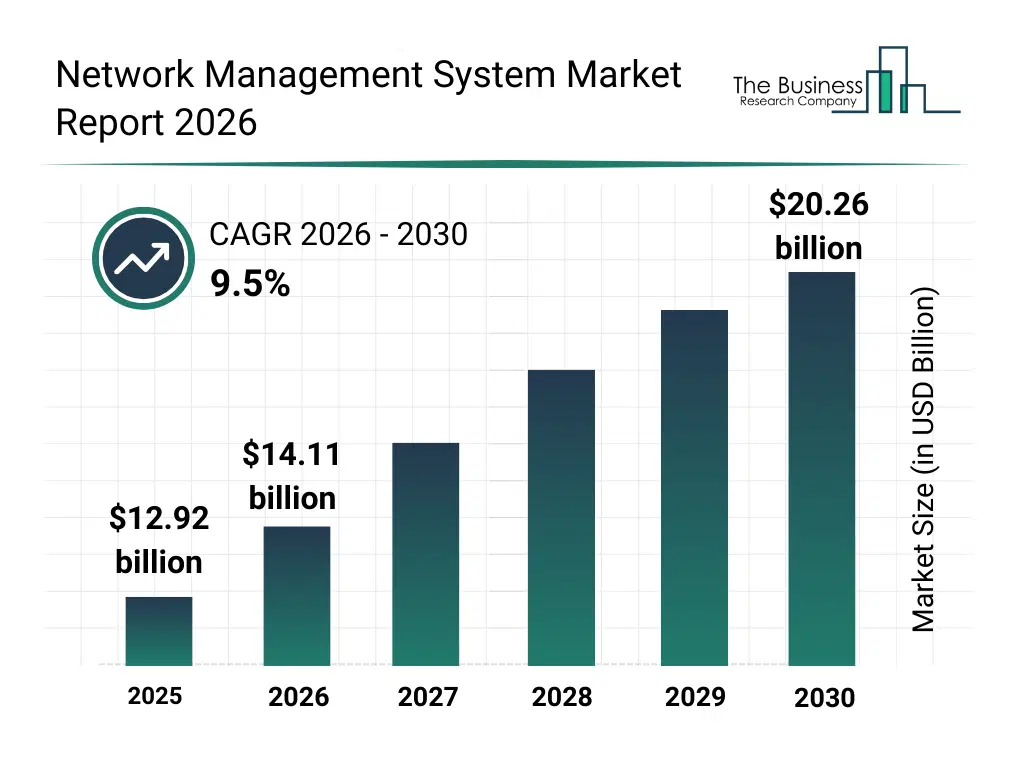
What Is The Network Management System Market Size and Share 2026?
The network management system market size has grown strongly in recent years. It will grow from $12.92 billion in 2025 to $14.11 billion in 2026 at a compound annual growth rate (CAGR) of 9.2%. The growth in the historic period can be attributed to growth of enterprise networks, increasing device connectivity, rising complexity of IT infrastructure, need for centralized network control, early adoption of monitoring software.What Is The Network Management System Market Growth Forecast?
The network management system market size is expected to see strong growth in the next few years. It will grow to $20.26 billion in 2030 at a compound annual growth rate (CAGR) of 9.5%. The growth in the forecast period can be attributed to expansion of cloud managed networks, demand for real time network intelligence, growth of hybrid IT environments, increased focus on network reliability, rising investments in network automation. Major trends in the forecast period include automated network configuration management, centralized network visibility platforms, proactive fault detection systems, policy based network administration, performance optimization analytics.
Global Network Management System Market Segmentation
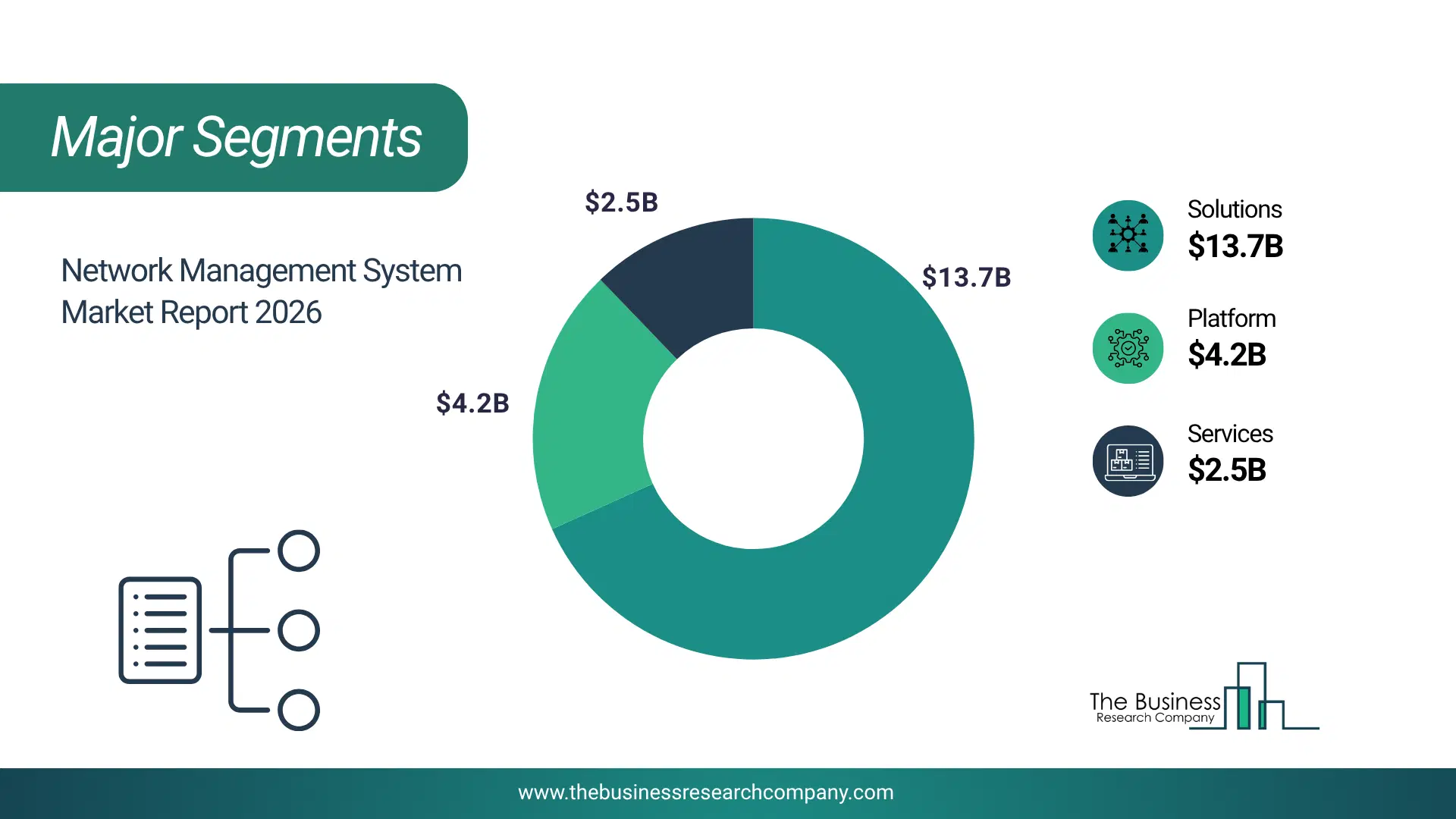
1) By Component: Platform, Solutions, Services 2) By Organization: Large Enterprises, Small and Medium Enterprises 3) By Deployment: On-Premise, Cloud 4) By End-User: Banking, Financial Services, And Insurance, Information Technology And Telecom, Healthcare, Media And Communication, Retail, Other End-Users Subsegments: 1) By Platform: Network Monitoring Platforms, Configuration Management Platforms, Performance Management Platforms, Security Management Platforms 2) By Solutions: Network Automation Solutions, Network Optimization Solutions, Network Analytics Solutions, Fault Management Solutions 3) By Services: Consulting Services, Implementation Services, Support And Maintenance Services, Training Services The top segments in the network management system market will be: • Solutions will reach $13.7 billion by 2030. • Platform will reach $4.16 billion by 2030. • Services will reach $2.41 billion by 2030.What Is The Driver Of The Network Management System Market?
The increasing number of IoT-linked devices is expected to boost the growth of the network management system market going forward. An IoT-linked device refers to a physical object or system that is equipped with sensors, actuators, and connectivity capabilities, allowing it to collect and exchange data with other devices through the Internet of Things (IoT) infrastructure. The network management handle complexity and data volume, ensuring seamless connectivity, monitoring performance, and optimizing data processing for efficient IoT device integration. For instance, in August 2025, according to a report published by Ericsson, a Sweden-based telecommunications company, in 2024, around 70.9% of people in the EU used internet?connected devices, also referred to as IoT or “smart” devices. The highest usage was in the Netherlands (94.8%), Ireland (90.6%) and Denmark (87.0%). Specifically, 0.5% used cars with built-in wireless connections, 7.9% used health-related IoT devices, and 2.3% used internet-connected toys. Therefore, the increasing number of IoT-linked devices is driving the growth of the network management system industry.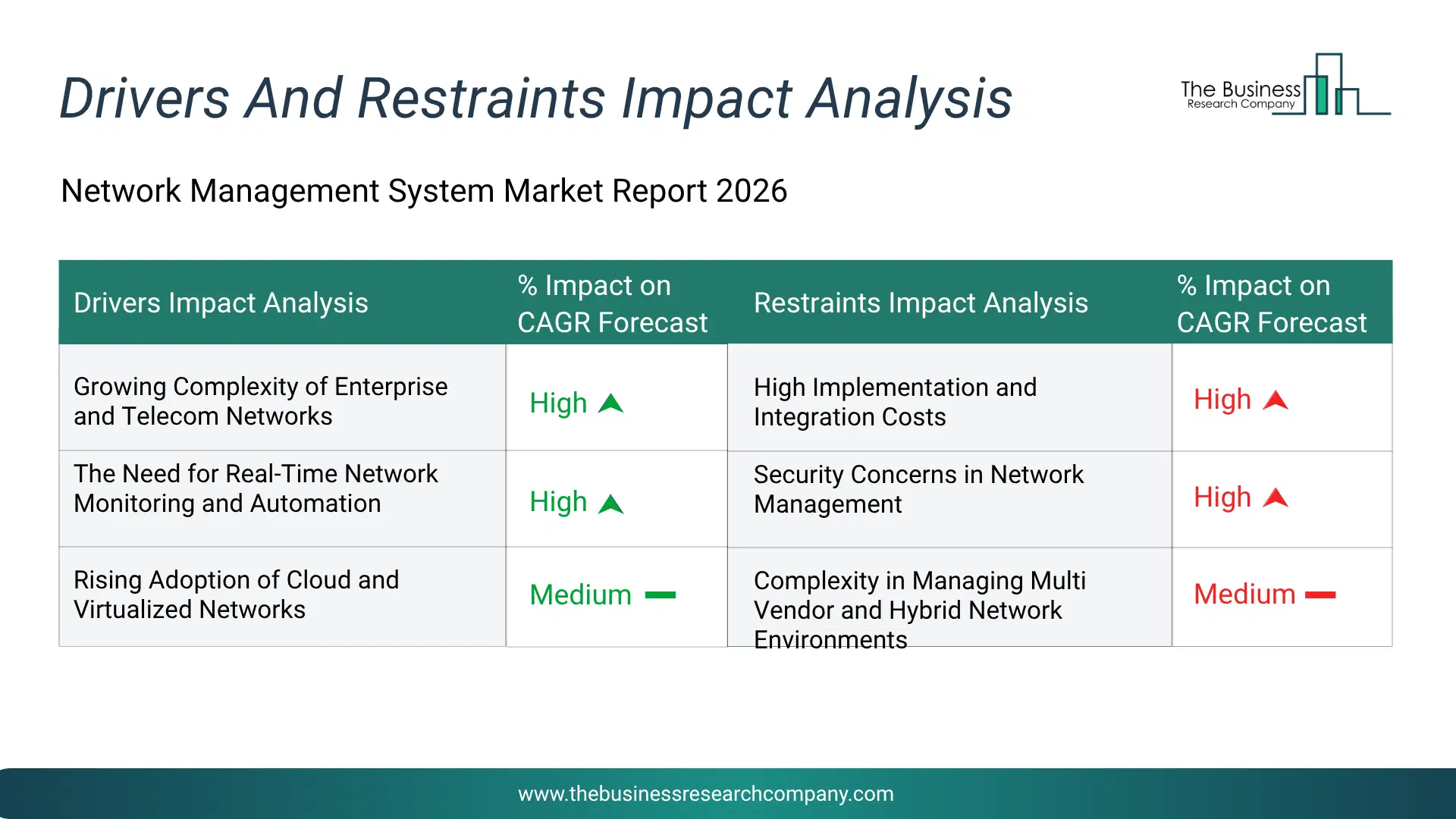
Infographic Chart Showing Key Market Drivers Analysis And Restraints For Network Management System Market
The chart presents an impact analysis of key drivers and restraints, quantifying their relative influence on the market's growth rate and helping assess the balance between growth enablers and limiting factors. This chart offers a high-level perspective; the full report contains more detailed insights.
How Will The Drivers Impact Growth In The Global Network Management System Market?
• Growing Complexity of Enterprise and Telecom Networks (High) – During the forecast period, the growing complexity of enterprise and telecom networks is expected to become a key growth driver for the network management system market by 2030. Modern enterprise and telecom networks are increasingly complex, incorporating hybrid cloud environments, 5g, iot, and sd -wan infrastructures. Network management systems help monitor, configure, and optimize these networks efficiently, ensuring performance, reliability, and minimal downtime. The rising complexity drives organizations to adopt advanced nms solutions to maintain operational efficiency and service quality. • The Need for Real-Time Network Monitoring and Automation (High) – During the forecast period, the need for real-time network monitoring and automation is expected to emerge as a major factor driving the expansion of the network management system market by 2030. Organizations increasingly demand real-time visibility and proactive management of network performance to prevent outages, security breaches, and service degradation. Network management systems equipped with ai-driven analytics, automated fault detection, and predictive maintenance capabilities allow rapid identification and resolution of issues. The growing emphasis on automation and real-time insights significantly drives nms adoption. • Rising Adoption of Cloud and Virtualized Networks (Medium) – During the forecast period, the rising adoption of cloud and virtualized networks is expected to act as a key growth catalyst for the network management system market by 2030. The shift to cloud-based and virtualized networks creates a need for centralized management and orchestration tools. Nms solutions provide end-to-end visibility, configuration management, and policy enforcement across physical, virtual, and hybrid environments. As more enterprises and service providers migrate to cloud-native architectures, demand for robust network management solutions grows steadily.How Will The Restraints Impact Growth In The Global Network Management System Market?
• High Implementation and Integration Costs (High) – During the forecast period, the deploying a comprehensive nms involves significant investments in software licenses, hardware, integration, and training. Smaller enterprises or operators with limited budgets may find it difficult to justify such expenditures. Additionally, integrating nms with legacy systems can be complex and time-consuming, restraining market growth despite the rising demand for network automation. • Security Concerns in Network Management (High) – During the forecast period, the managing and monitoring critical network infrastructure exposes potential vulnerabilities, especially if nms platforms are not properly secured. Unauthorized access or misconfigurations can lead to network downtime or breaches, making organizations cautious about deployment. Security concerns, particularly for cloud-integrated and multi-vendor networks, act as a restraint on faster adoption. • Complexity in Managing Multi Vendor and Hybrid Network Environments (Medium) – During the forecast period, the complexity in managing multi vendor and hybrid network environments acts as a restraint for the network management system market by increasing operational difficulty and integration challenges. Organizations often use hardware and software from different vendors, which may not be fully compatible with a single management platform. This leads to configuration issues, inconsistent performance monitoring, and increased troubleshooting efforts. Additionally, hybrid environments that combine on premises and cloud infrastructure require advanced coordination and specialized expertise. As a result, deployment becomes more complex, slowing adoption and increasing reliance on skilled network professionals.Key Players In The Global Network Management System Market
Major companies operating in the network management system market are Deutsche Telekom AG; Huawei Technologies Co Ltd; Hewlett Packard Enterprise Development LP; International Business Machines Corporation; Cisco Systems Inc.; Ericsson AB; Nokia Corporation; Juniper Networks Inc.; Micro Focus International plc; BMC Software Inc.; Alcatel-Lucent Enterprise S.A.; Viavi Solutions Inc.; Extreme Networks Inc.; Zoho Corporation Pvt Ltd; NETSCOUT Systems Inc.; SolarWinds Inc.; Kaseya VSA LLC; Paessler AG; LiveAction Inc.; eG Innovations Inc.; Colasoft Technology Co Ltd; Cubro Network Visibility; Kentik Inc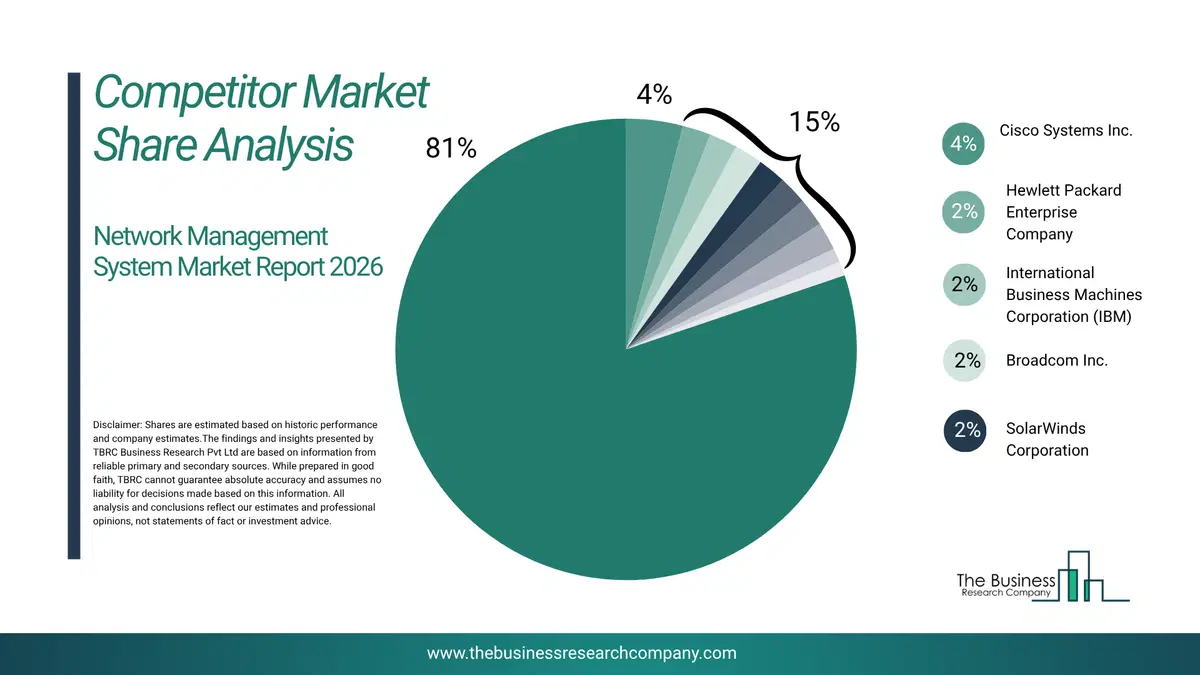
This chart is for illustrative purposes; the full report includes a detailed competitor analysis and comprehensive overview of the top 10 companies in the market.
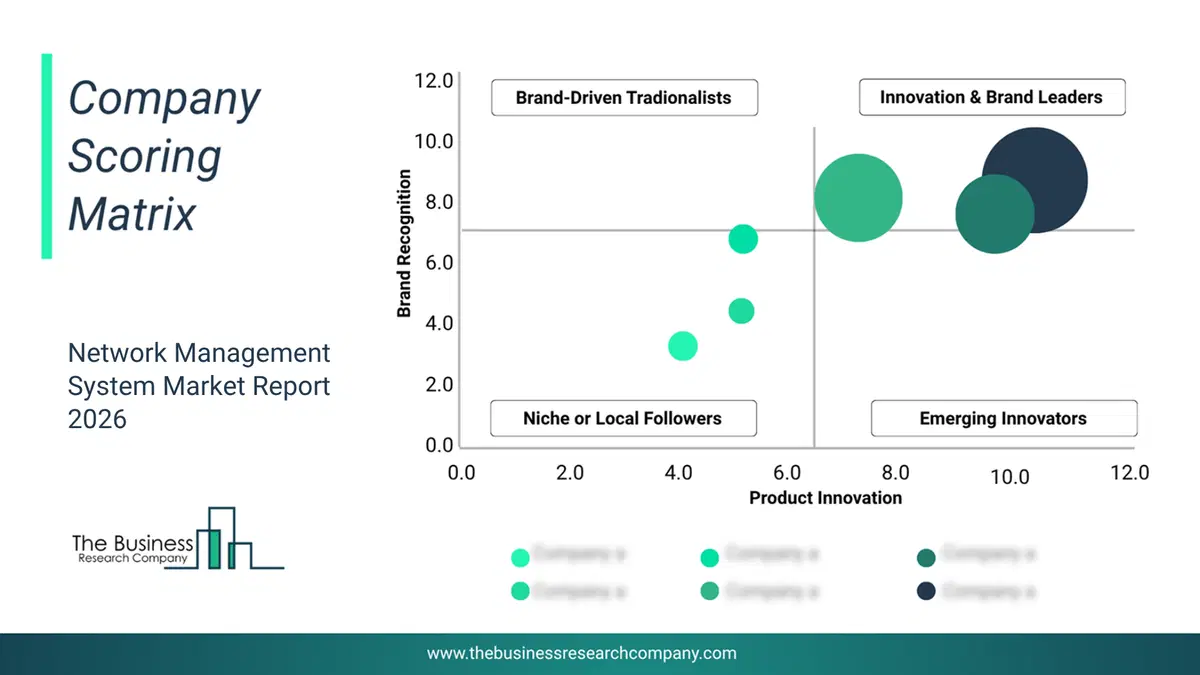
This chart maps companies by product innovation and brand strength, with bubble size indicating relative revenue, helping identify market leaders, challengers, and niche players. This is an illustrative chart; the full report provides a complete and accurate competitive analysis.
Global Network Management System Market Trends and Insights
Major companies operating in the network management system market are developing innovative products, such as digital network management solutions, to meet larger customer bases, increase sales, and increase revenue. A digital network management solution refers to a comprehensive set of software tools, technologies, and processes designed to monitor, optimize, and control the performance and security of computer networks. For instance, in February 2023, Huawei Technologies Co. Ltd., a China-based technology company, launched the Digital Managed Network Solution. The digital managed network solution empowers carriers to seize digital transformation opportunities and drive new growth by offering a range of innovative services. This solution facilitates the transformation of carriers from Internet Service Providers (ISPs) to Managed Service Providers (MSPs). The notable features are private line + managed LAN, which enables the transition from standard private lines to comprehensive cloud-managed network services. Private Line + Managed Security uses a cloud service architecture to provide cost-effective and customizable security solutions. It simplifies cloud and on-premises services, allowing for faster provisioning and a 36% reduction in Total Cost of Ownership (TCO).What Are Latest Mergers And Acquisitions In The Network Management System Market?
In March 2023, Hewlett Packard Enterprise (HPE), a US-based information technology company by acquiring OpsRamp for an undisclosed amount. This strategic acquisition, aims to bolster GreenLake's capabilities in detecting and resolving IT service management issues through intelligent management and hybrid cloud monitoring. By integrating OpsRamp's advanced AI technologies, HPE seeks to improve operational efficiency and provide a more robust service offering to its customers. OpsRamp is a US-based AI and machine learning IT operations platform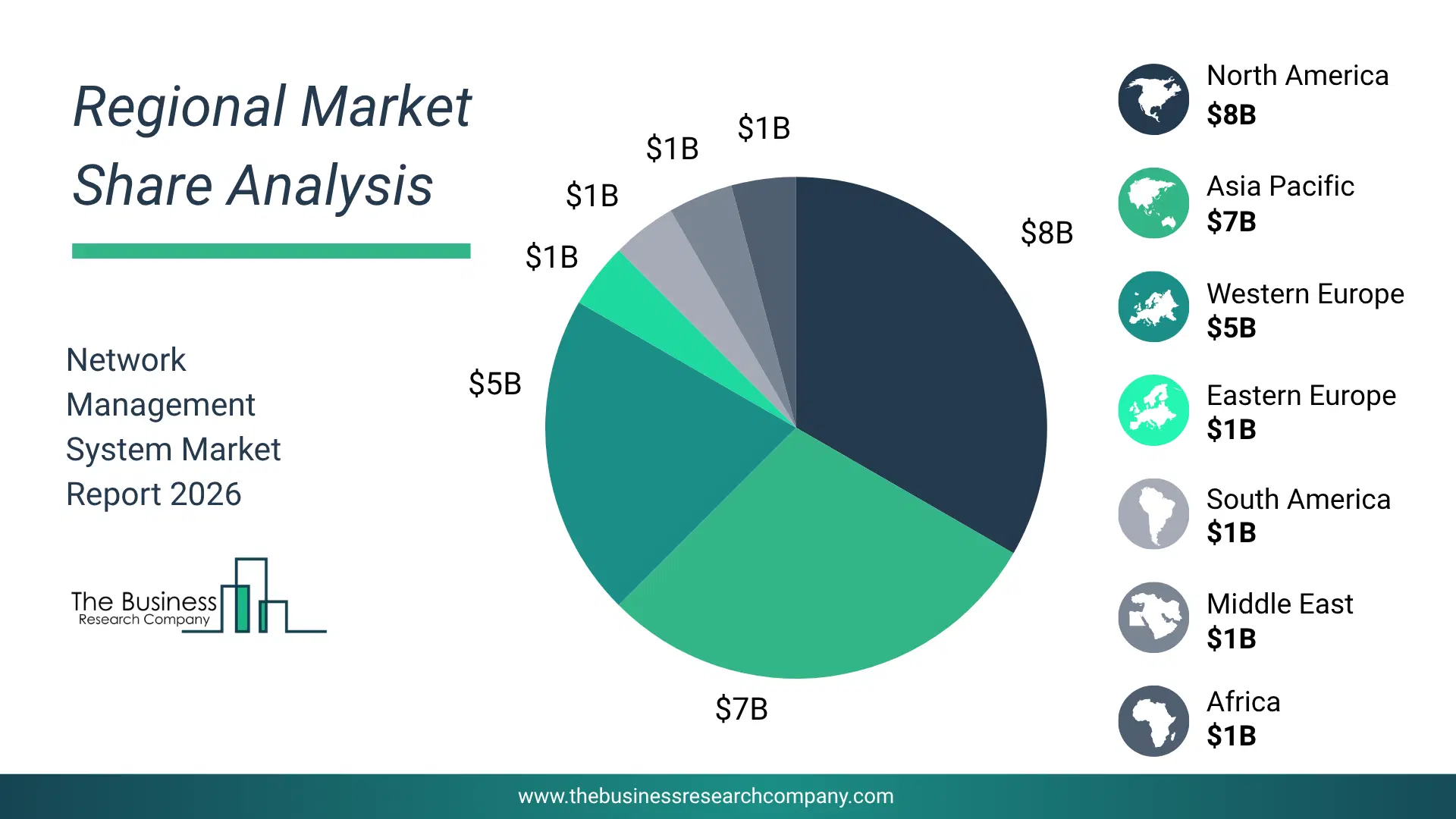
Regional Insights
North America was the largest region in the network management system market in 2025. Asia-Pacific is expected to be the fastest-growing region in the forecast period. The regions covered in this market report are Asia-Pacific, South East Asia, Western Europe, Eastern Europe, North America, South America, Middle East, Africa. The countries covered in this market report are Australia, Brazil, China, France, Germany, India, Indonesia, Japan, Taiwan, Russia, South Korea, UK, USA, Canada, Italy, SpainWhat Defines the Network Management System Market?
The network management system (NMS) market includes revenues earned by entities by providing network performance and monitoring, cloud monitoring, virtual monitoring, SDN monitoring, network configuration, log and event management, IP address management, VOIP monitoring, consulting services, integration and deployment services, training, support, and maintenance services. The market value includes the value of related goods sold by the service provider or included within the service offering. Only goods and services traded between entities or sold to end consumers are included.How is Market Value Defined and Measured?
The market value is defined as the revenues that enterprises gain from the sale of goods and/or services within the specified market and geography through sales, grants, or donations in terms of the currency (in USD unless otherwise specified). The revenues for a specified geography are consumption values that are revenues generated by organizations in the specified geography within the market, irrespective of where they are produced. It does not include revenues from resales along the supply chain, either further along the supply chain or as part of other products.
This chart presents market attractiveness based on a quantitative evaluation of growth, competition, strategic alignment, and risk, offering a clear view of opportunity areas for decision-making. This chart is for illustrative purposes; the full report contains the complete analysis.

This chart highlights the Total Addressable Market (TAM) by estimating the maximum revenue opportunity using an assumption-driven approach, supporting strategic planning and opportunity sizing across markets. The chart is illustrative; the full report provides a more comprehensive analysis.
What Key Data and Analysis Are Included in the Network Management System Market Report 2026?
The network management system market research report is one of a series of new reports from The Business Research Company that provides market statistics, including industry global market size, regional shares, competitors with the market share, detailed market segments, market trends and opportunities, and any further data you may need to thrive in the network management system industry. The market research report delivers a complete perspective of everything you need, with an in-depth analysis of the current and future state of the industry.Network Management System Market Report Forecast Analysis
| Report Attribute | Details |
|---|---|
| Market Size Value In 2026 | $14.11 billion |
| Revenue Forecast In 2030 | $20.26 billion |
| Growth Rate | CAGR of 9.5% from 2026 to 2030 |
| Base Year For Estimation | 2025 |
| Actual Estimates/Historical Data | 2020-2025 |
| Forecast Period | 2026 - 2030 |
| Market Representation | Revenue in USD Billion and CAGR from 2026 to 2030 |
| Segments Covered | Component, Organization, Deployment, End-User |
| Regional Scope | Asia-Pacific, Western Europe, Eastern Europe, North America, South America, Middle East, Africa |
| Country Scope | The countries covered in the report are Australia, Brazil, China, France, Germany, India, ... |
| Key Companies Profiled | Deutsche Telekom AG; Huawei Technologies Co Ltd; Hewlett Packard Enterprise Development LP; International Business Machines Corporation; Cisco Systems Inc.; Ericsson AB; Nokia Corporation; Juniper Networks Inc.; Micro Focus International plc; BMC Software Inc.; Alcatel-Lucent Enterprise S.A.; Viavi Solutions Inc.; Extreme Networks Inc.; Zoho Corporation Pvt Ltd; NETSCOUT Systems Inc.; SolarWinds Inc.; Kaseya VSA LLC; Paessler AG; LiveAction Inc.; eG Innovations Inc.; Colasoft Technology Co Ltd; Cubro Network Visibility; Kentik Inc |
| Customization Scope | Request for Customization |
| Pricing And Purchase Options | Explore Purchase Options |