
Network Operators Market Report 2026
Global Outlook – By Type Of Operator (Mobile Network Operators, Fixed Network Operators, Virtual Network Operators, Hybrid Network Operators), By Service Type (Voice Services, Data Services, Internet Broadband Services, Managed Network Services, Cloud And Edge Connectivity Services), By Network Technology (Second Generation Or Third Generation Network Operators, Fourth Generation Long-Term Evolution Operators, Fifth Generation Operators, Fiber-optic Network Operators, Satellite Network Operators), By Application (Banking, Financial Services, and Insurance, Healthcare And Life Sciences, Retail And E-commerce, Government And Public Sector, Media And Entertainment), By End User (Residential Users, Enterprise Or Corporate Users, Government And Public Sector, Industrial Users, Telecom Wholesale Clients) – Market Size, Trends, Strategies, and Forecast to 2030
Network Operators Market Overview
• Network Operators market size has reached to $1812.96 billion in 2025 • Expected to grow to $1898.86 billion in 2030 at a compound annual growth rate (CAGR) of 5% • Growth Driver: The Increasing Demand For High-Speed Internet Connectivity Driving The Growth Of The Market Due To Widespread Smart Device Adoption • Market Trend: Application-Optimized Optical Solutions For AI-Driven Network Infrastructure • North America was the largest region in 2025 and Asia-Pacific is the fastest growing region.What Is Covered Under Network Operators Market?
Network operators are organizations or companies that build, operate, and maintain communication networks to deliver connectivity services such as voice, data, and internet access. They manage the underlying infrastructure and technical operations required to ensure reliable and continuous network performance. Their primary role is to enable seamless communication and data exchange across different users and geographic locations. The main type of operator for network operators are mobile network operators, fixed network operators, virtual network operators, and hybrid network operators. Mobile network operators refer to telecom providers that deliver wireless communication services such as voice, messaging, and mobile data through licensed spectrum and cellular infrastructure. These operators offer a range of service types, including voice services, data services, internet broadband services, managed network services, and cloud and edge connectivity services, they operate across different network technologies, such as second generation or third generation network operators, fourth generation long-term evolution operators, fifth generation operators, fiber-optic network operators, and satellite network operators. These are applied across multiple applications, including banking, financial services and insurance, healthcare and life sciences, retail and e-commerce, government and public sector, and media and entertainment, and serve different end users, such as residential users, enterprise or corporate users, government and public sector, industrial users, and telecom wholesale clients.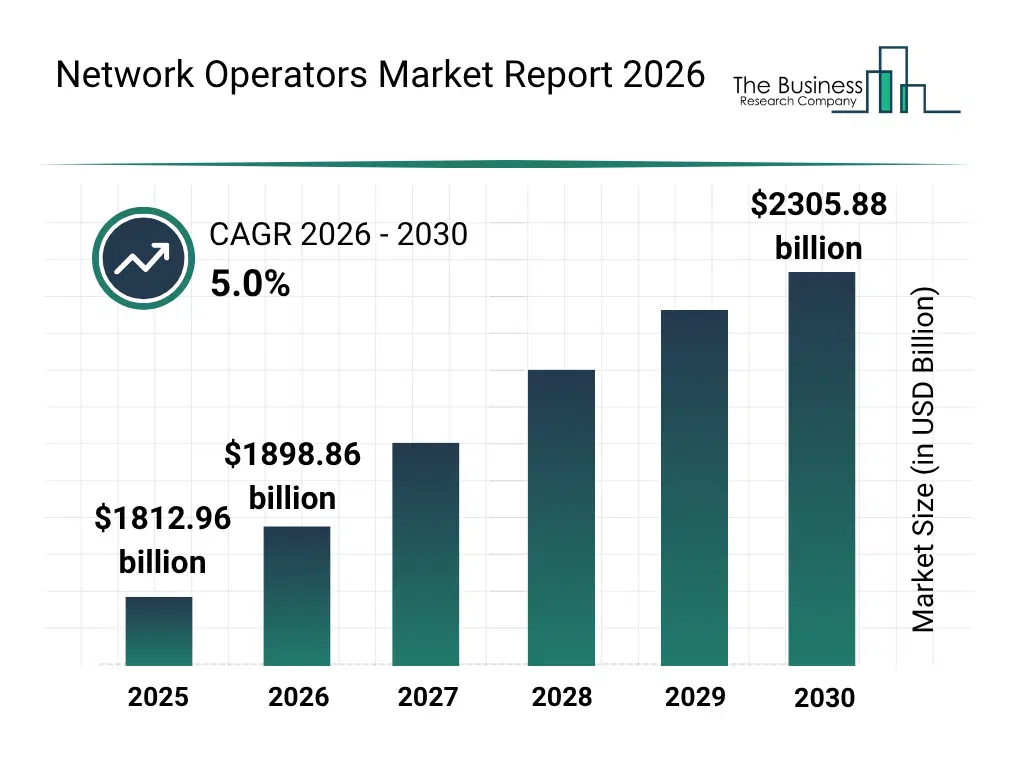
What Is The Network Operators Market Size and Share 2026?
The network operators market size has grown steadily in recent years. It will grow from $1812.96 billion in 2025 to $1898.86 billion in 2026 at a compound annual growth rate (CAGR) of 4.7%. The growth in the historic period can be attributed to 2G and 3G network expansion, voice and sms dominated revenue models, telecom market privatization and deregulation, rapid smartphone penetration growth, fiber backbone infrastructure rollout.What Is The Network Operators Market Growth Forecast?
The network operators market size is expected to see steady growth in the next few years. It will grow to $2305.88 billion by 2030 at a compound annual growth rate (CAGR) of 5.0%. The growth in the forecast period can be attributed to 5G network densification and rollout expansion, ai-driven network optimization and automation, edge computing integration in telecom networks, open ran adoption for cost-efficient deployment, satellite and non-terrestrial network integration for global coverage. Major trends in the forecast period include telecom infrastructure sharing and tower colocation expansion, spectrum auction liberalization and policy reforms, rural and remote connectivity expansion initiatives, network operator consolidation and merger activities, wholesale roaming and interconnection pricing optimization pressures.
Global Network Operators Market Segmentation
1) By Type Of Operator: Mobile Network Operators, Fixed Network Operators, Virtual Network Operators, Hybrid Network Operators 2) By Service Type: Voice Services, Data Services, Internet Broadband Services, Managed Network Services, Cloud And Edge Connectivity Services 3) By Network Technology: Second Generation Or Third Generation Network Operators, Fourth Generation Long-Term Evolution Operators, Fifth Generation Operators, Fiber-optic Network Operators, Satellite Network Operators 4) By Application: Banking, Financial Services, and Insurance, Healthcare And Life Sciences, Retail And E-commerce, Government And Public Sector, Media And Entertainment 5) By End User: Residential Users, Enterprise Or Corporate Users, Government And Public Sector, Industrial Users, Telecom Wholesale Clients Subsegments: 1) By Mobile Network Operators (MNOs): Voice And Messaging Services, Mobile Broadband, Internet Of Things And Machine-To-Machine (M2M) Connectivity, Enterprise Mobility And Managed Services 2) By Fixed Network Operators (FNOs): Fiber-To-The-Home (FTTH) Broadband Services, Digital Subscriber Line And Copper-Based Internet Services, Cable Broadband Services, Dedicated Enterprise Leased Line Services 3) By Virtual Network Operators (MVNOs): Discount Prepaid Virtual Network Operators (MVNOs) Services, Full-Service Virtual Network Operators (MVNOs) Offerings, Data-Only Virtual Network Operators (MVNOs) Services, Internet Of Things Or Machine-To-Machine (M2M) Virtual Network Operators (MVNOs) Connectivity Solutions 4) By Hybrid Network Operators: Fixed-Mobile Converged Services, Multi-Network (Multi-Host) Connectivity Services, Fifth Generation-Enabled Hybrid Broadband Solutions, Enterprise Integrated Connectivity ServicesWhat Is The Driver Of The Network Operators Market?
The increasing demand for high-speed internet connectivity is expected to propel the growth of the network operators' market going forward. High-speed internet connectivity refers to the ability to transmit data over a network at fast speeds, enabling seamless access to online services such as streaming, communication, browsing, and cloud-based applications with minimal latency and interruptions. The increasing demand for high-speed internet connectivity is primarily driven by the widespread adoption of smart devices, which require fast and reliable internet access to support data-intensive applications such as streaming, online gaming, and cloud-based services. Network operators enable high-speed internet connectivity by building, managing, and continuously upgrading network infrastructure to ensure faster data transmission, wider coverage, and reliable service for users. For instance, in November 2024, according to the UK Parliament's House of Commons Library, a UK-based government administration, as of January 2024, gigabit-capable broadband covered 78% of UK premises, up from 72% in January 2023 and 64% in January 2022. Therefore, increasing demand for high-speed internet connectivity is driving the growth of the network operators' market.Key Players In The Global Network Operators Market
Major companies operating in the network operators market are China Mobile Limited, Verizon Communications Inc., AT And T Inc., Deutsche Telekom AG, T-Mobile US Inc., China Telecom Corporation Limited, China Unicom Limited, Orange S.A., SoftBank Group Corp., Telefónica S.A., KDDI Corporation, BT Group plc, KT Corporation, Bharti Airtel Limited, Telstra Group Limited, SK Telecom Co. Ltd., Reliance Jio Infocomm Limited, Singapore Telecommunications Limited, Telenor ASA, Vodafone Group Plc
This chart is for illustrative purposes; the full report includes a detailed competitor analysis and comprehensive overview of the top 10 companies in the market.
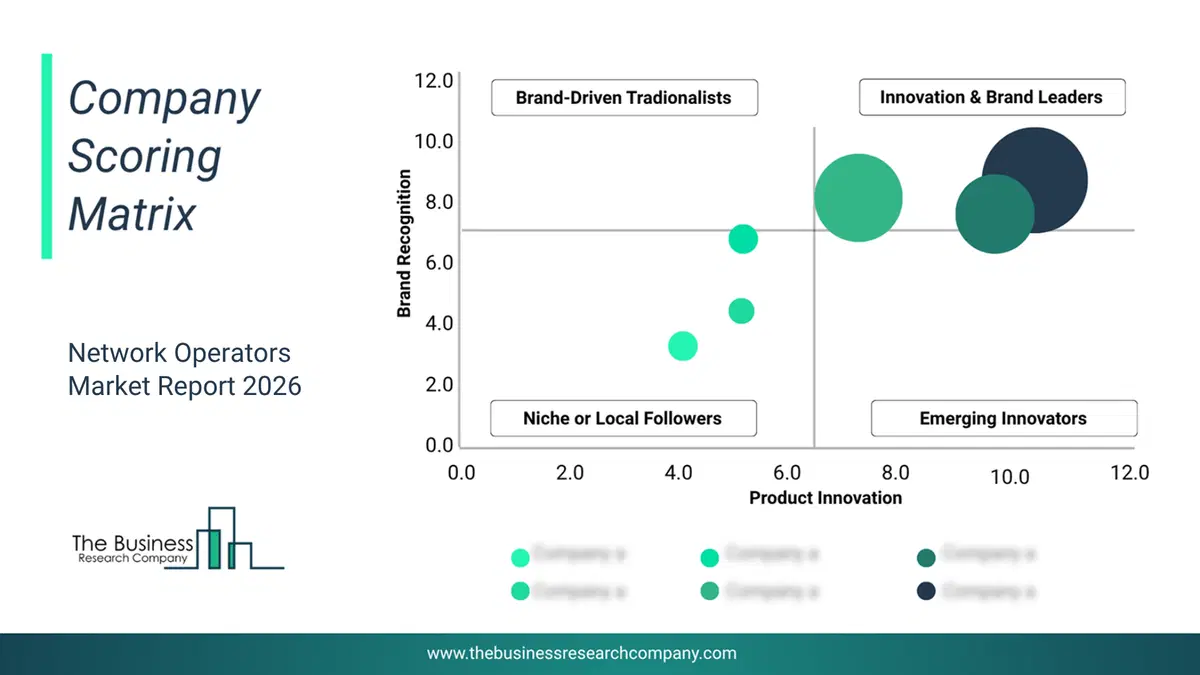
This chart maps companies by product innovation and brand strength, with bubble size indicating relative revenue, helping identify market leaders, challengers, and niche players. This is an illustrative chart; the full report provides a complete and accurate competitive analysis.
Global Network Operators Market Trends and Insights
Major companies operating in the network operators market are focusing on developing innovative solutions, such as network infrastructure solutions, to enhance high-capacity data transmission, improve network efficiency, and support AI-driven and cloud-based connectivity demands. Network infrastructure solutions refer to the integrated hardware, software, and services that enable the design, deployment, management, and optimization of communication networks for reliable data transmission and connectivity. For instance, in March 2026, Nokia Corporation, a Finland-based telecommunications and networking technology company, launched its suite of application-optimized optical solutions designed for AI-driven network environments. This solution integrates intelligent automation, programmable optical transport, and high-capacity coherent optics to dynamically adjust network performance based on application needs. It enhances scalability by efficiently managing massive data traffic generated by AI models, cloud computing, and hyperscale data centres while improving energy efficiency and reducing operational complexity compared to conventional fixed optical systems. The platform also supports end-to-end network visibility, faster service provisioning, and improved reliability for mission-critical applications across telecom and enterprise networks.What Are Latest Mergers And Acquisitions In The Network Operators Market?
In January 2025, Swisscom Ltd., a Switzerland-based telecommunications company, acquired Vodafone Italia for an undisclosed amount. With this acquisition, Swisscom aims to strengthen its position in the European telecommunications market by creating a larger converged operator that combines fixed and mobile capabilities under the Fastweb + Vodafone brand, enhancing scale, network infrastructure, and competitive offerings in Italy. Vodafone Italia S.p.A. is an Italy-based telecommunications operator that specializes in providing mobile communication, fixed broadband, and integrated digital connectivity services to residential, enterprise, and public sector customers.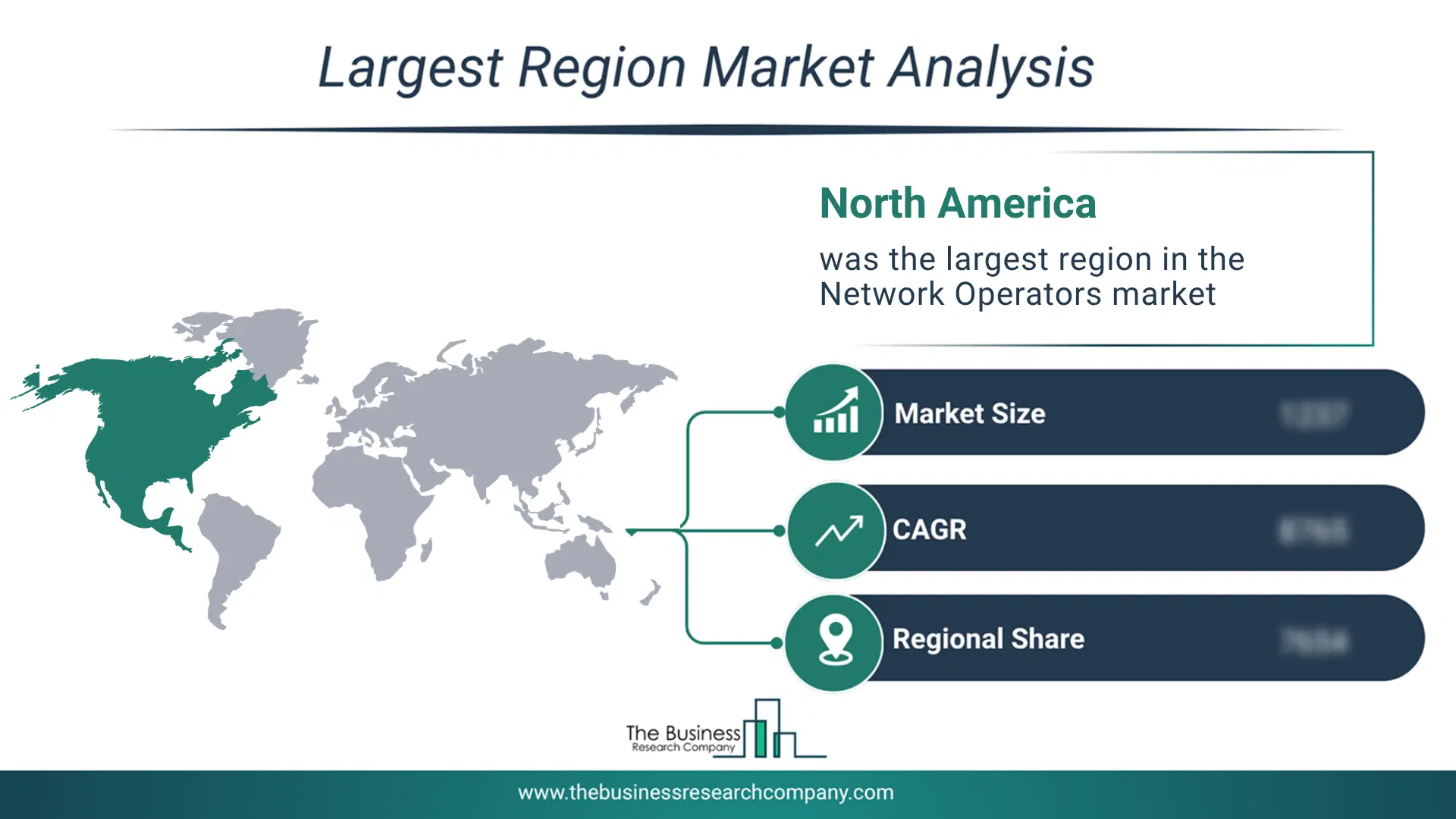
Regional Insights
North America was the largest region in the network operators market in 2025. Asia-Pacific is expected to be the fastest-growing region in the forecast period. The regions covered in this market report are Asia-Pacific, South East Asia, Western Europe, Eastern Europe, North America, South America, Middle East, Africa. The countries covered in this market report are Australia, Brazil, China, France, Germany, India, Indonesia, Japan, Taiwan, Russia, South Korea, UK, USA, Canada, Italy, Spain.What Defines the Network Operators Market?
The network operators market consists of revenues earned by entities by providing services such as mobile virtual network operations (MVNO), network infrastructure leasing, international roaming and interconnection services, private network deployment and management, and value-added services including content delivery and security solutions. The market value includes the value of related goods sold by the service provider or included within the service offering. The network operators market also consists of sales of network infrastructure equipment, customer premises equipment, network management software, and telecommunication towers and antennas. Values in this market are ‘factory gate’ values, that is, the value of goods sold by the manufacturers or creators of the goods, whether to other entities (including downstream manufacturers, wholesalers, distributors, and retailers) or directly to end customers. The value of goods in this market includes related services sold by the creators of the goods.How is Market Value Defined and Measured?
The market value is defined as the revenues that enterprises gain from the sale of goods and/or services within the specified market and geography through sales, grants, or donations in terms of the currency (in USD unless otherwise specified). The revenues for a specified geography are consumption values that are revenues generated by organizations in the specified geography within the market, irrespective of where they are produced. It does not include revenues from resales along the supply chain, either further along the supply chain or as part of other products.
This chart presents market attractiveness based on a quantitative evaluation of growth, competition, strategic alignment, and risk, offering a clear view of opportunity areas for decision-making. This chart is for illustrative purposes; the full report contains the complete analysis.

This chart highlights the Total Addressable Market (TAM) by estimating the maximum revenue opportunity using an assumption-driven approach, supporting strategic planning and opportunity sizing across markets. The chart is illustrative; the full report provides a more comprehensive analysis.
What Key Data and Analysis Are Included in the Network Operators Market Report 2026?
The network operators market research report is one of a series of new reports from The Business Research Company that provides market statistics, including industry global market size, regional shares, competitors with the market share, detailed market segments, market trends and opportunities, and any further data you may need to thrive in the network operators industry. The market research report delivers a complete perspective of everything you need, with an in-depth analysis of the current and future state of the industry.Network Operators Market Report Forecast Analysis
| Report Attribute | Details |
|---|---|
| Market Size Value In 2026 | $1898.86 billion |
| Revenue Forecast In 2030 | $2305.88 billion |
| Growth Rate | CAGR of 5% from 2026 to 2030 |
| Base Year For Estimation | 2025 |
| Actual Estimates/Historical Data | 2020-2025 |
| Forecast Period | 2026 - 2030 |
| Market Representation | Revenue in USD Billion and CAGR from 2026 to 2030 |
| Segments Covered | Type Of Operator, Service Type, Network Technology, Application, End User |
| Regional Scope | Asia-Pacific, Western Europe, Eastern Europe, North America, South America, Middle East, Africa |
| Country Scope | The Countries Covered In This Market Report Are Australia, Brazil, China, France, Germany, India, Indonesia, Japan, Taiwan, Russia, South Korea, Uk, Usa, Canada, Italy, Spain. |
| Key Companies Profiled | China Mobile Limited, Verizon Communications Inc., AT And T Inc., Deutsche Telekom AG, T-Mobile US Inc., China Telecom Corporation Limited, China Unicom Limited, Orange S.A., SoftBank Group Corp., Telefónica S.A., KDDI Corporation, BT Group plc, KT Corporation, Bharti Airtel Limited, Telstra Group Limited, SK Telecom Co. Ltd., Reliance Jio Infocomm Limited, Singapore Telecommunications Limited, Telenor ASA, Vodafone Group Plc |
| Customization Scope | Request for Customization |
| Pricing And Purchase Options | Explore Purchase Options |