

Network Sensors Market Report 2026
Global Outlook – By Sensor Type (Physical Sensors, Environmental Sensors, Optical Sensors, Thermal Sensors, Chemical Sensors, Motion And Position Sensors), By Connectivity Technology (Wired Networks, Wireless Local Area Network (WLAN), Low Power Wide Area Network (LPWAN), Cellular Networks, Satellite Communication), By Deployment Mode (On-Premises, Cloud-Based, Hybrid), By Application (Industrial Monitoring, Network Performance Monitoring, Security And Surveillance, Asset Tracking And Management, Predictive Maintenance, Environmental Monitoring), By End User (Manufacturing, Healthcare, Transportation And Logistics, Energy And Utilities, Telecommunications, Government And Smart Cities, Retail, Agriculture) – Market Size, Trends, Strategies, and Forecast to 2030
Network Sensors Market Overview
• Network Sensors market size has reached to $100.32 billion in 2025 • Expected to grow to $112.17 billion in 2030 at a compound annual growth rate (CAGR) of 12.1% • Growth Driver: Rapid Growth Of IoT And Connected Devices Driving The Market Growth Due To Increasing Deployment Of Network Sensors • Market Trend: Innovations In Edge Artificial Intelligence (AI) Enable Advanced Machine Health Monitoring In Industrial Network Sensors • North America was the largest region in 2025 and Asia-Pacific is the fastest growing region.What Is Covered Under Network Sensors Market?
Network sensors refer to interconnected sensing devices that collect, transmit, and analyze data from physical or digital environments to support monitoring, automation, and decision-making across enterprise and IoT ecosystems. These sensors enable real-time data acquisition, communication, and integration with cloud and data center platforms, facilitating enhanced visibility, predictive insights, and efficient management of connected assets and infrastructure. The main sensor types of the network sensors are physical sensors, environmental sensors, optical sensors, thermal sensors, chemical sensors, and motion and position sensors. Physical sensors refer to devices that detect and measure physical parameters such as pressure, force, or displacement within a networked environment. These sensors operate through various connectivity technologies, including wired networks, wireless local area network (WLAN), low power wide area network (LPWAN), cellular networks, and satellite communication. They are deployed through different deployment modes, such as on-premises, cloud-based, and hybrid, and are used across multiple applications, including industrial monitoring, network performance monitoring, security and surveillance, asset tracking and management, predictive maintenance, and environmental monitoring, serving diverse end users, such as manufacturing, healthcare, transportation and logistics, energy and utilities, telecommunications, government and smart cities, retail, and agriculture.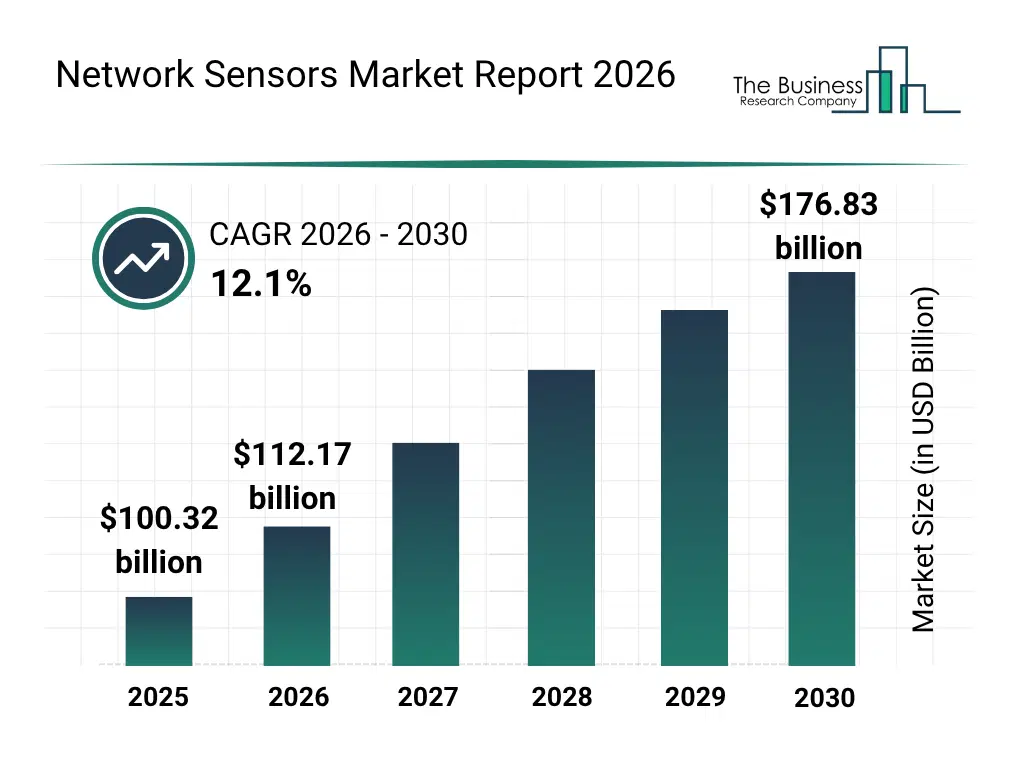
What Is The Network Sensors Market Size and Share 2026?
The network sensors market size has grown rapidly in recent years. It will grow from $100.32 billion in 2025 to $112.17 billion in 2026 at a compound annual growth rate (CAGR) of 11.8%. The growth in the historic period can be attributed to growth of industrial automation systems, increasing adoption of basic iot devices, expansion of manufacturing monitoring systems, rise in demand for real time data collection, development of wireless communication protocols.What Is The Network Sensors Market Growth Forecast?
The network sensors market size is expected to see rapid growth in the next few years. It will grow to $176.83 billion by 2030 at a compound annual growth rate (CAGR) of 12.1%. The growth in the forecast period can be attributed to expansion of smart factories and industry 4.0 adoption, increasing deployment of AI powered sensor analytics, rising demand for predictive maintenance solutions, growth of edge computing based sensor processing, increasing integration of cloud iot ecosystems. Major trends in the forecast period include edge AI enabled sensor intelligence, wireless sensor network expansion with lpwan integration, predictive maintenance driven sensor analytics, industrial iot sensor interoperability standards, cloud connected real time sensor data platforms.
Global Network Sensors Market Segmentation
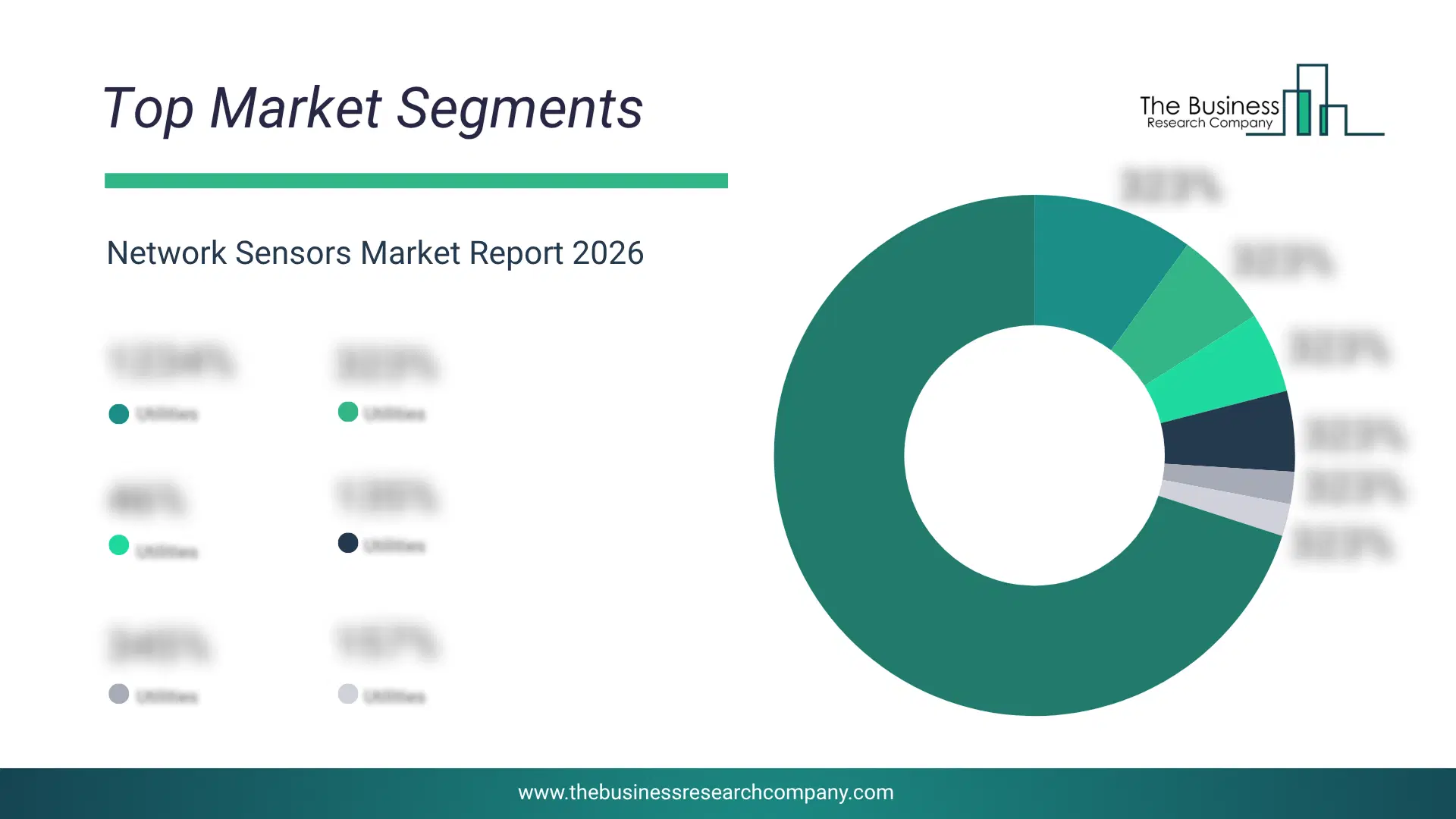
1) By Sensor Type: Physical Sensors, Environmental Sensors, Optical Sensors, Thermal Sensors, Chemical Sensors, Motion And Position Sensors 2) By Connectivity Technology: Wired Networks, Wireless Local Area Network (WLAN), Low Power Wide Area Network (LPWAN), Cellular Networks, Satellite Communication 3) By Deployment Mode: On-Premises, Cloud-Based, Hybrid 4) By Application: Industrial Monitoring, Network Performance Monitoring, Security And Surveillance, Asset Tracking And Management, Predictive Maintenance, Environmental Monitoring 5) By End User: Manufacturing, Healthcare, Transportation And Logistics, Energy And Utilities, Telecommunications, Government And Smart Cities, Retail, Agriculture Subsegments: 1) By Physical Sensors: Pressure Sensors, Force Sensors, Acceleration Sensors, Vibration Sensors, Displacement Sensors 2) By Environmental Sensors: Temperature Sensors, Humidity Sensors, Air Quality Sensors, Gas Sensors, Soil Moisture Sensors 3) By Optical Sensors: Photoelectric Sensors, Infrared Sensors, Ultraviolet Sensors, Fiber Optic Sensors, Light Intensity Sensors 4) By Thermal Sensors: Thermocouple Sensors, Resistance Temperature Detectors, Thermistor Sensors, Infrared Temperature Sensors, Semiconductor Temperature Sensors 5) By Chemical Sensors: Electrochemical Sensors, Optical Chemical Sensors, Catalytic Sensors, Biosensors, Gas Chemical Sensors 6) By Motion And Position Sensors: Proximity Sensors, Gyroscope Sensors, Accelerometer Sensors, Position Encoders, Magnetic SensorsWhat Is The Driver Of The Network Sensors Market?
The rapid growth of IoT and connected devices is expected to propel the growth of the network sensors market going forward. IoT and connected devices are physical objects equipped with sensors, software, and network connectivity that allow them to gather, share, and respond to data over the internet. The growth in IoT and connected devices is largely driven by the widespread rollout of 5G networks, as faster and more reliable connectivity enables a greater number of devices to operate simultaneously across both consumer and industrial environments. The rising number of connected devices directly increases demand for network sensors, as each device requires embedded sensing capabilities to monitor, detect, and relay real-time physical and environmental data across networked systems. For instance, in April 2025, according to Ericsson, a Sweden-based telecommunications company, global IoT connections reached 18.8 billion connections in 2024 and are expected to increase to 43.0 billion connections by 2030. Therefore, the rapid growth of IoT and connected devices is driving the growth of the network sensors industry.Key Players In The Global Network Sensors Market
Major companies operating in the network sensors market are Cisco Systems Inc; Intel Corporation; Broadcom Inc; ABB Ltd; Hewlett Packard Enterprise Company; TE Connectivity Ltd; Emerson Electric Co.; Analog Devices Inc; Rockwell Automation Inc; Omron Corporation; Yokogawa Electric Corporation; Semtech Corporation; NETSCOUT Systems Inc; Rapid7; Darktrace plc; Sensirion AG; ExtraHop Networks Inc; Nozomi Networks Inc; TEKTELIC Communications Inc; Libelium Comunicaciones Distribuidas S.L.; Monnit Corporation
This chart is for illustrative purposes; the full report includes a detailed competitor analysis and comprehensive overview of the top 10 companies in the market.
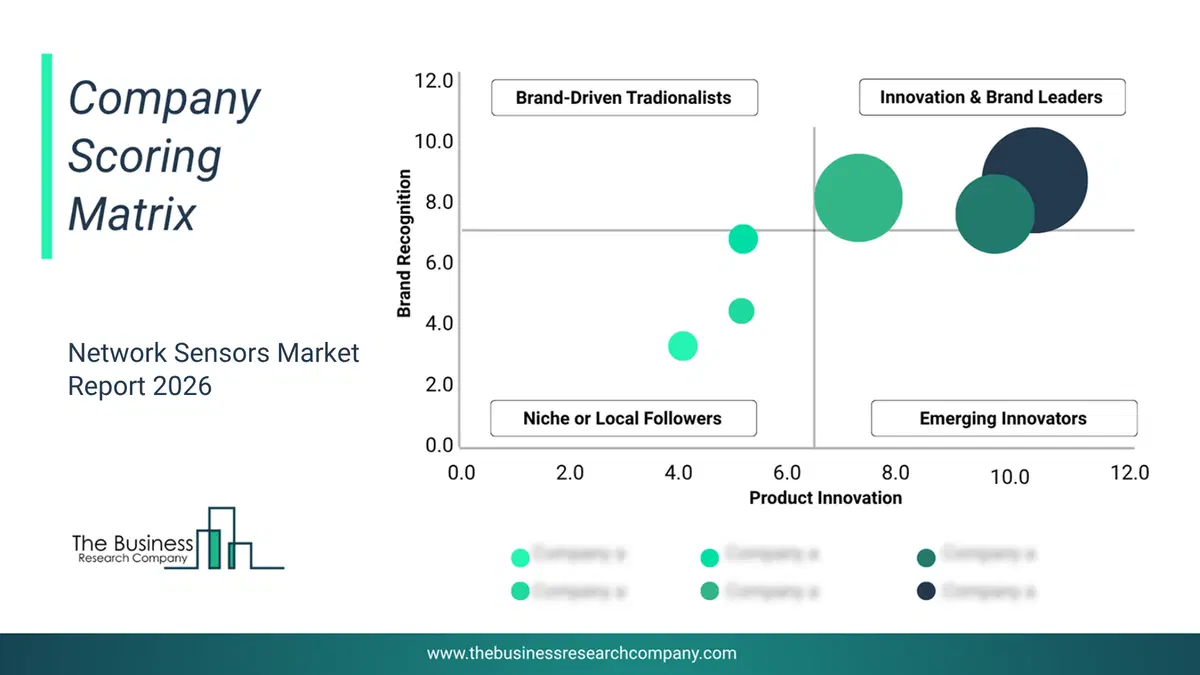
This chart maps companies by product innovation and brand strength, with bubble size indicating relative revenue, helping identify market leaders, challengers, and niche players. This is an illustrative chart; the full report provides a complete and accurate competitive analysis.
Global Network Sensors Market Trends and Insights
Major companies operating in the network sensors market are focusing on developing advanced solutions, such as edge AI-native sensing platforms, to enable real-time machine health monitoring, reduce unplanned downtime, and improve operational efficiency. Edge AI-native sensing platforms refer to intelligent sensor systems that process and analyze data locally on devices, enabling faster insights and reducing reliance on cloud infrastructure. For instance, in November 2024, Augury, a US-based industrial AI company, introduced the Halo R4000 series of sensors, the first industrial-grade edge AI-native machine health sensing platform. The solution integrates AI-driven diagnostics directly into sensors to continuously monitor equipment performance, detect anomalies, and provide actionable insights, thereby enhancing predictive maintenance capabilities and minimizing operational disruptions across industrial environments.What Are Latest Mergers And Acquisitions In The Network Sensors Market?
In September 2025, Avery Dennison, a US-based materials science and digital identification solutions company, expanded its strategic partnership with Wiliot to enable real-time, item-level visibility across global supply chains using ambient IoT sensors. The collaboration aims to integrate battery-free IoT sensor technology into intelligent labels to provide continuous tracking, condition monitoring, and enhanced supply chain transparency at scale. Wiliot is an Israel-based ambient IoT technology company that provides network sensors, primarily in the form of battery-free IoT sensing tags that operate within a broader IoT network ecosystem.
Regional Insights
North America was the largest region in the network sensors market in 2025. Asia-Pacific is expected to be the fastest-growing region in the forecast period. The regions covered in this market report are Asia-Pacific, South East Asia, Western Europe, Eastern Europe, North America, South America, Middle East, Africa. The countries covered in this market report are Australia, Brazil, China, France, Germany, India, Indonesia, Japan, Taiwan, Russia, South Korea, UK, USA, Canada, Italy, Spain.What Defines the Network Sensors Market?
The network sensors market consists of sales of wireless sensor nodes, data loggers, and sensor gateways. Values in this market are ‘factory gate’ values, that is, the value of goods sold by the manufacturers or creators of the goods, whether to other entities (including downstream manufacturers, wholesalers, distributors, and retailers) or directly to end customers. The value of goods in this market includes related services sold by the creators of the goods.How is Market Value Defined and Measured?
The market value is defined as the revenues that enterprises gain from the sale of goods and/or services within the specified market and geography through sales, grants, or donations in terms of the currency (in USD unless otherwise specified). The revenues for a specified geography are consumption values that are revenues generated by organizations in the specified geography within the market, irrespective of where they are produced. It does not include revenues from resales along the supply chain, either further along the supply chain or as part of other products.
This chart presents market attractiveness based on a quantitative evaluation of growth, competition, strategic alignment, and risk, offering a clear view of opportunity areas for decision-making. This chart is for illustrative purposes; the full report contains the complete analysis.

This chart highlights the Total Addressable Market (TAM) by estimating the maximum revenue opportunity using an assumption-driven approach, supporting strategic planning and opportunity sizing across markets. The chart is illustrative; the full report provides a more comprehensive analysis.
What Key Data and Analysis Are Included in the Network Sensors Market Report 2026?
The network sensors market research report is one of a series of new reports from The Business Research Company that provides market statistics, including industry global market size, regional shares, competitors with the market share, detailed market segments, market trends and opportunities, and any further data you may need to thrive in the network sensors industry. The market research report delivers a complete perspective of everything you need, with an in-depth analysis of the current and future state of the industry.Network Sensors Market Report Forecast Analysis
| Report Attribute | Details |
|---|---|
| Market Size Value In 2026 | $112.17 billion |
| Revenue Forecast In 2030 | $176.83 billion |
| Growth Rate | CAGR of 12.1% from 2026 to 2030 |
| Base Year For Estimation | 2025 |
| Actual Estimates/Historical Data | 2020-2025 |
| Forecast Period | 2026 - 2030 |
| Market Representation | Revenue in USD Billion and CAGR from 2026 to 2030 |
| Segments Covered | Sensor Type, Connectivity Technology, Deployment Mode, Application, End User |
| Regional Scope | Asia-Pacific, Western Europe, Eastern Europe, North America, South America, Middle East, Africa |
| Country Scope | The Countries Covered In This Market Report Are Australia, Brazil, China, France, Germany, India, Indonesia, Japan, Taiwan, Russia, South Korea, Uk, Usa, Canada, Italy, Spain. |
| Key Companies Profiled | Cisco Systems Inc, Intel Corporation, Broadcom Inc, ABB Ltd, Hewlett Packard Enterprise Company, TE Connectivity Ltd, Emerson Electric Co., Analog Devices Inc, Rockwell Automation Inc, Omron Corporation, Yokogawa Electric Corporation, Semtech Corporation, NETSCOUT Systems Inc, Rapid7, Darktrace plc, Sensirion AG, ExtraHop Networks Inc, Nozomi Networks Inc, TEKTELIC Communications Inc, Libelium Comunicaciones Distribuidas S.L., Monnit Corporation |
| Customization Scope | Request for Customization |
| Pricing And Purchase Options | Explore Purchase Options |