

Network Slicing Analytics Market Report 2026
Global Outlook – By Component (Software, Hardware, Services), By Deployment Mode (On-Premises, Cloud), By Organization Size (Small And Medium Enterprises (SMEs), Large Enterprises), By Industry Vertical (Banking Financial Services And Insurance (BFSI), Healthcare, Manufacturing, Information Technology (IT) And Telecom, Automotive, Media And Entertainment, Other Industry Verticals), By Application (Performance Monitoring, Security Analytics, Service Level Agreement (SLA) Management, Network Optimization, Other Applications) – Market Size, Trends, Strategies, and Forecast to 2030
Network Slicing Analytics Market Overview
• Network Slicing Analytics market size has reached to $2.57 billion in 2025 • Expected to grow to $8.15 billion in 2030 at a compound annual growth rate (CAGR) of 25.9% • Growth Driver: Increasing 5G Network Rollout Fueling The Growth Of The Market Due To Need For Slice Performance Monitoring • Market Trend: Enabling SLA Assurance With Intelligent Transport Slice Analytics • North America was the largest region in 2025 and Asia-Pacific is the fastest growing region.Market Gains By 2030 – Top Opportunities By Segment
Market Gain identifies the most promising market opportunities by highlighting the segments or products expected to generate the highest incremental revenue growth over the next five years.
What Is Covered Under Network Slicing Analytics Market?
Network slicing analytics refers to the ecosystem of tools, platforms, and solutions designed to collect, process, and analyze data related to the performance, utilization, and behavior of network slices in advanced communication networks. It enables real time visibility, monitoring, and optimization of virtualized network resources to ensure service quality, reliability, and efficiency. The main components of network slicing analytics include software, hardware, and services. Software refers to solutions that monitor, analyze, and optimize network slices by providing real-time insights into performance, security, and resource allocation to ensure efficient and reliable connectivity. These solutions can be deployed through on-premises or cloud modes. The adoption spans organizations of different sizes, including small and medium enterprises and large enterprises. The various applications involved include performance monitoring, security analytics, service level agreement (SLA) management, network optimization, and other applications, used across industry verticals such as banking, financial services and insurance, healthcare, manufacturing, information technology and telecom, automotive, media and entertainment, and other industry verticals.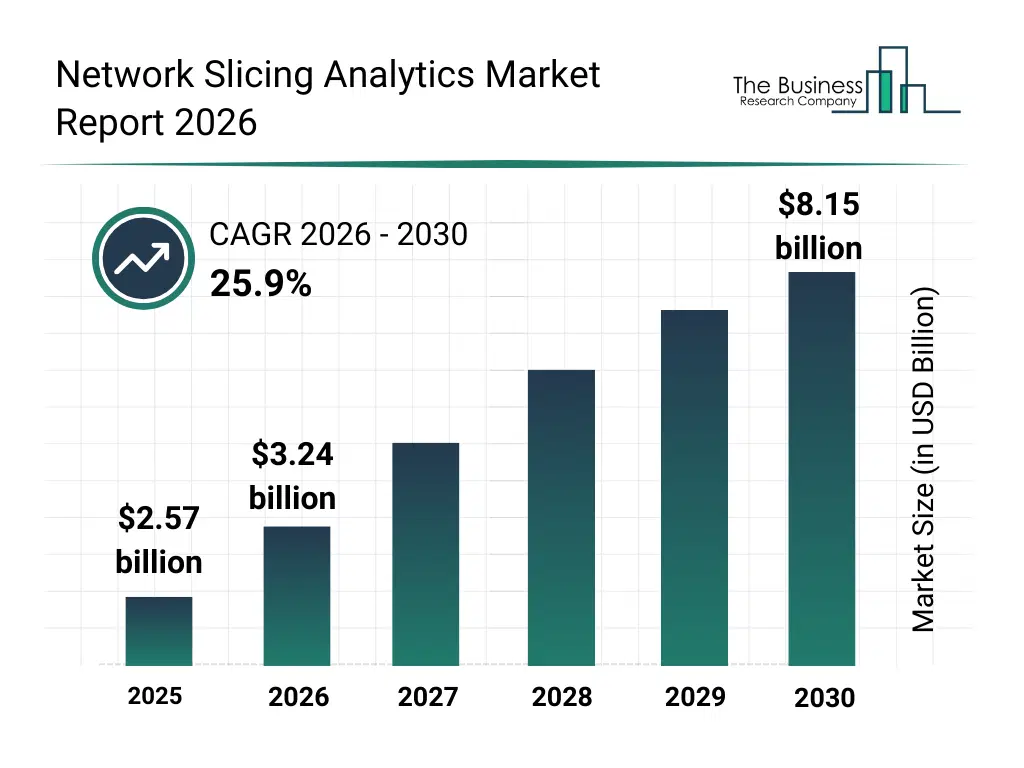
What Is The Network Slicing Analytics Market Size and Share 2026?
The network slicing analytics market size has grown exponentially in recent years. It will grow from $2.57 billion in 2025 to $3.24 billion in 2026 at a compound annual growth rate (CAGR) of 26.0%. The growth in the historic period can be attributed to growth of 5G network deployments, increasing adoption of virtualized network functions (VNF), rising demand for quality of service (QoS) management, expansion of telecom infrastructure investments, need for efficient network resource utilization.What Is The Network Slicing Analytics Market Growth Forecast?
The network slicing analytics market size is expected to see exponential growth in the next few years. It will grow to $8.15 billion in 2030 at a compound annual growth rate (CAGR) of 25.9%. The growth in the forecast period can be attributed to proliferation of private 5G networks, increasing use of edge computing in telecom, rising demand for network automation, growth in connected devices and IoT traffic, increasing adoption of AI driven network management. Major trends in the forecast period include dynamic slice performance monitoring and optimization, real time network visibility and traffic intelligence, predictive analytics for proactive network management, sla driven service assurance for network slices, integration of analytics with multi domain network orchestration.
Global Network Slicing Analytics Market Segmentation
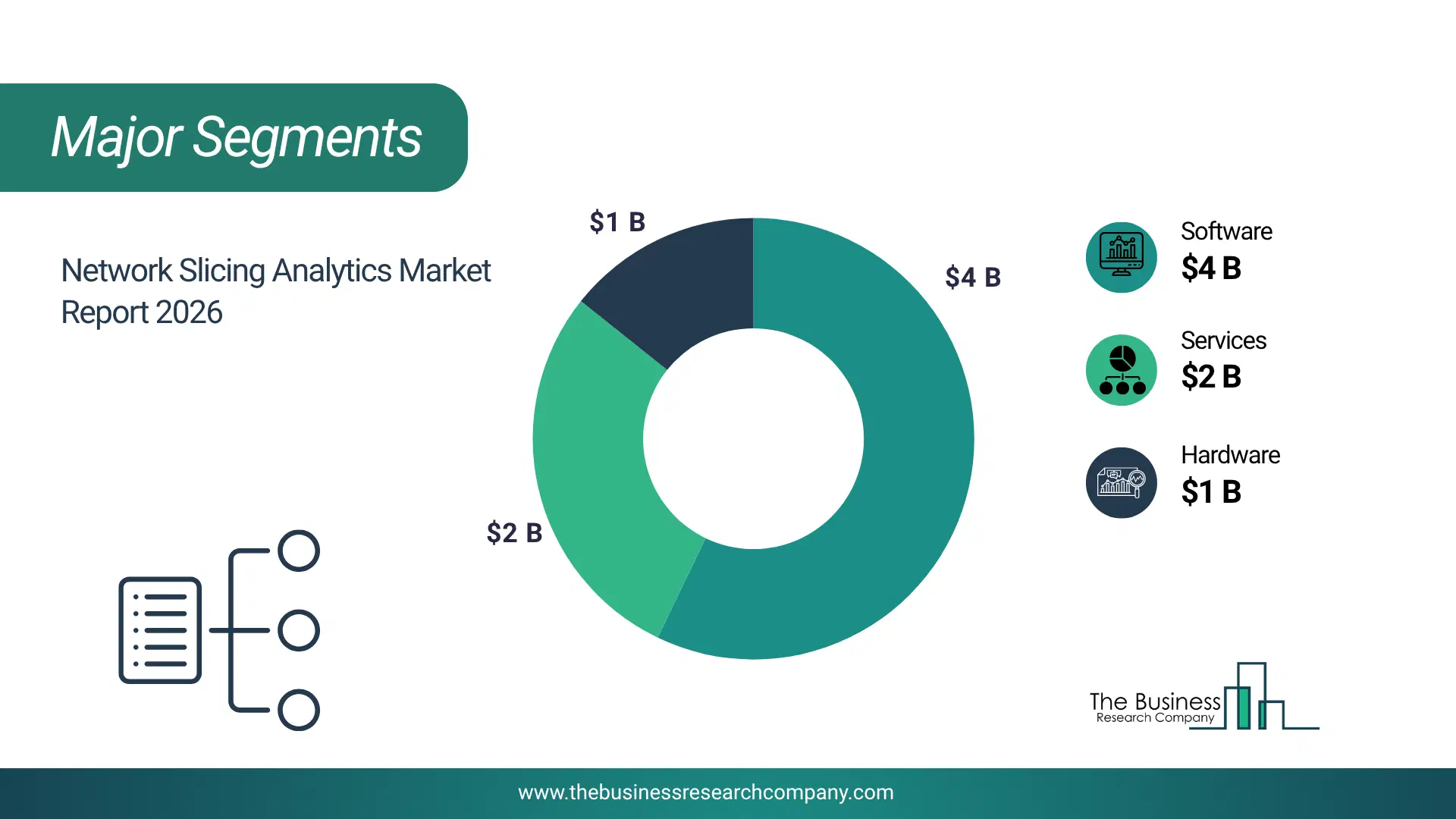
1) By Component: Software, Hardware, Services 2) By Deployment Mode: On-Premises, Cloud 3) By Organization Size: Small And Medium Enterprises (SMEs), Large Enterprises 4) By Industry Vertical: Banking Financial Services And Insurance (BFSI), Healthcare, Manufacturing, Information Technology (IT) And Telecom, Automotive, Media And Entertainment, Other Industry Verticals 5) By Application: Performance Monitoring, Security Analytics, Service Level Agreement (SLA) Management, Network Optimization, Other Applications Subsegments: 1) By Software: Network Monitoring Software, Performance Analytics Software, Traffic Management Software, Service Assurance Software 2) By Hardware: Network Probes, Edge Computing Devices, Data Collection Sensors, Monitoring Appliances 3) By Services: Consulting Services, Implementation Services, Managed Services, Support And Maintenance Services The top segments in the network slicing analytics market will be: • Software will reach $4.35 Billion by 2030. • Services will reach $1.5 Billion by 2030. • Hardware will reach $0.51 Billion by 2030.What Is The Driver Of The Network Slicing Analytics Market?
The increasing rollout of fifth-generation (5G) networks is expected to propel the growth of the network slicing analytics market going forward. The rollout of fifth-generation (5G) networks refers to the deployment and commercialization of advanced mobile communication infrastructure that enables higher data speeds, lower latency, increased network capacity, and support for next-generation digital applications. This rollout is increasing due to the rising global demand for ultra-reliable, low-latency connectivity to support new technologies. Network slicing analytics supports this rollout by enabling operators to optimize, monitor, and assure the performance of dedicated virtual network slices for critical applications. For instance, in February 2024, according to the GSM Association, a UK-based mobile industry association, 5G has been the fastest mobile generation rollout to date, surpassing one billion connections by the end of 2022, rising to 1.6 billion connections at the end of 2023, and reaching 5.5 billion by 2030. Therefore, the increasing rollout of fifth-generation (5G) networks is driving the growth of the network slicing analytics industry.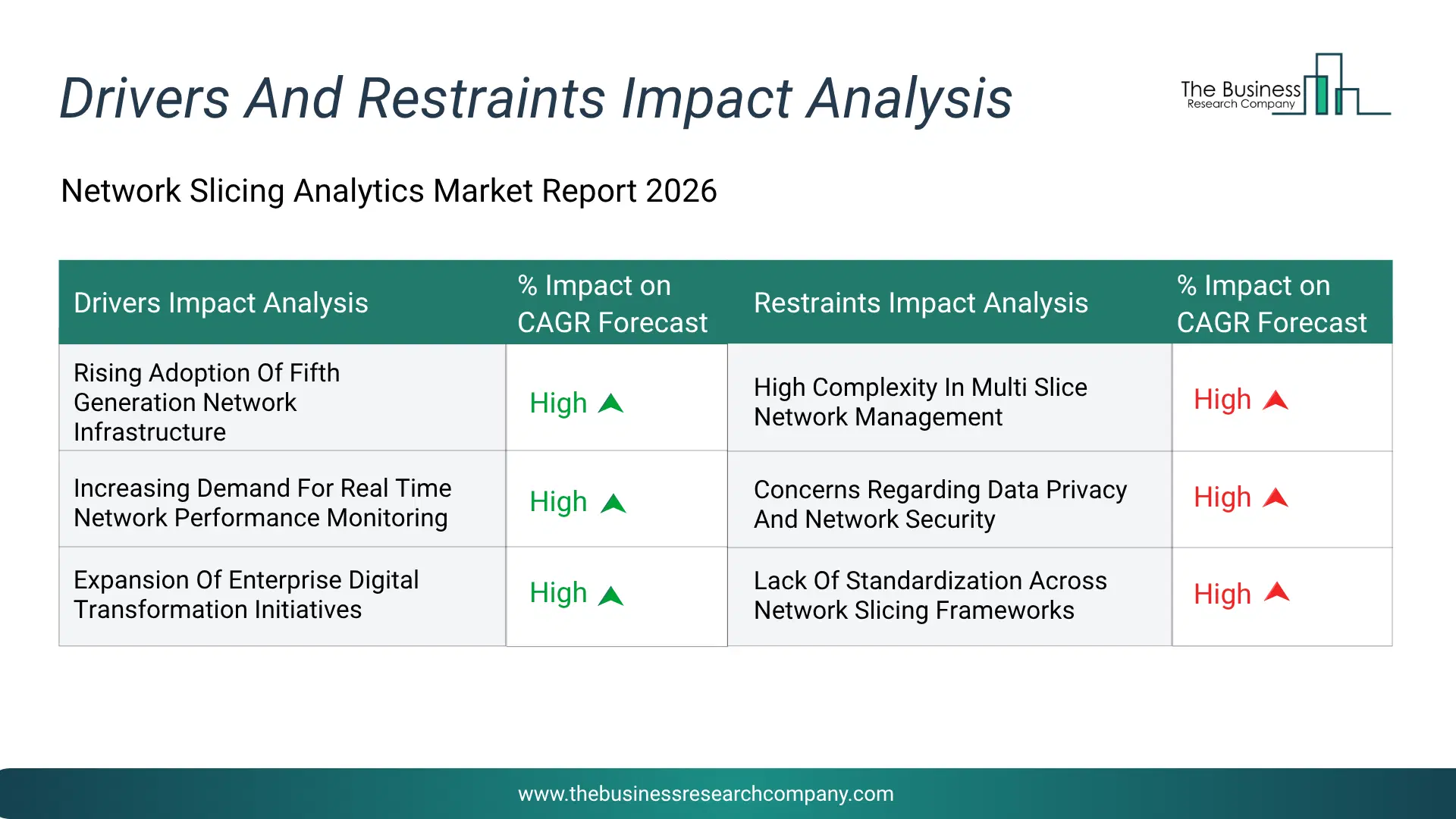
Infographic Chart Showing Key Market Drivers Analysis And Restraints For Network Slicing Analytics Market
The chart presents an impact analysis of key drivers and restraints, quantifying their relative influence on the market's growth rate and helping assess the balance between growth enablers and limiting factors. This chart offers a high-level perspective; the full report contains more detailed insights.
How Will The Drivers Impact Growth In The Global Network Slicing Analytics Market?
• Rising Adoption Of Fifth Generation Network Infrastructure (High) – During the forecast period, the rising adoption of fifth generation network infrastructure is expected to become a key growth driver for the network slicing analytics market by 2030. Rising adoption of fifth generation network infrastructure is significantly driving the growth of the network slicing analytics market due to the increasing deployment of advanced communication networks across industries. Fifth generation networks require efficient allocation and monitoring of multiple virtual network slices to support diverse applications and service requirements. Network slicing analytics solutions help operators maintain service quality, optimize bandwidth utilization, and ensure operational reliability in complex network environments. The growing dependence on ultra low latency and high bandwidth services is further increasing the need for real time network performance visibility. • Increasing Demand For Real Time Network Performance Monitoring (High) – During the forecast period, the increasing demand for real time network performance monitoring is expected to emerge as a major factor driving the expansion of the network slicing analytics market by 2030. Increasing demand for real time network performance monitoring is accelerating the adoption of network slicing analytics solutions as communication networks become more dynamic and data intensive. Service providers require continuous visibility into slice performance, traffic patterns, and resource utilization to maintain uninterrupted connectivity and service assurance. Network slicing analytics enables proactive identification of congestion, service degradation, and network inefficiencies across multiple virtualized network environments. The rising use of connected devices, cloud applications, and mission critical communication services is creating additional pressure on network operators to ensure consistent performance. • Expansion Of Enterprise Digital Transformation Initiatives (High) – During the forecast period, the expansion of enterprise digital transformation initiatives is expected to act as a key growth catalyst for the network slicing analytics market by 2030. Expansion of enterprise digital transformation initiatives is contributing to the growth of the network slicing analytics market as businesses increasingly rely on advanced communication infrastructure for operational continuity and efficiency. Enterprises across manufacturing, healthcare, transportation, and financial services sectors require customized network slices to support specific applications and workloads. Network slicing analytics solutions provide valuable insights into network behavior, capacity utilization, and service performance, enabling organizations to optimize network operations. The increasing integration of cloud computing, remote operations, and connected ecosystems is also increasing the requirement for reliable network management tools.How Will The Restraints Impact Growth In The Global Network Slicing Analytics Market?
• High Complexity In Multi Slice Network Management (High) – During the forecast period, the high complexity in multi slice network management is restraining the growth of the network slicing analytics market due to the operational challenges associated with managing diverse virtualized network environments. Monitoring and analyzing multiple network slices simultaneously requires extensive coordination between network components, service providers, and operational systems. The complexity increases further when organizations attempt to maintain consistent service quality across different applications and user groups. Integration of analytics solutions with existing network infrastructure can also create deployment and operational difficulties. These challenges may limit adoption among organizations with limited technical expertise or operational resources. • Concerns Regarding Data Privacy And Network Security (High) – During the forecast period, the concerns regarding data privacy and network security are limiting the expansion of the network slicing analytics market as analytics platforms process large volumes of sensitive network and user data. Organizations remain cautious about potential risks related to unauthorized access, data breaches, and misuse of network performance information. The increasing use of virtualized and interconnected communication environments further raises concerns about maintaining secure data transmission and operational integrity. Regulatory compliance requirements associated with data handling and network security also create additional operational burdens for service providers. These concerns may slow down the implementation of analytics solutions in highly regulated industries and critical infrastructure sectors. • Lack Of Standardization Across Network Slicing Frameworks (High) – During the forecast period, the lack of standardization across network slicing frameworks is expected to restrain the growth of the network slicing analytics market. Network slicing analytics solutions must operate across diverse communication networks, vendors, and virtualization platforms, each of which may implement different architectures, interfaces, and management protocols. The absence of universally accepted standards for network slice creation, orchestration, monitoring, and analytics creates interoperability challenges between equipment providers and service operators. These inconsistencies increase integration complexity, limit seamless data exchange, and require additional customization for multi-vendor deployments. Service providers may also encounter difficulties in scaling analytics capabilities across heterogeneous network environments while maintaining consistent performance and service quality. Furthermore, evolving industry standards and technology specifications introduce uncertainty in long-term infrastructure planning and investment decisions. These challenges increase implementation costs and delay the large-scale deployment of network slicing analytics solutions. Consequently, the lack of standardization across network slicing frameworks remains a significant restraint on the growth of the network slicing analytics market.Key Players In The Global Network Slicing Analytics Market
Major companies operating in the network slicing analytics market are Samsung Electronics Co. Ltd., Huawei Technologies Co. Ltd., Accenture plc, International Business Machines Corporation, Cisco Systems Inc., Hewlett Packard Enterprise Company, Telefonaktiebolaget LM Ericsson, NEC Corporation, Nokia Corporation, ZTE Corporation, VMware Inc., Juniper Networks Inc., Keysight Technologies Inc., Amdocs Limited, Ciena Corporation, Mavenir Systems Inc., Amantya Technologies Pvt. Ltd., Blue Planet Corporation, Argela Yazılım ve Bilişim Teknolojileri Sanayi ve Ticaret A.Ş., and Tambora Systems Pte. Ltd.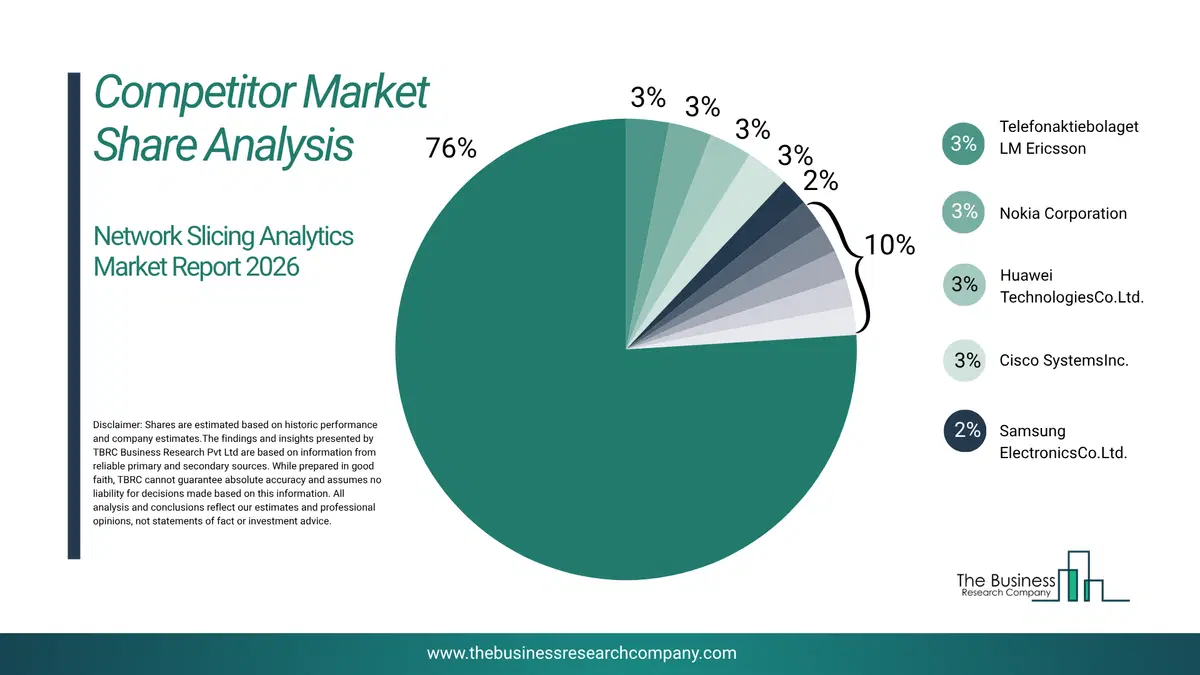
This chart is for illustrative purposes; the full report includes a detailed competitor analysis and comprehensive overview of the top 10 companies in the market.
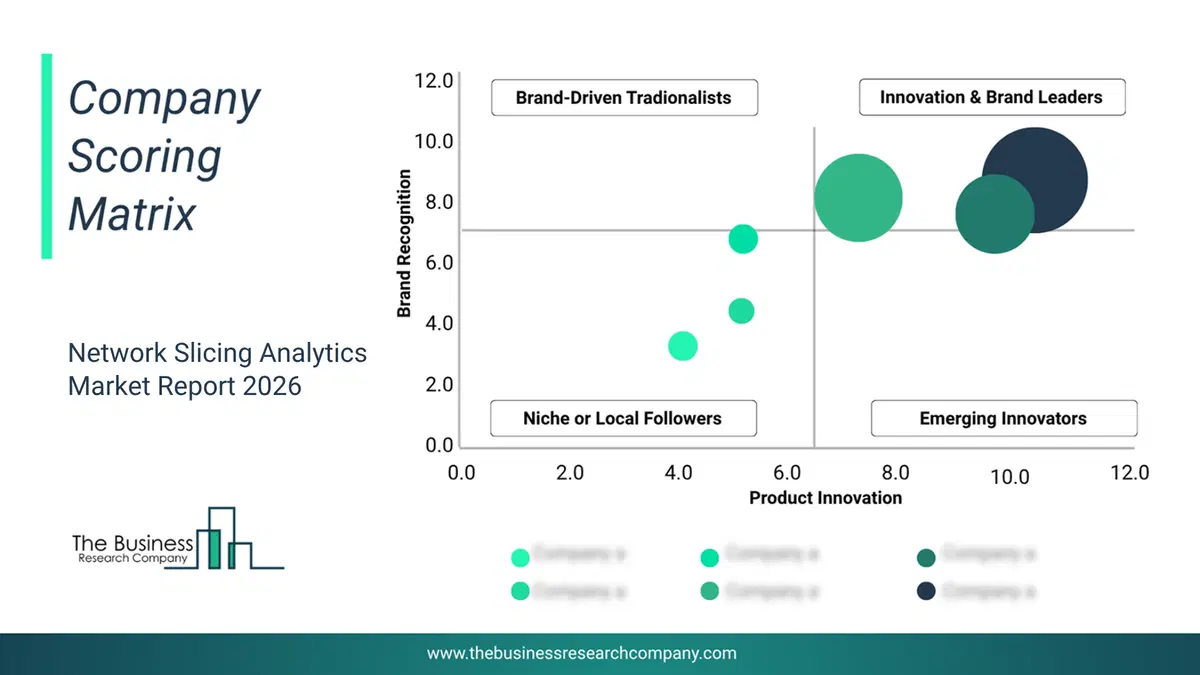
This chart maps companies by product innovation and brand strength, with bubble size indicating relative revenue, helping identify market leaders, challengers, and niche players. This is an illustrative chart; the full report provides a complete and accurate competitive analysis.
Global Network Slicing Analytics Market Trends and Insights
Major companies operating in the network slicing analytics market are focusing on adoption of innovative technologies such as transport slice automation and analytics to enhance end-to-end slice visibility, ensure SLA compliance, and enable real-time optimization of network resources across 5G infrastructures. Transport slice automation and analytics refer to software-driven systems that continuously analyze slice-level performance data across transport networks to support dynamic resource allocation, predictive fault detection, and SLA compliance for enterprise and 5G standalone services. For instance, in February 2024, Cisco Systems, Inc., a US-based networking and communications technology company, introduced transport slice automation capabilities within Cisco Crosswork Network Controller 6.0, which enables real-time visibility into transport slice performance, supports automated resource optimization for hybrid cloud and 5G standalone slicing use cases, and integrates analytics with orchestration to improve SLA assurance for enterprise services.What Are Latest Mergers And Acquisitions In The Network Slicing Analytics Market?
In February 2023, RADCOM Ltd., an Israel-based provider of cloud-native 5G network intelligence, service assurance, and analytics solutions, acquired Continual Ltd. for $2.5 million. With this acquisition, RADCOM aimed to enrich its RADCOM ACE analytics portfolio with advanced mobility experience analytics to enhance 5G assurance, location, and mobility insights for telecom operators. Continual Ltd. is an Israel-based provider of AI- and machine-learning-driven mobility experience analytics designed to optimize subscriber mobility experience and network performance.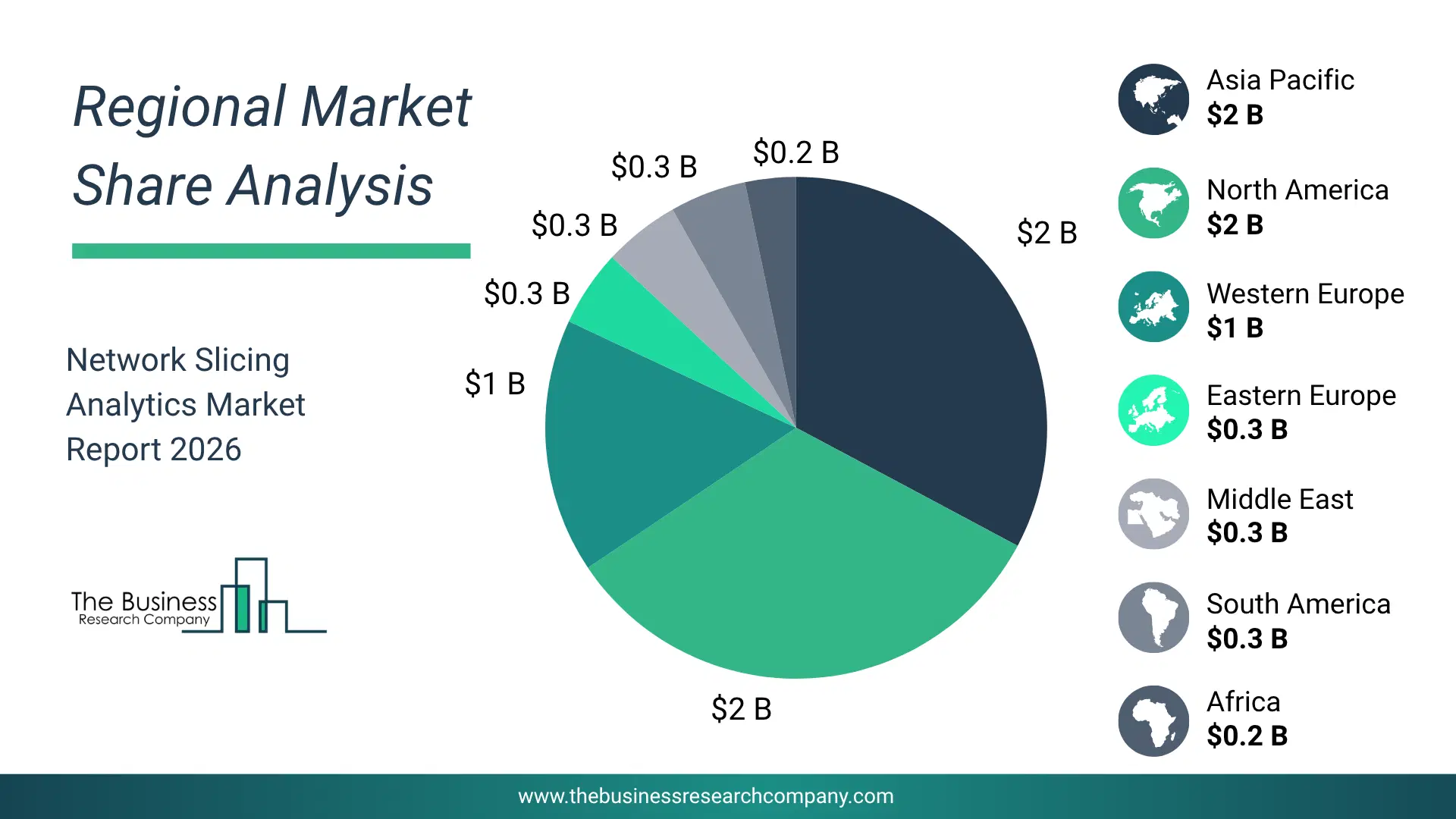
Regional Outlook
North America was the largest region in the network slicing analytics market in 2025. Asia-Pacific is expected to be the fastest-growing region in the forecast period. The regions covered in this market report are Asia-Pacific, South East Asia, Western Europe, Eastern Europe, North America, South America, Middle East, Africa. The countries covered in this market report are Australia, Brazil, China, France, Germany, India, Indonesia, Japan, Taiwan, Russia, South Korea, UK, USA, Canada, Italy, Spain.What Defines the Network Slicing Analytics Market?
The network slicing analytics includes revenues earned by entities by providing services such as network slice performance monitoring, traffic and usage analytics, quality of service analysis, real time network visibility, predictive analytics, and network optimization insights. The market value includes the value of related goods sold by the service provider or included within the service offering. The network slicing analytics market consists of sales of network slicing analytics software, analytics platforms, monitoring and reporting tools, data visualization dashboards, and network performance management solutions. Values in this market are ‘factory gate’ values, that is the value of goods sold by the manufacturers or creators of the goods, whether to other entities (including downstream manufacturers, wholesalers, distributors and retailers) or directly to end customers. The value of goods in this market includes related services sold by the creators of the goods.How is Market Value Defined and Measured?
The market value is defined as the revenues that enterprises gain from the sale of goods and/or services within the specified market and geography through sales, grants, or donations in terms of the currency (in USD unless otherwise specified). The revenues for a specified geography are consumption values that are revenues generated by organizations in the specified geography within the market, irrespective of where they are produced. It does not include revenues from resales along the supply chain, either further along the supply chain or as part of other products.
This chart presents market attractiveness based on a quantitative evaluation of growth, competition, strategic alignment, and risk, offering a clear view of opportunity areas for decision-making. This chart is for illustrative purposes; the full report contains the complete analysis.

This chart highlights the Total Addressable Market (TAM) by estimating the maximum revenue opportunity using an assumption-driven approach, supporting strategic planning and opportunity sizing across markets. The chart is illustrative; the full report provides a more comprehensive analysis.
What Key Data and Analysis Are Included in the Network Slicing Analytics Market Report 2026?
The network slicing analytics market research report is one of a series of new reports from The Business Research Company that provides market statistics, including industry global market size, regional shares, competitors with the market share, detailed market segments, market trends and opportunities, and any further data you may need to thrive in the network slicing analytics industry. The market research report delivers a complete perspective of everything you need, with an in-depth analysis of the current and future state of the industry.Network Slicing Analytics Market Report Forecast Analysis
| Report Attribute | Details |
|---|---|
| Market Size Value In 2026 | $3.24 billion |
| Revenue Forecast In 2030 | $8.15 billion |
| Growth Rate | CAGR of 26.0% from 2026 to 2030 |
| Base Year For Estimation | 2025 |
| Actual Estimates/Historical Data | 2020-2025 |
| Forecast Period | 2026 - 2030 |
| Market Representation | Revenue in USD Billion and CAGR from 2026 to 2030 |
| Segments Covered | Component, Deployment Mode, Organization Size, Industry Vertical, Application |
| Regional Scope | Asia-Pacific, Western Europe, Eastern Europe, North America, South America, Middle East, Africa |
| Country Scope | The countries covered in the report are Australia, Brazil, China, France, Germany, India, Indonesia, Japan, Taiwan, Russia, South Korea, UK, USA, Canada, Italy, Spain. |
| Key Companies Profiled | Samsung Electronics Co. Ltd., Huawei Technologies Co. Ltd., Accenture plc, International Business Machines Corporation, Cisco Systems Inc., Hewlett Packard Enterprise Company, Telefonaktiebolaget LM Ericsson, NEC Corporation, Nokia Corporation, ZTE Corporation, VMware Inc., Juniper Networks Inc., Keysight Technologies Inc., Amdocs Limited, Ciena Corporation, Mavenir Systems Inc., Amantya Technologies Pvt. Ltd., Blue Planet Corporation, Argela Yazılım ve Bilişim Teknolojileri Sanayi ve Ticaret A.Ş., and Tambora Systems Pte. Ltd. |
| Customization Scope | Request for Customization |
| Pricing And Purchase Options | Explore Purchase Options |