
Neuro-Symbolic Artificial Intelligence (AI) Market Report 2026
Global Outlook – By Component (Software, Hardware, Services), By Deployment Mode (On-Premises, Cloud), By Technology (Neural Networks, Symbolic Reasoning, Hybrid Systems), By Application (Natural Language Processing, Computer Vision, Robotics, Knowledge Representation, Other Applications), By End-User (Banking, Financial Services and Insurance (BFSI), Healthcare, Automotive, Retail, Information Technology (IT) and Telecommunications, Manufacturing, Other End-Users) – Market Size, Trends, Strategies, and Forecast to 2030
Neuro-Symbolic Artificial Intelligence (AI) Market Overview
• Neuro-Symbolic Artificial Intelligence (AI) market size has reached to $1.62 billion in 2025 • Expected to grow to $6.31 billion in 2030 at a compound annual growth rate (CAGR) of 31.1% • Growth Driver: Rising Healthcare Expenditure Fueling The Growth Of The Market Due To Increasing Investment In Advanced Healthcare Solutions • Market Trend: Advanced System Enhances Transparency And Reduces AI Hallucinations • North America was the largest region in 2025 and Asia-Pacific is the fastest growing region.What Is Covered Under Neuro-Symbolic Artificial Intelligence (AI) Market?
Neuro-symbolic artificial intelligence (AI) is an advanced approach that integrates neural networks with symbolic reasoning to combine learning-based pattern recognition with logical, rule-based decision-making. It enables systems to interpret complex data while also understanding relationships, structures, and contextual knowledge. This hybrid framework enhances transparency, accuracy, and generalization in ai-driven problem-solving. The main components of neuro-symbolic artificial intelligence (AI) include software, hardware, and services. Software refers to platforms, frameworks, and hybrid AI algorithms that integrate neural network–based learning with symbolic reasoning to enhance explain ability, decision-making accuracy, and generalization across complex tasks. Different deployment modes are on-premises and cloud. Multiple technologies are neural networks, symbolic reasoning, and hybrid systems. Various applications are natural language processing, computer vision, robotics, knowledge representation, and others, and they are used by several end-users such as banking, financial services and insurance (BFSI), healthcare, automotive, retail, information technology (IT) and telecommunications, manufacturing, and others.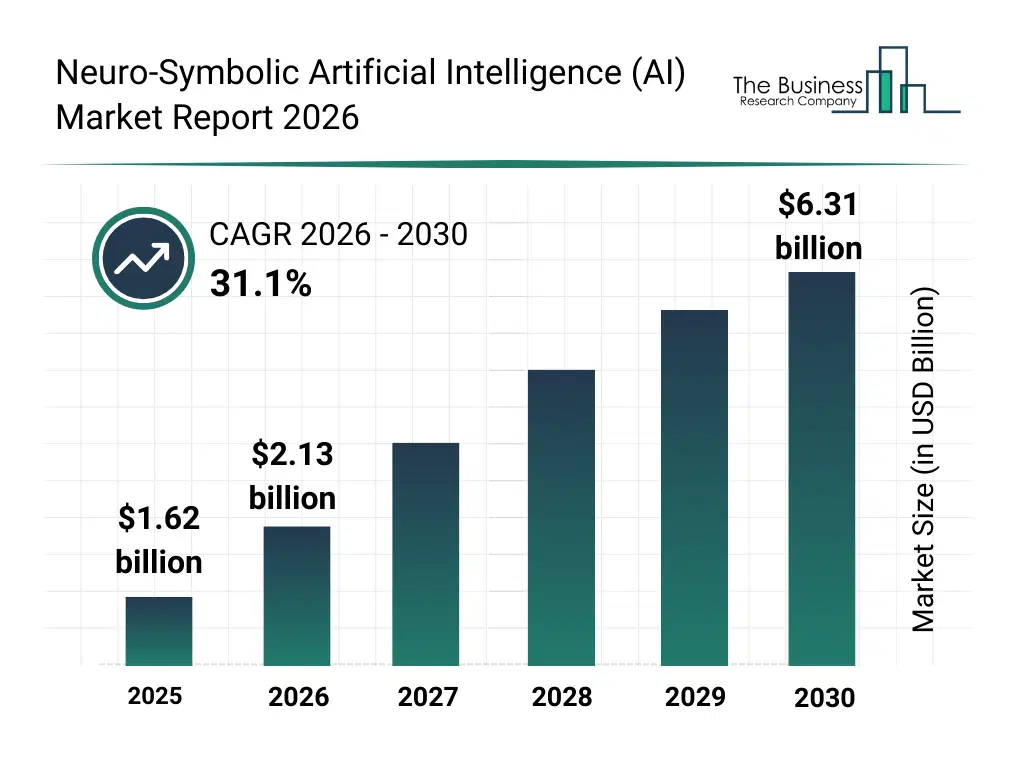
What Is The Neuro-Symbolic Artificial Intelligence (AI) Market Size and Share 2026?
The neuro-symbolic artificial intelligence market size has grown exponentially in recent years. It will grow from $1.62 billion in 2025 to $2.13 billion in 2026 at a compound annual growth rate (CAGR) of 31.4%. The growth in the historic period can be attributed to increasing demand for explainable ai, growing adoption of hybrid learning models, rising need for data-efficient ai methods, expansion of knowledge graph usage, and increasing reliance on ai for high-stakes decision making.What Is The Neuro-Symbolic Artificial Intelligence (AI) Market Growth Forecast?
The neuro-symbolic artificial intelligence market size is expected to see exponential growth in the next few years. It will grow to $6.31 billion in 2030 at a compound annual growth rate (CAGR) of 31.1%. The growth in the forecast period can be attributed to increasing demand for trustworthy and transparent ai, growing expansion of autonomous systems, rising need for hybrid reasoning in healthcare and bfsi, expanding adoption of cloud-based ai platforms, and increasing integration of symbolic reasoning in nlp and vision. Major trends in the forecast period include advancements in hybrid neural-symbolic architectures, innovations in ai reasoning frameworks, developments in knowledge-graph-powered models, increasing research in multi-modal neuro-symbolic systems, and rising adoption of logic-enhanced reinforcement learning.
Global Neuro-Symbolic Artificial Intelligence (AI) Market Segmentation
1) By Component: Software, Hardware, Services 2) By Deployment Mode: On-Premises, Cloud 3) By Technology: Neural Networks, Symbolic Reasoning, Hybrid Systems 4) By Application: Natural Language Processing, Computer Vision, Robotics, Knowledge Representation, Other Applications 5) By End-User: Banking, Financial Services and Insurance (BFSI), Healthcare, Automotive, Retail, Information Technology (IT) and Telecommunications, Manufacturing, Other End-Users Subsegments: 1) By Software: Hybrid Reasoning Platforms, Knowledge Graph Management Tools, Neural Symbolic Integration Frameworks, Logic Driven Inference Engines 2) By Hardware: Neural Processing Units, Symbolic Reasoning Accelerators, Hybrid Computing Architectures, High Performance Server Systems 3) By Services: Consulting And Integration Services, Deployment And Implementation Services, Training And Support Services, Maintenance And Optimization ServicesWhat Are The Drivers Of The Neuro-Symbolic Artificial Intelligence (AI) Market?
The rising healthcare expenditure is expected to propel the growth of the neuro-symbolic artificial intelligence (AI) market going forward. Healthcare expenditure refers to the total amount of financial resources spent on healthcare services, including medical treatments, hospital care, medications, and public health initiatives, by governments, businesses, and individuals. The increasing demand for healthcare expenditure is due to the rising prevalence of chronic diseases, which require long-term and costly treatments. Rising healthcare expenditure enhances neuro-symbolic artificial intelligence (AI) by driving investment in advanced AI solutions that improve diagnostics, patient care, and operational efficiency. Increased funding enables the integration of symbolic reasoning with neural networks, supporting more accurate, explainable, and scalable healthcare applications. For instance, in May 2024, according to the Office for National Statistics, a UK-based government department, total healthcare expenditure saw a 5.6% increase in nominal terms in 2023, an increase of 0.9% growth compared to 2022. Therefore, the rising healthcare expenditure is driving the growth of theneuro-symbolic artificial intelligence (AI) market. The rising adoption of AI-powered decision-making tools is expected to propel the growth of the neuro-symbolic artificial intelligence (AI) market going forward. AI-powered decision-making tools are software systems that use artificial intelligence, such as machine learning and predictive analytics, to automate and enhance business decisions and insights. The rise in adoption is due to increasing enterprise digitalization and the need for data-driven strategic decision-making. Neuro-symbolic artificial intelligence (AI) enhances AI-powered decision-making tools by combining the learning capabilities of neural networks with the reasoning strengths of symbolic AI. It improves the accuracy and interpretability of decisions, enabling organizations to process complex data, derive actionable insights, and make informed choices efficiently. For instance, in January 2025, according to Eurostat, a Luxembourg-based statistical office of the European Union, in 2024, 13.5% of enterprises with 10 or more employees used AI technologies, up from 8.0% in 2023, marking a 5.5 percentage-point increase. Therefore, the rising adoption of AI-powered decision-making tools is driving the growth of the neuro-symbolic artificial intelligence (AI) industry. The rise in digital transformation is expected to propel the growth of the neuro-symbolic artificial intelligence (AI) market going forward. Digital transformation is the integration of digital technologies into all aspects of business to improve operations, enhance value delivery, and enable innovation while fostering agile and data-driven practices. Neuro-symbolic artificial intelligence (AI) enhances digital transformation by combining the strengths of symbolic reasoning and machine learning, enabling organizations to make smarter, faster, and more accurate decisions. It improves data interpretation, automates complex workflows, and supports advanced analytics, driving operational efficiency and innovation across business processes. For instance, in July 2024, according to the Office for National Statistics, a UK-based government agency, the digital infrastructure program received a $535 million (£434 million) investment by 2022, with an additional $907 million (£736 million) allocated for the period of 2023 to 2025. Therefore, the rise in digital transformation is driving the growth of the neuro-symbolic artificial intelligence (AI) industry.Key Players In The Global Neuro-Symbolic Artificial Intelligence (AI) Market
Major companies operating in the neuro-symbolic artificial intelligence (AI) market are Microsoft Corporation, Lenovo Group Limited, International Business Machines Corporation, Qualcomm Incorporated, NVIDIA Corporation, ExtensityAI FlexCo, RAAPID Inc., ONTOTEXT AD, Stardog Union Inc., Kognitos Inc., Cycorp Inc., Abzu ApS, Franz Inc., Imandra Inc., Synfini Inc., icogz Inc., UMNAI Ltd., Growth Protocol Inc., Permion Inc., Lakmoos AI s.r.o., SynaLinks SAS, Rippletide
This chart is for illustrative purposes; the full report includes a detailed competitor analysis and comprehensive overview of the top 10 companies in the market.
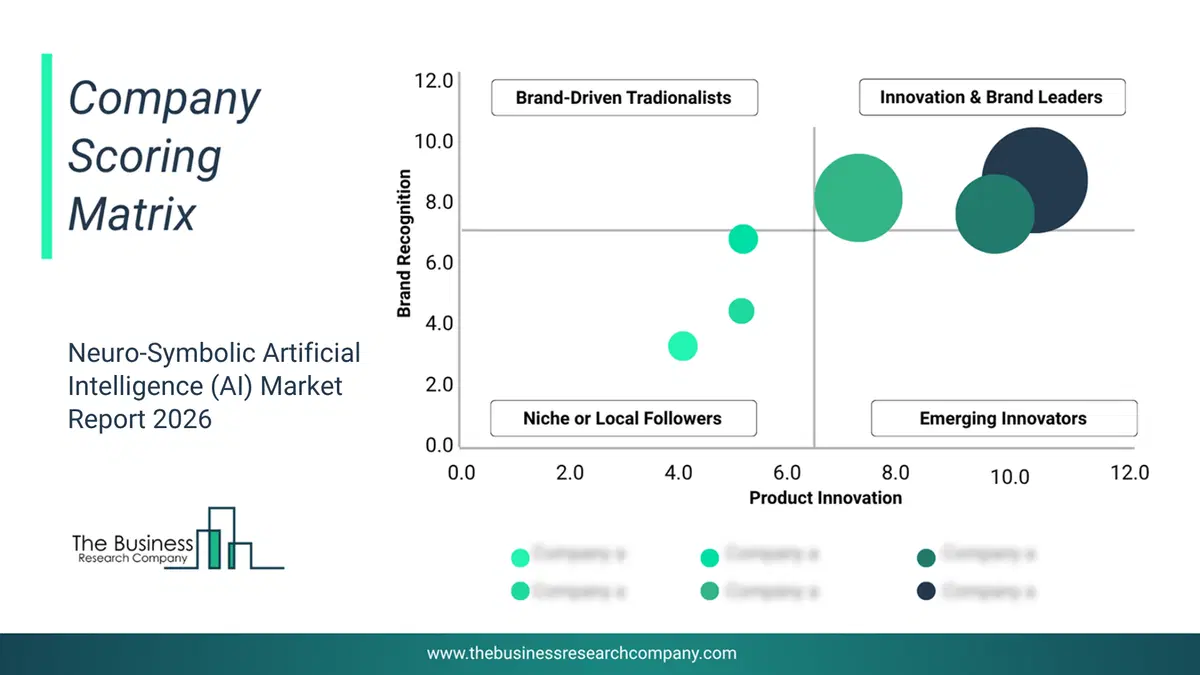
This chart maps companies by product innovation and brand strength, with bubble size indicating relative revenue, helping identify market leaders, challengers, and niche players. This is an illustrative chart; the full report provides a complete and accurate competitive analysis.
Global Neuro-Symbolic Artificial Intelligence (AI) Market Trends and Insights
Major companies operating in the neuro-symbolic artificial intelligence (AI) market are focusing on developing advanced platforms that combine symbolic reasoning with AI learning to boost efficiency, enhance transparency, and reduce AI-related risks such as hallucinations. Symbolic reasoning with AI learning refers to the combination of human-readable, rule-based logic (symbolic reasoning) with machine learning (neural networks) capabilities in a single AI system. For instance, in June 2025, Kognitos, a US-based software company, launched its neurosymbolic AI platform. It is the first platform to uniquely combine reasoning with learning power, establishing a new, dynamic system of record for business operations. It includes a patented Process Refinement Engine and uses English as code, enabling rapid automation of complex business processes with robust governance and without AI hallucinations. It also incorporates a comprehensive guidance center and automatic agent regression testing, ensuring automated workflows, auditable, and aligned with business evolution, significantly reducing maintenance costs for enterprises.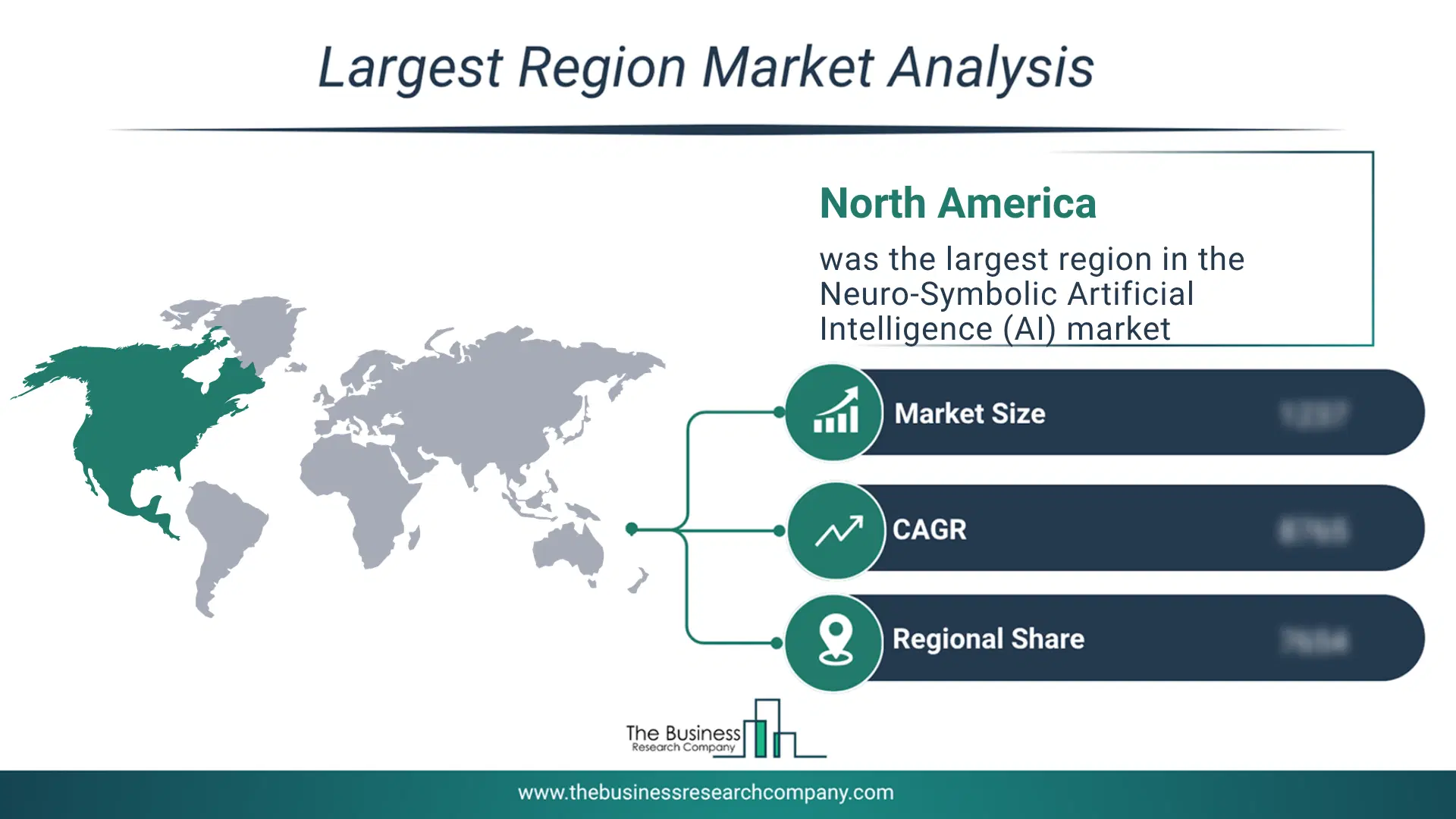
Regional Insights
North America was the largest region in the neuro-symbolic artificial intelligence market in 2025. Asia‑Pacific is expected to be the fastest-growing region in the forecast period. The regions covered in this market report are Asia-Pacific, South East Asia, Western Europe, Eastern Europe, North America, South America, Middle East, Africa. The countries covered in this market report are Australia, Brazil, China, France, Germany, India, Indonesia, Japan, Taiwan, Russia, South Korea, UK, USA, Canada, Italy, Spain.What Defines the Neuro-Symbolic Artificial Intelligence (AI) Market?
The neuro-symbolic artificial intelligence (AI) market consists of revenues earned by entities by providing services such as deployment and maintenance services, explain ability and auditing services, and ontology management services. The market value includes the value of related goods sold by the service provider or included within the service offering. The neuro-symbolic artificial intelligence market includes sales of high-performance computer servers, robotics platforms, smart sensors, and data storage appliances. Values in this market are ‘factory gate’ values, that is, the value of goods sold by the manufacturers or creators of the goods, whether to other entities (including downstream manufacturers, wholesalers, distributors, and retailers) or directly to end customers. The value of goods in this market includes related services sold by the creators of the goods.How is Market Value Defined and Measured?
The market value is defined as the revenues that enterprises gain from the sale of goods and/or services within the specified market and geography through sales, grants, or donations in terms of the currency (in USD unless otherwise specified). The revenues for a specified geography are consumption values that are revenues generated by organizations in the specified geography within the market, irrespective of where they are produced. It does not include revenues from resales along the supply chain, either further along the supply chain or as part of other products.
This chart presents market attractiveness based on a quantitative evaluation of growth, competition, strategic alignment, and risk, offering a clear view of opportunity areas for decision-making. This chart is for illustrative purposes; the full report contains the complete analysis.

This chart highlights the Total Addressable Market (TAM) by estimating the maximum revenue opportunity using an assumption-driven approach, supporting strategic planning and opportunity sizing across markets. The chart is illustrative; the full report provides a more comprehensive analysis.
What Key Data and Analysis Are Included in the Neuro-Symbolic Artificial Intelligence (AI) Market Report 2026?
The neuro-symbolic artificial intelligence (ai) market research report is one of a series of new reports from The Business Research Company that provides market statistics, including industry global market size, regional shares, competitors with the market share, detailed market segments, market trends and opportunities, and any further data you may need to thrive in the neuro-symbolic artificial intelligence (ai) industry. The market research report delivers a complete perspective of everything you need, with an in-depth analysis of the current and future state of the industry.Neuro-Symbolic Artificial Intelligence (AI) Market Report Forecast Analysis
| Report Attribute | Details |
|---|---|
| Market Size Value In 2026 | $2.13 billion |
| Revenue Forecast In 2030 | $6.31 billion |
| Growth Rate | CAGR of 31.1% from 2026 to 2030 |
| Base Year For Estimation | 2025 |
| Actual Estimates/Historical Data | 2020-2025 |
| Forecast Period | 2026 - 2030 |
| Market Representation | Revenue in USD Billion and CAGR from 2026 to 2030 |
| Segments Covered | Component, Deployment Mode, Technology, Application, End-User |
| Regional Scope | Asia-Pacific, Western Europe, Eastern Europe, North America, South America, Middle East, Africa |
| Country Scope | The Countries Covered In This Market Report Are Australia, Brazil, China, France, Germany, India, Indonesia, Japan, Taiwan, Russia, South Korea, Uk, Usa, Canada, Italy, Spain. |
| Key Companies Profiled | Microsoft Corporation, Lenovo Group Limited, International Business Machines Corporation, Qualcomm Incorporated, NVIDIA Corporation, ExtensityAI FlexCo, RAAPID Inc., ONTOTEXT AD, Stardog Union Inc., Kognitos Inc., Cycorp Inc., Abzu ApS, Franz Inc., Imandra Inc., Synfini Inc., icogz Inc., UMNAI Ltd., Growth Protocol Inc., Permion Inc., Lakmoos AI s.r.o., SynaLinks SAS, Rippletide |
| Customization Scope | Request for Customization |
| Pricing And Purchase Options | Explore Purchase Options |