
Neurointerventional Devices Market Report 2026
Global Outlook – By Product (Embolic Coils, Carotid Stents, Intracranial Stents, Neurovascular Thrombectomy, Embolic Protection Device, Flow Diverters Device, Intrasaccular Device, Other Products), By Indication (Brain Aneurysm, Stroke, Other Indications), By Technique (Neurothrombectomy Procedure, Cerebral Angiography, Stenting, Coiling Procedures, Flow Disruption), By End User (Hospitals, Ambulatory Surgical Centers, Specialty Clinics, Research Institutes) – Market Size, Trends, Strategies, and Forecast to 2030
Neurointerventional Devices Market Overview
• Neurointerventional Devices market size has reached to $2.76 billion in 2025 • Expected to grow to $3.91 billion in 2030 at a compound annual growth rate (CAGR) of 7.1% • Growth Driver: Rising Incidence Of Neurological Disorders Fueling The Growth Of The Market Due To Aging Population And Increasing Disease Burden • Market Trend: Advanced Aspiration Technologies Reshape Competitive Landscape In Neurointerventional • North America was the largest region in 2025.What Is Covered Under Neurointerventional Devices Market?
Neurointerventional devices are specialized medical tools used in minimally invasive procedures to diagnose and treat conditions affecting the blood vessels of the brain, spine, head, and neck. Their primary purpose is to restore or improve blood flow, remove clots, repair aneurysms, or treat vascular malformations without the need for open surgery. The main product types of neurointerventional devices include embolic coils, carotid stents, intracranial stents, neurovascular thrombectomy devices, embolic protection devices, flow diverters, intrasaccular devices, and others. Embolic coils are small, flexible metal devices used in neurointerventional procedures to block blood flow within an aneurysm or abnormal blood vessel, promoting clotting and preventing rupture or bleeding. These devices are used for various indications such as brain aneurysm, strokes, and others. They are employed through different techniques including neurothrombectomy procedures, cerebral angiography, stenting, coiling procedures, and flow disruption. The key end users include hospitals, ambulatory surgical centers, specialty clinics, and research institutes.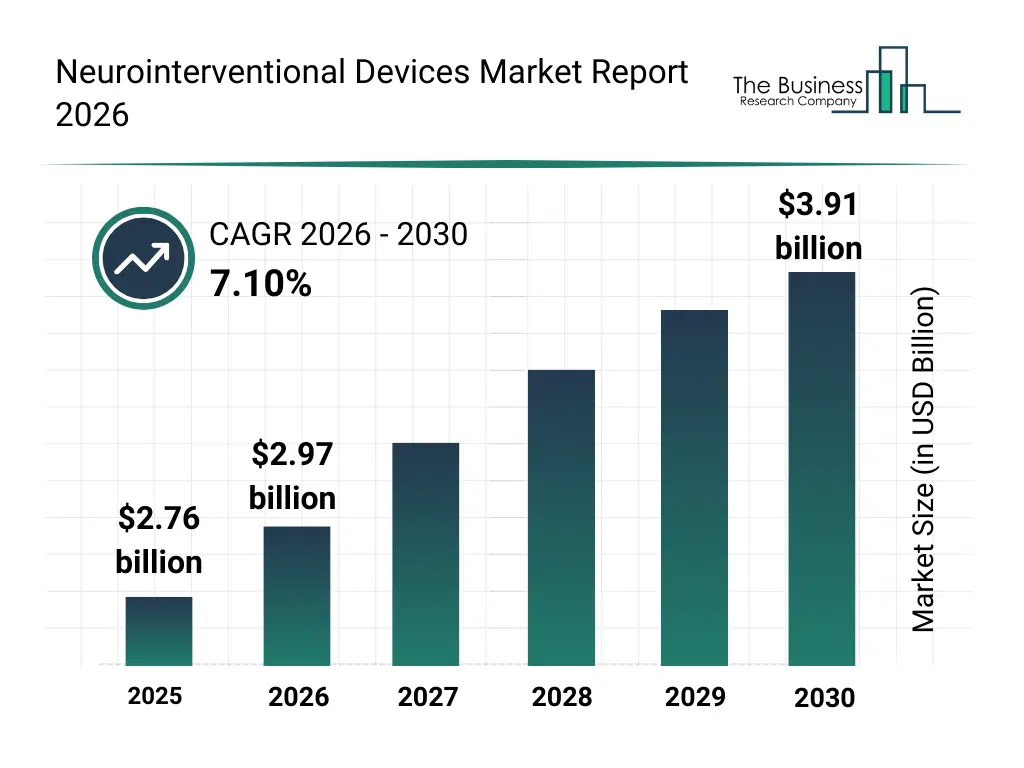
What Is The Neurointerventional Devices Market Size and Share 2026?
The neurointerventional devices market size has grown strongly in recent years. It will grow from $2.76 billion in 2025 to $2.97 billion in 2026 at a compound annual growth rate (CAGR) of 7.6%. The growth in the historic period can be attributed to rising prevalence of stroke and aneurysm, improvements in catheter and stent design, increasing neurology specialist training programs, growing adoption of minimally invasive procedures, expansion of hospital neurovascular departments.What Is The Neurointerventional Devices Market Growth Forecast?
The neurointerventional devices market size is expected to see strong growth in the next few years. It will grow to $3.91 billion in 2030 at a compound annual growth rate (CAGR) of 7.1%. The growth in the forecast period can be attributed to aging population growth, increasing investments in neurovascular research, expansion of comprehensive stroke centers, demand for faster reperfusion outcomes, rising healthcare expenditure in emerging economies. Major trends in the forecast period include advanced image-guided neurointervention, shift toward minimally invasive stroke treatment, rising adoption of flow diversion technologies, increasing demand for rapid clot retrieval devices, expansion of neurointerventional procedures in emerging markets.
Global Neurointerventional Devices Market Segmentation
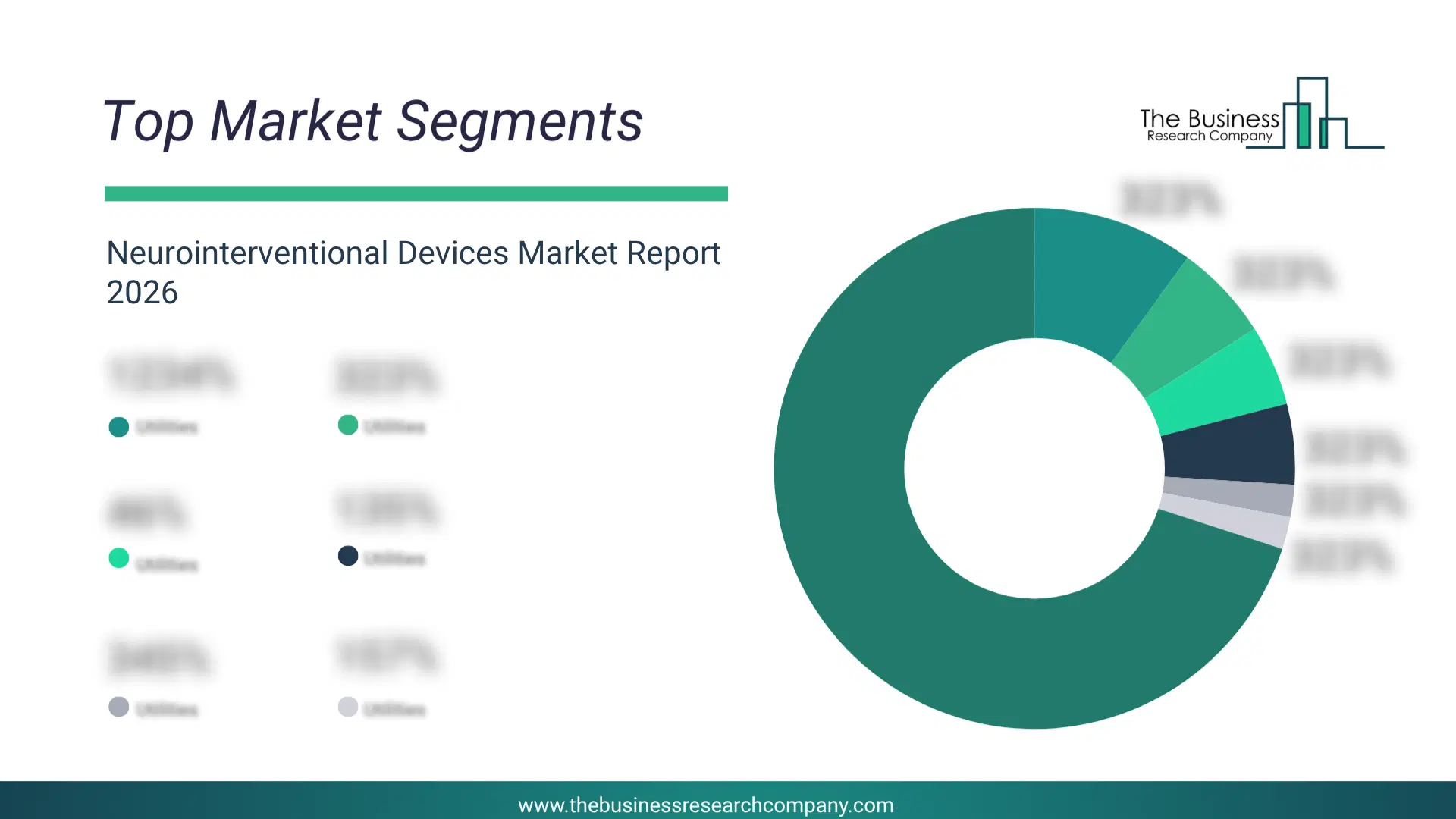
1) By Product: Embolic Coils, Carotid Stents, Intracranial Stents, Neurovascular Thrombectomy, Embolic Protection Device, Flow Diverters Device, Intrasaccular Device, Other Products 2) By Indication: Brain Aneurysm, Stroke, Other Indications 3) By Technique: Neurothrombectomy Procedure, Cerebral Angiography, Stenting, Coiling Procedures, Flow Disruption 4) By End User: Hospitals, Ambulatory Surgical Centers, Specialty Clinics, Research Institutes Subsegments: 1) By Embolic Coils: Bare Platinum Coils, Coated Or Modified Coils, Complex-Shaped Coils, Detachable Coils 2) By Carotid Stents: Open-Cell Stents, Closed-Cell Stents, Hybrid-Cell Stents, Drug-Eluting Stents 3) By Intracranial Stents: Self-Expanding Stents, Balloon-Expandable Stents, Drug-Eluting Stents 4) By Neurovascular Thrombectomy Devices: Stent Retrievers, Aspiration Catheters, Combined Thrombectomy Systems 5) By Embolic Protection Devices: Distal Filters, Proximal Occlusion Devices, Distal Occlusion Devices 6) By Flow Diverters Devices: Braided Flow Diverters, Dual-Layer Flow Diverters, Coated Flow Diverters 7) By Intrasaccular Devices: Woven Mesh Implants, Expandable Mesh Baskets, Flow Disrupting Implants 8) By Other Products: Microcatheters, Guidewires, Balloon Catheters, Distal Access CathetersWhat Is The Driver Of The Neurointerventional Devices Market?
The rising incidence of neurological disorders is expected to propel the growth of the neurointerventional devices market going forward. A neurological disorder refers to any condition that affects the brain, spinal cord, or nerves, disrupting normal functioning. The increase in neurological disorders is driven by an aging global population, as advancing age increases the risk of neurodegenerative conditions due to the natural decline in brain function and cellular repair mechanisms. Neurointerventional devices help treat neurological disorders by enabling minimally invasive procedures to diagnose and manage conditions such as brain aneurysms, strokes, and vascular malformations, thereby reducing risk and recovery time and improving patient outcomes. For instance, in April 2024, according to a report by the Alzheimer's Association, a US-based nonprofit voluntary health organization, in 2022, 6.5 million Americans aged 65 and older were diagnosed with Alzheimer's dementia, increasing to 6.9 million in 2024. Therefore, the rising incidence of neurological disorders is driving the growth of the neurointerventional devices industry.Key Players In The Global Neurointerventional Devices Market
Major companies operating in the neurointerventional devices market are Medtronic plc, Stryker Corporation, Johnson And Johnson, Abbott Laboratories, Boston Scientific Corporation, Terumo Corporation, Kaneka Corporation, Cook Medical LLC, Merit Medical Systems Inc., MicroPort Scientific Corporation, Penumbra Inc., Asahi Intecc Co Ltd, MicroVention Inc, Phenox GmbH, Balt Group SAS, Balton Sp z o o, Zylox Tonbridge Medical Technology Co Ltd, Veiva Scientific Co Ltd, InspireMD Inc, Rapid Medical Ltd, Wallaby Medical, Cerus Endovascular Ltd
This chart is for illustrative purposes; the full report includes a detailed competitor analysis and comprehensive overview of the top 10 companies in the market.
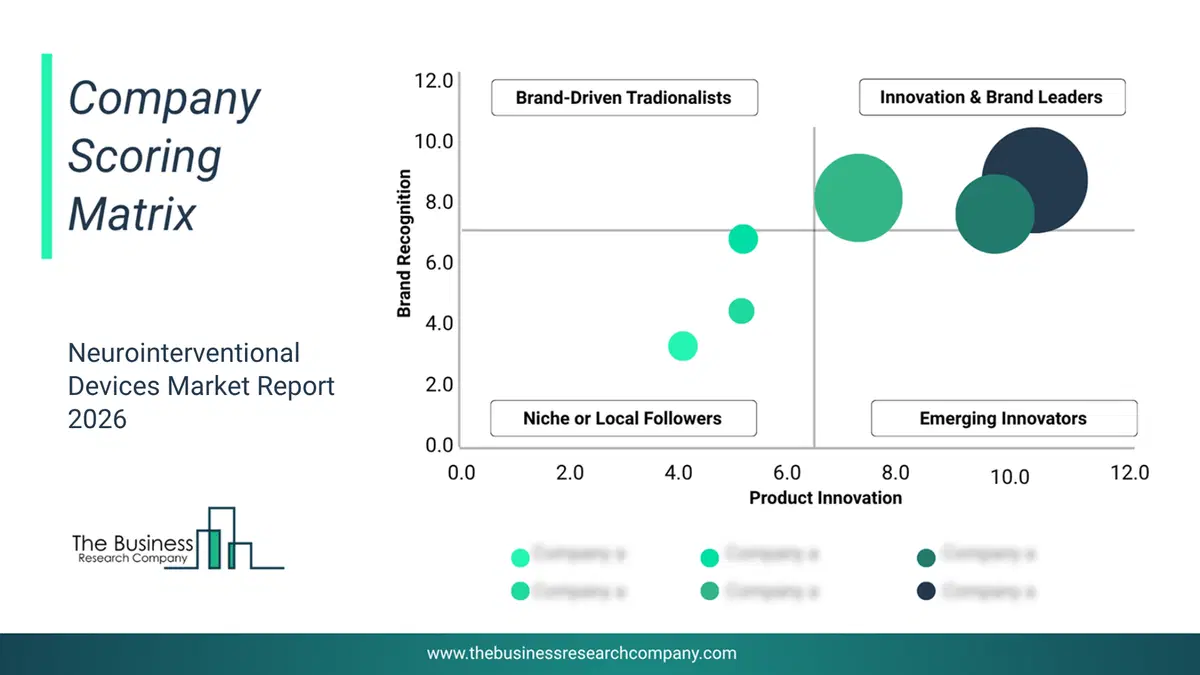
This chart maps companies by product innovation and brand strength, with bubble size indicating relative revenue, helping identify market leaders, challengers, and niche players. This is an illustrative chart; the full report provides a complete and accurate competitive analysis.
Global Neurointerventional Devices Market Trends and Insights
Major companies operating in the neurointerventional devices market are focusing on developing innovative solutions, such as large-bore aspiration reperfusion catheters with advanced delivery aids. Aspiration reperfusion catheters are long, large-lumen, flexible catheters engineered to deliver powerful distal vacuum aspiration directly at the clot site; compared with traditional stent-retriever techniques they emphasize direct aspiration (sometimes combined with adjunctive devices) to remove occlusions with fewer device passes, lower device complexity at the clot face, and potentially shorter procedure workflow. For instance, in May 2024, Penumbra Inc., a US-based medical device company, launched RED 43, RED 72 with SENDit Technology, and RED 78, a family of neurovascular reperfusion catheters introduced to Europe that expand the company’s aspiration-based thrombectomy offerings. The RED devices are composed of multi-layer catheter shafts (PTFE liners, hybrid stainless steel/nitinol coils) and precision polymer distal tips to balance lumen size with distal trackability; they function by advancing the catheter to or near the thrombus and applying aspiration via Penumbra’s ENGINE aspiration source to extract clot. Unique features include engineered transition zones and REDglide technology for improved deliverability through tortuous vessels, a range of lumen sizes.What Are Latest Mergers And Acquisitions In The Neurointerventional Devices Market?
In September 2024, Boston Scientific, a US-based medical technology company, acquired Silk Road Medical for approximately $1.18 billion. With this acquisition, Boston Scientific aims to expand its portfolio in vascular surgery, enhance its stroke prevention offerings, and accelerate its mission to transform patient treatment paradigms for vascular disease. Silk Road Medical is a US-based company that specializes in medical devices such as transcarotid artery revascularization systems, including the ENROUTE transcarotid neuroprotection and stent systems.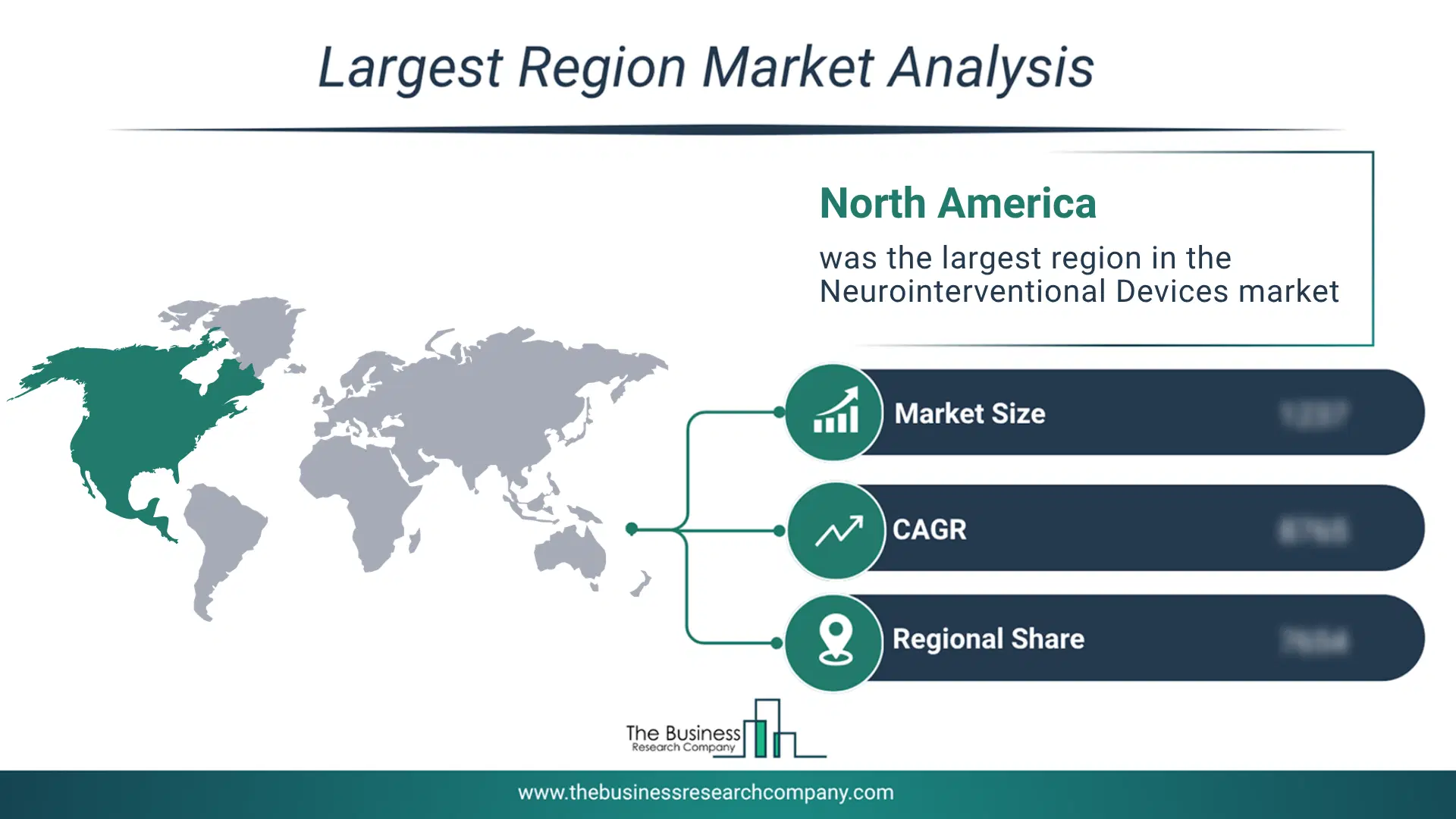
Regional Outlook
North America was the largest region in the neurointerventional market in 2025. The regions covered in this market report are Asia-Pacific, South East Asia, Western Europe, Eastern Europe, North America, South America, Middle East, Africa. The countries covered in this market report are Australia, Brazil, China, France, Germany, India, Indonesia, Japan, Taiwan, Russia, South Korea, UK, USA, Canada, Italy, SpainWhat Defines the Neurointerventional Devices Market?
The neurointerventional devices market consists of sales of catheters, stents, embolic coils, thrombectomy devices, and guidewires. Values in this market are ‘factory gate’ values, that is, the value of goods sold by the manufacturers or creators of the goods, whether to other entities (including downstream manufacturers, wholesalers, distributors, and retailers) or directly to end customers. The value of goods in this market includes related services sold by the creators of the goods.How is Market Value Defined and Measured?
The market value is defined as the revenues that enterprises gain from the sale of goods and/or services within the specified market and geography through sales, grants, or donations in terms of the currency (in USD unless otherwise specified). The revenues for a specified geography are consumption values that are revenues generated by organizations in the specified geography within the market, irrespective of where they are produced. It does not include revenues from resales along the supply chain, either further along the supply chain or as part of other products.
This chart presents market attractiveness based on a quantitative evaluation of growth, competition, strategic alignment, and risk, offering a clear view of opportunity areas for decision-making. This chart is for illustrative purposes; the full report contains the complete analysis.

This chart highlights the Total Addressable Market (TAM) by estimating the maximum revenue opportunity using an assumption-driven approach, supporting strategic planning and opportunity sizing across markets. The chart is illustrative; the full report provides a more comprehensive analysis.
What Key Data and Analysis Are Included in the Neurointerventional Devices Market Report 2026?
The neurointerventional devices market research report is one of a series of new reports from The Business Research Company that provides market statistics, including industry global market size, regional shares, competitors with the market share, detailed market segments, market trends and opportunities, and any further data you may need to thrive in the neurointerventional devices industry. The market research report delivers a complete perspective of everything you need, with an in-depth analysis of the current and future state of the industry.Neurointerventional Devices Market Report Forecast Analysis
| Report Attribute | Details |
|---|---|
| Market Size Value In 2026 | $2.97 billion |
| Revenue Forecast In 2030 | $3.91 billion |
| Growth Rate | CAGR of 7.1% from 2026 to 2030 |
| Base Year For Estimation | 2025 |
| Actual Estimates/Historical Data | 2020-2025 |
| Forecast Period | 2026 - 2030 |
| Market Representation | Revenue in USD Billion and CAGR from 2026 to 2030 |
| Segments Covered | Product, Indication, Technique, End User |
| Regional Scope | Asia-Pacific, Western Europe, Eastern Europe, North America, South America, Middle East, Africa |
| Country Scope | The countries covered in the report are Australia, Brazil, China, France, Germany, India, Indonesia, Japan, Taiwan, Russia, South Korea, UK, USA, Canada, Italy, Spain. |
| Key Companies Profiled | Medtronic plc, Stryker Corporation, Johnson And Johnson, Abbott Laboratories, Boston Scientific Corporation, Terumo Corporation, Kaneka Corporation, Cook Medical LLC, Merit Medical Systems Inc., MicroPort Scientific Corporation, Penumbra Inc., Asahi Intecc Co Ltd, MicroVention Inc, Phenox GmbH, Balt Group SAS, Balton Sp z o o, Zylox Tonbridge Medical Technology Co Ltd, Veiva Scientific Co Ltd, InspireMD Inc, Rapid Medical Ltd, Wallaby Medical, Cerus Endovascular Ltd |
| Customization Scope | Request for Customization |
| Pricing And Purchase Options | Explore Purchase Options |