
Neuromorphic Chips Market Report 2026
Global Outlook – By Components ( Software, Hardware), By Function ( Signal Processing, Data Processing, Image Recognition, Process optimization), By End Use Industry ( Aerospace And Defense, Automotive, Healthcare, Industrial, Consumer Electronics, Other End User Industries) – Market Size, Trends, Strategies, and Forecast to 2030
Neuromorphic Chips Market Overview
• Neuromorphic Chips market size has reached to $0.77 billion in 2025 • Expected to grow to $1.38 billion in 2030 at a compound annual growth rate (CAGR) of 12.2% • Growth Driver: Neuromorphic Chips Market Surge Fueled By Rising Demand In Robotics And Automation • Market Trend: Launch Of Innovative Neuromorphic Development Kit For Enhanced Edge AI Applications • North America was the largest region in 2025 and Asia-Pacific is the fastest growing region.What Is Covered Under Neuromorphic Chips Market?
Neuromorphic chips are computer hardware designed to mimic the structure and function of the human brain. They use artificial neurons and synapses to process information, allowing them to solve problems, recognize patterns, and make decisions more quickly and efficiently than traditional computers. These chips are characterized by collocated processing and memory and massively parallel processing, enabling them to perform multiple functions simultaneously. The main components of neuromorphic chips are software and hardware. Software refers to the programs, algorithms, and codes that are designed to run on or interact with these specialized chips. The various functions include signal processing, data processing, image recognition, and process optimization and are used by various end-use industries such as aerospace and defense, automotive, healthcare, industrial, consumer electronics, and other end-user industries.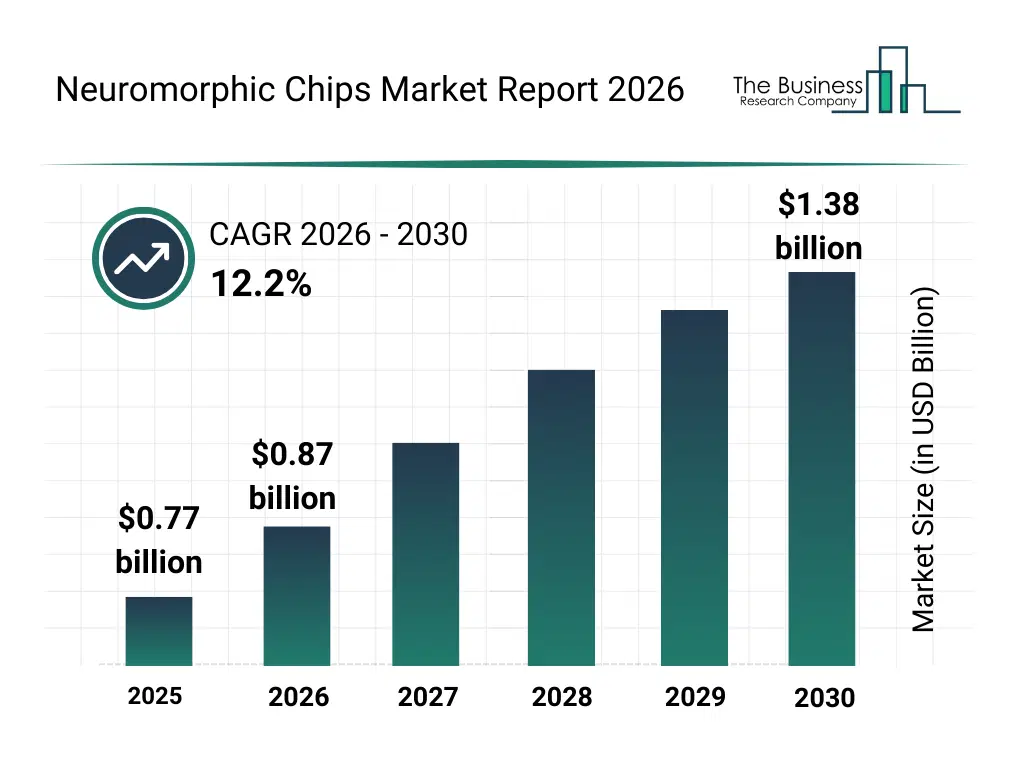
What Is The Neuromorphic Chips Market Size 2026 And Growth Rate?
The neuromorphic chips market size has grown rapidly in recent years. It will grow from $0.77 billion in 2025 to $0.87 billion in 2026 at a compound annual growth rate (CAGR) of 12.5%. The growth in the historic period can be attributed to rise in early neuromorphic research initiatives, advancements in semiconductor miniaturization, increased adoption of AI in embedded systems, development of low power processing architectures, initial commercialization of neuromorphic processors.What Is The Neuromorphic Chips Market Growth Forecast?
The neuromorphic chips market size is expected to see rapid growth in the next few years. It will grow to $1.38 billion in 2030 at a compound annual growth rate (CAGR) of 12.2%. The growth in the forecast period can be attributed to growing demand for autonomous decision making hardware, expansion of edge AI applications, rise in smart robotics deployments, increasing investments in neuromorphic r&d, integration of neuromorphic chips into consumer electronics. Major trends in the forecast period include increasing integration of neuromorphic chips in edge AI systems, growing adoption of brain inspired computing architectures, rising use of neuromorphic chips for autonomous decision making, surging application of neuromorphic hardware in industrial automation, expanding deployment of neuromorphic technology for smart mobility, advancements in spiking neural network architectures, rising demand for ultra low power high efficiency processors, increased deployment of memristor based neuromorphic hardware, growing use of neuromorphic systems for real time pattern recognition, expansion of neuromorphic computing in robotics and automation.
Global Neuromorphic Chips Market Segmentation
1) By Components: Software, Hardware 2) By Function: Signal Processing, Data Processing, Image Recognition, Process optimization 3) By End Use Industry: Aerospace And Defense, Automotive, Healthcare, Industrial, Consumer Electronics, Other End User Industries Subsegments: 1) By Software: Neuromorphic Programming Environments, Simulation And Modeling Tools, Machine Learning Algorithms For Neuromorphic Systems, Data Processing And Analytics Software, Development And Debugging Tools 2) By Hardware: Neuromorphic Processors, Neuromorphic Sensors, Specialized Integrated Circuits (Ics), Field-Programmable Gate Arrays (Fpgas) For Neuromorphic Applications, Neuromorphic Chip Systems And PlatformsWhat Is The Driver Of The Neuromorphic Chips Market?
The growing demand for robotics and automation is expected to propel the growth of the neuromorphic chips market going forward. Robotics and automation refer to the use of computers, control systems, and information technology to handle industrial processes and machinery. Robotics and automation use neuromorphic chips to utilize brain-inspired computing concepts to increase the capabilities of automated systems and robots. For instance, in September 2024, according to International Federation of Robotics, a Germany-based non-profit organization, in 2023, industrial robot installations in Europe grew by 9%, reaching a new peak of 92,393 units. Of these, 80% were installed in the European Union, totaling 73,534 units a 2% increase from the previous year. Therefore, the growing demand for robotics and automation is driving the growth of the neuromorphic chips industry.Key Players In The Global Neuromorphic Chips Market
Major companies operating in the neuromorphic chips market are Samsung Electronics Limited, Lockheed Martin Corporation, Intel Corp., International Business Machine Corporation, IBM Corporation, SK Hynix Inc., Qualcomm, Hewlett Packard Enterprise, Cadence Design Systems Inc., Nepes Corp., Nepes Corporation, CEA Leti, HRL Laboratories LLC, Altium LLC, SynSense AG, Innatera, Brain Corporation, Vicarious FPC Inc., GrAI Matter Labs, Gyrfalcon Technology Inc, Ceryx Medical, Brain chip Holdings Ltd., Numenta, Inc., Koniku, Applied Brain Research, Inc., General Vision Inc., Knowm Inc.
This chart is for illustrative purposes; the full report includes a detailed competitor analysis and comprehensive overview of the top 10 companies in the market.
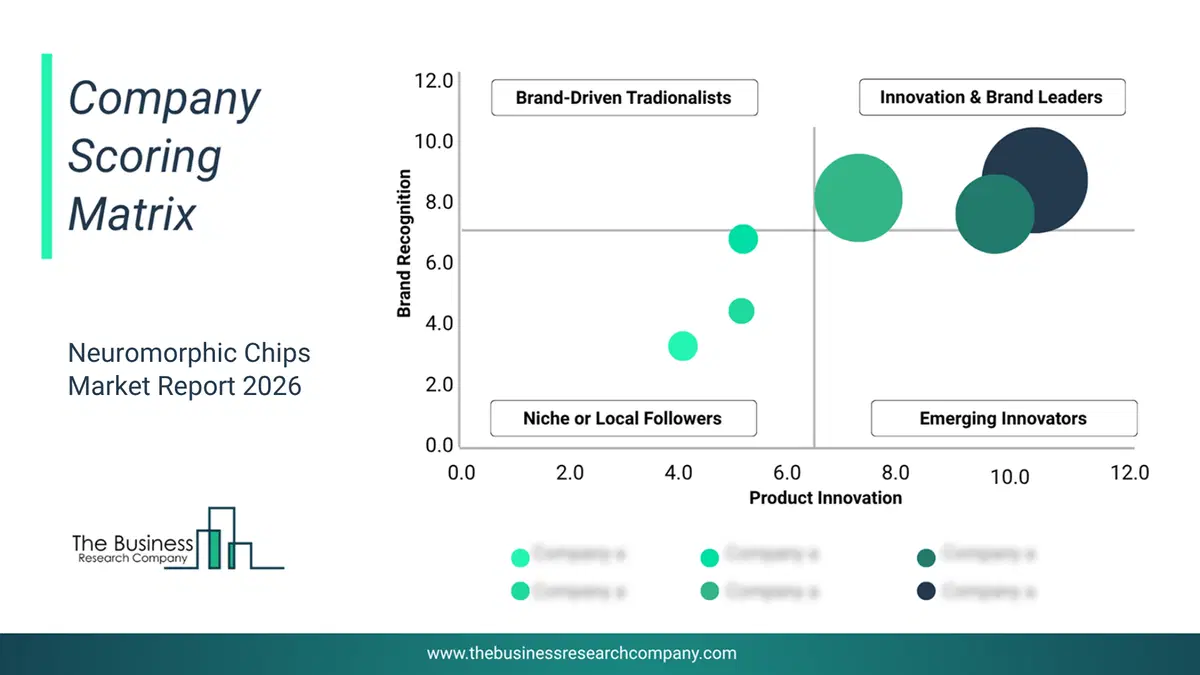
This chart maps companies by product innovation and brand strength, with bubble size indicating relative revenue, helping identify market leaders, challengers, and niche players. This is an illustrative chart; the full report provides a complete and accurate competitive analysis.
Global Neuromorphic Chips Market Trends and Insights
Major companies operating in the neuromorphic chips market are focused on developing innovative solutions, such as neuromorphic development kits, for smart wearables and industrial monitoring devices. A neuromorphic development kit is a tool designed for building and testing AI systems that mimic the brain's neural processing, enabling efficient, low-power sensory data processing in applications like robotics and IoT. For instance, in September 2023, SynSense AG, a Switzerland-based company that specializes in neuromorphic intelligence and application solutions, launched the Xylo IMU HDK, a neuromorphic development kit. The Xylo IMU HDK is a neuromorphic development kit featuring a specialized chip designed for ultra-low-power motion processing applications, enabling human movement analysis, industrial monitoring, and human-computer interaction. It includes a 3-axis accelerometer, configurable SNN processing, and a flexible power-efficient design suitable for various wearables and monitoring devices.What Are Latest Mergers And Acquisitions In The Neuromorphic Chips Market?
In February 2024, SynSense, a China-based provider of ultra-low-power neuromorphic processors and edge-AI chips, acquired iniVation for an undisclosed amount. With this acquisition, SynSense aims to create an end-to-end neuromorphic platform, enhancing its technological capabilities by combining neuromorphic vision sensing with its processing solutions. iniVation is a Switzerland-based provider of neuromorphic vision sensors and event-based camera systems for applications in robotics, consumer electronics, automotive, and industrial markets.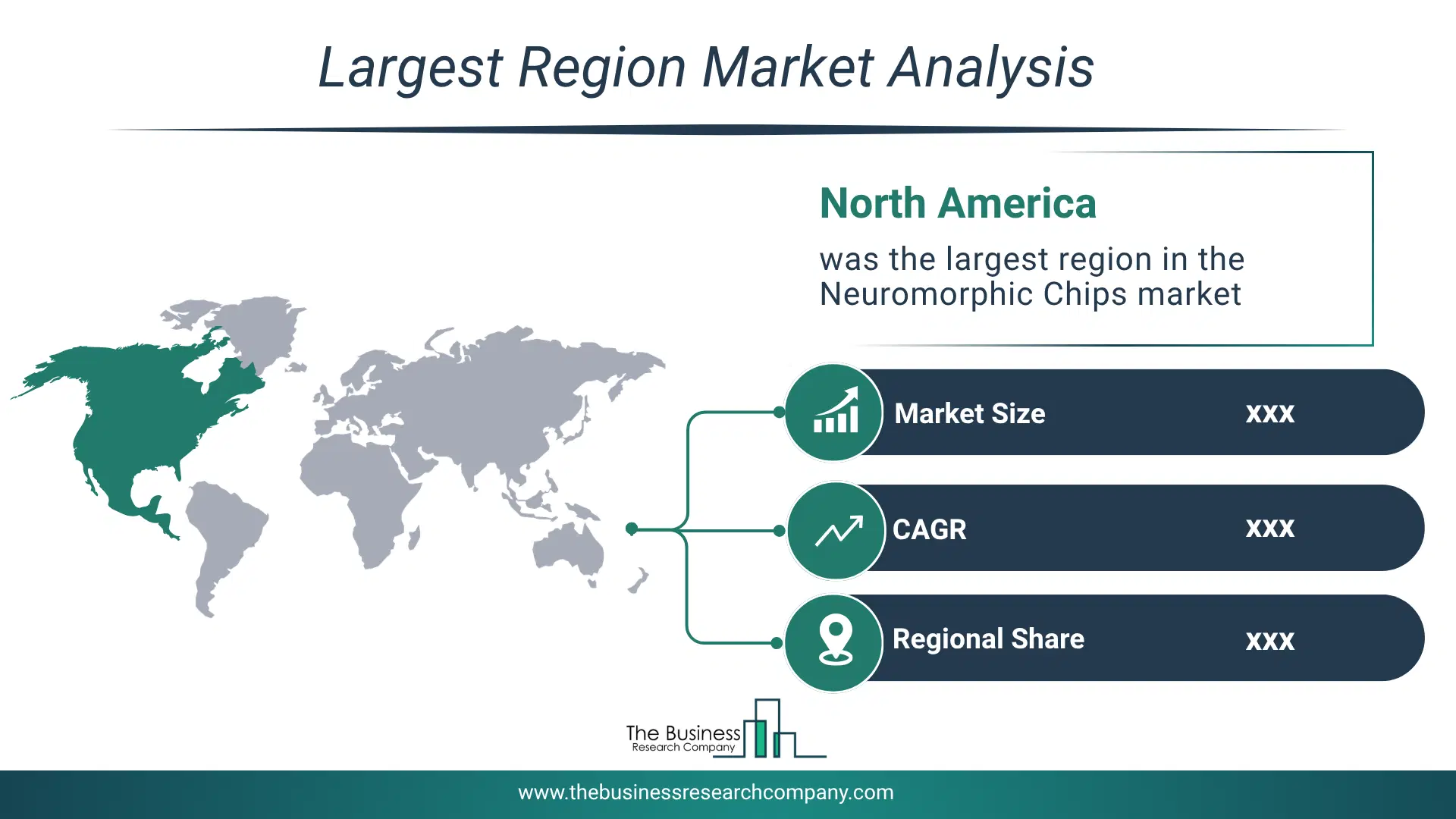
Regional Outlook
North America was the largest region in the neuromorphic chips market in 2025. Asia-Pacific is expected to be the fastest-growing region in the forecast period. The regions covered in this market report are Asia-Pacific, South East Asia, Western Europe, Eastern Europe, North America, South America, Middle East, Africa. The countries covered in this market report are Australia, Brazil, China, France, Germany, India, Indonesia, Japan, Taiwan, Russia, South Korea, UK, USA, Canada, Italy, Spain.What Defines the Neuromorphic Chips Market?
The neuromorphic chips market consists of sales of spiking neural networks (SNNs) chips, truenorth chips, loihi chips, memristor-based chips, and mixed-signal neuromorphic chips. Values in this market are ‘factory gate’ values, that is the value of goods sold by the manufacturers or creators of the goods, whether to other entities (including downstream manufacturers, wholesalers, distributors and retailers) or directly to end customers. The value of goods in this market includes related services sold by the creators of the goods.How is Market Value Defined and Measured?
The market value is defined as the revenues that enterprises gain from the sale of goods and/or services within the specified market and geography through sales, grants, or donations in terms of the currency (in USD unless otherwise specified). The revenues for a specified geography are consumption values that are revenues generated by organizations in the specified geography within the market, irrespective of where they are produced. It does not include revenues from resales along the supply chain, either further along the supply chain or as part of other products.
This chart presents market attractiveness based on a quantitative evaluation of growth, competition, strategic alignment, and risk, offering a clear view of opportunity areas for decision-making. This chart is for illustrative purposes; the full report contains the complete analysis.

This chart highlights the Total Addressable Market (TAM) by estimating the maximum revenue opportunity using an assumption-driven approach, supporting strategic planning and opportunity sizing across markets. The chart is illustrative; the full report provides a more comprehensive analysis.
What Key Data and Analysis Are Included in the Neuromorphic Chips Market Report 2026?
The neuromorphic chips market research report is one of a series of new reports from The Business Research Company that provides market statistics, including industry global market size, regional shares, competitors with the market share, detailed market segments, market trends and opportunities, and any further data you may need to thrive in the neuromorphic chips industry. The market research report delivers a complete perspective of everything you need, with an in-depth analysis of the current and future state of the industry.Neuromorphic Chips Market Report Forecast Analysis
| Report Attribute | Details |
|---|---|
| Market Size Value In 2026 | $0.87 billion |
| Revenue Forecast In 2030 | $1.38 billion |
| Growth Rate | CAGR of 12.2% from 2026 to 2030 |
| Base Year For Estimation | 2025 |
| Actual Estimates/Historical Data | 2020-2025 |
| Forecast Period | 2026 - 2030 |
| Market Representation | Revenue in USD Billion and CAGR from 2026 to 2030 |
| Segments Covered | Components, Function, End Use Industry |
| Regional Scope | Asia-Pacific, Western Europe, Eastern Europe, North America, South America, Middle East, Africa |
| Country Scope | The countries covered in the report are Australia, Brazil, China, France, Germany, India, Indonesia, Japan, Taiwan, Russia, South Korea, UK, USA, Canada, Italy, Spain. |
| Key Companies Profiled | Samsung Electronics Limited, Lockheed Martin Corporation, Intel Corp., International Business Machine Corporation, IBM Corporation, SK Hynix Inc., Qualcomm, Hewlett Packard Enterprise, Cadence Design Systems Inc., Nepes Corp., Nepes Corporation, CEA Leti, HRL Laboratories LLC, Altium LLC, SynSense AG, Innatera, Brain Corporation, Vicarious FPC Inc., GrAI Matter Labs, Gyrfalcon Technology Inc, Ceryx Medical, Brain chip Holdings Ltd., Numenta, Inc., Koniku, Applied Brain Research, Inc., General Vision Inc., Knowm Inc. |
| Customization Scope | Request for Customization |
| Pricing And Purchase Options | Explore Purchase Options |