
Neuromorphic Hardware Market Report 2026
Global Outlook – By Hardware Type (Digital Complementary Metal–Oxide–Semiconductor Or Neuromorphic, Analog Or Mixed-Signal Neuromorphic, Memristive Or Resistive, Photonic Neuromorphic, Spintronic Or Magnetic Tunnel Junction-Based), By Component (Processors Or Chips, Sensors, Memory, Software Development Kits And Development Tools, Reference Designs And Eval Kits), By Deployment (On-Premises, Cloud-Based, Hybrid, Data-Center Accelerators), By Application (Image Recognition, Signal Processing), By End-Use Industry (Information Technology And Telecom, Automotive And Transportation, Healthcare And Life Sciences, Consumer Electronics, Aerospace And Defense, Industrial And Manufacturing, Others End-Use Industries) – Market Size, Trends, Strategies, and Forecast to 2030
Neuromorphic Hardware Market Overview
• Neuromorphic Hardware market size has reached to $0.06 billion in 2025 • Expected to grow to $0.18 billion in 2030 at a compound annual growth rate (CAGR) of 24.7% • Growth Driver: Expansion Of Autonomous Vehicles And Robotics Fueling The Growth Of The Market Due To Increasing Need For Human-Like Real-Time Processing And Adaptive Intelligence • Market Trend: Advancing Large-Scale Neuromorphic Systems To Enable Energy-Efficient, Brain-Inspired AI Computing At Unprecedented Scale • North America was the largest region in 2025 and Asia-Pacific is the fastest growing region.What Is Covered Under Neuromorphic Hardware Market?
Neuromorphic hardware refers to computing systems designed to mimic the structure and functioning of biological neural networks using specialized architectures, materials, and circuits. It operates by processing information through event-driven, parallel, and energy-efficient mechanisms that replicate how neurons and synapses communicate in the human brain. This hardware is significant because it enables faster, low-power, and adaptive computation for advanced artificial intelligence applications that require real-time learning and sensory processing. The main hardware types of the neuromorphic hardware include digital complementary metal–oxide–semiconductor (CMOS) or neuromorphic, analog or mixed-signal neuromorphic, memristive or resistive, photonic neuromorphic, and spintronic or magnetic tunnel junction–based hardware. Digital CMOS or neuromorphic hardware refers to processors designed using standard digital CMOS technology to emulate neural network architectures, enabling high-speed computation and energy efficiency. Different components are processors or chips, sensors, memory, software development kits and development tools, and reference designs and evaluation kits. Multiple deployments are on-premises, cloud-based, hybrid, and data-center accelerators. Various applications are image recognition, signal processing, data classification, object detection, robotics control, and edge artificial intelligence processing, and they are used by several end-use industries such as information technology and telecom, automotive and transportation, healthcare and life sciences, consumer electronics, aerospace and defense, industrial and manufacturing, and others.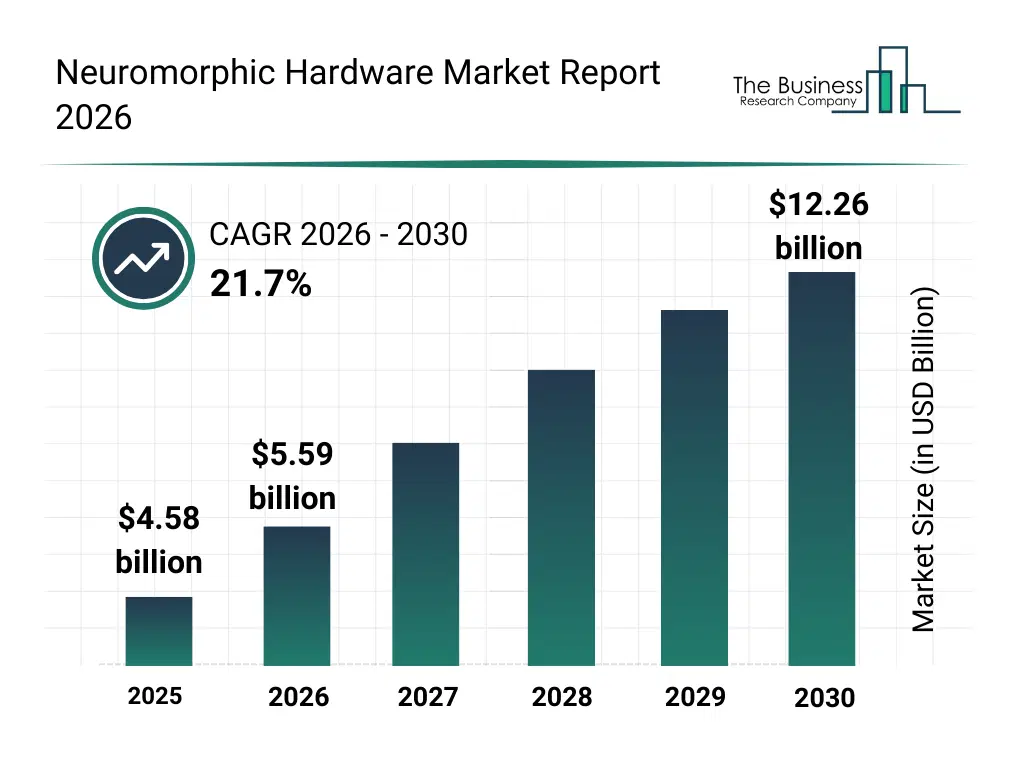
What Is The Neuromorphic Hardware Market Size and Share 2026?
The neuromorphic hardware market size has grown exponentially in recent years. It will grow from $0.06 billion in 2025 to $0.07 billion in 2026 at a compound annual growth rate (CAGR) of 28.1%. The growth in the historic period can be attributed to increasing demand for low-power computing, growing adoption of AI workloads, rising need fOrreal-time data processing, expanding use of edge computing devices, and growing interest in brain-inspired architectures.What Is The Neuromorphic Hardware Market Growth Forecast?
The neuromorphic hardware market size is expected to see exponential growth in the next few years. It will grow to $0.18 billion in 2030 at a compound annual growth rate (CAGR) of 24.7%. The growth in the forecast period can be attributed to increasing deployment of artificial intelligence (AI) at the edge, growing integration in autonomous systems, rising demand for energy-efficient processors, expanding applications in robotics and healthcare, and growing investments in neuromorphic. Major trends in the forecast period include technology advancements in memristive architectures, innovations in spiking neural network designs, developments in event-driven neuromorphic sensors, research and developments in photonic computing, advancements in hybrid neuromorphic-artificial intelligence (AI) chip integration.
Global Neuromorphic Hardware Market Segmentation
2) By Component: Processors Or Chips, Sensors, Memory, Software Development Kits And Development Tools, Reference Designs And Eval Kits 3) By Deployment: On-Premises, Cloud-Based, Hybrid, Data-Center Accelerators 4) By Application: Image Recognition, Signal Processing, Data Classification, Object Detection, Robotics Control, Edge Artificial Intelligence Processing 5) By End-Use Industry: Information Technology And Telecom, Automotive And Transportation, Healthcare And Life Sciences, Consumer Electronics, Aerospace And Defense, Industrial And Manufacturing, Others End-Use Industries Subsegments: 1) By Digital Complementary Metal–Oxide–Semiconductor Neuromorphic: Complementary Metal–Oxide–Semiconductor Based Processors, Complementary Metal–Oxide–Semiconductor Based Memory Devices, Complementary Metal–Oxide–Semiconductor Based Neuromorphic Circuits, Complementary Metal–Oxide–Semiconductor Based Integrated Systems 2) By Analog Or Mixed-Signal Neuromorphic: Analog Synaptic Array Circuits, Mixed-Signal Neuromorphic Processing Units, Analog Neural Network Accelerators, Mixed-Signal Computational Cores 3) By Memristive Or Resistive: Memristor Based Synaptic Devices, Resistive Random Access Memory Arrays, Memristive Neural Network Accelerators, Resistive Switching Logic Elements 4) By Photonic Neuromorphic: Photonic Neural Network Processors, Optical Synaptic Interconnect Devices, Photonic Computing Modules, Integrated Photonic Neuromorphic Circuits 5) By Spintronic Or Magnetic Tunnel Junction-Based Hardware Types: Spintronic Synaptic Element Arrays, Magnetic Tunnel Junction Neural Cores, Spintronic Logic Processing Units, Spintronic Memory Accelerator DevicesWhat Is The Driver Of The Neuromorphic Hardware Market?
The expansion of autonomous vehicles and robotics is expected to propel the growth of the neuromorphic hardware market going forward. Autonomous vehicles and robotics refer to systems capable of performing tasks with minimal or no human intervention by using advanced sensors, processors, and machine-learning algorithms to perceive, interpret, and respond to their environment. The rise in autonomous vehicles and robotics is due to the growing need for automation and operational efficiency across industries such as transportation, manufacturing, logistics, and defense. Neuromorphic hardware supports expansion of autonomous vehicles and robotics by mimicking the neural architecture of the human brain, enabling ultra-low-latency processing, real-time learning, low-power computation, and adaptive intelligence that traditional processors cannot achieve. For instance, in September 2025, according to the International Federation of Robotics, a Germany-based industry association representing the robotics sector, in 2024, China recorded 2,027,000 industrial robots working in factories, compared to just over 1,890,000 units in 2023, with annual installations reaching 295,000 units, up 7% from the previous year, representing 54% of global demand and marking the highest level ever recorded. Therefore, the expansion of autonomous vehicles and robotics is driving the growth of the neuromorphic hardware industry.Key Players In The Global Neuromorphic Hardware Market
Major companies operating in the neuromorphic hardware market are Samsung Electronics Co. Ltd., International Business Machines Corporation, Intel Corporation, Mythic Inc., Prophesee S.A., SynSense AG, Innatera Nanosystems B.V., Crocus Technology Inc., Syntiant Corp., Aspinity Inc., Crossbar Inc., GrAI Matter Labs (GML), BrainChip Holdings Ltd., Weebit Nano Ltd., iniVation AG, Knowm Inc., Neurophos Ltd., Eta Compute Inc., Applied Brain Research Inc., MemryX Inc.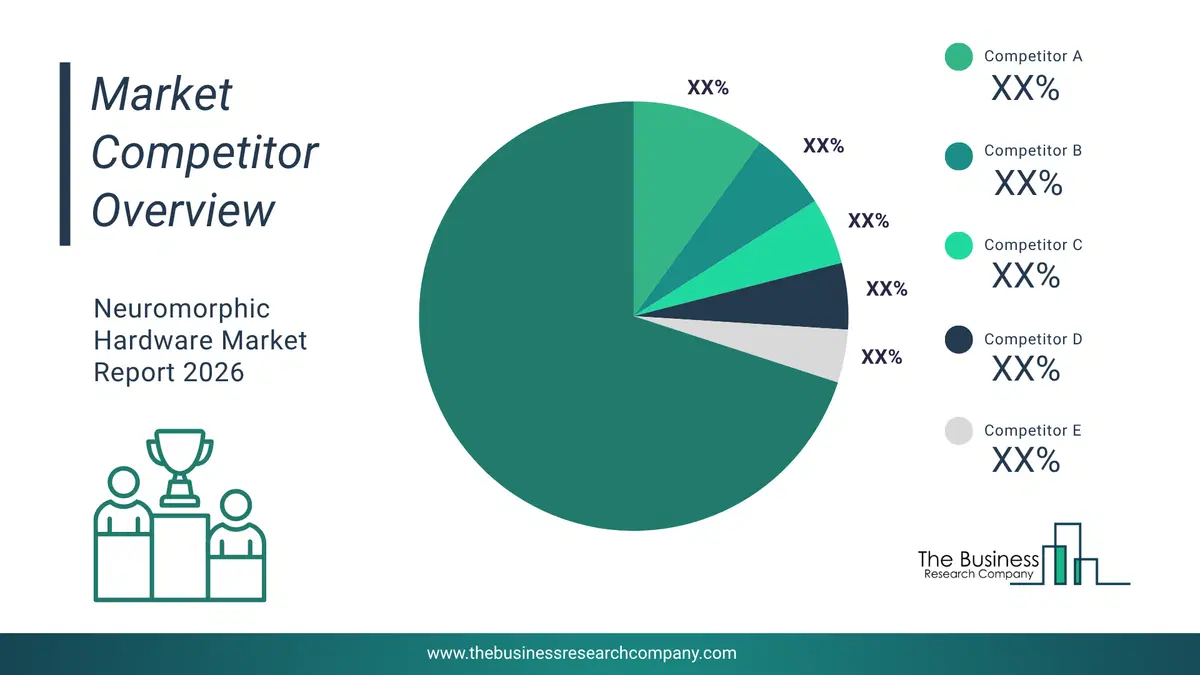
This chart is for illustrative purposes; the full report includes a detailed competitor analysis and comprehensive overview of the top 10 companies in the market.
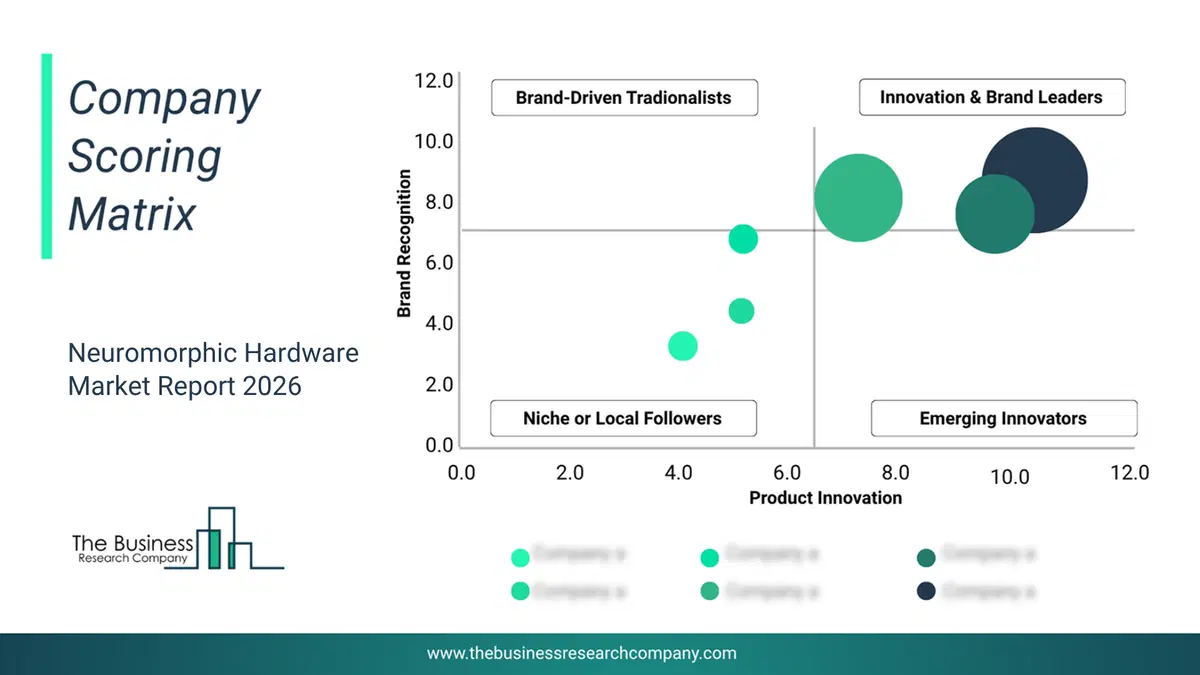
This chart maps companies by product innovation and brand strength, with bubble size indicating relative revenue, helping identify market leaders, challengers, and niche players. This is an illustrative chart; the full report provides a complete and accurate competitive analysis.
Global Neuromorphic Hardware Market Trends and Insights
Major companies operating in the neuromorphic hardware market are focusing on technological advancements, such as ultra-efficient, brain-inspired intelligence, to enable edge devices to process complex data streams locally with minimal power consumption and high computational efficiency. Ultra-efficient, brain-inspired intelligence is the capability of a neuromorphic chip to mimic the parallel processing and event-driven operation of the human brain, allowing devices to perform real-time pattern recognition, adaptive learning, and low-latency inference while maintaining energy efficiency and reliability as deployment scales. For instance, in May 2025, Innatera Inc., a US-based semiconductor company, launched Pulsar, the world’s first mass-market neuromorphic microcontroller for the sensor edge. The chip integrates spiking neural network capabilities into a compact, low-power platform, enabling smart sensors, Internet of Things (IoT) devices, and edge artificial intelligence (AI) applications to process sensory inputs locally, make autonomous decisions, and reduce dependence on cloud computation.What Are Latest Mergers And Acquisitions In The Neuromorphic Hardware Market?
In February 2024, SynSense Group, a Switzerland-based neuromorphic computing company, acquired iniVation AG for an undiclosed amount. Through this acquisition, SynSense Group aims to combine its ultra-low-power neuromorphic processing technology with iniVation’s event-based vision sensing to deliver fully integrated edge artificial intelligence (AI) solutions, enabling development of high-efficiency, low-latency spiking neural network (SNN) chips and vision-sensor systems for robotics, autonomous vehicles, consumer electronics, and aerospace applications. iniVation AG is a Switzerland-based specialist in neuromorphic vision systems.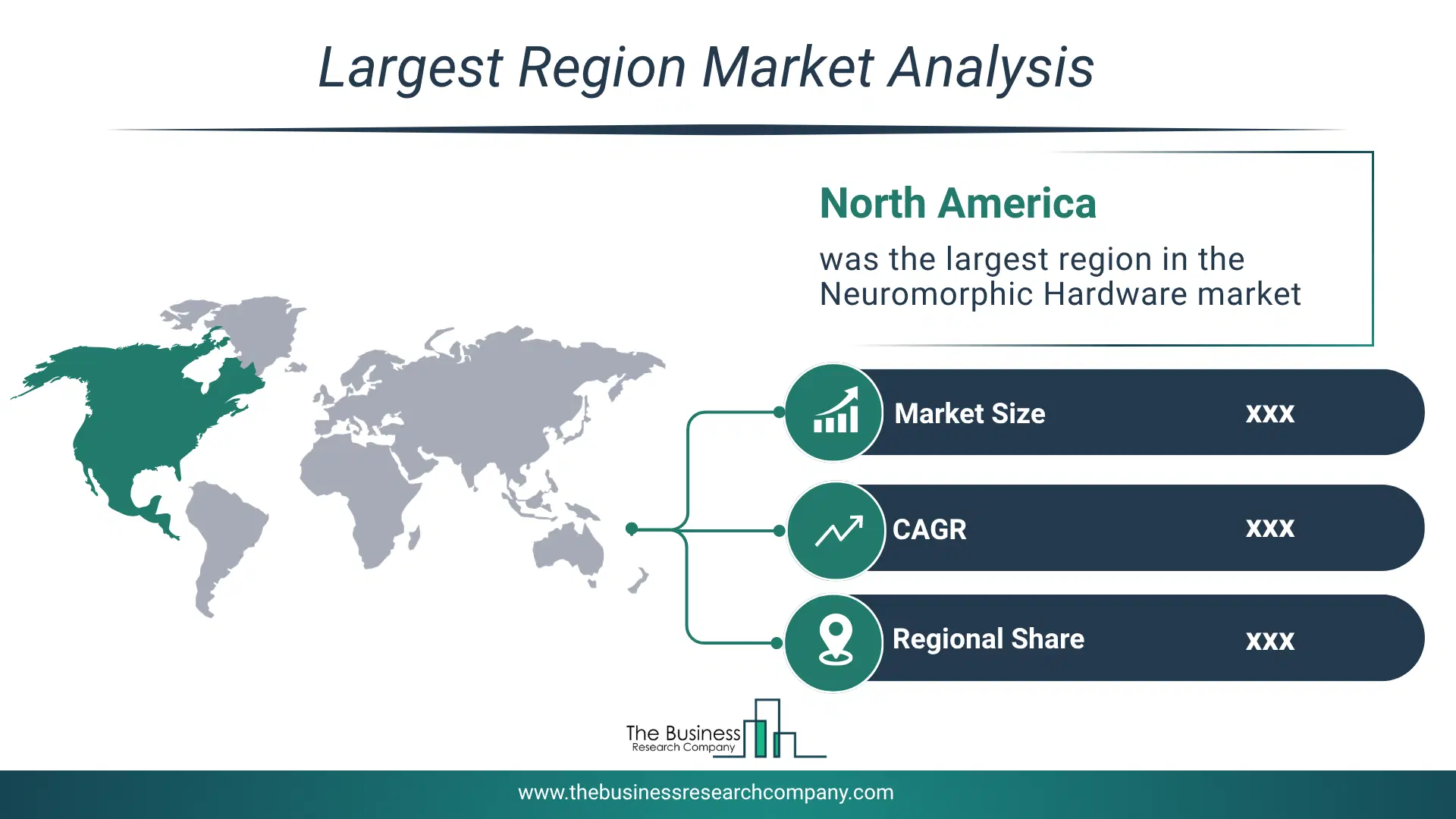
Regional Outlook
North America was the largest region in the neuromorphic hardware market in 2025. Asia-Pacific is expected to be the fastest-growing region in the forecast period. The regions covered in this market report are Asia-Pacific, South East Asia, Western Europe, Eastern Europe, North America, South America, Middle East, Africa. The countries covered in this market report are Australia, Brazil, China, France, Germany, India, Indonesia, Japan, Taiwan, Russia, South Korea, UK, USA, Canada, Italy, Spain.What Defines the Neuromorphic Hardware Market?
The neuromorphic hardware market consists of revenues earned by entities by providing services such as design and development services, system integration services, consulting services, training and education services, maintenance and support services, and cloud deployment services. The market value includes the value of related goods sold by the service provider or included within the service offering. The neuromorphic hardware market also includes sales of neuromorphic chips, memristors, photonic processors, spintronic devices, neural network accelerators, sensory modules, memory modules, and evaluation kits. Values in this market are ‘factory gate’ values, that is the value of goods sold by the manufacturers or creators of the goods, whether to other entities (including downstream manufacturers, wholesalers, distributors and retailers) or directly to end customers. The value of goods in this market includes related services sold by the creators of the goods.How is Market Value Defined and Measured?
The market value is defined as the revenues that enterprises gain from the sale of goods and/or services within the specified market and geography through sales, grants, or donations in terms of the currency (in USD unless otherwise specified). The revenues for a specified geography are consumption values that are revenues generated by organizations in the specified geography within the market, irrespective of where they are produced. It does not include revenues from resales along the supply chain, either further along the supply chain or as part of other products.
This chart presents market attractiveness based on a quantitative evaluation of growth, competition, strategic alignment, and risk, offering a clear view of opportunity areas for decision-making. This chart is for illustrative purposes; the full report contains the complete analysis.

This chart highlights the Total Addressable Market (TAM) by estimating the maximum revenue opportunity using an assumption-driven approach, supporting strategic planning and opportunity sizing across markets. The chart is illustrative; the full report provides a more comprehensive analysis.
What Key Data and Analysis Are Included in the Neuromorphic Hardware Market Report 2026?
The neuromorphic hardware market research report is one of a series of new reports from The Business Research Company that provides market statistics, including industry global market size, regional shares, competitors with the market share, detailed market segments, market trends and opportunities, and any further data you may need to thrive in the neuromorphic hardware industry. The market research report delivers a complete perspective of everything you need, with an in-depth analysis of the current and future state of the industry.Neuromorphic Hardware Market Report Forecast Analysis
| Report Attribute | Details |
|---|---|
| Market Size Value In 2026 | $0.07 billion |
| Revenue Forecast In 2030 | $0.18 billion |
| Growth Rate | CAGR of 24.7% from 2026 to 2030 |
| Base Year For Estimation | 2025 |
| Actual Estimates/Historical Data | 2020-2025 |
| Forecast Period | 2026 - 2030 |
| Market Representation | Revenue in USD Billion and CAGR from 2026 to 2030 |
| Segments Covered | Hardware Type, Component, Deployment, Application, End-Use Industry |
| Regional Scope | Asia-Pacific, Western Europe, Eastern Europe, North America, South America, Middle East, Africa |
| Country Scope | The countries covered in the report are Australia, Brazil, China, France, Germany, India, Indonesia, Japan, Taiwan, Russia, South Korea, UK, USA, Canada, Italy, Spain. |
| Key Companies Profiled | Samsung Electronics Co. Ltd., International Business Machines Corporation, Intel Corporation, Mythic Inc., Prophesee S.A., SynSense AG, Innatera Nanosystems B.V., Crocus Technology Inc., Syntiant Corp., Aspinity Inc., Crossbar Inc., GrAI Matter Labs (GML), BrainChip Holdings Ltd., Weebit Nano Ltd., iniVation AG, Knowm Inc., Neurophos Ltd., Eta Compute Inc., Applied Brain Research Inc., MemryX Inc. |
| Customization Scope | Request for Customization |
| Pricing And Purchase Options | Explore Purchase Options |