
Neutral Atom Quantum Computer Market Report 2026
Global Outlook – By Type (Adiabatic Quantum Computers, Gate Quantum Computers), By Component Type (Hardware, Software, Services), By Technology Type (Trapped Atomic Systems, Optical Lattice Systems, Atom-Photon Interfaces, Quantum Dot Systems), By Application (Cryptography, Optimization, Machine Learning, Material Science, Other Applications), By End-User (Banking, Financial Services And Insurance, Healthcare, Government, Aerospace And Defense, Information Technology And Telecommunications, Other End-Users) – Market Size, Trends, Strategies, and Forecast to 2030
Neutral Atom Quantum Computer Market Overview
• Neutral Atom Quantum Computer market size has reached to $0.93 billion in 2025 • Expected to grow to $2.93 billion in 2030 at a compound annual growth rate (CAGR) of 25.7% • Growth Driver: Growing Demand For Quantum Computing Solutions Fueling The Growth Of The Market Due To Need For Solving Complex Optimization Problems • Market Trend: Partner Programs Drive Advancement In Neutral-Atom Quantum Technologies • North America was the largest region in 2025 and Asia-Pacific is the fastest growing region.What Is Covered Under Neutral Atom Quantum Computer Market?
A neutral atom quantum computer is a type of quantum computer that uses electrically neutral atoms as qubits to perform advanced calculations. These atoms are trapped and precisely controlled using lasers and optical tweezers. Neutral atom quantum computers solve complex problems such as optimization, simulation, and cryptography that are beyond the capabilities of classical computers. This platform offers long coherence times, reconfigurability, and strong potential for large-scale quantum computing. The main types of neutral atom quantum computer are adiabatic quantum computers and gate quantum computers. Adiabatic quantum computers refer to a type of quantum computer that solves problems by slowly evolving the system's quantum state from an initial simple state to the final state that represents the solution. The neutral atom quantum computer market is segmented by components into hardware, software, and services. By technology type, it includes trapped atomic systems, optical lattice systems, atom-photon interfaces, and quantum dot systems. Key application areas encompass cryptography, optimization, machine learning, material science, and other emerging uses. End-users span across sectors such as banking, financial services and insurance (BFSI), healthcare, government, aerospace and defense, information technology and telecommunications, along with other industries.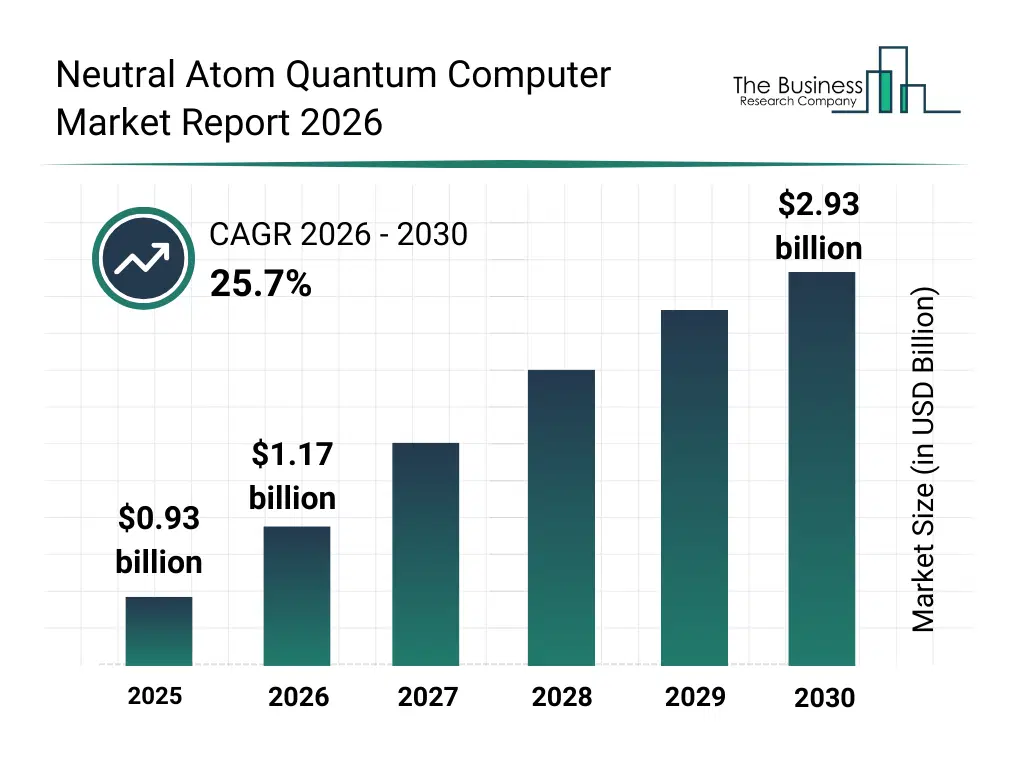
What Is The Neutral Atom Quantum Computer Market Size and Share 2026?
The neutral atom quantum computer market size has grown exponentially in recent years. It will grow from $0.93 billion in 2025 to $1.17 billion in 2026 at a compound annual growth rate (CAGR) of 26.2%. The growth in the historic period can be attributed to advances in atomic physics research, early quantum simulation experiments, government-funded quantum research programs, development of optical tweezer technology, academic collaboration in quantum science.What Is The Neutral Atom Quantum Computer Market Growth Forecast?
The neutral atom quantum computer market size is expected to see exponential growth in the next few years. It will grow to $2.93 billion in 2030 at a compound annual growth rate (CAGR) of 25.7%. The growth in the forecast period can be attributed to demand for large-scale quantum processors, growth of quantum cloud services, increased enterprise investment in quantum research, advancements in quantum error correction, rising applications in cryptography and optimization. Major trends in the forecast period include scalable neutral atom qubit architectures, laser-based qubit control systems, quantum error mitigation techniques, hybrid quantum classical computing, cloud-based quantum computing access.
Global Neutral Atom Quantum Computer Market Segmentation
1) By Type: Adiabatic Quantum Computers, Gate Quantum Computers 2) By Component Type: Hardware, Software, Services 3) By Technology Type: Trapped Atomic Systems, Optical Lattice Systems, Atom-Photon Interfaces, Quantum Dot Systems 4) By Application: Cryptography, Optimization, Machine Learning, Material Science, Other Applications 5) By End-User: Banking, Financial Services And Insurance, Healthcare, Government, Aerospace And Defense, Information Technology And Telecommunications, Other End-Users Subsegments: 1) By Adiabatic Quantum Computers: Quantum Annealers, Optimization-Focused Systems, Energy Landscape Solvers, Analog Quantum Simulators 2) By Gate Quantum Computers: Digital Quantum Processors, Universal Quantum Computers, Error-Corrected Qubit Systems, Programmable Quantum Gate ArraysWhat Is The Driver Of The Neutral Atom Quantum Computer Market?
The growing demand for quantum computing solutions is expected to propel the growth of the neutral atom quantum computer market going forward. Quantum computing solutions refer to technologies, software, and services that leverage the principles of quantum mechanics to perform computations far more efficiently than classical systems for specific complex problems. The demand for quantum computing solutions is increasing due to the need to solve complex optimization problems beyond classical computers' capabilities. Neutral atom quantum computers enhance quantum computing by offering highly scalable and reconfigurable architectures, making them ideal for advanced problem-solving across industries. They improve computational efficiency by enabling precise quantum operations with long coherence times, accelerating optimization, cryptography, and material science innovation. For instance, according to Quantum Insider, a Canada-based media and market intelligence platform, the quantum computing vendor revenue reached $1 billion in 2024 and is expected to grow significantly, expanding to around $5 billion by 2030. Therefore, the growing demand for quantum computing solutions is driving the growth of the neutral atom quantum computer industry.Key Players In The Global Neutral Atom Quantum Computer Market
Major companies operating in the neutral atom quantum computer market are Google LLC, Microsoft Corporation, Amazon Web Services Inc., Intel Corporation, International Business Machines Corporation (IBM), Honeywell International Inc., NVIDIA Corporation, Atos SE, ColdQuanta, Xanadu Quantum Technologies Inc., QuEra Computing Inc., Q-CTRL Pty Ltd., PASQAL SAS, Atom Computing Inc., IonQ Inc., D-Wave Systems Inc., qBraid, Planqc Inc., M Squared Lasers Limited, Classiq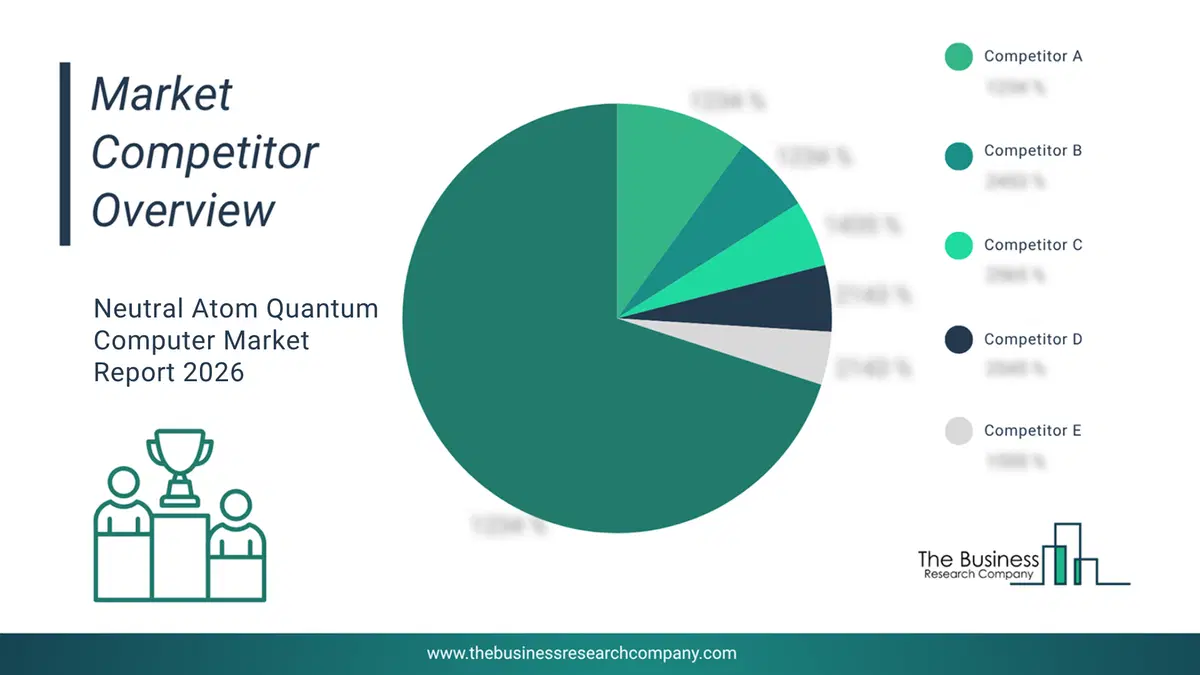
This chart is for illustrative purposes; the full report includes a detailed competitor analysis and comprehensive overview of the top 10 companies in the market.
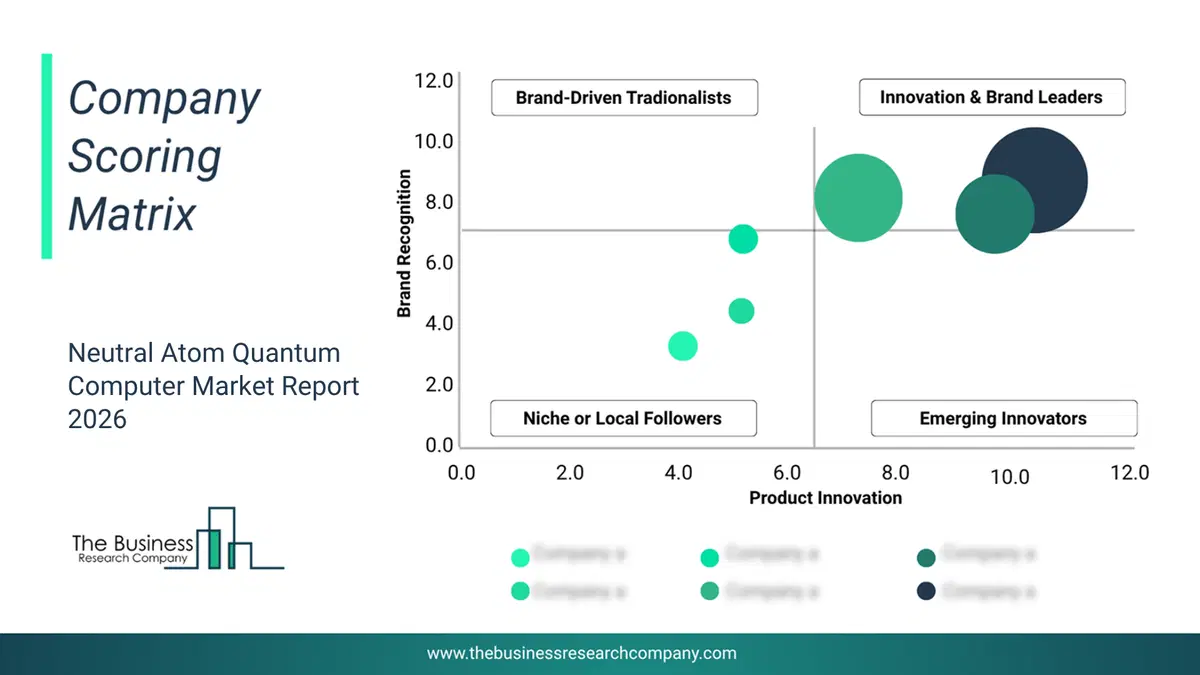
This chart maps companies by product innovation and brand strength, with bubble size indicating relative revenue, helping identify market leaders, challengers, and niche players. This is an illustrative chart; the full report provides a complete and accurate competitive analysis.
Global Neutral Atom Quantum Computer Market Trends and Insights
Major companies operating in the neutral atom quantum computer market are focusing on the alliance Partner Program to enhance computational scalability, reduce error rates, and accelerate the development of real-world quantum applications across industries. An alliance partner program is a strategic initiative where a company forms partnerships with other organizations such as technology providers, service firms, or software developers to collaborate on shared goals, products, or services. For instance, in August 2024, QuEra Computing Inc., a US-based quantum computing company, launched the QuEra Quantum Alliance Partner Program to accelerate the advancement and adoption of neutral-atom quantum computing. The initiative brings together a global network of technology and solutions companies, including BIP, BlueQubit, Classiq, E4, Kipu Quantum, and others, to collaborate on quantum innovations and deliver powerful computing solutions. Members gain early access to QuEra’s technology, direct support from its scientific team, and opportunities for joint go-to-market activities. QuEra’s neutral-atom platform, known for scalability, coherence, and dynamic qubit control, remains the only one publicly accessible via the cloud and offers a promising path to fault-tolerant quantum computing.What Are Latest Mergers And Acquisitions In The Neutral Atom Quantum Computer Market?
In July 2024, Classiq, an Israel-based quantum software company, partnered with QuEra Computing Inc. Through this partnership, Classiq integrated its quantum software development platform with QuEra’s neutral atom quantum computer, enabling seamless access to advanced quantum computing capabilities. QuEra Computing Inc. is a US-based quantum computing company specializing in developing scalable, reconfigurable quantum computers using neutral atoms as qubits for advanced computational applications.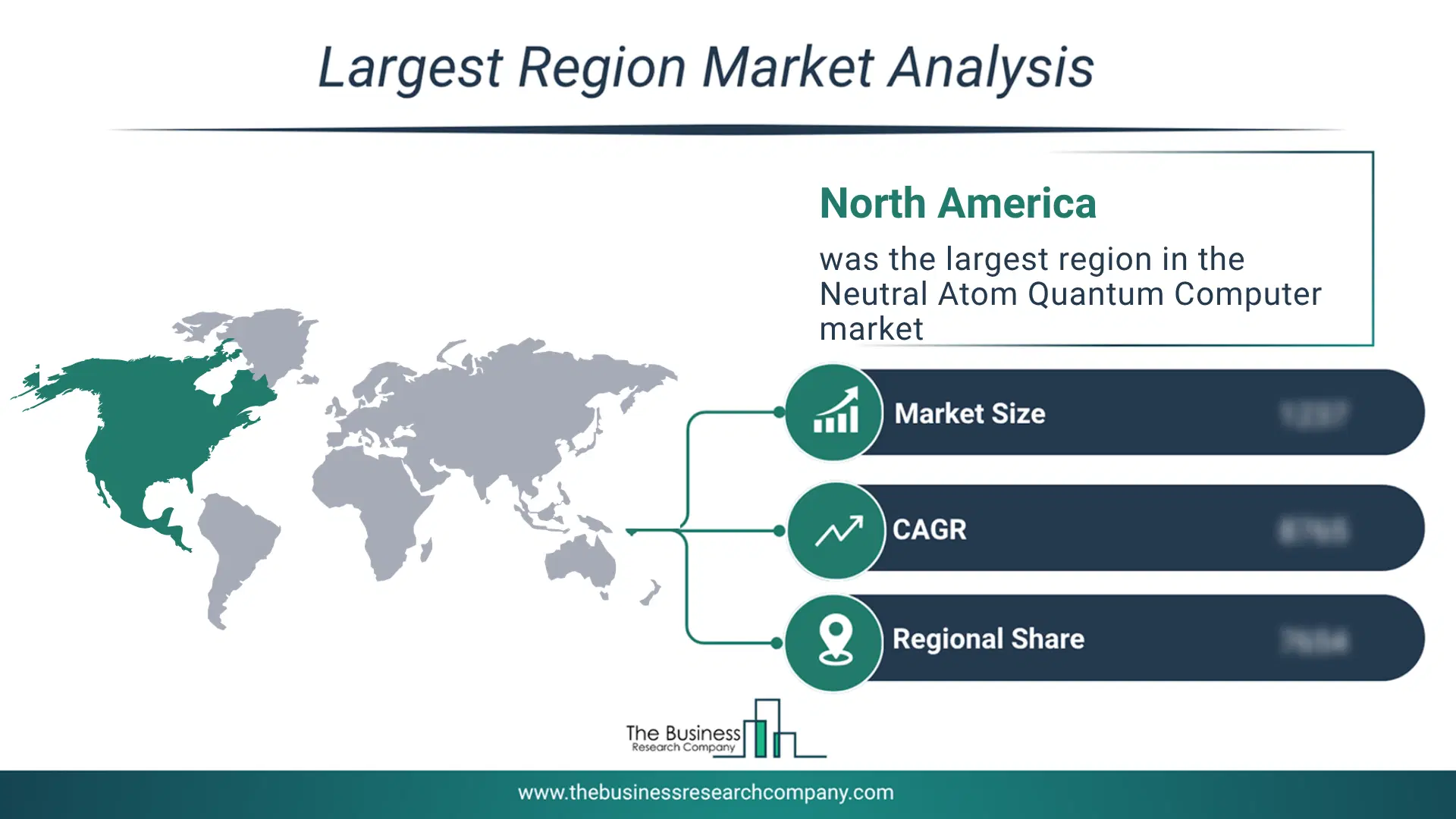
Regional Insights
North America was the largest region in the neutral atom quantum computer market in 2025. Asia-Pacific is expected to be the fastest-growing region in the forecast period. The regions covered in this market report are Asia-Pacific, South East Asia, Western Europe, Eastern Europe, North America, South America, Middle East, Africa. The countries covered in this market report are Australia, Brazil, China, France, Germany, India, Indonesia, Japan, Taiwan, Russia, South Korea, UK, USA, Canada, Italy, Spain.What Defines the Neutral Atom Quantum Computer Market?
The neutral atom quantum computer market consists of sales of quantum processors, optical tweezer arrays, laser control systems, cryogenic and vacuum hardware, specialized software platforms for programming and simulating neutral atom systems. Values in this market are ‘factory gate’ values, that is the value of goods sold by the manufacturers or creators of the goods, whether to other entities (including downstream manufacturers, wholesalers, distributors and retailers) or directly to end customers. The value of goods in this market includes related services sold by the creators of the goods.How is Market Value Defined and Measured?
The market value is defined as the revenues that enterprises gain from the sale of goods and/or services within the specified market and geography through sales, grants, or donations in terms of the currency (in USD unless otherwise specified). The revenues for a specified geography are consumption values that are revenues generated by organizations in the specified geography within the market, irrespective of where they are produced. It does not include revenues from resales along the supply chain, either further along the supply chain or as part of other products.
This chart presents market attractiveness based on a quantitative evaluation of growth, competition, strategic alignment, and risk, offering a clear view of opportunity areas for decision-making. This chart is for illustrative purposes; the full report contains the complete analysis.

This chart highlights the Total Addressable Market (TAM) by estimating the maximum revenue opportunity using an assumption-driven approach, supporting strategic planning and opportunity sizing across markets. The chart is illustrative; the full report provides a more comprehensive analysis.
What Key Data and Analysis Are Included in the Neutral Atom Quantum Computer Market Report 2026?
The neutral atom quantum computer market research report is one of a series of new reports from The Business Research Company that provides market statistics, including industry global market size, regional shares, competitors with the market share, detailed market segments, market trends and opportunities, and any further data you may need to thrive in the neutral atom quantum computer industry. The market research report delivers a complete perspective of everything you need, with an in-depth analysis of the current and future state of the industry.Neutral Atom Quantum Computer Market Report Forecast Analysis
| Report Attribute | Details |
|---|---|
| Market Size Value In 2026 | $1.17 billion |
| Revenue Forecast In 2030 | $2.93 billion |
| Growth Rate | CAGR of 25.7% from 2026 to 2030 |
| Base Year For Estimation | 2025 |
| Actual Estimates/Historical Data | 2020-2025 |
| Forecast Period | 2026 - 2030 |
| Market Representation | Revenue in USD Billion and CAGR from 2026 to 2030 |
| Segments Covered | Type, Component Type, Technology Type, Application, End-User |
| Regional Scope | Asia-Pacific, Western Europe, Eastern Europe, North America, South America, Middle East, Africa |
| Country Scope | The Countries Covered In This Market Report Are Australia, Brazil, China, France, Germany, India, Indonesia, Japan, Taiwan, Russia, South Korea, Uk, Usa, Canada, Italy, Spain. |
| Key Companies Profiled | Google LLC, Microsoft Corporation, Amazon Web Services Inc., Intel Corporation, International Business Machines Corporation (IBM), Honeywell International Inc., NVIDIA Corporation, Atos SE, ColdQuanta, Xanadu Quantum Technologies Inc., QuEra Computing Inc., Q-CTRL Pty Ltd., PASQAL SAS, Atom Computing Inc., IonQ Inc., D-Wave Systems Inc., qBraid, Planqc Inc., M Squared Lasers Limited, Classiq |
| Customization Scope | Request for Customization |
| Pricing And Purchase Options | Explore Purchase Options |