
Next-Gen Biometric Authentication Market Report 2026
Global Outlook – By Authentication Type (Single Factor Authentication, Multi Factor Authentication), By Technology (Fingerprint Recognition, Iris Recognition, Palm Print Recognition, Face Recognition, Signature Recognition, Other Technologies), By End Users (Government And Defense, Banking, Financial Services, And Insurance (BFSI), Healthcare, Information Technology And Telecom, Retail, Travel And Hospitality, Other End Users) – Market Size, Trends, Strategies, and Forecast to 2030
Next-Gen Biometric Authentication Market Overview
• Next-Gen Biometric Authentication market size has reached to $66.97 billion in 2025 • Expected to grow to $183.46 billion in 2030 at a compound annual growth rate (CAGR) of 22.2% • Growth Driver: Rising Cyber Attacks Driving The Growth Of The Market Due To Increasing Sophistication Of Hacking Techniques • Market Trend: Advancing Biometric Technology For Secure And Seamless Identity Verification • North America was the largest region in 2025.What Is Covered Under Next-Gen Biometric Authentication Market?
Next gen biometric authentication is a modern security system that uses unique physical traits to verify a person's identity. It provides a safer and more convenient way to access devices or services. These systems go beyond traditional fingerprint and facial recognition by incorporating behavioral analysis, liveness detection, and continuous authentication for accuracy and security. The main types of next-gen biometric authentication are single factor authentication, multi factor authentication. Single factor authentication method uses one biometric trait, such as a fingerprint or facial feature, to verify a person's identity. The various technology includes fingerprint recognition, iris recognition, palm print recognition, face recognition, signature recognition, others. These are used by various end users such as government and defense, banking, financial services, and insurance (BFSI), healthcare, information technology and telecom, retail, travel and hospitality, others.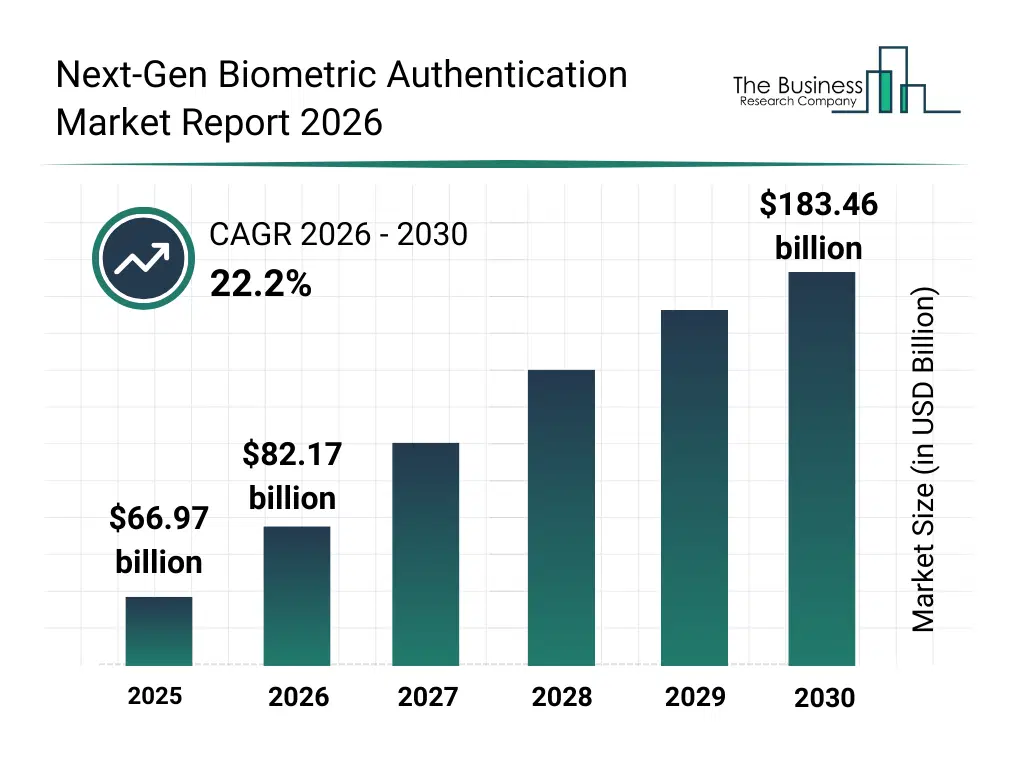
What Is The Next-Gen Biometric Authentication Market Size and Share 2026?
The next-gen biometric authentication market size has grown exponentially in recent years. It will grow from $66.97 billion in 2025 to $82.17 billion in 2026 at a compound annual growth rate (CAGR) of 22.7%. The growth in the historic period can be attributed to increasing identity theft incidents, early adoption of fingerprint systems, growth of digital banking services, expansion of mobile device security, regulatory push for secure authentication.What Is The Next-Gen Biometric Authentication Market Growth Forecast?
The next-gen biometric authentication market size is expected to see exponential growth in the next few years. It will grow to $183.46 billion in 2030 at a compound annual growth rate (CAGR) of 22.2%. The growth in the forecast period can be attributed to rising adoption of passwordless security, growth of digital identity platforms, increasing use of biometric mfa, advancements in AI driven security analytics, expansion of biometric use in public services. Major trends in the forecast period include behavioral biometrics integration, continuous authentication models, advanced liveness detection techniques, multi modal biometric verification, adaptive risk based authentication.
Global Next-Gen Biometric Authentication Market Segmentation
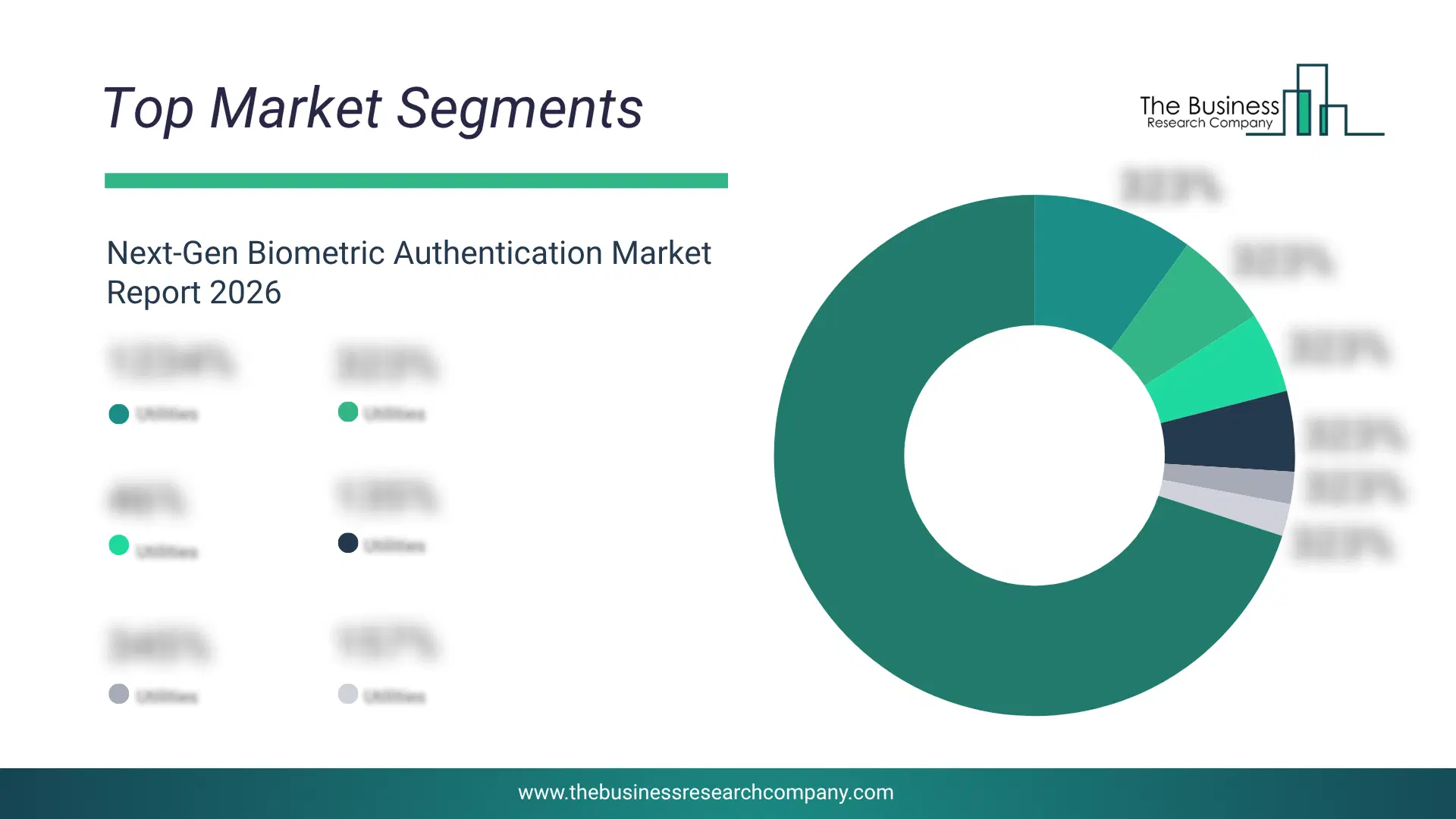
1) By Authentication Type: Single Factor Authentication, Multi Factor Authentication 2) By Technology: Fingerprint Recognition, Iris Recognition, Palm Print Recognition, Face Recognition, Signature Recognition, Other Technologies 3) By End Users: Government And Defense, Banking, Financial Services, And Insurance (BFSI), Healthcare, Information Technology And Telecom, Retail, Travel And Hospitality, Other End Users Subsegments: 1) By Single Factor Authentication Type: Fingerprint Recognition, Facial Recognition, Iris Recognition, Voice Recognition, Palm Vein Recognition 2) By Multi Factor Authentication Type: Biometric And PIN Combination, Biometric And Password Combination, Biometric And Token-Based Authentication, Biometric And Behavioral Authentication, Adaptive Biometric AuthenticationWhat Is The Driver Of The Next-Gen Biometric Authentication Market?
Rising number of cyber-attacks is expected to propel the growth of the next-gen biometric authentication market going forward. Cyber-attacks are malicious attempts by individuals or groups to compromise, damage, or gain unauthorized access to computer systems, networks, or data, often with the intent to steal information, disrupt operations, or cause harm. The rising number of cyber-attacks is due to the increasing sophistication of hacking techniques, as cybercriminals continuously develop advanced malware that can bypass traditional security measures and exploit system vulnerabilities more effectively. Next-gen biometric authentication enhances cybersecurity by leveraging advanced AI-driven multi-modal biometrics, blockchain integration, and continuous authentication techniques to prevent identity theft thereby significantly reducing cybercrimes across digital platforms, and critical infrastructure. For instance, on October, 2025, according to the Department of Defence Australia, an Australia-based government department, during the In FY2024–25, ASD’s ACSC received over 42,500 calls to the Australian Cyber Security Hotline, a 16% increase from the previous year. ASD’s ACSC also responded to over 1,200 cyber security incidents, an 11% increase. Therefore, the rising number of cyber-attacks drives the next-gen biometric authentication industry.Key Players In The Global Next-Gen Biometric Authentication Market
Major companies operating in the next-gen biometric authentication market are Apple Inc., Samsung Electronics Co. Ltd., Siemens AG, Fujitsu Limited, NEC Corporation, Safron S.A, Thales Group, IDEMIA, Synaptics Inc., HID Global Corporation, ZKTeco Co. Ltd., Clear Secure Inc., Fingerprint Cards AB, Precise Biometrics, Suprema Inc., Aware Inc., IriTech Inc., BIO-key International Inc., BioID GmbH, Luxand Inc.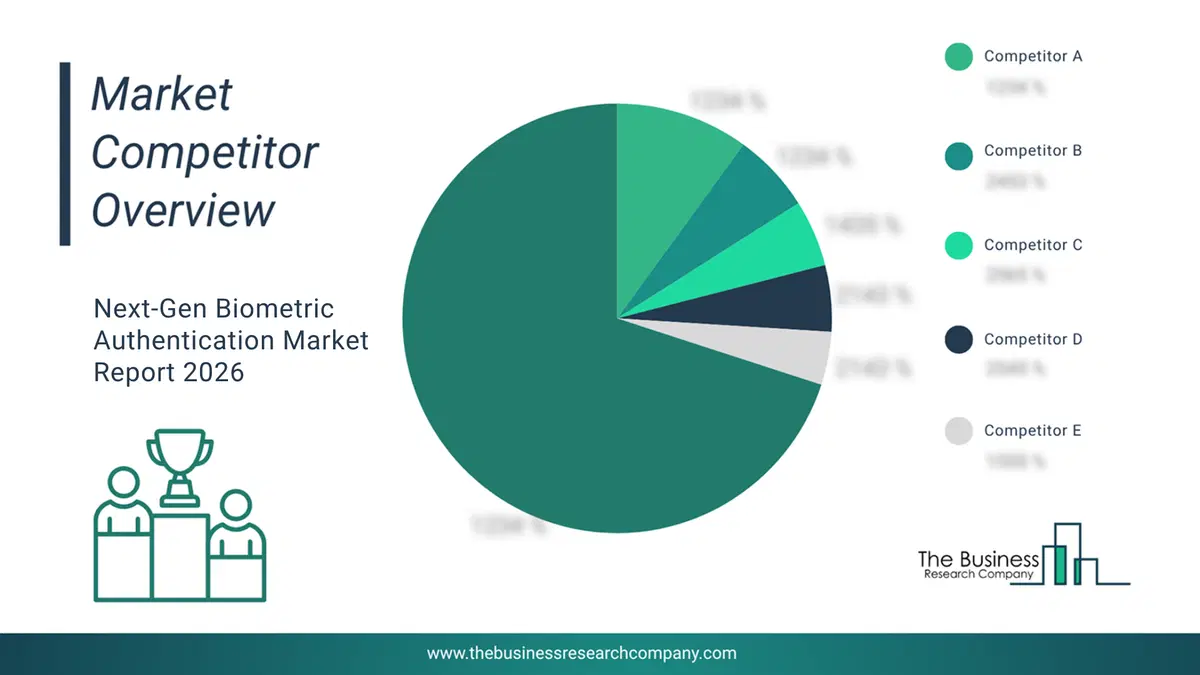
This chart is for illustrative purposes; the full report includes a detailed competitor analysis and comprehensive overview of the top 10 companies in the market.
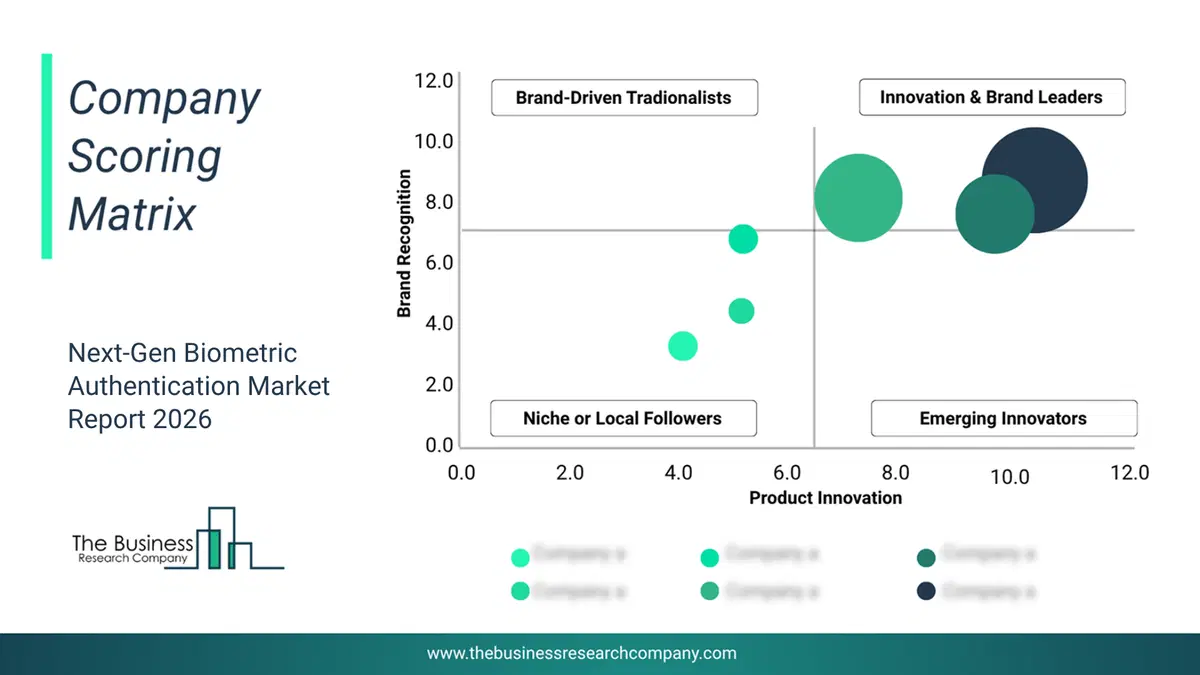
This chart maps companies by product innovation and brand strength, with bubble size indicating relative revenue, helping identify market leaders, challengers, and niche players. This is an illustrative chart; the full report provides a complete and accurate competitive analysis.
Global Next-Gen Biometric Authentication Market Trends and Insights
Major companies operating in the next gen biometric authentication market are focusing on developing innovative products, such as liveness-detection fingerprint scanners, to prevent spoofing and enhance trust in passwordless authentication. Liveness detection in biometrics is a security feature that verifies the fingerprint comes from a live finger, not a fake or copy, to block presentation attacks. For instance, in October 2025, BIO key International, a U.S.-based provider of biometric identity and access management (IAM) solutions, launched its EcoID III USB Fingerprint Scanner. It offers liveness detection and anti-spoofing to reject fake fingerprints; captures images very quickly, supported by LED-guided 360° finger placement for an intuitive user experience; enables encrypted device-to-host communication and application locking for end to end security; and meets rigorous standards such as FBI FAP 20, NIST PIV, and NIBSS certifications for high-assurance use. By combining strong biometric security with affordability and broad interoperability, this scanner helps enterprises adopt robust, tokenless authentication.What Are Latest Mergers And Acquisitions In The Next-Gen Biometric Authentication Market?
In April 2024, Amadeus IT Group S.A., a Spain-based provider of travel-technology services, passenger and airport software, and reservation systems, acquired Vision-Box – Soluções de Visão por Computador, S.A. for an undisclosed amount. With this acquisition, Amadeus IT Group S.A. aims to integrate biometric identity verification across the entire passenger journey, from booking and check-in to security screening and border control, to enhance operational efficiency and strengthen aviation security. Vision-Box – Soluções de Visão por Computador, S.A., a Portugal-based provider of biometric systems and identity-management solutions, that offers next-gen biometric authentication solutions.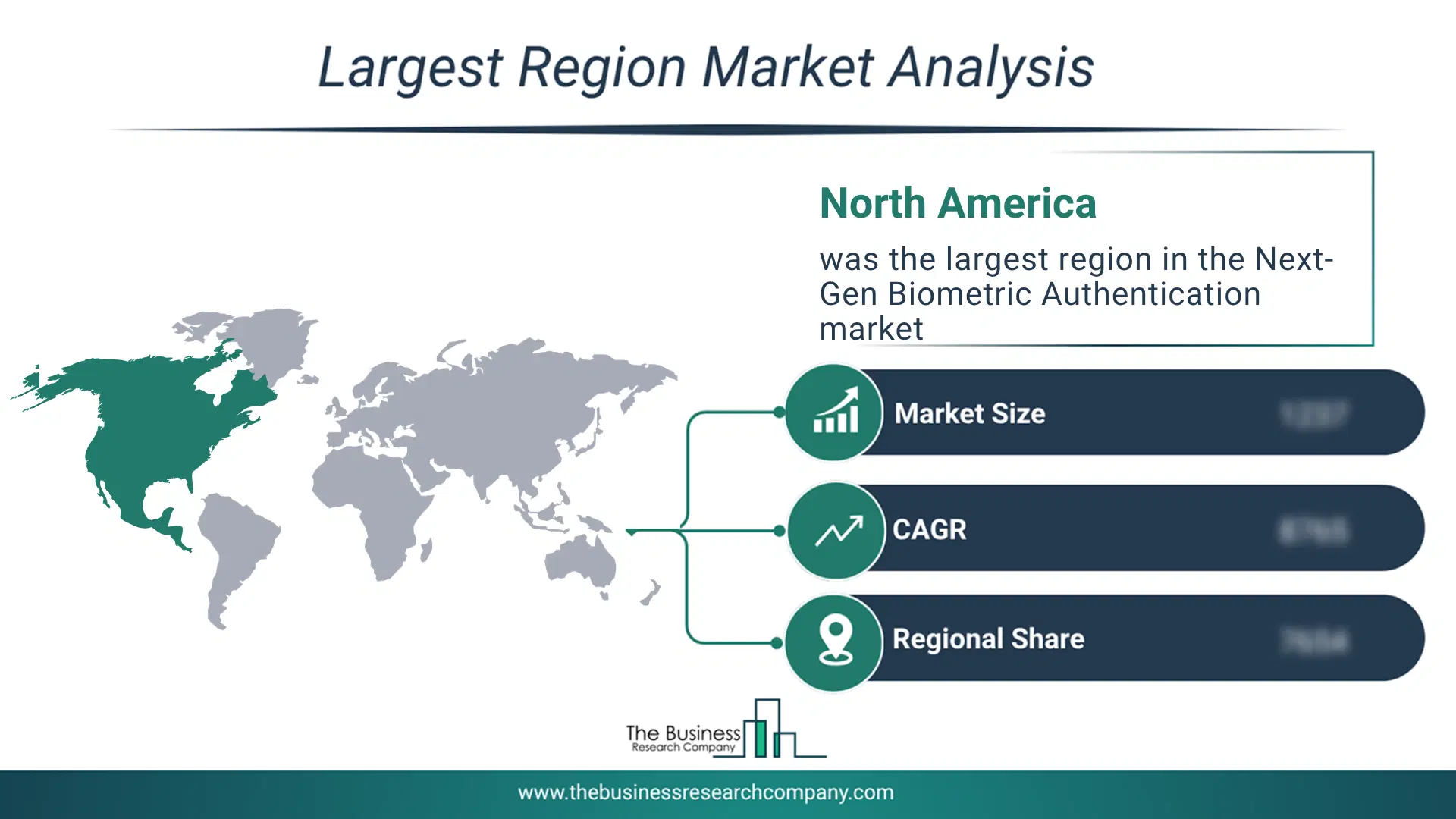
Regional Insights
North America was the largest region in the next-gen biometric authentication market in 2025. The regions covered in this market report are Asia-Pacific, South East Asia, Western Europe, Eastern Europe, North America, South America, Middle East, Africa. The countries covered in this market report are Australia, Brazil, China, France, Germany, India, Indonesia, Japan, Taiwan, Russia, South Korea, UK, USA, Canada, Italy, Spain.What Defines the Next-Gen Biometric Authentication Market?
The next-gen biometric authentication market consists of revenues earned by entities by providing advanced biometric authentication services and multimodal authentication. The market value includes the value of related goods sold by the service provider or included within the service offering. The next-gen biometric authentication market also includes sales of biometric devices, authentication platforms, and secure identity management systems. Values in this market are ‘factory gate’ values, that is, the value of goods sold by the manufacturers or creators of the goods, whether to other entities (including downstream manufacturers, wholesalers, distributors, and retailers) or directly to end customers. The value of goods in this market includes related services sold by the creators of the goods.How is Market Value Defined and Measured?
The market value is defined as the revenues that enterprises gain from the sale of goods and/or services within the specified market and geography through sales, grants, or donations in terms of the currency (in USD unless otherwise specified). The revenues for a specified geography are consumption values that are revenues generated by organizations in the specified geography within the market, irrespective of where they are produced. It does not include revenues from resales along the supply chain, either further along the supply chain or as part of other products.
This chart presents market attractiveness based on a quantitative evaluation of growth, competition, strategic alignment, and risk, offering a clear view of opportunity areas for decision-making. This chart is for illustrative purposes; the full report contains the complete analysis.

This chart highlights the Total Addressable Market (TAM) by estimating the maximum revenue opportunity using an assumption-driven approach, supporting strategic planning and opportunity sizing across markets. The chart is illustrative; the full report provides a more comprehensive analysis.
What Key Data and Analysis Are Included in the Next-Gen Biometric Authentication Market Report 2026?
The next-gen biometric authentication market research report is one of a series of new reports from The Business Research Company that provides market statistics, including industry global market size, regional shares, competitors with the market share, detailed market segments, market trends and opportunities, and any further data you may need to thrive in the next-gen biometric authentication industry. The market research report delivers a complete perspective of everything you need, with an in-depth analysis of the current and future state of the industry.Next-Gen Biometric Authentication Market Report Forecast Analysis
| Report Attribute | Details |
|---|---|
| Market Size Value In 2026 | $82.17 billion |
| Revenue Forecast In 2030 | $183.46 billion |
| Growth Rate | CAGR of 22.2% from 2026 to 2030 |
| Base Year For Estimation | 2025 |
| Actual Estimates/Historical Data | 2020-2025 |
| Forecast Period | 2026 - 2030 |
| Market Representation | Revenue in USD Billion and CAGR from 2026 to 2030 |
| Segments Covered | Authentication Type, Technology, End Users |
| Regional Scope | Asia-Pacific, Western Europe, Eastern Europe, North America, South America, Middle East, Africa |
| Country Scope | The Countries Covered In This Market Report Are Australia, Brazil, China, France, Germany, India, Indonesia, Japan, Taiwan, Russia, South Korea, Uk, Usa, Canada, Italy, Spain. |
| Key Companies Profiled | Apple Inc., Samsung Electronics Co. Ltd., Siemens AG, Fujitsu Limited, NEC Corporation, Safron S.A, Thales Group, IDEMIA, Synaptics Inc., HID Global Corporation, ZKTeco Co. Ltd., Clear Secure Inc., Fingerprint Cards AB, Precise Biometrics, Suprema Inc., Aware Inc., IriTech Inc., BIO-key International Inc., BioID GmbH, Luxand Inc. |
| Customization Scope | Request for Customization |
| Pricing And Purchase Options | Explore Purchase Options |