
Next-Generation Advanced Batteries Market Report 2026
Global Outlook – By Component (Battery Cells, Battery Modules And Packs, Battery Management Systems (BMS) And Integrated Electronics, Manufacturing Equipment And Technology Licensing), By Technology (Solid Electrolyte Battery, Magnesium Ion Battery, Next-Generation Flow Battery, Metal-Air Battery, Lithium-Sulfur Battery), By Battery Form Factor (Cylindrical Cells, Prismatic Cells, Pouch Cells, Battery Packs), By Power Or Capacity (Below 300 Wh, 300 Wh To 100 kWh, Above 100 kWh), By End-User (Automotive And Transportation, Electronics And Consumer Goods, Energy And Utilities, Aerospace And Defense, Industrial Manufacturing, Research And Development Or Labs) – Market Size, Trends, Strategies, and Forecast to 2030
Next-Generation Advanced Batteries Market Overview
• Next-Generation Advanced Batteries market size has reached to $14.21 billion in 2025 • Expected to grow to $27.64 billion in 2030 at a compound annual growth rate (CAGR) of 11.6% • Growth Driver: Rising Demand For Faster Charging And Safer Battery Technologies Driving Growth Of The Market Due To Increasing Need For Efficiency, Safety, And Durability • Market Trend: Empowering Energy Storage With Ceramic Solid?State Separator Production, Enhanced Safety, And Scalable Manufacturing • North America was the largest region in 2025 and Asia-Pacific is the fastest growing region.What Is Covered Under Next-Generation Advanced Batteries Market?
Next-generation advanced batteries are electrochemical energy storage systems that use novel chemistries, materials and cell architectures (for example solid-state, lithium-sulfur, silicon-anode or metal-air designs) to deliver materially higher energy density, faster charging, longer cycle life and improved safety compared with conventional batteries. Its purpose is to enable higher-range electric vehicles, more cost-effective and flexible grid and behind-the-meter storage, and smaller-form high-performance portable and industrial devices while supporting decarbonization and improved lifecycle sustainability. The main components of next-generation advanced batteries include battery cells, battery modules and packs, battery management systems (BMS) and integrated electronics, and manufacturing equipment and technology licensing. A battery cell is a single electrochemical unit that stores and converts chemical energy into electrical energy to power devices. Different technologies include solid electrolyte batteries, magnesium ion batteries, next-generation flow batteries, metal-air batteries, and lithium-sulfur batteries. Multiple battery form factors are cylindrical cells, prismatic cells, pouch cells, and battery packs. Various power or capacity involved are below 300 Wh, 300 Wh to 100 kWh, and above 100 kWh, and they are used by several end-users such as automotive and transportation, electronics and consumer goods, energy and utilities, aerospace and defense, industrial manufacturing, research and development or labs, and others.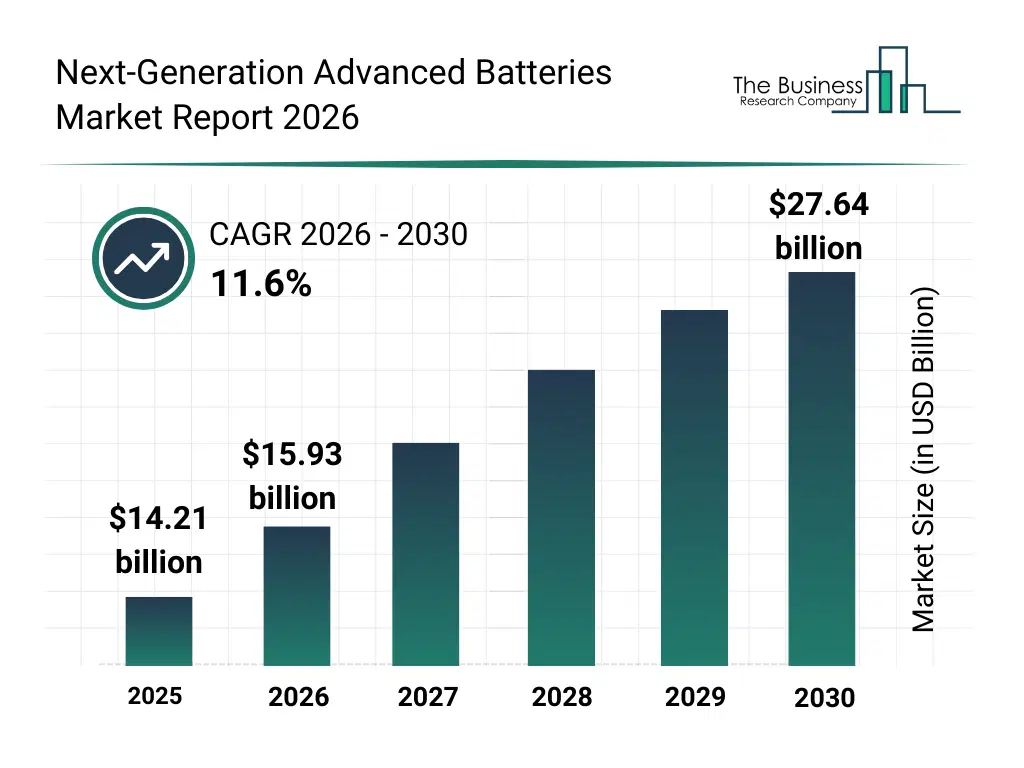
What Is The Next-Generation Advanced Batteries Market Size and Share 2026?
The next-generation advanced batteries market size has grown rapidly in recent years. It will grow from $14.21 billion in 2025 to $15.93 billion in 2026 at a compound annual growth rate (CAGR) of 11.9%. The growth in the historic period can be attributed to increasing adoption of electric vehicles, integration with renewable energy systems, the need for cost-effective alternatives to lithium-ion batteries, growing demand for energy storage solutions, government incentives for clean energy, advances in battery chemistry research.What Is The Next-Generation Advanced Batteries Market Growth Forecast?
The next-generation advanced batteries market size is expected to see rapid growth in the next few years. It will grow to $27.64 billion in 2030 at a compound annual growth rate (CAGR) of 11.6%. The growth in the forecast period can be attributed to solid-state battery commercialization, expansion of grid energy storage demand, increased investment in battery research, diversification of battery chemistries (sodium-ion/lithium-sulfur), supportive government policies and subsidies, rising demand in consumer electronics and aerospace. Major trends in the forecast period include adoption of solid-state technologies, growth of lithium-sulfur and lithium-air batteries, the expansion of battery recycling and second-life use, strategic partnerships and supply chain localization, regional market growth in apac and north america, integration with AI and battery management systems.
Global Next-Generation Advanced Batteries Market Segmentation
1) By Component: Battery Cells, Battery Modules And Packs, Battery Management Systems (BMS) And Integrated Electronics, Manufacturing Equipment And Technology Licensing 2) By Technology: Solid Electrolyte Battery, Magnesium Ion Battery, Next-Generation Flow Battery, Metal-Air Battery, Lithium-Sulfur Battery 3) By Battery Form Factor: Cylindrical Cells, Prismatic Cells, Pouch Cells, Battery Packs 4) By Power Or Capacity: Below 300 Wh, 300 Wh To 100 kWh, Above 100 kWh 5) By End-User: Automotive And Transportation, Electronics And Consumer Goods, Energy And Utilities, Aerospace And Defense, Industrial Manufacturing, Research And Development Or Labs Subsegments: 1) By Battery Cells: Cylindrical Cells, Prismatic Cells, Pouch Cells, Coin Cells, Blade Cells 2) By Battery Modules And Packs: Modular Battery Packs, Pack With Integrated Cooling, Pack With Thermal Management, High-Capacity Battery Packs, Custom Battery Modules 3) By Battery Management Systems And Integrated Electronics: State-Of-Charge Management Systems, State-Of-Health Monitoring Systems, Battery Protection Systems, Energy Management Controllers, Cell Balancing Systems 4) By Manufacturing Equipment And Technology Licensing: Electrode Coating Equipment, Cell Assembly Machines, Formation And Aging Equipment, Testing And Inspection Systems, Technology Licensing ServicesWhat Is The Driver Of The Next-Generation Advanced Batteries Market?
The rising demand for faster charging and safer battery technologies is expected to propel the growth of the next generation advanced batteries market going forward. Faster charging and safer battery technologies refer to energy storage solutions capable of delivering rapid charge cycles, improved safety performance, longer durability, and high efficiency. Demand for faster charging and safer battery technologies is rising as consumers rely more on electric vehicles and high-performance portable electronics that must recharge quickly without overheating or posing fire risks. Next generation advanced batteries supports faster charging and safer battery technologies because broader EV adoption emphasizes the need for batteries that charge quickly and reliably. For instance, in May 2025, according to the International Energy Agency, a France-based intergovernmental organization, more than 1.3 million public electric vehicle charging points were added globally in 2024, a 30% increase from the previous year, with fast chargers reaching 2 million, ultra-fast chargers growing over 50% to nearly 10% of all fast chargers. Therefore, the rising demand for faster charging and safer battery technologies is driving the growth of the next generation advanced batteries market.Key Players In The Global Next-Generation Advanced Batteries Market
Major companies operating in the next-generation advanced batteries market are Toyota Motor Corporation, SK On Co. Ltd., BYD Company Ltd., Panasonic Corporation, Contemporary Amperex Technology Co. Limited (CATL), LG Energy Solution, Toshiba Corporation, Samsung SDI Co. Ltd., Northvolt AB, Amara Raja Energy & Mobility Ltd., QuantumScape Corporation, ProLogium Technology Co. Ltd., Sila Nanotechnologies Inc., Lyten Inc., Blue Solutions, StoreDot Ltd., Factorial Energy Inc., SES AI Corporation, Solid Power Inc., Amprius Technologies Inc., Morrow Batteries, Faradion Limited, HiNa Battery Technology Co. Ltd., Ilika PLC
This chart is for illustrative purposes; the full report includes a detailed competitor analysis and comprehensive overview of the top 10 companies in the market.
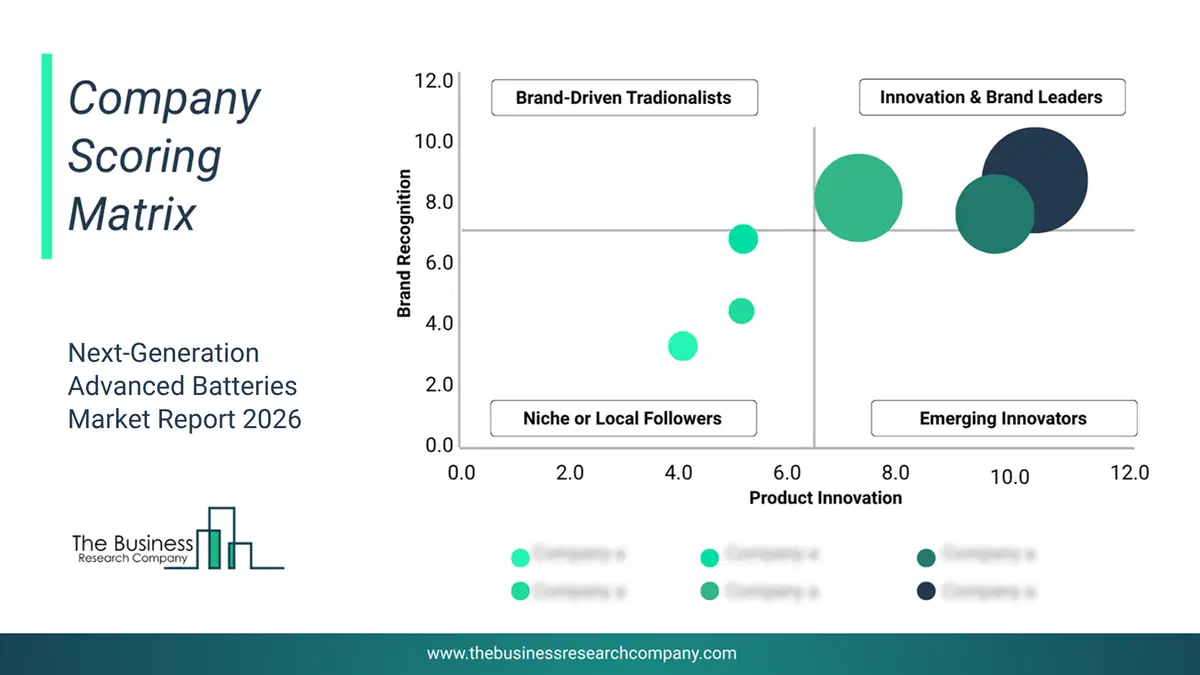
This chart maps companies by product innovation and brand strength, with bubble size indicating relative revenue, helping identify market leaders, challengers, and niche players. This is an illustrative chart; the full report provides a complete and accurate competitive analysis.
Global Next-Generation Advanced Batteries Market Trends and Insights
Major companies operating in the next‑generation advanced batteries market are focusing on developing advanced manufacturing enhancements, such as ceramic solid‑state separator production, to improve battery safety, energy density, and production scalability for electric vehicles and grid storage applications. Ceramic solid‑state separators are engineered to provide robust ionic conductivity while preventing thermal runaway and enhancing mechanical stability under high charge‑discharge conditions, enabling safer, longer‑lasting batteries. For instance, in December 2024, QuantumScape Corporation, a US-based advanced battery technology company, released its next‑generation solid‑state battery separator production equipment, Cobra, designed to enable high‑precision production of ceramic solid‑state separators. Cobra facilitates scalable manufacturing of next‑generation solid‑state battery components with improved uniformity, reliability, and throughput, supporting the transition from lab‑scale innovation to commercial production. The equipment is engineered to meet the stringent tolerances required for solid‑state electrolyte interfaces, addressing key challenges associated with large‑scale adoption of solid‑state batteries.What Are Latest Mergers And Acquisitions In The Next-Generation Advanced Batteries Market?
In December 2023, Komatsu Ltd., a Japan‑based manufacturer of construction and mining equipment, acquired American Battery Solutions LLC for an undisclosed amount. Through this acquisition, Komatsu Ltd. aims to enhance its next‑generation advanced battery offerings by integrating American Battery Solutions LLC’s expertise in battery system engineering, cell design, and manufacturing, enabling improved electrification, energy storage performance, and sustainability across heavy equipment and industrial applications. American Battery Solutions LLC is a US‑based next-generation advanced battery technology company, delivering customized battery solutions and electric powertrain components.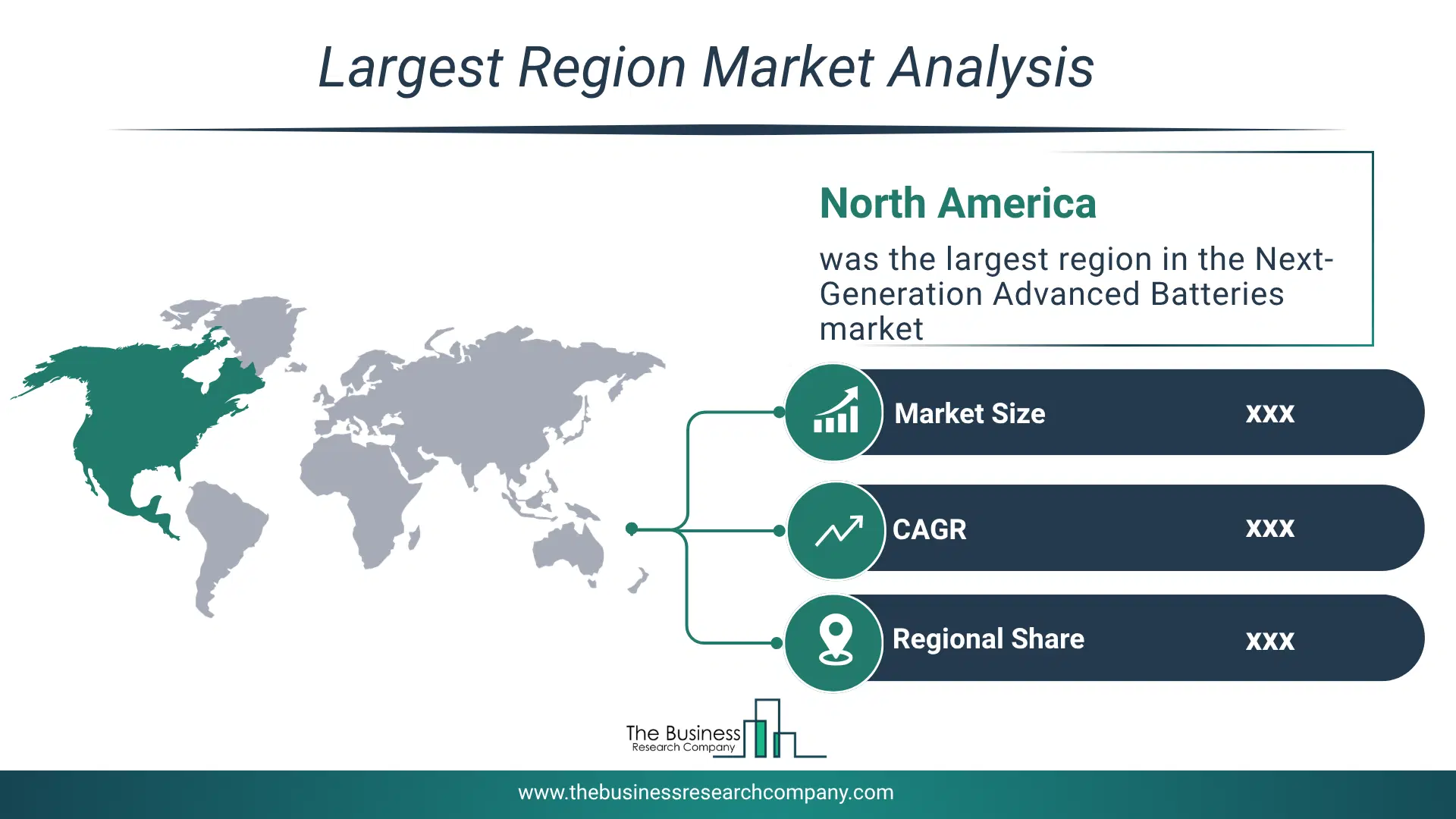
Regional Insights
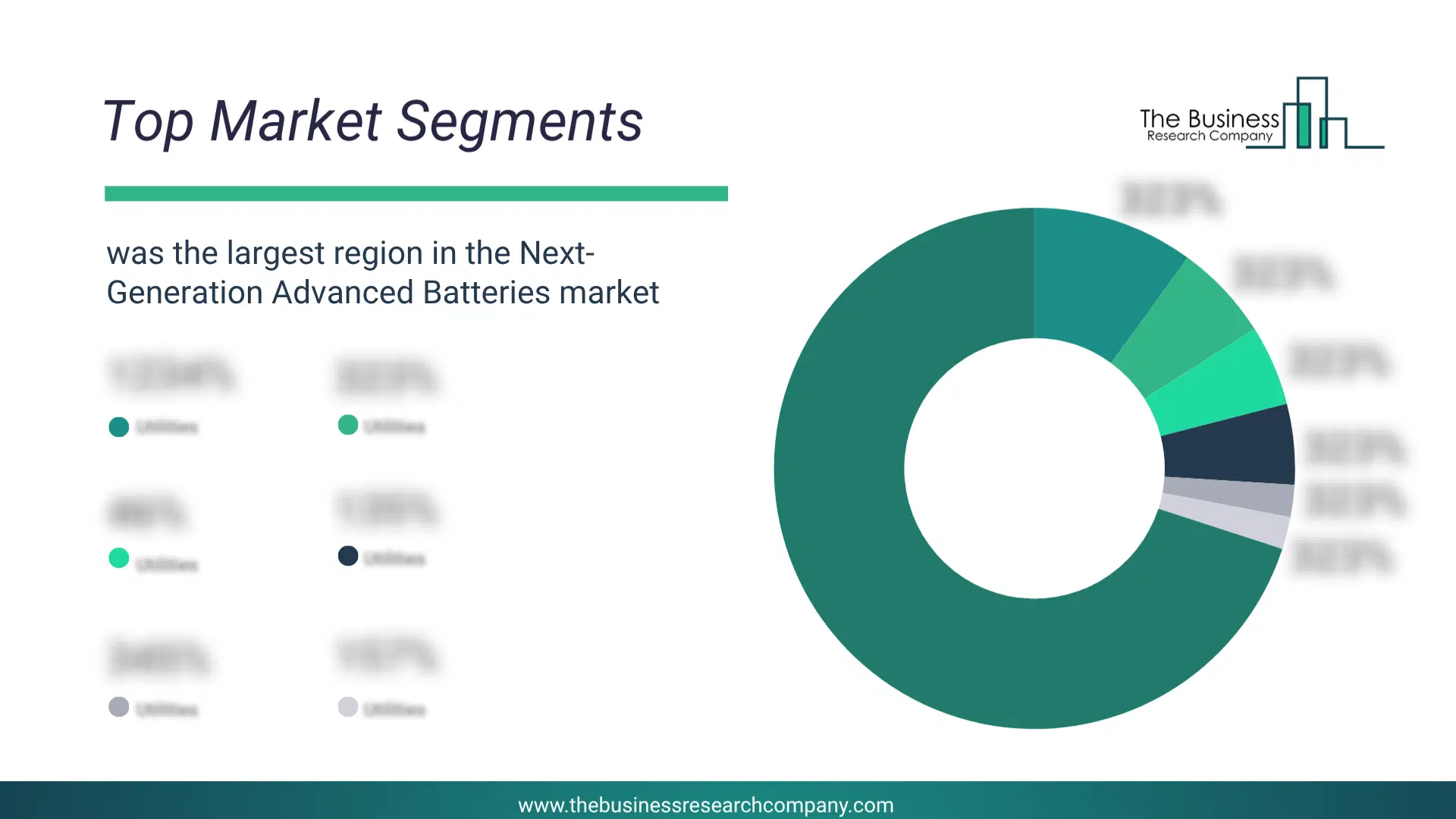
North America was the largest region in the next-generation advanced batteries market in 2025. Asia-Pacific is expected to be the fastest-growing region in the forecast period. The regions covered in this market report are Asia-Pacific, South East Asia, Western Europe, Eastern Europe, North America, South America, Middle East, Africa. The countries covered in this market report are Australia, Brazil, China, France, Germany, India, Indonesia, Japan, Taiwan, Russia, South Korea, UK, USA, Canada, Italy, Spain.What Defines the Next-Generation Advanced Batteries Market?
The next-generation advanced batteries market consists of sales of solid-state batteries, lithium–sulfur batteries, lithium–air batteries, sodium-ion advanced batteries, and silicon-anode high-energy lithium batteries. Values in this market are ‘factory gate’ values, that is the value of goods sold by the manufacturers or creators of the goods, whether to other entities (including downstream manufacturers, wholesalers, distributors and retailers) or directly to end customers. The value of goods in this market includes related services sold by the creators of the goods.How is Market Value Defined and Measured?
The market value is defined as the revenues that enterprises gain from the sale of goods and/or services within the specified market and geography through sales, grants, or donations in terms of the currency (in USD unless otherwise specified). The revenues for a specified geography are consumption values that are revenues generated by organizations in the specified geography within the market, irrespective of where they are produced. It does not include revenues from resales along the supply chain, either further along the supply chain or as part of other products.
This chart presents market attractiveness based on a quantitative evaluation of growth, competition, strategic alignment, and risk, offering a clear view of opportunity areas for decision-making. This chart is for illustrative purposes; the full report contains the complete analysis.

This chart highlights the Total Addressable Market (TAM) by estimating the maximum revenue opportunity using an assumption-driven approach, supporting strategic planning and opportunity sizing across markets. The chart is illustrative; the full report provides a more comprehensive analysis.
What Key Data and Analysis Are Included in the Next-Generation Advanced Batteries Market Report 2026?
The next-generation advanced batteries market research report is one of a series of new reports from The Business Research Company that provides market statistics, including industry global market size, regional shares, competitors with the market share, detailed market segments, market trends and opportunities, and any further data you may need to thrive in the next-generation advanced batteries industry. The market research report delivers a complete perspective of everything you need, with an in-depth analysis of the current and future state of the industry.Next-Generation Advanced Batteries Market Report Forecast Analysis
| Report Attribute | Details |
|---|---|
| Market Size Value In 2026 | $15.93 billion |
| Revenue Forecast In 2030 | $27.64 billion |
| Growth Rate | CAGR of 11.9% from 2026 to 2030 |
| Base Year For Estimation | 2025 |
| Actual Estimates/Historical Data | 2020-2025 |
| Forecast Period | 2026 - 2030 |
| Market Representation | Revenue in USD Billion and CAGR from 2026 to 2030 |
| Segments Covered | Component, Technology, Battery Form Factor, Power Or Capacity, End-User |
| Regional Scope | Asia-Pacific, Western Europe, Eastern Europe, North America, South America, Middle East, Africa |
| Country Scope | The countries covered in the report are Australia, Brazil, China, France, Germany, India, Indonesia, Japan, Taiwan, Russia, South Korea, UK, USA, Canada, Italy, Spain. |
| Key Companies Profiled | Toyota Motor Corporation, SK On Co. Ltd., BYD Company Ltd., Panasonic Corporation, Contemporary Amperex Technology Co. Limited (CATL), LG Energy Solution, Toshiba Corporation, Samsung SDI Co. Ltd., Northvolt AB, Amara Raja Energy & Mobility Ltd., QuantumScape Corporation, ProLogium Technology Co. Ltd., Sila Nanotechnologies Inc., Lyten Inc., Blue Solutions, StoreDot Ltd., Factorial Energy Inc., SES AI Corporation, Solid Power Inc., Amprius Technologies Inc., Morrow Batteries, Faradion Limited, HiNa Battery Technology Co. Ltd., Ilika PLC |
| Customization Scope | Request for Customization |
| Pricing And Purchase Options | Explore Purchase Options |