
Next-Generation Data Storage Market Report 2026
Global Outlook – By Туре (Direct Attached Storage (DAS), Network Attached Storage (NAS), Storage Area Network (SAN), Other Types), By Technology (Magnetic Storage, Hybrid Flash Array, Solid State Drive (SSD)), By Architecture (File-Based, Object-Based, Block Storage), By Deployment (On Premise, Cloud), By Industrial Vertical (BFSI, Government, Retail, IT And Telecommunication, Manufacturing, Healthcare, Education, Media And Entertainment) – Market Size, Trends, Strategies, and Forecast to 2030
Next-Generation Data Storage Market Overview
• Next-Generation Data Storage market size has reached to $94.72 billion in 2025 • Expected to grow to $175.73 billion in 2030 at a compound annual growth rate (CAGR) of 13.2% • Growth Driver: Increasing Cybersecurity Concerns Propel Growth In Next-Generation Data Storage Market • Market Trend: Revolutionizing AI Data Management With Advanced Software-Defined Storage Solutions • North America was the largest region in 2025 and Asia-Pacific is the fastest growing region.What Is Covered Under Next-Generation Data Storage Market?
Next-generation data storage refers to a kind of data storage instrument that is comprised of cutting-edge data storage products and services to handle increasing amounts of data and a significant amount of unstructured data. The use of next-generation data storage devices enables more rapid and straightforward data recovery as well as reliable data preservation. The main types of next-generation data storage are direct attached storage (DAS), network attached storage (NAS), storage area network (SAN), and others. Direct-attached storage (DAS) refers to data storage devices that are physically attached to the computer. DAS-type next-generation storage devices include FireWire drives and solid-state drives. The technologies of next-generation data storage include magnetic storage, hybrid flash array, and solid-state drive (SSD) that are stored in various forms such as file-based, object-based, and block storage, deployed as on-premises and cloud. The end-users of next-generation data storage include BFSI, government, retail, IT and telecommunication, manufacturing, healthcare, education, and media and entertainment.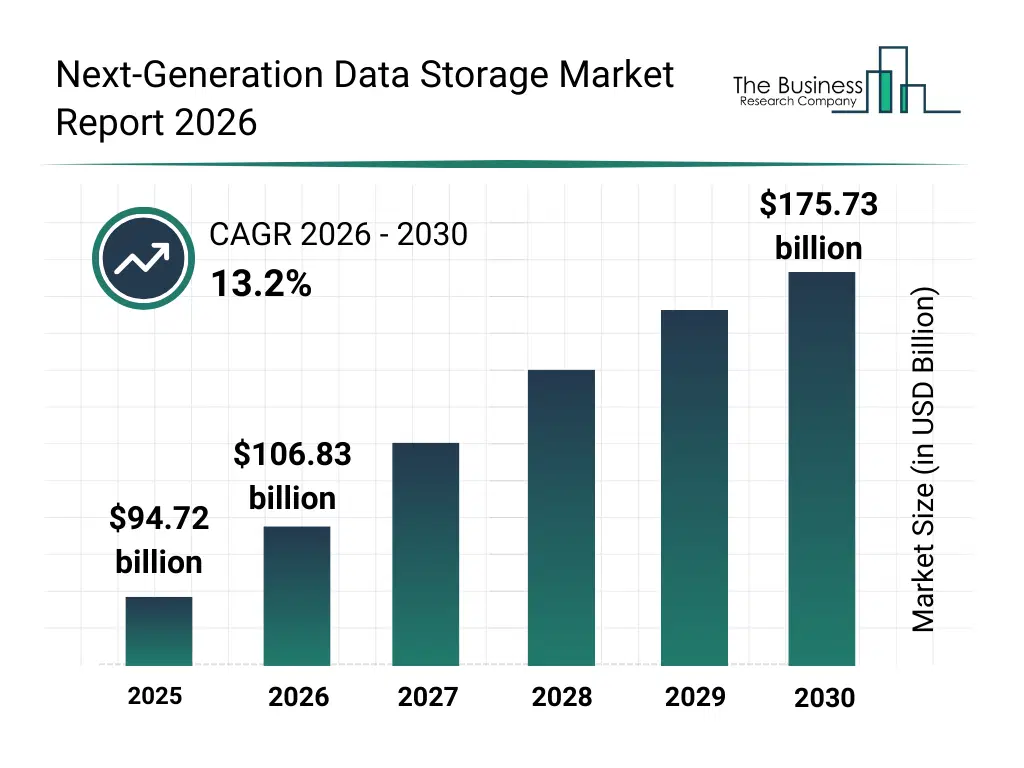
What Is The Next-Generation Data Storage Market Size and Share 2026?
The next-generation data storage market size has grown rapidly in recent years. It will grow from $94.72 billion in 2025 to $106.83 billion in 2026 at a compound annual growth rate (CAGR) of 12.8%. The growth in the historic period can be attributed to growth of enterprise data volumes, expansion of data centers, early adoption of cloud computing, demand for reliable data backup, increasing use of virtualization.What Is The Next-Generation Data Storage Market Growth Forecast?
The next-generation data storage market size is expected to see rapid growth in the next few years. It will grow to $175.73 billion in 2030 at a compound annual growth rate (CAGR) of 13.2%. The growth in the forecast period can be attributed to rise in unstructured data generation, AI driven data workloads, growth of hybrid cloud environments, demand for low latency access, increasing focus on data resilience. Major trends in the forecast period include high performance flash storage, object based storage adoption, hybrid cloud storage integration, software defined storage expansion, advanced data recovery solutions.
Global Next-Generation Data Storage Market Segmentation
1) By ????: Direct Attached Storage (DAS), Network Attached Storage (NAS), Storage Area Network (SAN), Other Types 2) By Technology: Magnetic Storage, Hybrid Flash Array, Solid State Drive (SSD) 3) By Architecture: File-Based, Object-Based, Block Storage 4) By Deployment: On Premise, Cloud 5) By Industrial Vertical: BFSI, Government, Retail, IT And Telecommunication, Manufacturing, Healthcare, Education, Media And Entertainment Subsegments: 1) By Direct Attached Storage (DAS): Internal Storage Devices, External Storage Devices 2) By Network Attached Storage (NAS): Home NAS Solutions, Enterprise NAS Solutions 3) By Storage Area Network (SAN): Fibre Channel SAN, iSCSI SAN 4) By Other Types: Cloud Storage Solutions, Hybrid Storage Systems, Object StorageWhat Is The Driver Of The Next-Generation Data Storage Market?
Increasing cybersecurity concerns are expected to propel the growth of the next-generation data storage market going forward. Cybersecurity concerns refer to the apprehensions and issues related to the protection of computer systems, networks, and data from theft, damage, unauthorized access, or any form of cyber threats. The next-generation data storage technologies offer exciting possibilities for cybersecurity, such as massive scalability and distributed access, making it harder for attackers to target a single point of failure. For instance, in April 2024, according to Parachute Technology, a US-based IT solutions company, in the first half of 2023, government agencies experienced 49 cyber incidents, marking an 11% increase compared to 2022. Therefore, the increasing cybersecurity concerns are driving the growth of the next-generation data storage industry.Key Players In The Global Next-Generation Data Storage Market
Major companies operating in the next-generation data storage market are Samsung Electronics Co. Ltd.; Dell Technologies Inc.; Hitachi Ltd.; Huawei Technologies Co. Ltd.; IBM (The International Business Machines Corporation); SK hynix Inc.; Fujitsu Limited; Hewlett Packard Enterprise Company; Toshiba Corporation; Western Digital Technologies Inc.; Inspur Group Co. Ltd.; NetApp Inc.; Pure Storage Inc.; Nutanix Inc.; DataDirect Networks; Everspin Technologies Inc.; Cloudian Inc.; Drobo Inc.; Viking Technology; Avalanche Technology Inc.; Spin Memory Inc.; 4DS Memory Limited; Nantero Inc.; Tegile Systems Inc.; Kaminario Inc.; Infortrend Technology Inc.; Seagate Technology PLC
This chart is for illustrative purposes; the full report includes a detailed competitor analysis and comprehensive overview of the top 10 companies in the market.
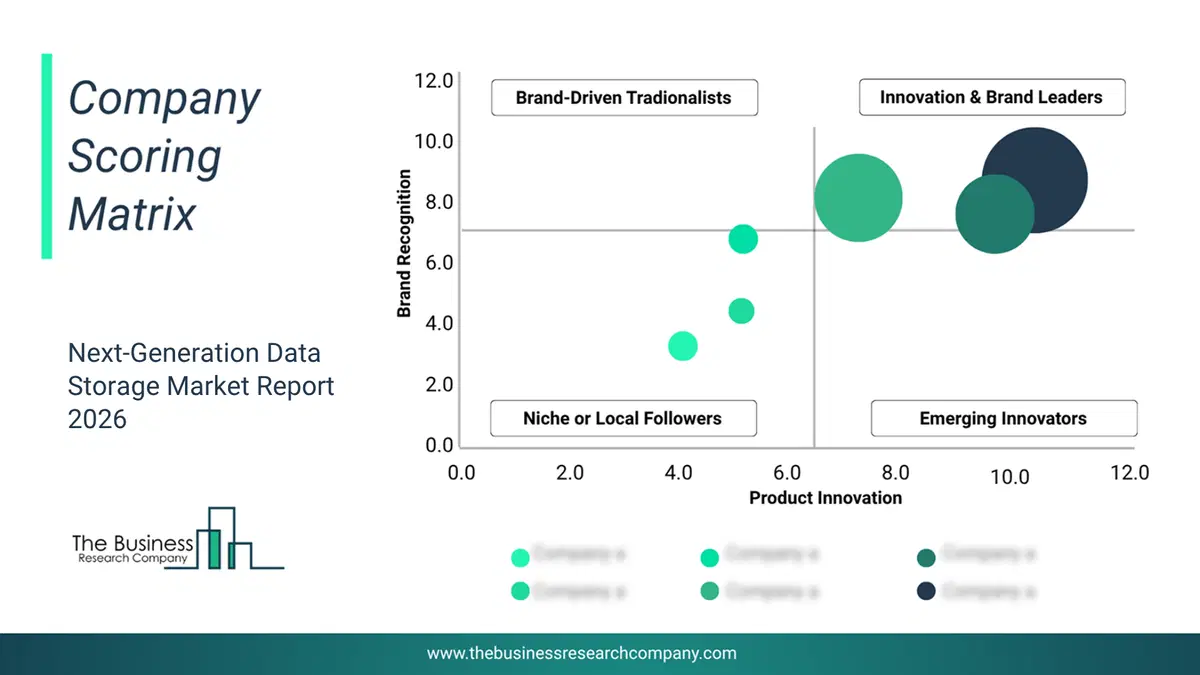
This chart maps companies by product innovation and brand strength, with bubble size indicating relative revenue, helping identify market leaders, challengers, and niche players. This is an illustrative chart; the full report provides a complete and accurate competitive analysis.
Global Next-Generation Data Storage Market Trends and Insights
Major companies operating in the next-generation data storage market are increasingly focusing on product innovations to strengthen their market position and meet the rising demand for scalable, intelligent data management solutions. Advanced storage platforms designed to simplify deployment, enhance governance, and support AI-driven workloads are emerging as significant developments in this space. For instance, in November 2023, DataDirect Networks, a US-based software company, introduced DDN Infinia an advanced software-defined storage platform built to address the complex challenges of AI data management. The platform offers exceptional ease of use, enabling deployment in just 10 minutes, along with uninterrupted service through rolling upgrades and automated storage allocation. It supports rapid tenant creation via dynamic data provisioning, features robust multi-tenancy with automated SLA management, and provides sophisticated metadata capabilities to strengthen governance and control. DDN Infinia ensures secure, scalable data processing across diverse environments, including Amazon S3 object storage, making it a pivotal innovation in next-generation data storage.What Are Latest Mergers And Acquisitions In The Next-Generation Data Storage Market?
In March 2023, AkamAI Technologies, a US-based software development company, acquired Ondat for an undisclosed amount. With the acquisition of Ondat's workforce and cloud storage technology, AkamAI will offer a fundamentally new method of cloud computing that combines core and dispersed computing sites with a massively scaled edge network. Ondat is a UK-based provider of cloud-based storage solutions with a native Kubernetes platform that provides persistent storage immediately on any Kubernetes cluster, enabling business operations.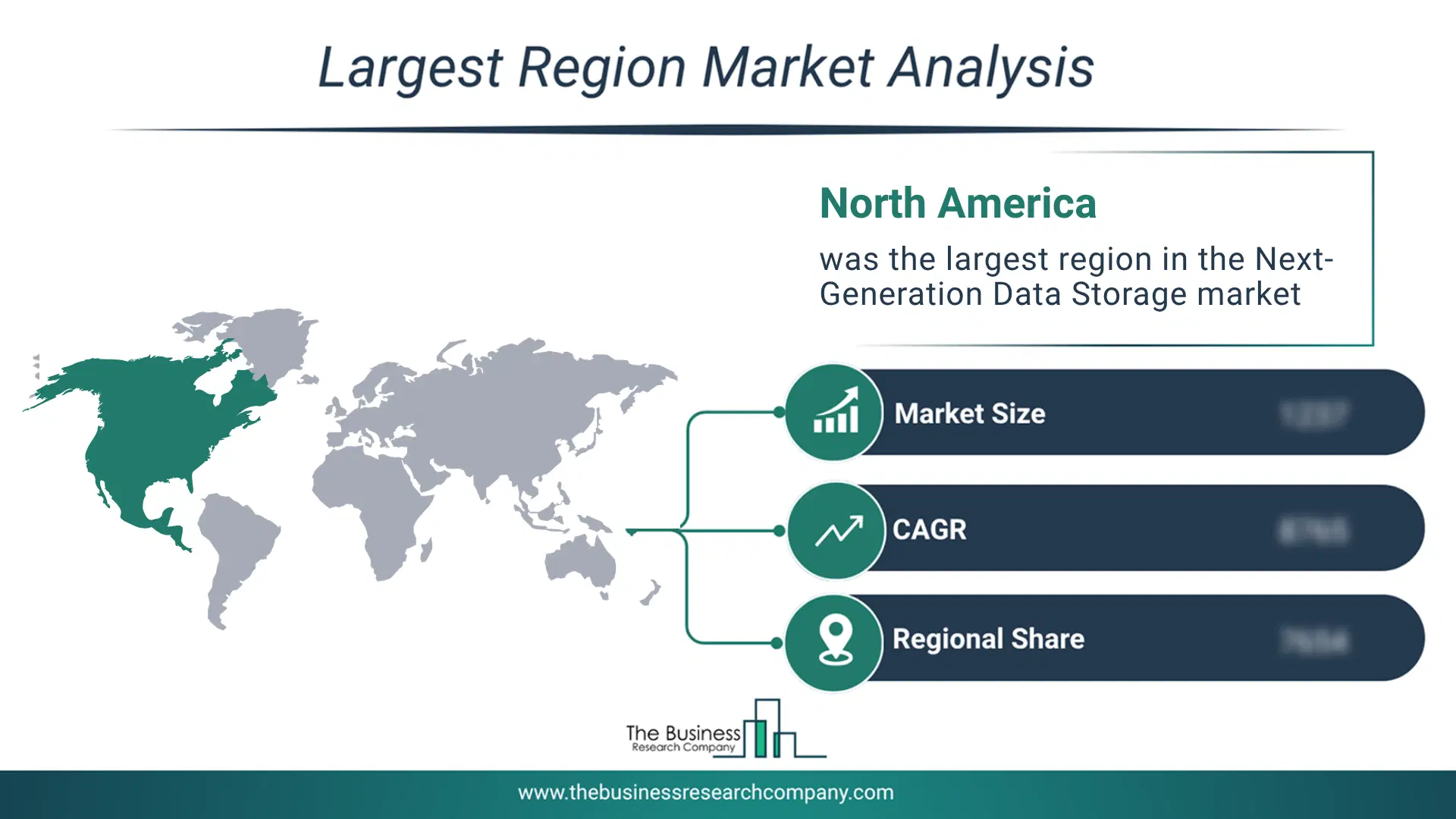
Regional Insights
North America was the largest region in the next-generation data storage market in 2025. Asia-Pacific is expected to be the fastest-growing region in the forecast period. The regions covered in this market report are Asia-Pacific, South East Asia, Western Europe, Eastern Europe, North America, South America, Middle East, Africa. The countries covered in this market report are Australia, Brazil, China, France, Germany, India, Indonesia, Japan, Taiwan, Russia, South Korea, UK, USA, Canada, Italy, SpainWhat Defines the Next-Generation Data Storage Market?
The next-generation data storage market consists of revenues earned by entities through online data storage and protection solutions. The market value includes the value of related goods sold by the service provider or included within the service offering. The next-generation data storage market also includes sales of storage devices like Parallel Advanced Technology Attachment (PATA) hard drives and Serial Advanced Technology Attachment (SATA) hard drives, which are used in providing next-generation data storage services. Values in this market are ‘factory gate’ values, that is, the value of goods sold by the manufacturers or creators of the goods, whether to other entities (including downstream manufacturers, wholesalers, distributors, and retailers) or directly to end customers. The value of goods in this market includes related services sold by the creators of the goods.How is Market Value Defined and Measured?
The market value is defined as the revenues that enterprises gain from the sale of goods and/or services within the specified market and geography through sales, grants, or donations in terms of the currency (in USD unless otherwise specified). The revenues for a specified geography are consumption values that are revenues generated by organizations in the specified geography within the market, irrespective of where they are produced. It does not include revenues from resales along the supply chain, either further along the supply chain or as part of other products.
This chart presents market attractiveness based on a quantitative evaluation of growth, competition, strategic alignment, and risk, offering a clear view of opportunity areas for decision-making. This chart is for illustrative purposes; the full report contains the complete analysis.

This chart highlights the Total Addressable Market (TAM) by estimating the maximum revenue opportunity using an assumption-driven approach, supporting strategic planning and opportunity sizing across markets. The chart is illustrative; the full report provides a more comprehensive analysis.
What Key Data and Analysis Are Included in the Next-Generation Data Storage Market Report 2026?
The next-generation data storage market research report is one of a series of new reports from The Business Research Company that provides market statistics, including industry global market size, regional shares, competitors with the market share, detailed market segments, market trends and opportunities, and any further data you may need to thrive in the next-generation data storage industry. The market research report delivers a complete perspective of everything you need, with an in-depth analysis of the current and future state of the industry.Next-Generation Data Storage Market Report Forecast Analysis
| Report Attribute | Details |
|---|---|
| Market Size Value In 2026 | $106.83 billion |
| Revenue Forecast In 2030 | $175.73 billion |
| Growth Rate | CAGR of 13.2% from 2026 to 2030 |
| Base Year For Estimation | 2025 |
| Actual Estimates/Historical Data | 2020-2025 |
| Forecast Period | 2026 - 2030 |
| Market Representation | Revenue in USD Billion and CAGR from 2026 to 2030 |
| Segments Covered | Туре, Technology, Architecture, Deployment, Industrial Vertical |
| Regional Scope | Asia-Pacific, Western Europe, Eastern Europe, North America, South America, Middle East, Africa |
| Country Scope | The Countries Covered In This Market Report Are Australia, Brazil, China, France, Germany, India, Indonesia, Japan, Taiwan, Russia, South Korea, Uk, Usa, Canada, Italy, Spain. |
| Key Companies Profiled | Samsung Electronics Co. Ltd., Dell Technologies Inc., Hitachi Ltd., Huawei Technologies Co. Ltd., IBM (The International Business Machines Corporation), SK hynix Inc., Fujitsu Limited, Hewlett Packard Enterprise Company, Toshiba Corporation, Western Digital Technologies Inc., Inspur Group Co. Ltd., NetApp Inc., Pure Storage Inc., Nutanix Inc., DataDirect Networks, Everspin Technologies Inc., Cloudian Inc., Drobo Inc., Viking Technology, Avalanche Technology Inc., Spin Memory Inc., 4DS Memory Limited, Nantero Inc., Tegile Systems Inc., Kaminario Inc., Infortrend Technology Inc., Seagate Technology PLC |
| Customization Scope | Request for Customization |
| Pricing And Purchase Options | Explore Purchase Options |