
Next-Generation Drug Conjugates Oncology Market Report 2026
Global Outlook – By Product Type (Antibody-Drug Conjugates, Peptide Drug Conjugates, Small Molecule Drug Conjugates, Polymer Drug Conjugates), By Technology (Cleavable Linker Technology, Non Cleavable Linker Technology, Site Specific Conjugation, Random Conjugation), By Application (Breast Cancer, Lung Cancer, Hematological Malignancies, Colorectal Cancer, Ovarian Cancer), By End User (Hospitals, Cancer Treatment Centers, Research Institutes, Specialty Clinics) – Market Size, Trends, Strategies, and Forecast to 2030
Next-Generation Drug Conjugates Oncology Market Overview
• Next-Generation Drug Conjugates Oncology market size has reached to $12.28 billion in 2025 • Expected to grow to $22.86 billion in 2030 at a compound annual growth rate (CAGR) of 13.3% • Growth Driver: Rising Incidence Of Cancer Fueling The Growth Of The Market Due To Increasing Demand For Targeted And Precision Cancer Therapies • Market Trend: Advancements In Targeted Antibody-Drug Conjugate Therapies • North America was the largest region in 2025 and Asia-Pacific is the fastest growing region.What Is Covered Under Next-Generation Drug Conjugates Oncology Market?
Next-generation drug conjugates oncology refers to an advanced approach to cancer treatment that uses targeted drug conjugates, such as antibody-drug conjugates (ADCs), to deliver therapeutic agents directly to cancer cells while minimizing damage to healthy tissues. These therapies are designed with improved targeting mechanisms, enhanced drug payloads, and optimized delivery technologies to increase treatment effectiveness, reduce side effects, and address resistant or hard-to-treat cancers. The main product types of next-generation drug conjugates oncology include antibody-drug conjugates, peptide drug conjugates, small molecule drug conjugates, and polymer drug conjugates. Antibody-drug conjugates refer to targeted cancer therapies that combine monoclonal antibodies with cytotoxic drugs to selectively kill tumor cells while minimizing damage to healthy tissue. These therapies are based on technologies including cleavable linker technology, non cleavable linker technology, site specific conjugation, and random conjugation. These are used across applications such as breast cancer, lung cancer, hematological malignancies, colorectal cancer, and ovarian cancer, they are utilized by end users including hospitals, cancer treatment centers, research institutes, and specialty clinics.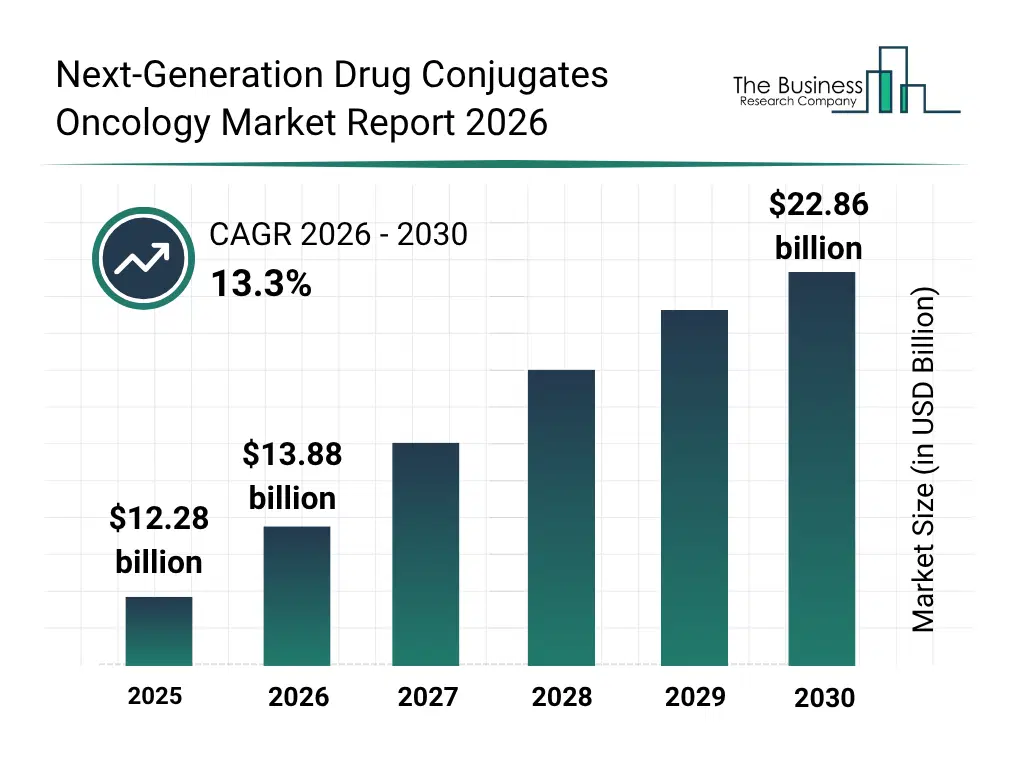
What Is The Next-Generation Drug Conjugates Oncology Market Size and Share 2026?
The next-generation drug conjugates oncology market size has grown rapidly in recent years. It will grow from $12.28 billion in 2025 to $13.88 billion in 2026 at a compound annual growth rate (CAGR) of 13.0%. The growth in the historic period can be attributed to rise of monoclonal antibody therapeutics, increasing global cancer prevalence, improvements in chemotherapy toxicity management, early approvals of targeted oncology biologics, expansion of oncology clinical trial activity.What Is The Next-Generation Drug Conjugates Oncology Market Growth Forecast?
The next-generation drug conjugates oncology market size is expected to see rapid growth in the next few years. It will grow to $22.86 billion in 2030 at a compound annual growth rate (CAGR) of 13.3%. The growth in the forecast period can be attributed to growth in precision oncology adoption, increasing investment in biologics and targeted therapies pipelines, expansion of companion diagnostic and biomarker testing, rising demand for targeted cancer therapies in emerging markets, advancements in next-generation payload engineering and conjugation technologies. Major trends in the forecast period include next-generation linker chemistry optimization improving stability and controlled drug release in antibody-drug conjugates, expansion of novel cytotoxic and immune-modulatory payloads to enhance therapeutic potency against resistant cancer cells, tumor microenvironment-responsive conjugates enabling selective activation of drugs within cancerous tissues, development of multi-specific and dual-targeting drug conjugates to overcome tumor heterogeneity and treatment resistance, increased use of biomarker-driven patient stratification to improve targeting precision and clinical outcomes.
Global Next-Generation Drug Conjugates Oncology Market Segmentation
1) By Product Type: Antibody-Drug Conjugates, Peptide Drug Conjugates, Small Molecule Drug Conjugates, Polymer Drug Conjugates 2) By Technology: Cleavable Linker Technology, Non Cleavable Linker Technology, Site Specific Conjugation, Random Conjugation 3) By Application: Breast Cancer, Lung Cancer, Hematological Malignancies, Colorectal Cancer, Ovarian Cancer 4) By End User: Hospitals, Cancer Treatment Centers, Research Institutes, Specialty Clinics Subsegments: 1) By Antibody-Drug Conjugates: Monoclonal Antibody Drug Conjugates, Bispecific Antibody Drug Conjugates, Site Specific Antibody Drug Conjugates 2) By Peptide Drug Conjugates: Targeted Peptide Drug Conjugates, Radiolabeled Peptide Drug Conjugates, Cyclic Peptide Drug Conjugates, Cell Penetrating Peptide Drug Conjugates, Tumor Targeting Peptide Drug Conjugates 3) By Small Molecule Drug Conjugates: Ligand Targeted Small Molecule Drug Conjugates, Folate Receptor Targeted Drug Conjugates, Prostate Specific Membrane Antigen Targeted Drug Conjugates, Dual Payload Small Molecule Drug Conjugates, Cleavable Linker Small Molecule Drug Conjugates 4) By Polymer Drug Conjugates: Biodegradable Polymer Drug Conjugates, Water Soluble Polymer Drug Conjugates, Polyethylene Glycol Based Drug Conjugates, Stimuli Responsive Polymer Drug Conjugates, Nanopolymer Drug ConjugatesWhat Is The Driver Of The Next-Generation Drug Conjugates Oncology Market?
The increasing incidence of cancer is expected to propel the growth of the next-generation drug conjugates oncology market going forward. Cancer incidence refers to the number of new cancer cases diagnosed within a specific population during a certain period. The increasing incidence of cancer is due to an aging population, with older age leading to the accumulation of genetic mutations and a decline in the body’s ability to repair damaged cells, which raises cancer risk over time. Next-generation drug conjugates in oncology help improve cancer treatment by delivering potent therapeutic agents directly to tumor cells, enhancing treatment precision while reducing damage to healthy tissues and minimizing systemic toxicity. For instance, in January 2026, according to the Centers for Disease Control and Prevention, a US-based government agency in the United States, 1,851,238 new cancer cases were recorded in 2022, and 613,349 deaths due to cancer occurred in 2023. Therefore, the increasing incidence of cancer is driving the growth of the next-generation drug conjugates oncology industry.Key Players In The Global Next-Generation Drug Conjugates Oncology Market
Major companies operating in the next-generation drug conjugates oncology market are F. Hoffmann-La Roche Ltd., Pfizer Inc., Novartis AG, AstraZeneca PLC, Eli Lilly and Company, Gilead Sciences Inc., Daiichi Sankyo Company Limited, Lonza Group AG, AbbVie Inc., FUJIFILM Corporation, Lotte Biologics Co Ltd., Ajinomoto Bio-Pharma Services Inc., Hansoh Pharmaceutical Group Company Limited, Piramal Pharma Solutions, Byondis B.V., Mersana Therapeutics, Sutro Biopharma, Alloy Therapeutics Inc., Adagene Inc., Sichuan Kelun-Biotech Biopharmaceutical Co Ltd., Tahoe Therapeutics Inc., Adcendo ApS, HanX Biopharmaceuticals Inc., Sidewinder Therapeutics Inc., Fortitude Biomedicines Inc., Valanx Biotech Pvt Ltd.Global Next-Generation Drug Conjugates Oncology Market Trends and Insights
Major companies operating in the next-generation drug conjugates oncology market are focusing on developing innovative therapies, such as human epidermal growth factor receptor 3-targeting antibody-drug conjugates (ADCs) to enhance tumor-specific drug delivery, improve treatment efficacy, and reduce systemic toxicity in cancer care. Human epidermal growth factor receptor-targeting antibody-drug conjugates are precision oncology therapies that combine monoclonal antibodies directed against HER3 receptors with potent cytotoxic agents, enabling selective delivery of anti-cancer drugs directly to tumor cells while minimizing damage to healthy tissues compared to conventional chemotherapy. For instance, in July 2025, DualityBio Ltd., a China-based biopharmaceutical company, announced that DB-1310 received Fast Track Designation from the U.S. Food and Drug Administration (FDA) for the treatment of advanced solid tumors with HER3 expression. The therapy is designed using DualityBio’s proprietary antibody-drug conjugate platform and incorporates a HER3-specific monoclonal antibody linked to a highly potent topoisomerase inhibitor payload. It is engineered to improve targeted tumor penetration and intracellular payload delivery while reducing off-target toxicity. The designation supports accelerated development and regulatory review for patients with limited treatment options, highlighting the growing focus on precision-targeted oncology therapeutics and next-generation conjugate technologies in cancer treatment.What Are Latest Mergers And Acquisitions In The Next-Generation Drug Conjugates Oncology Market?
In April 2024, Genmab A/S, a Denmark-based biotechnology company, acquired Profound Bio for $1.8 billion. With this acquisition, Genmab A/S aims to strengthen its oncology portfolio and expand its next-generation antibody-drug conjugate technology capabilities to accelerate the development of targeted cancer therapies. ProfoundBio Inc. is a US-based clinical-stage biotechnology company focused on developing next-generation antibody-drug conjugates and advanced oncology technologies for the treatment of solid tumors and other cancers.Regional Outlook
North America was the largest region next-generation drug conjugates oncology market in 2025. Asia-Pacific is expected to be the fastest-growing region in the forecast period. The regions covered in this market report are Australia, Brazil, China, France, Germany, India, Indonesia, Japan, Taiwan, Russia, South Korea, UK, USA, Canada, Italy, Spain. The countries covered in this market report are Australia, Brazil, China, France, Germany, India, Indonesia, Japan, Taiwan, Russia, South Korea, UK, USA, Canada, Italy, Spain.What Defines the Next-Generation Drug Conjugates Oncology Market?
The next-generation drug conjugates oncology market consists of revenues earned by entities by providing services such as targeted cancer therapy development, antibody-drug conjugate (ADC) research and development, clinical trial and oncology testing services, precision medicine and biomarker analysis, drug conjugate manufacturing, and commercialization services. The market value includes the value of related goods sold by the service provider or included within the service offering. The next-generation drug conjugates oncology market also includes sales of immune-stimulating antibody conjugates, dual-payload drug conjugates, radioligand drug conjugates, aptamer-drug conjugates, and nanoparticle-based drug conjugates. Values in this market are ‘factory gate’ values, that is the value of goods sold by the manufacturers or creators of the goods, whether to other entities (including downstream manufacturers, wholesalers, distributors and retailers) or directly to end customers. The value of goods in this market includes related services sold by the creators of the goods.How is Market Value Defined and Measured?
The market value is defined as the revenues that enterprises gain from the sale of goods and/or services within the specified market and geography through sales, grants, or donations in terms of the currency (in USD unless otherwise specified). The revenues for a specified geography are consumption values that are revenues generated by organizations in the specified geography within the market, irrespective of where they are produced. It does not include revenues from resales along the supply chain, either further along the supply chain or as part of other products.What Key Data and Analysis Are Included in the Next-Generation Drug Conjugates Oncology Market Report 2026?
The next-generation drug conjugates oncology market research report is one of a series of new reports from The Business Research Company that provides next-generation drug conjugates oncology market statistics, including next-generation drug conjugates oncology industry global market size, regional shares, competitors with a next-generation drug conjugates oncology market share, detailed next-generation drug conjugates oncology market segments, market trends and opportunities, and any further data you may need to thrive in the next-generation drug conjugates oncology industry. This next-generation drug conjugates oncology market research report delivers a complete perspective of everything you need, with an in-depth analysis of the current and future scenario of the industry.Next-Generation Drug Conjugates Oncology Market Report Forecast Analysis
| Report Attribute | Details |
|---|---|
| Market Size Value In 2026 | $13.88 billion |
| Revenue Forecast In 2030 | $22.86 billion |
| Growth Rate | CAGR of 13.3% from 2026 to 2030 |
| Base Year For Estimation | 2025 |
| Actual Estimates/Historical Data | 2020-2025 |
| Forecast Period | 2026 - 2030 |
| Market Representation | Revenue in USD Billion and CAGR from 2026 to 2030 |
| Segments Covered | Product Type, Technology, Application, End User |
| Regional Scope | Asia-Pacific, Western Europe, Eastern Europe, North America, South America, Middle East, Africa |
| Country Scope | The countries covered in the next-generation drug conjugates oncology market report are Australia, Brazil, China, France, Germany, India, Indonesia, Japan, Taiwan, Russia, South Korea, UK, USA, Canada, Italy, Spain. |
| Key Companies Profiled | F. Hoffmann-La Roche Ltd., Pfizer Inc., Novartis AG, AstraZeneca PLC, Eli Lilly and Company, Gilead Sciences Inc., Daiichi Sankyo Company Limited, Lonza Group AG, AbbVie Inc., FUJIFILM Corporation, Lotte Biologics Co Ltd., Ajinomoto Bio-Pharma Services Inc., Hansoh Pharmaceutical Group Company Limited, Piramal Pharma Solutions, Byondis B.V., Mersana Therapeutics, Sutro Biopharma, Alloy Therapeutics Inc., Adagene Inc., Sichuan Kelun-Biotech Biopharmaceutical Co Ltd., Tahoe Therapeutics Inc., Adcendo ApS, HanX Biopharmaceuticals Inc., Sidewinder Therapeutics Inc., Fortitude Biomedicines Inc., Valanx Biotech Pvt Ltd. |
| Customization Scope | Request for Customization |
| Pricing And Purchase Options | Explore Purchase Options |