
Next-Generation In-vehicle Networking (IVN) Market Report 2026
Global Outlook – By Type (Infotainment, Climate Control, Navigation, Driver Assistance Systems (DAS), Other Types), By Connectivity Standards (Controller Area Network (CAN), Local Interconnect Network (LIN), FlexRay, Radio Frequency (RF), Ethernet, Media-Oriented Systems Transport (MOST)), By Vehicle Type (Passenger Car, Light Commercial Vehicle (LCV), Heavy Commercial Vehicle (HCV), Automated Guided Vehicle (AGV)), By Application (Powertrain, Safety, Body Electronics, Chassis, Infotainment) – Market Size, Trends, Strategies, and Forecast to 2030
Next-Generation In-vehicle Networking (IVN) Market Overview
• Next-Generation In-vehicle Networking (IVN) market size has reached to $2.36 billion in 2025 • Expected to grow to $4.33 billion in 2030 at a compound annual growth rate (CAGR) of 12.9% • Growth Driver: Surge In Electric Vehicle Demand Driving The Growth Of The Market Due To Environmental And Technological Advancements • Market Trend: Advancements In Automotive Networking Multi-Gigabit Ethernet Chipsets Driving High-Speed Connectivity • North America was the largest region in 2025 and Asia-Pacific is the fastest growing region.What Is Covered Under Next-Generation In-vehicle Networking (IVN) Market?
Next-generation in-vehicle networking (IVN) refers to the advanced communication systems used in modern vehicles to connect various electronic control units (ECUs), sensors, infotainment systems, and other devices within the vehicle. It enables high-speed data exchange between these components to support various functions, from autonomous driving and advanced driver-assistance systems (ADAS) to infotainment and vehicle diagnostics. The main types of next-generation in-vehicle networking (IVN) are infotainment, climate control, navigation, driver assistance systems (das), and others. Infotainment refers to a combination of information and entertainment systems within vehicles, providing services like navigation, media playback, and internet connectivity. The various connectivity standards involved are controller area network (can), local interconnect network (lin), FlexRay, radio frequency (rf), ethernet, and media-oriented systems transport (most), which are installed in a passenger car, light commercial vehicle (LCV), heavy commercial vehicle (HCV), automated guided vehicle (AGV). The various applications involved are powertrain, safety, body electronics, chassis, and infotainment used in aerospace, agriculture, automotive, construction, manufacturing, and pharmaceuticals.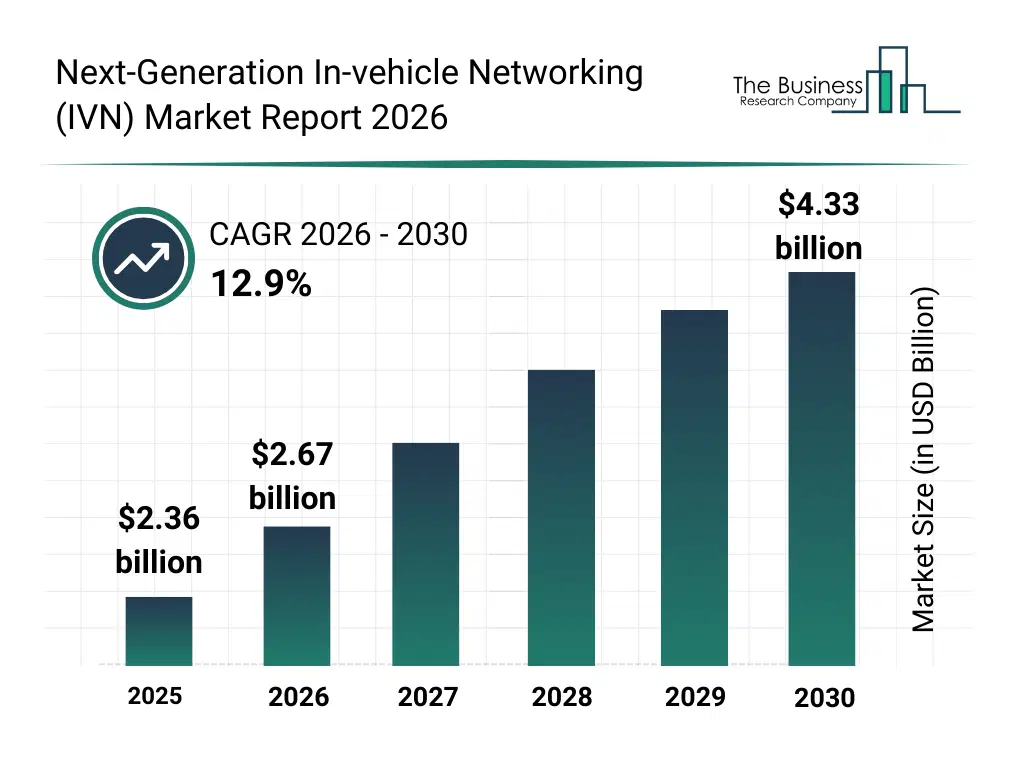
What Is The Next-Generation In-vehicle Networking (IVN) Market Size and Share 2026?
The next-generation in-vehicle networking (ivn) market size has grown rapidly in recent years. It will grow from $2.36 billion in 2025 to $2.67 billion in 2026 at a compound annual growth rate (CAGR) of 12.9%. The growth in the historic period can be attributed to increase in vehicle electronics complexity, growth in infotainment systems, need for reliable in vehicle communication, adoption of CAN and LIN networks, safety system integration.What Is The Next-Generation In-vehicle Networking (IVN) Market Growth Forecast?
The next-generation in-vehicle networking (ivn) market size is expected to see rapid growth in the next few years. It will grow to $4.33 billion in 2030 at a compound annual growth rate (CAGR) of 12.9%. The growth in the forecast period can be attributed to autonomous vehicle commercialization, connected car ecosystem growth, demand for low latency communication, expansion of V2X systems, software centric vehicle platforms. Major trends in the forecast period include adoption of automotive ethernet, growth of high speed data communication, integration of ADAS and autonomous systems, expansion of over the air updates, shift toward zonal architectures.
Global Next-Generation In-vehicle Networking (IVN) Market Segmentation
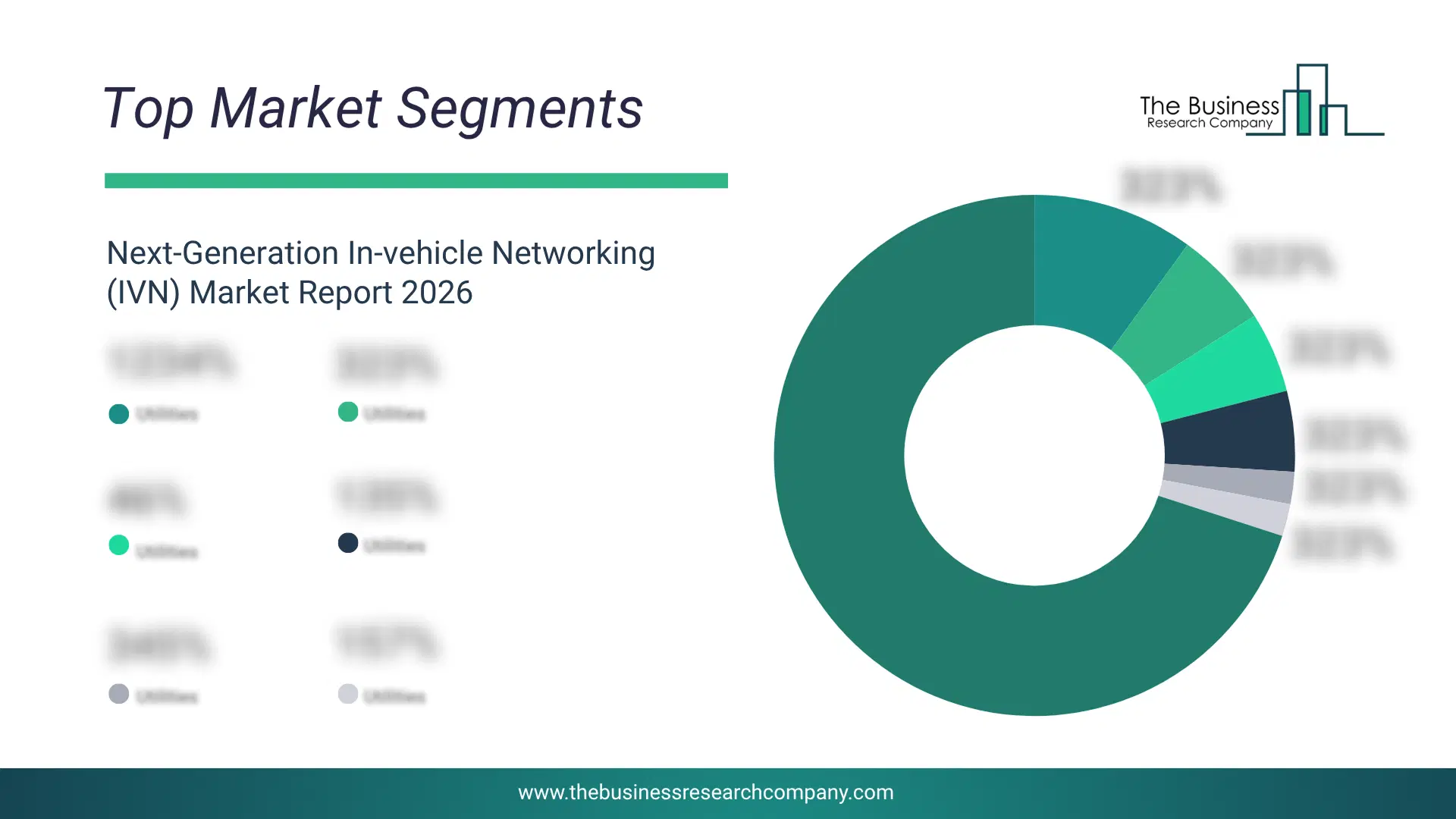
1) By Type: Infotainment, Climate Control, Navigation, Driver Assistance Systems (DAS), Other Types 2) By Connectivity Standards: Controller Area Network (CAN), Local Interconnect Network (LIN), FlexRay, Radio Frequency (RF), Ethernet, Media-Oriented Systems Transport (MOST) 3) By Vehicle Type: Passenger Car, Light Commercial Vehicle (LCV), Heavy Commercial Vehicle (HCV), Automated Guided Vehicle (AGV) 4) By Application: Powertrain, Safety, Body Electronics, Chassis, Infotainment Subsegments: 1) By Infotainment: Audio And Video Entertainment Systems, Bluetooth And Wi-Fi Connectivity, Smartphone Integration, Voice Recognition Systems, Touchscreen Displays, Rear-Seat Entertainment 2) By Climate Control: Automatic Climate Control Systems, Dual-Zone And Multi-Zone Climate Control, Air Quality Monitoring And Ionization Systems, Seat Heating And Ventilation, Remote Climate Control 3) By Navigation: GPS-based Navigation Systems, Real-time Traffic Updates And Route Optimization, Augmented Reality (AR) Navigation, Over-the-Air (OTA) Map Updates, Integration With Smart Assistants 4) By Driver Assistance Systems (DAS): Adaptive Cruise Control (ACC), Lane Departure Warning (LDW) And Lane Keeping Assist (LKA), Blind Spot Detection (BSD), Parking Assistance And Automated Parking Systems, Forward Collision Warning (FCW) And Automatic Emergency Braking (AEB), Night Vision And Driver Monitoring Systems 5) By Other Types: Vehicle-to-Everything (V2X) Communication, Over-the-Air (OTA) Software Updates, Predictive Maintenance Systems, Biometric Access And Security Systems, Telematics And Fleet ManagementWhat Is The Driver Of The Next-Generation In-vehicle Networking (IVN) Market?
The growing demand for electric vehicles is expected to propel the growth of the next-generation in-vehicle networking (IVN) market going forward. Electric vehicles (EVs) are vehicles that are powered entirely or partially by electricity rather than traditional internal combustion engines (ICE) that run on gasoline or diesel. The growing demand for electric vehicles (EVs) is due to reducing carbon emissions, lowering operating costs, and supporting energy independence. As concerns over climate change intensify, governments and consumers increasingly prioritize eco-friendly transportation options. EVs produce zero tailpipe emissions, making them an attractive solution for reducing air pollution and contributing to global carbon reduction goals. Next-generation in-vehicle networking (IVN) plays a crucial role in electric vehicles (EVs) by enabling seamless communication between various electronic systems within the vehicle, supporting the integration of advanced features, and ensuring optimal performance. For instance, in April 2024, according to International Energy Agency (IEA), a France-based energy-analysis organisation, nearly 14 million new electric cars were registered globally in 2023, electric car sales in 2023 were 3.5 million higher than in 2022, a 35 % year-on-year increase, and electric cars made up about 18 % of all cars sold in 2023, bringing the total number of electric cars on the world’s roads to roughly 40 million. Therefore, the growing demand for electric vehicles is driving the growth of the next-generation in-vehicle networking (IVN) industry.Key Players In The Global Next-Generation In-vehicle Networking (IVN) Market
Major companies operating in the next-generation in-vehicle networking (ivn) market report include Robert Bosch GmbH, NXP Semiconductors NV, Infineon Technologies AG, STMicroelectronics NV, Renesas Electronics Corporation, Texas Instruments Incorporated, Microchip Technology Inc., Broadcom Inc., Marvell Technology Inc., Analog Devices Inc., ON Semiconductor Corporation, Aptiv PLC, Continental AG, ZF Friedrichshafen AG, Denso Corporation, HARMAN International Industries Inc., TE Connectivity PLC, Molex LLC, Nexperia BV, Valeo S.A.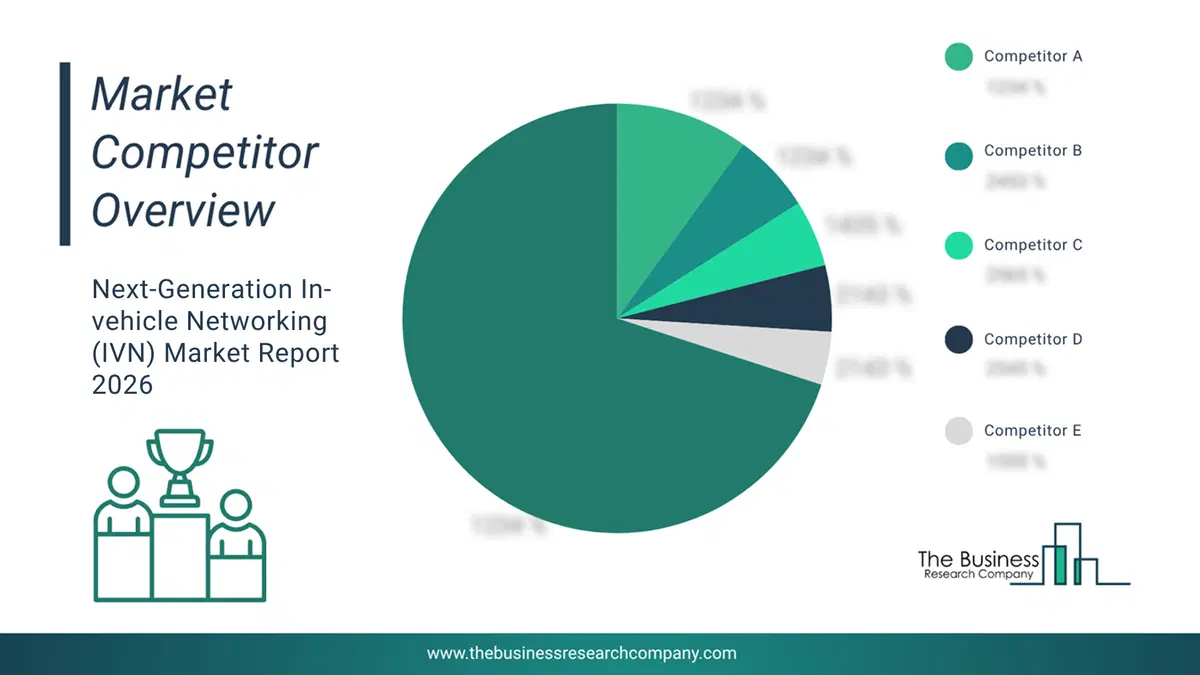
This chart is for illustrative purposes; the full report includes a detailed competitor analysis and comprehensive overview of the top 10 companies in the market.
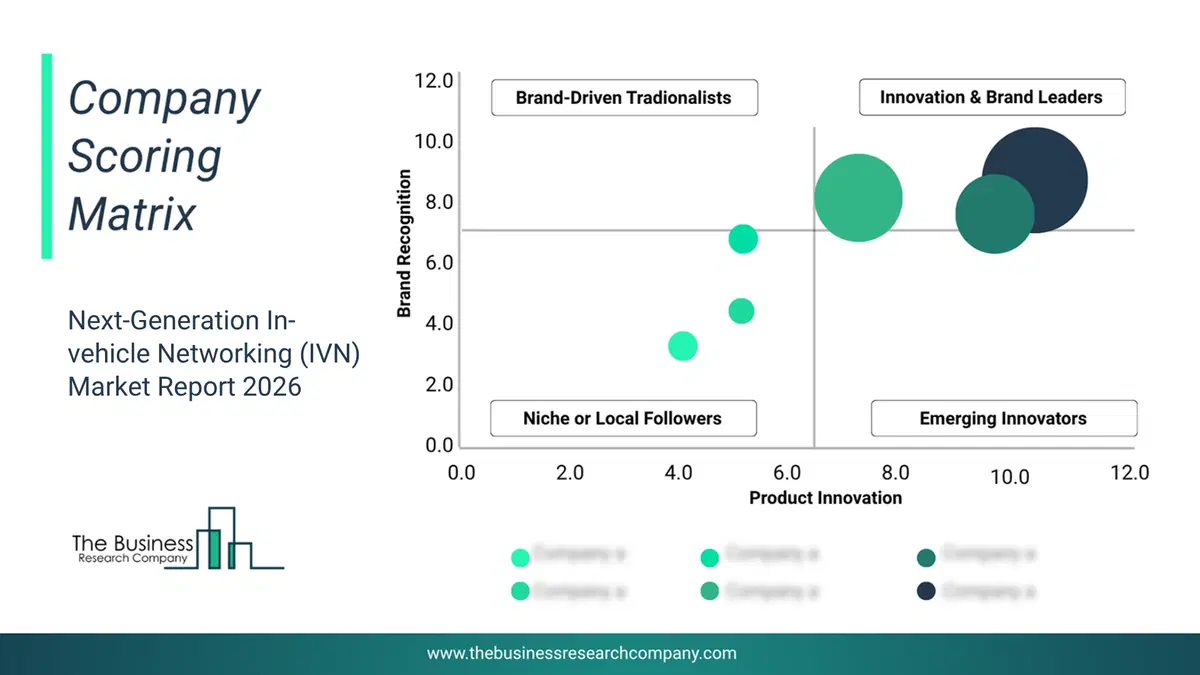
This chart maps companies by product innovation and brand strength, with bubble size indicating relative revenue, helping identify market leaders, challengers, and niche players. This is an illustrative chart; the full report provides a complete and accurate competitive analysis.
Global Next-Generation In-vehicle Networking (IVN) Market Trends and Insights
Major companies operating in the next-generation in-vehicle networking (IVN) market are focusing on developing innovative components, such as multi-gigabit Ethernet chipsets, to boost high-speed automotive connectivity. Multi-gigabit Ethernet chipsets are advanced networking solutions for fast, low-power, and scalable data transmission in automotive and industrial applications. For instance, in May 2024, Aeonsemi, a US-based integrated circuit (IC) design firm, launched Nemo, the industry's most comprehensive IEEE 802.3ch-compliant multi-gigabit Ethernet chipset for IVN. Nemo includes the world's first automotive switch with integrated 10GBASE-T1 PHYs, enabling energy-efficient, symmetric, and asymmetric Ethernet connectivity over long distances, reducing power consumption, and enhancing performance in next-gen automotive networks.What Are Latest Mergers And Acquisitions In The Next-Generation In-vehicle Networking (IVN) Market?
In April 2024, Microchip Technology Inc., a US-based semiconductor manufacturing company, acquired VSI Co. Ltd. for an undisclosed amount. This acquisition aims to enhance Microchip's automotive networking portfolio by integrating VSI's ASA Motion Link technologies for high-speed camera, sensor, and display connectivity in next-generation software-defined vehicles (SDVs). VSI Co. Ltd. is a South Korea-based company providing next-generation vehicle networking technology.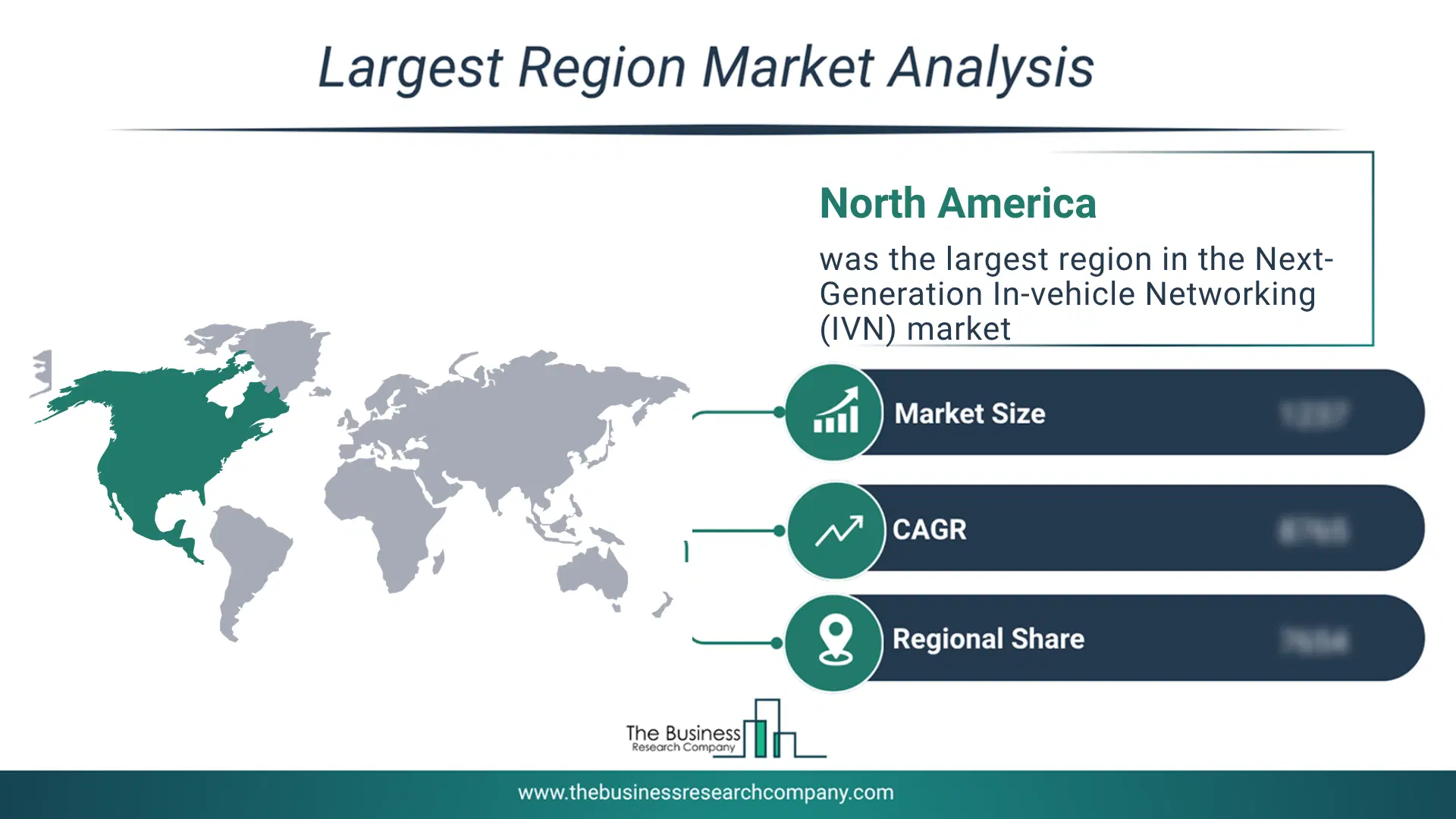
Regional Outlook
North America was the largest region in the next generation in-vehicle networking (IVN) market in 2025. Asia-Pacific is expected to be the fastest-growing region in the forecast period. The regions covered in this market report include Asia-Pacific, South East Asia, Western Europe, Eastern Europe, North America, South America, Middle East, Africa. The countries covered in this market report include Australia, Brazil, China, France, Germany, India, Indonesia, Japan, Taiwan, Russia, South Korea, UK, USA, Canada, Italy, SpainWhat Defines the Next-Generation In-vehicle Networking (IVN) Market?
The next generation in-vehicle networking (IVN) market consists of revenues earned by entities by providing services such as high-speed data communication, advanced driver-assistance systems (ADAS) integration, vehicle-to-everything (V2X) connectivity, in-cabin infotainment, and automotive cybersecurity. The market value includes the value of related goods sold by the service provider or included within the service offering. The next generation in-vehicle networking (IVN) market also includes sales of automotive Ethernet switches, SerDes chipsets, telematics control units (TCUs), gateway modules, and high-speed communication transceivers. Values in this market are ‘factory gate’ values, that is, the value of goods sold by the manufacturers or creators of the goods, whether to other entities (including downstream manufacturers, wholesalers, distributors, and retailers) or directly to end customers. The value of goods in this market includes related services sold by the creators of the goods.How is Market Value Defined and Measured?
The market value is defined as the revenues that enterprises gain from the sale of goods and/or services within the specified market and geography through sales, grants, or donations in terms of the currency (in USD unless otherwise specified). The revenues for a specified geography are consumption values that are revenues generated by organizations in the specified geography within the market, irrespective of where they are produced. It does not include revenues from resales along the supply chain, either further along the supply chain or as part of other products.
This chart presents market attractiveness based on a quantitative evaluation of growth, competition, strategic alignment, and risk, offering a clear view of opportunity areas for decision-making. This chart is for illustrative purposes; the full report contains the complete analysis.

This chart highlights the Total Addressable Market (TAM) by estimating the maximum revenue opportunity using an assumption-driven approach, supporting strategic planning and opportunity sizing across markets. The chart is illustrative; the full report provides a more comprehensive analysis.
What Key Data and Analysis Are Included in the Next-Generation In-vehicle Networking (IVN) Market Report 2026?
The next-generation in-vehicle networking (ivn) market research report is one of a series of new reports from The Business Research Company that provides market statistics, including industry global market size, regional shares, competitors with the market share, detailed market segments, market trends and opportunities, and any further data you may need to thrive in the next-generation in-vehicle networking (ivn) industry. The market research report delivers a complete perspective of everything you need, with an in-depth analysis of the current and future state of the industry.Next-Generation In-vehicle Networking (IVN) Market Report Forecast Analysis
| Report Attribute | Details |
|---|---|
| Market Size Value In 2026 | $2.67 billion |
| Revenue Forecast In 2030 | $4.33 billion |
| Growth Rate | CAGR of 12.9% from 2026 to 2030 |
| Base Year For Estimation | 2025 |
| Actual Estimates/Historical Data | 2020-2025 |
| Forecast Period | 2026 - 2030 - 2030 |
| Market Representation | Revenue in USD Billion and CAGR from 2026 to 2030 |
| Segments Covered | Type, Connectivity Standards, Vehicle Type, Application |
| Regional Scope | Asia-Pacific, Western Europe, Eastern Europe, North America, South America, Middle East, Africa |
| Country Scope | The countries covered in the report are Australia, Brazil, China, France, Germany, India, Indonesia, Japan, Taiwan, Russia, South Korea, UK, USA, Canada, Italy, Spain. |
| Key Companies Profiled | Robert Bosch GmbH, NXP Semiconductors NV, Infineon Technologies AG, STMicroelectronics NV, Renesas Electronics Corporation, Texas Instruments Incorporated, Microchip Technology Inc., Broadcom Inc., Marvell Technology Inc., Analog Devices Inc., ON Semiconductor Corporation, Aptiv PLC, Continental AG, ZF Friedrichshafen AG, Denso Corporation, HARMAN International Industries Inc., TE Connectivity PLC, Molex LLC, Nexperia BV, Valeo S.A. |
| Customization Scope | Request for Customization |
| Pricing And Purchase Options | Explore Purchase Options |