
Next Generation Light Anti-Tank Weapon (NLAW) Market Report 2026
Global Outlook – By Product Type (Disposable Systems, Reusable Systems, Reloadable Systems, Single Use Launch Systems), By Platform (Man Portable Systems, Vehicle Mounted Systems, Ground Based Systems), By Guidance Technology (Infrared Homing Systems, Laser Guided Systems, Wire Guided Systems, Fire And Forget Systems), By Range (Short Range, Medium Range, Long Range), By End User (Army, Special Forces, Paramilitary, Other End Users) – Market Size, Trends, Strategies, and Forecast to 2030
Next Generation Light Anti-Tank Weapon (NLAW) Market Overview
• Next Generation Light Anti-Tank Weapon (NLAW) market size has reached to $1.03 billion in 2025 • Expected to grow to $1.55 billion in 2030 at a compound annual growth rate (CAGR) of 8.4% • Growth Driver: Rising Geopolitical Tensions Driving The Market Growth Due To Increasing Defense Procurement Across Nations • Market Trend: Innovations In Next-Generation Light Anti-Tank Weapon (NLAW) Technology Enhance Battlefield Precision And Infantry Combat Effectiveness • North America was the largest region in 2025 and Asia-Pacific is the fastest growing region.What Is Covered Under Next Generation Light Anti-Tank Weapon (NLAW) Market?
The next-generation light anti-tank weapon (NLAW) is a lightweight, shoulder-fired anti-tank missile system developed to neutralize heavily armored vehicles and main battle tanks at short range. It provides infantry forces with highly mobile and rapid-response anti-armor capabilities for urban combat and defensive missions. The next-generation light anti-tank weapon (NLAW) equipped with top-attack and direct-attack modes enhances battlefield effectiveness, survivability, and tactical flexibility. The main product types of next generation light anti-tank weapon (NLAW) include disposable systems, reusable systems, reloadable systems, and single use launch systems. Disposable systems refer to lightweight, man-portable anti-tank missile systems designed for one-time use to engage armored targets with high precision. These systems are deployed across platforms including man portable systems, vehicle mounted systems, and ground based systems and utilize guidance technologies such as infrared homing systems, laser guided systems, wire guided systems, and fire and forget systems. They are available across range categories including short range, medium range, and long range and are used by end users including army, special forces, paramilitary, and others.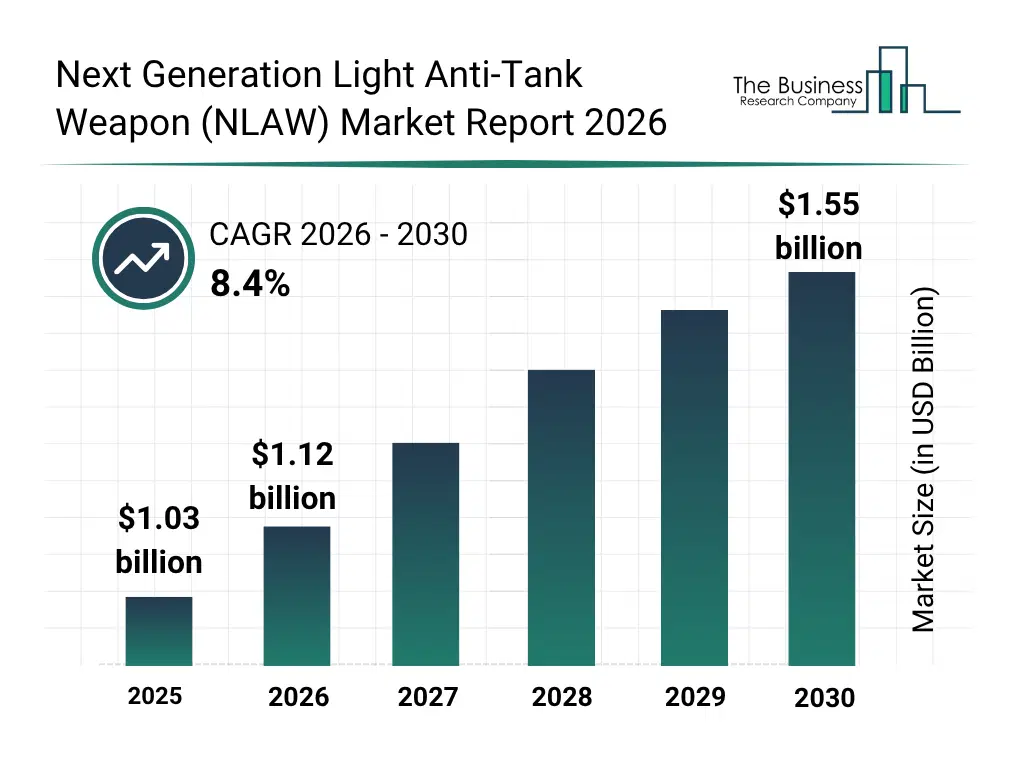
What Is The Next Generation Light Anti-Tank Weapon (NLAW) Market Size and Share 2026?
The next generation light anti-tank weapon (NLAW) market size has grown strongly in recent years. It will grow from $1.03 billion in 2025 to $1.12 billion in 2026 at a compound annual growth rate (CAGR) of 8.8%. The growth in the historic period can be attributed to growth in military modernization programs, increasing deployment of infantry anti-armor capabilities, rising procurement of portable battlefield weapon systems, expansion of defense spending across NATO and allied nations, growing focus on countering advanced armored vehicle threats.What Is The Next Generation Light Anti-Tank Weapon (NLAW) Market Growth Forecast?
The next generation light anti-tank weapon (NLAW) market size is expected to see strong growth in the next few years. It will grow to $1.55 billion in 2030 at a compound annual growth rate (CAGR) of 8.4%. The growth in the forecast period can be attributed to increasing investments in next-generation infantry weapon systems, rising demand for enhanced battlefield survivability solutions, growing emphasis on mobile and expeditionary combat operations, expansion of defense procurement programs for anti-armor capabilities, increasing focus on strengthening territorial defense and deterrence strategies. Major trends in the forecast period include increasing demand for lightweight and highly portable anti-armor weapon systems, growing adoption of top-attack capabilities against modern armored vehicles, rising focus on rapid-response infantry anti-tank solutions, expanding procurement of disposable and single-use anti-armor systems, increasing emphasis on urban warfare and close-range combat effectiveness.
Global Next Generation Light Anti-Tank Weapon (NLAW) Market Segmentation
1) By Product Type: Disposable Systems; Reusable Systems; Reloadable Systems; Single Use Launch Systems 2) By Platform: Man Portable Systems; Vehicle Mounted Systems; Ground Based Systems 3) By Guidance Technology: Infrared Homing Systems; Laser Guided Systems; Wire Guided Systems; Fire And Forget Systems 4) By Range: Short Range; Medium Range; Long Range 5) By End User: Army; Special Forces; Paramilitary; Other End Users Subsegments: 1) By Disposable Systems: Shoulder Fired Systems; Portable Missile Launchers; Fire And Forget Weapons; Lightweight Anti Armor Weapons 2) By Reusable Systems: Reload Capable Launch Units; Multi Shot Launch Systems; Advanced Guided Weapon Systems; Portable Tactical Launchers 3) By Reloadable Systems: Modular Missile Systems; Replaceable Ammunition Systems; Reusable Firing Units; Reload Assisted Weapon Platforms 4) By Single Use Launch Systems: Preloaded Missile Launchers; Compact Disposable Weapons; Infantry Anti Armor Systems; Short Range Tactical WeaponsWhat Are The Drivers Of The Next Generation Light Anti-Tank Weapon (NLAW) Market?
The rising geopolitical tensions are expected to propel the growth of the next-generation light anti-tank weapon (NLAW) market going forward. Geopolitical tensions refer to political, military, and territorial conflicts between countries that raise national security concerns and defense preparedness requirements. Rising geopolitical tensions are driven by increasing territorial disputes over strategic regions, borders, and maritime zones, intensifying military activities, economic sanctions, and instability across global trade and security systems. The next-generation light anti-tank weapon (NLAW) supports geopolitical tensions by providing lightweight and high-precision anti-armor capabilities that strengthen infantry combat effectiveness and accelerate the procurement of advanced tactical weapon systems globally. For instance, in July 2024, according to The Armed Conflict Location & Event Data Project (ACLED), a US-based non-profit organization, over 165,273 political violence events were recorded worldwide, marking a 15% increase from July 2023 to June 2024. Therefore, the rising geopolitical tensions are driving the growth of the next-generation light anti-tank weapon (NLAW) market. The growing defense modernization programs are expected to propel the growth of the next-generation light anti-tank weapon (NLAW) market going forward. Defense modernization programs refer to government-led initiatives focused on upgrading military equipment, weapon systems, and combat technologies to improve operational effectiveness and national security preparedness. Defense modernization programs are rising due to increasing geopolitical tensions and evolving battlefield threats that require armed forces to replace outdated systems with advanced portable weapons. Next-generation light anti-tank weapon (NLAW) systems support defense modernization by improving infantry mobility, precision strike capability, and rapid-response effectiveness against advanced armored threats with lightweight fire-and-forget technology. For instance, in March 2023, according to the Offices of the Under Secretaries of Defense (OUSD), a US-based Department of Defense authority, the fiscal year 2024 cybersecurity and acquisition (CA) budget of $13.5 billion is set to further advance the roadmap established under the digital modernization strategy (DMS) and the Department of Defense Cyber Strategy. Therefore, growing defense modernization programs is driving the growth of the Next Generation Light Anti-Tank Weapon (NLAW) industry.Key Players In The Global Next Generation Light Anti-Tank Weapon (NLAW) Market
Major companies operating in the next generation light anti-tank weapon (nlaw) market are Saab AB; Thales GroupGlobal Next Generation Light Anti-Tank Weapon (NLAW) Market Trends and Insights
Major companies operating in the next-generation light anti-tank weapon (NLAW) market are focusing on developing advanced anti-armor missile systems to improve targeting accuracy, mobility, and combat efficiency in modern warfare environments. An anti-armor missile system is a guided weapon system designed to destroy armored vehicles such as tanks using precision targeting and high-explosive warheads to improve battlefield combat effectiveness. For instance, in January 2024, Saab Bofors Dynamics, a Sweden-based manufacturing company, launched the NLAW Anti-Tank Weapon System to enhance short-range anti-armor combat capabilities, improve fire-and-forget targeting efficiency, and strengthen infantry effectiveness against modern armored threats in battlefield operations. The next-generation light anti-tank weapon (NLAW) system features a fire-and-forget guidance mechanism with Predicted Line of Sight (PLOS) technology, enabling operators to engage armored targets quickly without continuous tracking.Regional Outlook
North America was the largest region in the next-generation light anti-tank weapon (NLAW) market in 2025. Asia-Pacific is expected to be the fastest-growing region in the forecast period. The regions covered in this market report are Asia-Pacific, South East Asia, Western Europe, Eastern Europe, North America, South America, Middle East, Africa. The countries covered in this market report are Australia, Brazil, China, France, Germany, India, Indonesia, Japan, Taiwan, Russia, South Korea, UK, USA, Canada, Italy, Spain.What Defines the Next Generation Light Anti-Tank Weapon (NLAW) Market?
The next-generation light anti-tank weapon (NLAW) market consists of sales of missile guidance systems, HEAT warheads, launch tubes, optical sight units, and inertial measurement units (IMUs). Values in this market are ‘factory gate’ values, that is, the value of goods sold by the manufacturers or creators of the goods, whether to other entities (including downstream manufacturers, wholesalers, distributors, and retailers) or directly to end customers. The value of goods in this market includes related services sold by the creators of the goods.How is Market Value Defined and Measured?
The market value is defined as the revenues that enterprises gain from the sale of goods and/or services within the specified market and geography through sales, grants, or donations in terms of the currency (in USD unless otherwise specified). The revenues for a specified geography are consumption values that are revenues generated by organizations in the specified geography within the market, irrespective of where they are produced. It does not include revenues from resales along the supply chain, either further along the supply chain or as part of other products.What Key Data and Analysis Are Included in the Next Generation Light Anti-Tank Weapon (NLAW) Market Report 2026?
The next generation light anti-tank weapon (nlaw) market research report is one of a series of new reports from The Business Research Company that provides market statistics, including industry global market size, regional shares, competitors with the market share, detailed market segments, market trends and opportunities, and any further data you may need to thrive in the next generation light anti-tank weapon (nlaw) industry. The market research report delivers a complete perspective of everything you need, with an in-depth analysis of the current and future state of the industry.Next Generation Light Anti-Tank Weapon (NLAW) Market Report Forecast Analysis
| Report Attribute | Details |
|---|---|
| Market Size Value In 2026 | $1.12 billion |
| Revenue Forecast In 2030 | $1.55 billion |
| Growth Rate | CAGR of 8.4% from 2026 to 2030 |
| Base Year For Estimation | 2025 |
| Actual Estimates/Historical Data | 2020-2025 |
| Forecast Period | 2026 - 2030 |
| Market Representation | Revenue in USD Billion and CAGR from 2026 to 2030 |
| Segments Covered | Product Type, Platform, Guidance Technology, Range, End User |
| Regional Scope | Asia-Pacific, Western Europe, Eastern Europe, North America, South America, Middle East, Africa |
| Country Scope | The countries covered in the report are Australia, Brazil, China, France, Germany, India, ... |
| Key Companies Profiled | Saab AB; Thales Group |
| Customization Scope | Request for Customization |
| Pricing And Purchase Options | Explore Purchase Options |