
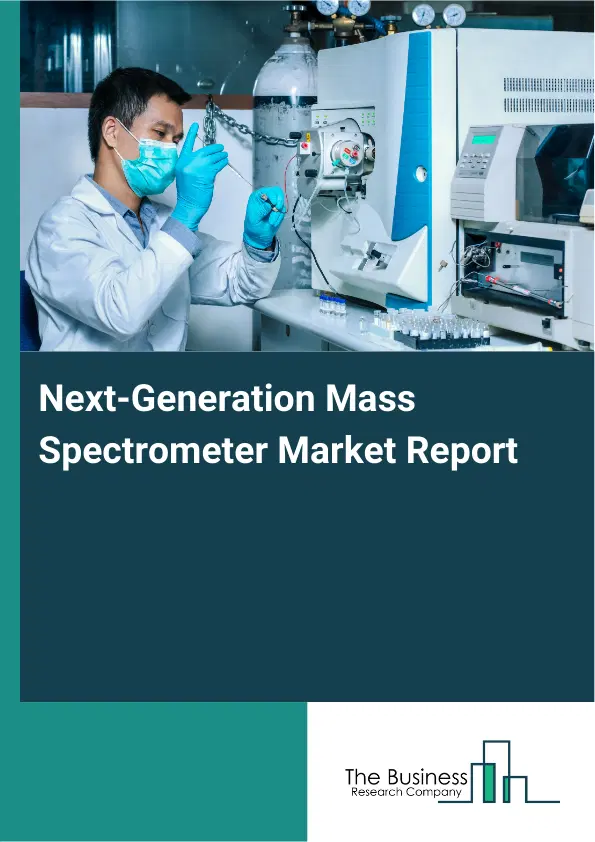
Next-Generation Mass Spectrometer Market Report 2026
Global Outlook – By Type (Fourier Transform, Linear Ion Trap Mass Spectrometry, Other Types), By Application (Pharmaceuticals, Biotechnology, Clinical Diagnostics, Environmental Analysis, Food And Beverage Testing, Forensic Science, Other Applications), By End User (Research Laboratories, Academic Institutions, Pharmaceutical Companies, Biotechnology Firms, Clinical Laboratories, Government Agencies) – Market Size, Trends, Strategies, and Forecast to 2030
Next-Generation Mass Spectrometer Market Overview
• Next-Generation Mass Spectrometer market size has reached to $3.6 billion in 2025 • Expected to grow to $5.75 billion in 2030 at a compound annual growth rate (CAGR) of 9.8% • Growth Driver: Personalized Medicine Is Fueling The Growth Of The Market Due To Its Demand For Precise And Tailored Molecular Analysis • Market Trend: Advancements In High-Performance Mass Spectrometry For Complex Biological Analysis • North America was the largest region in 2025 and Asia-Pacific is the fastest growing region.What Is Covered Under Next-Generation Mass Spectrometer Market?
A next-generation mass spectrometer is an advanced analytical instrument designed to provide ultra-high sensitivity, resolution, and speed for detecting and quantifying molecules across a wide range of applications, from proteomics and metabolomics to drug discovery and environmental analysis. It often integrates cutting-edge technologies such as artificial intelligence, novel ion optics, and real-time data processing to enhance performance, reduce sample requirements, and deliver more accurate, comprehensive molecular insights. The main types of next-generation mass spectrometers are fourier transform, linear ion trap mass spectrometry, and others. The fourier transform is a mathematical technique that transforms a time-domain signal into its frequency-domain representation, showing how the signal's energy is distributed across different frequencies. The various applications involved are pharmaceuticals, biotechnology, clinical diagnostics, environmental analysis, food and beverage testing, forensic science, and others, and they are used by various end users such as research laboratories, academic institutions, pharmaceutical companies, biotechnology firms, clinical laboratories, and government agencies.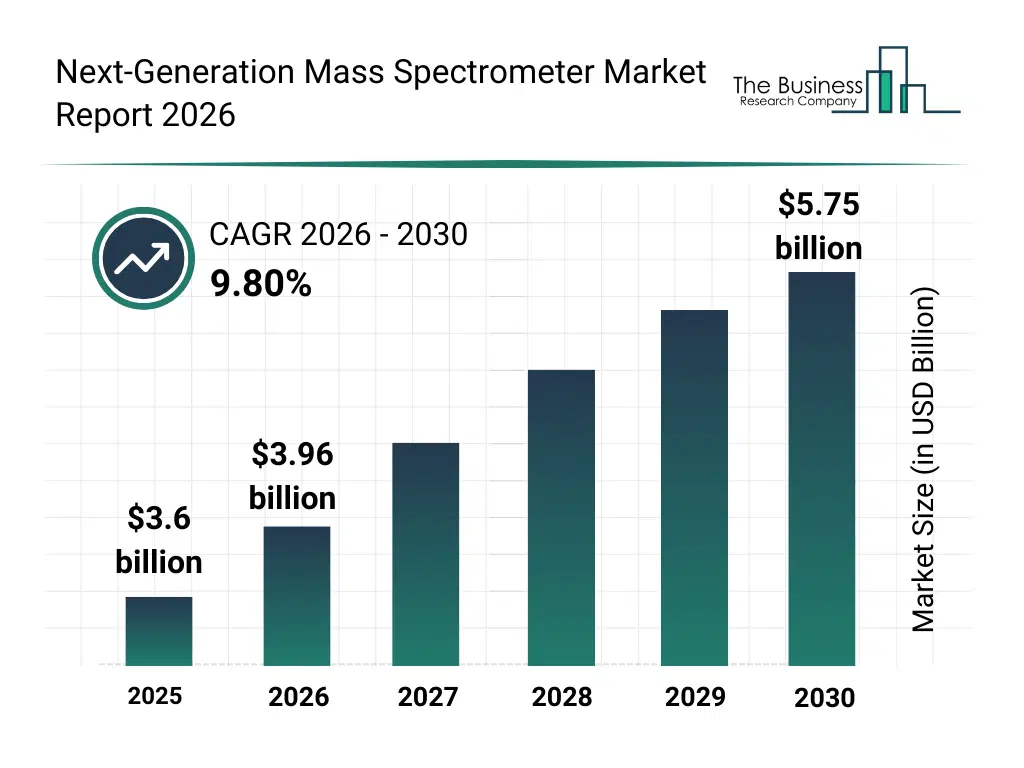
What Is The Next-Generation Mass Spectrometer Market Size and Share 2026?
The next-generation mass spectrometer market size has grown rapidly in recent years. It will grow from $3.6 billion in 2025 to $3.96 billion in 2026 at a compound annual growth rate (CAGR) of 10.1%. The growth in the historic period can be attributed to limited sensitivity and resolution of early mass spectrometers, reliance on conventional ion trap and quadrupole systems, growing pharmaceutical and biotech research, increasing demand for accurate molecular analysis, high operational complexity and maintenance costs.What Is The Next-Generation Mass Spectrometer Market Growth Forecast?
The next-generation mass spectrometer market size is expected to see strong growth in the next few years. It will grow to $5.75 billion in 2030 at a compound annual growth rate (CAGR) of 9.8%. The growth in the forecast period can be attributed to development of next-generation ft-ms and orbitrap systems, integration of ai-based data interpretation, expansion of clinical diagnostics and forensic applications, rising environmental monitoring and food safety testing, demand for high-throughput and automated mass spectrometry systems. Major trends in the forecast period include rising demand for high-resolution mass spectrometry, integration of real-time data processing and analytics, expansion of proteomics and metabolomics research, increased adoption in environmental and food testing applications, focus on miniaturization and enhanced sensitivity of instruments.
Global Next-Generation Mass Spectrometer Market Segmentation
1) By Type: Fourier Transform, Linear Ion Trap Mass Spectrometry, Other Types 2) By Application: Pharmaceuticals, Biotechnology, Clinical Diagnostics, Environmental Analysis, Food And Beverage Testing, Forensic Science, Other Applications 3) By End User: Research Laboratories, Academic Institutions, Pharmaceutical Companies, Biotechnology Firms, Clinical Laboratories, Government Agencies Subsegments: 1) By Fourier Transform: Fourier Transform Ion Cyclotron Resonance (FT-ICR), Fourier Transform Orbitrap Mass Spectrometry, Hybrid FT-MS Systems, High-Resolution Accurate Mass (HRAM) FT-MS 2) By Linear Ion Trap Mass Spectrometry: Quadrupole Ion Trap, Three-Dimensional Linear Ion Trap, Dual-Pressure Linear Ion Trap, Linear Ion Trap-Time Of Flight (LIT-TOF) Hybrid 3) By Other Types: Time-Of-Flight Mass Spectrometry (TOF-MS), Quadrupole Mass Spectrometry, Orbitrap Mass Spectrometry (Non-FT Applications), Magnetic Sector Mass Spectrometry, Ion Mobility Mass Spectrometry, Hybrid Mass SpectrometersWhat Is The Driver Of The Next-Generation Mass Spectrometer Market?
The growing emphasis on personalized medicine is expected to propel the growth of the next-generation mass spectrometer market going forward. Personalized medicine is a medical approach that tailors treatment and healthcare decisions to an individual’s unique genetic, environmental, and lifestyle factors for more effective outcomes. The growing emphasis on personalized medicine is due to the need to provide tailored treatments that improve patient outcomes, reduce side effects, and optimize healthcare efficiency based on individual genetic and lifestyle factors. The next-generation mass spectrometer supports personalized medicine by providing highly precise and comprehensive molecular analysis that helps identify individual biomarkers, monitor therapeutic responses, and guide tailored treatment plans for improved patient outcomes. For instance, in February 2024, according to a report by the Personalized Medicine Coalition, a US-based non-profit organization, in 2023, the Food and Drug Administration (FDA), a US-based federal agency, authorized 16 new personalized medicines for rare disease patients, up from six in 2022. Therefore, the growing emphasis on personalized medicine will drive the growth of the next-generation mass spectrometer industry.Key Players In The Global Next-Generation Mass Spectrometer Market
Major companies operating in the next-generation mass spectrometer market are Hitachi Ltd., Thermo Fisher Scientific Inc., Danaher Corporation, Agilent Technologies Inc., PerkinElmer Inc., Shimadzu Corporation, Waters Corporation, Bruker Corporation, HORIBA Ltd., JEOL Ltd., Rigaku Corporation, LECO Corporation, Hiden Analytical Ltd., Scion Instruments Ltd., MOBILion Systems Inc., Jiangsu Skyray Instrument Co. Ltd., Advion Inc., Postnova Analytics GmbH, Kore Technology Ltd., Variolytics GmbH, Spectroswiss, Excellims Corporation, 908 Devices Inc.
This chart is for illustrative purposes; the full report includes a detailed competitor analysis and comprehensive overview of the top 10 companies in the market.
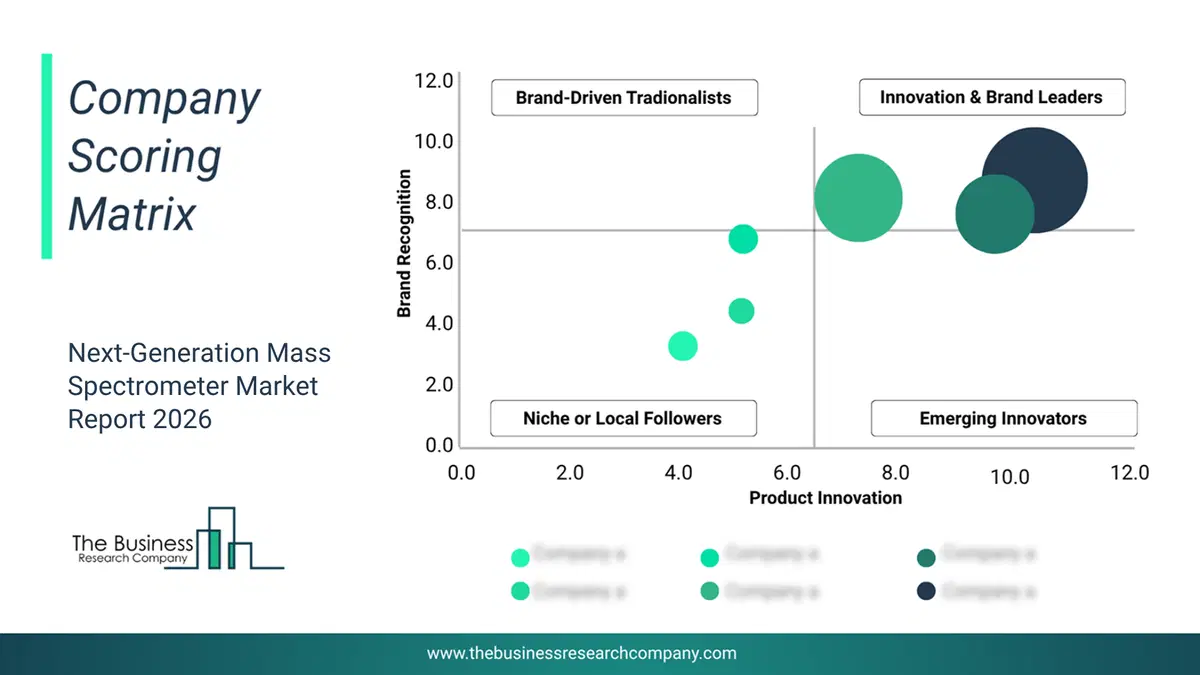
This chart maps companies by product innovation and brand strength, with bubble size indicating relative revenue, helping identify market leaders, challengers, and niche players. This is an illustrative chart; the full report provides a complete and accurate competitive analysis.
Global Next-Generation Mass Spectrometer Market Trends and Insights
Major companies operating in the next-generation mass spectrometer market are focusing on the development of highly efficient instruments that enable researchers to analyze complex biological samples with unprecedented precision and speed. These innovations aim to improve biomarker discovery, facilitate early disease detection, and accelerate the development of personalized therapies. For instance, in June 2023, Thermo Fisher Scientific Inc., a US-based clinical research company, launched the Orbitrap Astral mass spectrometer, featuring fast throughput, high sensitivity, and deep proteome coverage, one of the most significant mass spectrometry advancements in 15 years. This next-generation instrument enables researchers to detect previously inaccessible low-abundance proteins by combining ultra-fast scan speeds, exceptional sensitivity, and deep proteome coverage, significantly advancing large-scale proteomic analysis. It also incorporates enhanced ion transmission efficiency, improved dynamic range, and up to four times higher throughput, allowing for faster biomarker discovery, precise quantification, and the development of targeted therapies across a wide range of diseases.What Are Latest Mergers And Acquisitions In The Next-Generation Mass Spectrometer Market?
In July 2024, Thermo Fisher Scientific, a US-based clinical research company, acquired Olink Holdings AB for $3.1 billion. Through this acquisition, Thermo Fisher aims to expand its capabilities in proteomics by integrating Olink’s next-generation protein analysis solutions, accelerating scientific discovery, and advancing precision medicine. Olink Holdings AB is a Sweden-based company that provides next-generation proteomics solutions that are integrated in next-generation mass spectrometers.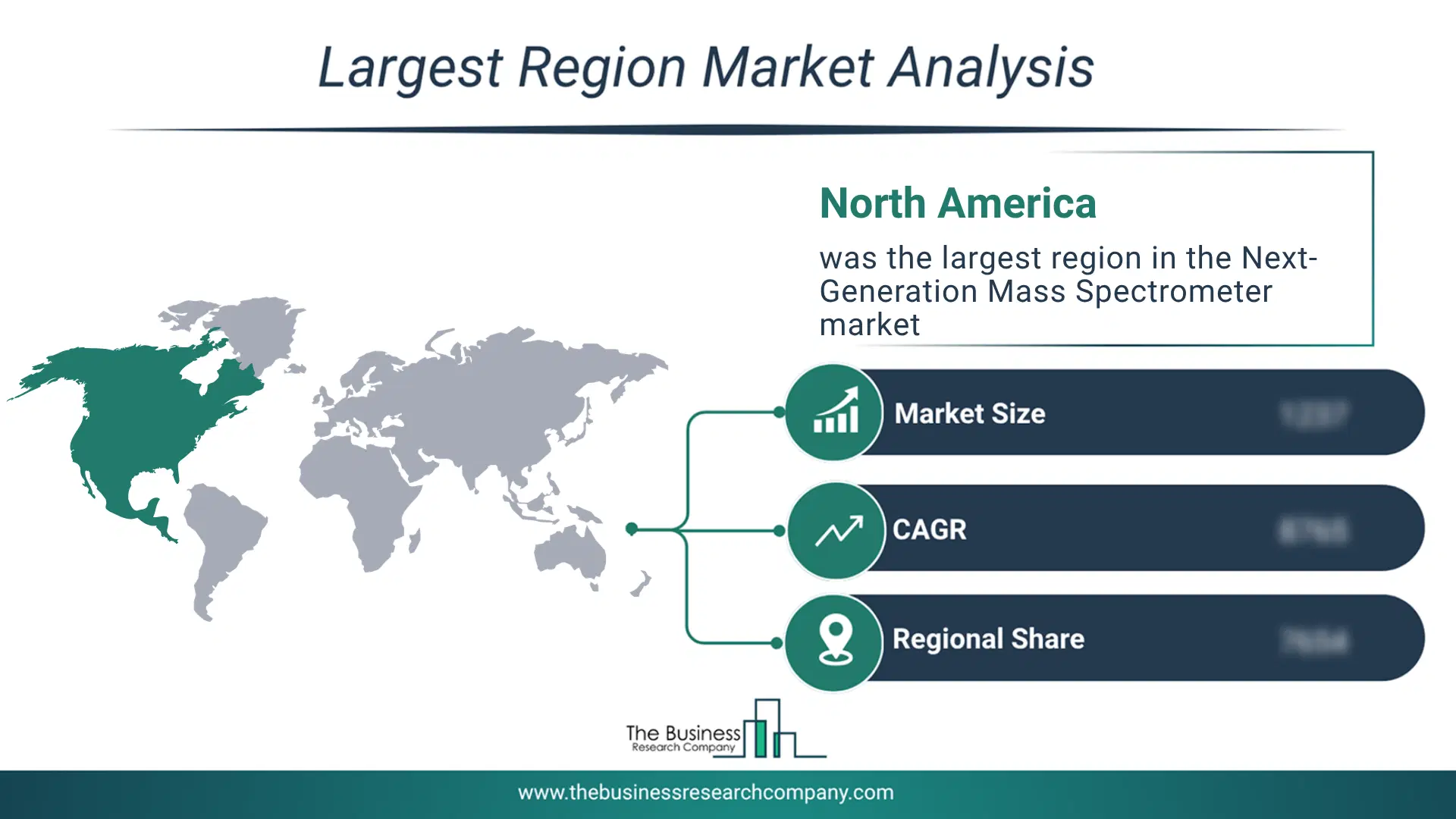
Regional Outlook
North America was the largest region in the next-generation mass spectrometer market in 2025. Asia-Pacific is expected to be the fastest-growing region in the forecast period. The regions covered in this market report are Asia-Pacific, South East Asia, Western Europe, Eastern Europe, North America, South America, Middle East, Africa. The countries covered in this market report are Australia, Brazil, China, France, Germany, India, Indonesia, Japan, Taiwan, Russia, South Korea, UK, USA, Canada, Italy, SpainWhat Defines the Next-Generation Mass Spectrometer Market?
The next-generation mass spectrometer consists of sales of electrospray ionization, atmospheric pressure chemical ionization, trapped ion mobility spectrometry, faraday cups, and photodiode arrays. Values in this market are ‘factory gate’ values, that is the value of goods sold by the manufacturers or creators of the goods, whether to other entities (including downstream manufacturers, wholesalers, distributors and retailers) or directly to end customers. The value of goods in this market includes related services sold by the creators of the goods.How is Market Value Defined and Measured?
The market value is defined as the revenues that enterprises gain from the sale of goods and/or services within the specified market and geography through sales, grants, or donations in terms of the currency (in USD unless otherwise specified). The revenues for a specified geography are consumption values that are revenues generated by organizations in the specified geography within the market, irrespective of where they are produced. It does not include revenues from resales along the supply chain, either further along the supply chain or as part of other products.
This chart presents market attractiveness based on a quantitative evaluation of growth, competition, strategic alignment, and risk, offering a clear view of opportunity areas for decision-making. This chart is for illustrative purposes; the full report contains the complete analysis.

This chart highlights the Total Addressable Market (TAM) by estimating the maximum revenue opportunity using an assumption-driven approach, supporting strategic planning and opportunity sizing across markets. The chart is illustrative; the full report provides a more comprehensive analysis.
What Key Data and Analysis Are Included in the Next-Generation Mass Spectrometer Market Report 2026?
The next-generation mass spectrometer market research report is one of a series of new reports from The Business Research Company that provides market statistics, including industry global market size, regional shares, competitors with the market share, detailed market segments, market trends and opportunities, and any further data you may need to thrive in the next-generation mass spectrometer industry. The market research report delivers a complete perspective of everything you need, with an in-depth analysis of the current and future state of the industry.Next-Generation Mass Spectrometer Market Report Forecast Analysis
| Report Attribute | Details |
|---|---|
| Market Size Value In 2026 | $3.96 billion |
| Revenue Forecast In 2030 | $5.75 billion |
| Growth Rate | CAGR of 9.8% from 2026 to 2030 |
| Base Year For Estimation | 2025 |
| Actual Estimates/Historical Data | 2020-2025 |
| Forecast Period | 2026 - 2030 |
| Market Representation | Revenue in USD Billion and CAGR from 2026 to 2030 |
| Segments Covered | Type, Application, End User |
| Regional Scope | Asia-Pacific, Western Europe, Eastern Europe, North America, South America, Middle East, Africa |
| Country Scope | The countries covered in the report are Australia, Brazil, China, France, Germany, India, Indonesia, Japan, Taiwan, Russia, South Korea, UK, USA, Canada, Italy, Spain. |
| Key Companies Profiled | Hitachi Ltd., Thermo Fisher Scientific Inc., Danaher Corporation, Agilent Technologies Inc., PerkinElmer Inc., Shimadzu Corporation, Waters Corporation, Bruker Corporation, HORIBA Ltd., JEOL Ltd., Rigaku Corporation, LECO Corporation, Hiden Analytical Ltd., Scion Instruments Ltd., MOBILion Systems Inc., Jiangsu Skyray Instrument Co. Ltd., Advion Inc., Postnova Analytics GmbH, Kore Technology Ltd., Variolytics GmbH, Spectroswiss, Excellims Corporation, 908 Devices Inc. |
| Customization Scope | Request for Customization |
| Pricing And Purchase Options | Explore Purchase Options |