
Next Generation Memory Market Report 2026
Global Outlook – By Technology (Nonvolatile Memories, Volatile Memories), By Memory Wafer Size (Two Hundred Millimeter, Three Hundred Millimeter, Other Memory Wafer Sizes), By Material Type (Ferroelectric Materials, Magnetic Materials, Phase Change Materials, Metal Oxides, Carbon Based Materials, Other Material Types), By Application (Consumer Electronics, Automotive Electronics, Data Centers And High Performance Computing, Industrial Internet Of Things, Neuromorphic Computing Or Artificial Intelligence Hardware, Telecommunications, Aerospace And Defense, Other Applications) – Market Size, Trends, Strategies, and Forecast to 2030
Next Generation Memory Market Overview
• Next Generation Memory market size has reached to $5.85 billion in 2025 • Expected to grow to $15.63 billion in 2030 at a compound annual growth rate (CAGR) of 21.7% • Growth Driver: The Rapid Growth Of Data Centers Driving The Growth Of The Market Due To Rising Demand For Cloud Computing • Market Trend: Advancements In High-Bandwidth Multi-Layer Memory Architectures For AI And Data Center Workloads • Asia-Pacific was the largest region and fastest growing region.What Is Covered Under Next Generation Memory Market?
Next generation memory refers to advanced memory technologies designed to surpass traditional memory in terms of speed, storage density, energy efficiency, and durability. These technologies are used in modern computing systems to support high-performance applications such as artificial intelligence, big data processing, and cloud computing. The main technologies of next generation memory include nonvolatile memories and volatile memories. Nonvolatile memories refer to advanced memory technologies that retain stored data even when power is removed, providing high-speed, energy-efficient, and reliable data storage for modern computing applications. These memory technologies are manufactured on wafer sizes including two hundred millimeter, three hundred millimeter, and other memory wafer sizes. They utilize materials such as ferroelectric materials, magnetic materials, phase change materials, metal oxides, carbon based materials, and others and are used in applications including consumer electronics, automotive electronics, data centers and high performance computing, industrial Internet of Things, neuromorphic computing or artificial intelligence hardware, telecommunications, aerospace and defense, and others.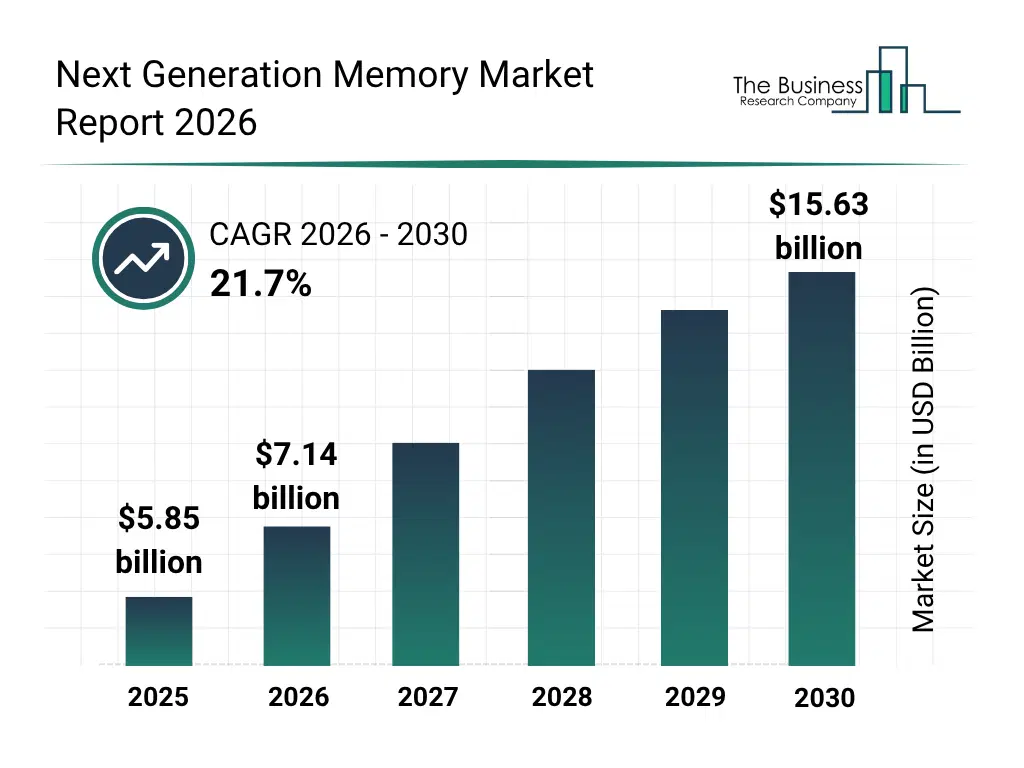
What Is The Next Generation Memory Market Size and Share 2026?
The next generation memory market size has grown exponentially in recent years. It will grow from $5.85 billion in 2025 to $7.14 billion in 2026 at a compound annual growth rate (CAGR) of 22.1%. The growth in the historic period can be attributed to increasing demand for faster computing systems, growing adoption of semiconductor based electronic devices, rising expansion of data storage requirements, increasing development of advanced computing infrastructure, growing need for improved memory performance and reliability.What Is The Next Generation Memory Market Growth Forecast?
The next generation memory market size is expected to see exponential growth in the next few years. It will grow to $15.63 billion in 2030 at a compound annual growth rate (CAGR) of 21.7%. The growth in the forecast period can be attributed to increasing demand for AI and high performance computing applications, rising adoption of advanced memory solutions in data centers, growing deployment of edge computing infrastructure, increasing requirement for energy efficient memory technologies, expanding use of next generation memory in automotive and industrial applications. Major trends in the forecast period include increasing adoption of high bandwidth memory for advanced computing applications, growing development of low power and energy efficient memory technologies, rising demand for high density memory solutions in data intensive applications, increasing integration of advanced memory architectures in next generation computing systems, growing focus on durable and high performance memory technologies.
Global Next Generation Memory Market Segmentation
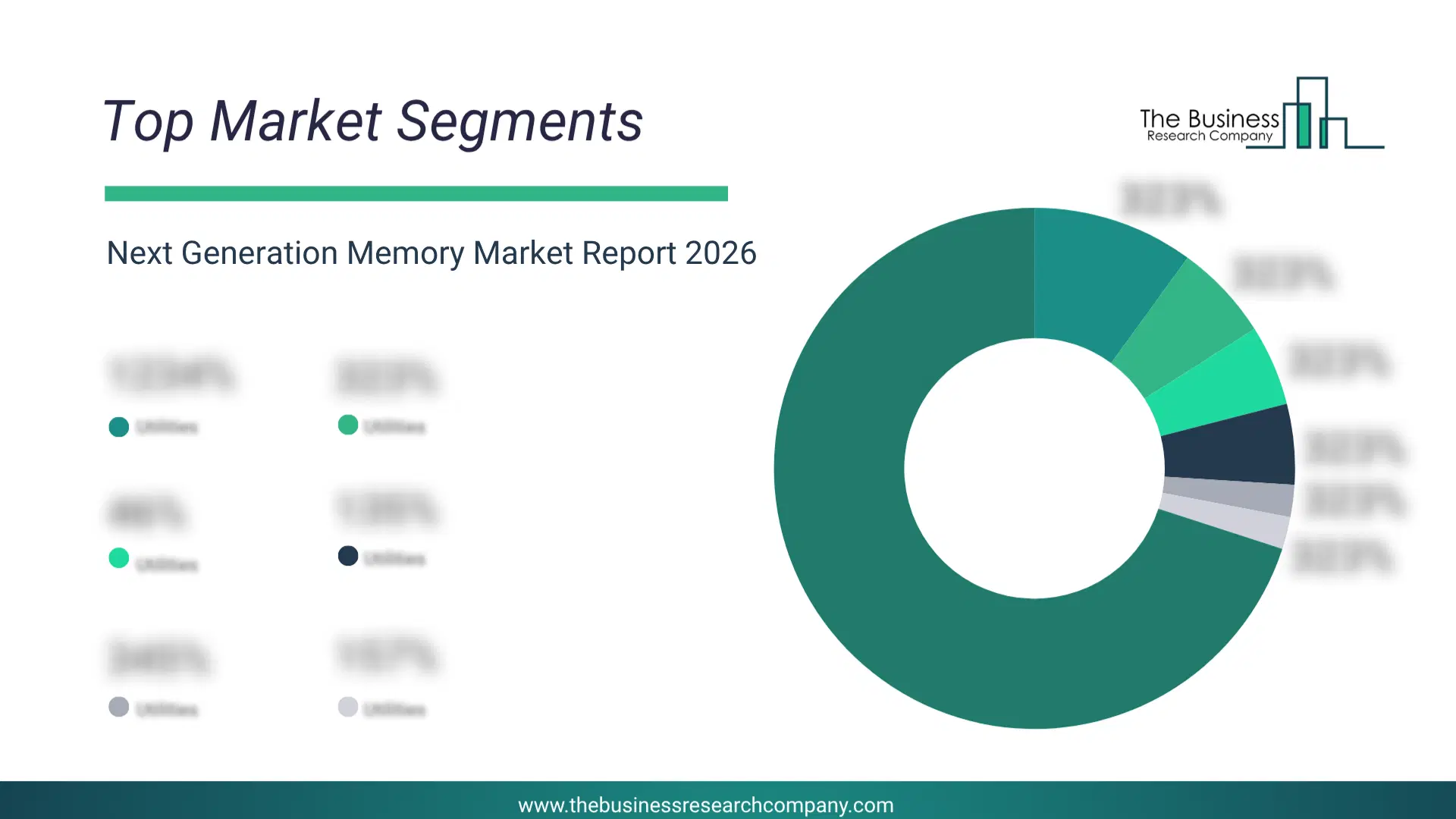
2) By Memory Wafer Size: Two Hundred Millimeter, Three Hundred Millimeter, Other Memory Wafer Sizes 3) By Material Type: Ferroelectric Materials, Magnetic Materials, Phase Change Materials, Metal Oxides, Carbon Based Materials, Other Material Types 4) By Application: Consumer Electronics, Automotive Electronics, Data Centers And High Performance Computing, Industrial Internet Of Things, Neuromorphic Computing Or Artificial Intelligence Hardware, Telecommunications, Aerospace And Defense, Other Applications Subsegments: 1) By Nonvolatile Memories: Phase Change Memory, Resistive Random Access Memory, Magnetoresistive Random Access Memory, Ferroelectric Random Access Memory, Conductive Bridge Random Access Memory, Three Dimensional Crosspoint Memory, Spin Transfer Torque Memory, Domain Wall Memory 2) By Volatile Memories: Static Random Access Memory, Dynamic Random Access Memory, Embedded Dynamic Random Access Memory, Pseudo Static Random Access Memory, Zero Capacitor Random Access Memory, Twin Transistor Random Access Memory, High Bandwidth Memory, Graphics Dynamic Random Access MemoryWhat Is The Driver Of The Next Generation Memory Market?
The rapid growth of data centers is expected to propel the growth of the next generation memory market going forward. Data centers refer to specialized facilities that house computer systems, servers, storage devices, and networking equipment used to store, process, and manage large volumes of digital data. Rapid growth of data centers is due to the rising demand for cloud computing, which requires large-scale, centralized infrastructure to store, process, and deliver vast amounts of data and applications efficiently over the internet. Next generation memory empowers data centers by delivering ultra-high bandwidth, lower latency, and improved energy efficiency, enabling faster data processing and scalable performance for cloud computing and AI-driven workloads. For instance, in July 2024 according to the Office for National Statistics, a UK-based Government department in 2022, data centres saw the largest percentage increase in investment of all assets, rising by 77.7% to reach $2.79 billion. Therefore, the rapid growth of data centers is driving the growth of the next generation memory industry.Key Players In The Global Next Generation Memory Market
Major companies operating in the next generation memory market are Avalanche Technology Inc., Everspin Technologies Inc., Ferroelectric Memory Company, GlobalFoundries Inc., Infineon Technologies AG, Intel Corporation, Kioxia Holdings Corporation, Macronix International Co. Ltd., Micron Technology Inc., Nanya Technology Corporation, NXP Semiconductors N.V., Powerchip Semiconductor Manufacturing Corporation, Rambus Inc., Renesas Electronics Corporation, Samsung Electronics Co. Ltd., SK hynix Inc., Sony Semiconductor Solutions Corporation, STMicroelectronics N.V., Taiwan Semiconductor Manufacturing Company Ltd., Weebit Nano Ltd., Western Digital Corporation, Winbond Electronics Corporation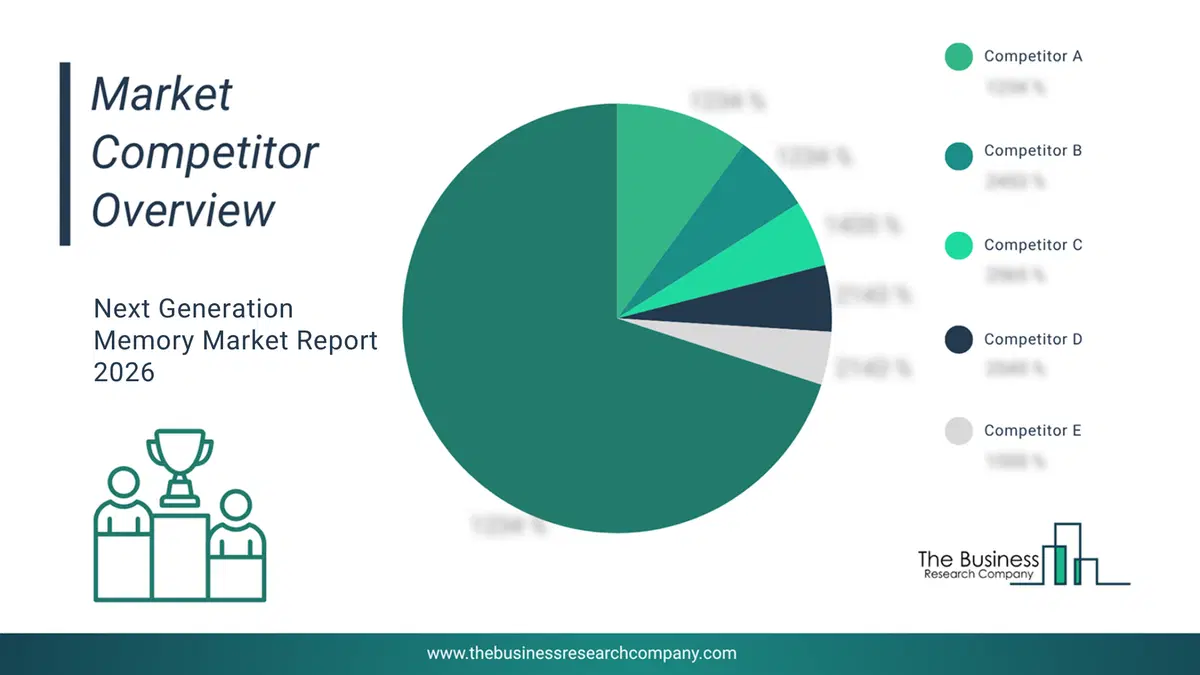
This chart is for illustrative purposes; the full report includes a detailed competitor analysis and comprehensive overview of the top 10 companies in the market.
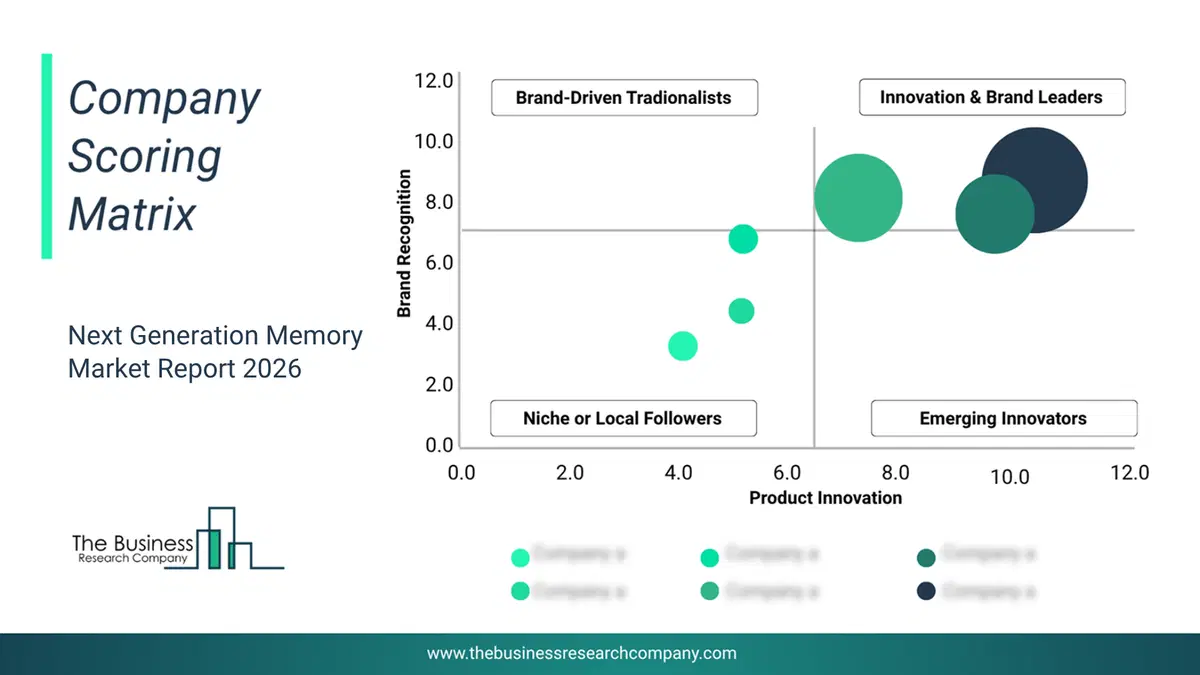
This chart maps companies by product innovation and brand strength, with bubble size indicating relative revenue, helping identify market leaders, challengers, and niche players. This is an illustrative chart; the full report provides a complete and accurate competitive analysis.
Global Next Generation Memory Market Trends and Insights
Major companies operating in the next generation memory market are focusing on developing innovative solutions, such as high-bandwidth multi-layer memory architectures to enhance data processing speed, improve energy efficiency, and support large-scale artificial intelligence and data center workloads. High-bandwidth multi-layer memory architectures are advanced semiconductor memory systems that stack multiple DRAM layers vertically to significantly increase data transfer rates and capacity compared to conventional memory technologies, enabling faster computation and reduced latency in AI training and inference tasks. For instance, in January 2026, SK Hynix Inc., a South Korea-based semiconductor memory manufacturer, launched its next-generation AI memory solutions at CES 2026, introducing advanced HBM and AI memory modules designed for high-performance computing and generative AI workloads. These solutions feature vertically stacked DRAM layers, ultra-wide memory interfaces, and improved power efficiency to support massive data throughput required by AI model training and inference. They are engineered to reduce latency, enhance bandwidth scalability, and optimize thermal performance in hyperscale data centers and AI accelerators, making them suitable for cloud computing, autonomous systems, and advanced analytics applications.What Are Latest Mergers And Acquisitions In The Next Generation Memory Market?
In June 2026, NVIDIA Corporation, a US-based technology company, partnered with SK Hynix to advance next-generation memory technologies for AI factories. With this partnership, NVIDIA and SK hynix aim to co-develop and optimize high-bandwidth memory (HBM) and advanced DRAM solutions to improve data transfer speed, reduce latency, and enhance energy efficiency in large-scale artificial intelligence and data center workloads. SK Hynix Inc. is a South Korea-based company specializing in semiconductor memory solutions, including DRAM, NAND flash, and high-bandwidth memory products.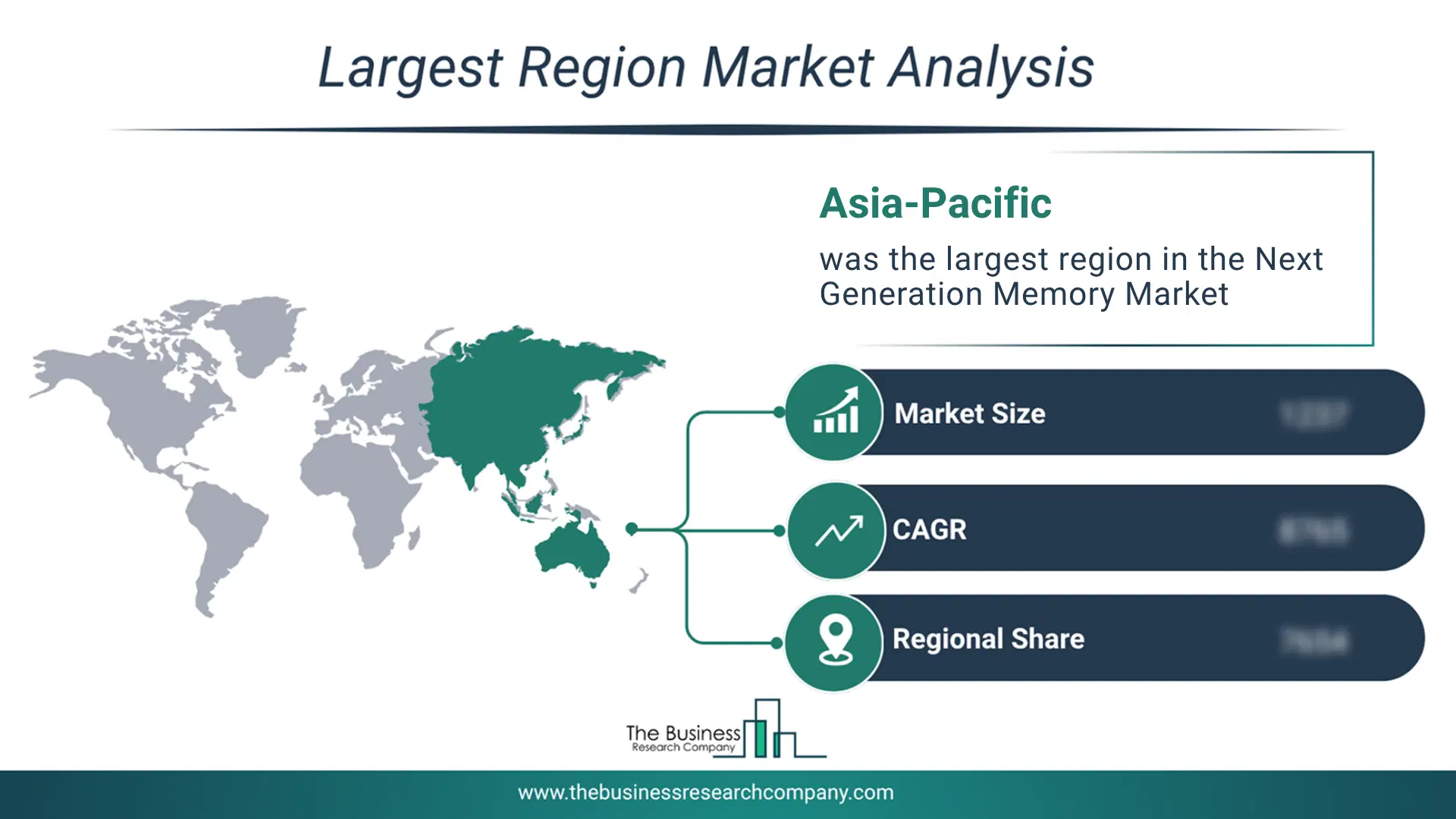
Regional Outlook/Insights
Asia-Pacific was the largest region in the next generation memory market in 2025. Asia-Pacific is expected to be the fastest-growing region in the forecast period. The regions covered in this market report are Asia-Pacific, South East Asia, Western Europe, Eastern Europe, North America, South America, Middle East, Africa. The countries covered in this market report are Australia, Brazil, China, France, Germany, India, Indonesia, Japan, Taiwan, Russia, South Korea, UK, USA, Canada, Italy, Spain.What Defines the Next Generation Memory Market?
The next generation memory market consists of sales of high bandwidth memory, phase change memory, 3d cross point memory, and ferroelectric random access memory. Values in this market are ‘factory gate’ values, that is the value of goods sold by the manufacturers or creators of the goods, whether to other entities (including downstream manufacturers, wholesalers, distributors and retailers) or directly to end customers. The value of goods in this market includes related services sold by the creators of the goods.How is Market Value Defined and Measured?
The market value is defined as the revenues that enterprises gain from the sale of goods and/or services within the specified market and geography through sales, grants, or donations in terms of the currency (in USD unless otherwise specified). The revenues for a specified geography are consumption values that are revenues generated by organizations in the specified geography within the market, irrespective of where they are produced. It does not include revenues from resales along the supply chain, either further along the supply chain or as part of other products.
This chart presents market attractiveness based on a quantitative evaluation of growth, competition, strategic alignment, and risk, offering a clear view of opportunity areas for decision-making. This chart is for illustrative purposes; the full report contains the complete analysis.

This chart highlights the Total Addressable Market (TAM) by estimating the maximum revenue opportunity using an assumption-driven approach, supporting strategic planning and opportunity sizing across markets. The chart is illustrative; the full report provides a more comprehensive analysis.
What Key Data and Analysis Are Included in the Next Generation Memory Market Report 2026?
The next generation memory market research report is one of a series of new reports from The Business Research Company that provides next generation memory market statistics, including next generation memory industry global market size, regional shares, competitors with a next generation memory market share, detailed next generation memory market segments, market trends and opportunities, and any further data you may need to thrive in the next generation memory industry. This next generation memory market research report delivers a complete perspective of everything you need, with an in-depth analysis of the current and future scenario of the industry.Next Generation Memory Market Report Forecast Analysis
| Report Attribute | Details |
|---|---|
| Market Size Value In 2026 | $7.14 billion |
| Revenue Forecast In 2030 | $15.63 billion |
| Growth Rate | CAGR of 21.7% from 2026 to 2030 |
| Base Year For Estimation | 2025 |
| Actual Estimates/Historical Data | 2020-2025 |
| Forecast Period | 2026 - 2030 |
| Market Representation | Revenue in USD Billion and CAGR from 2026 to 2030 |
| Segments Covered | Technology, Memory Wafer Size, Material Type, Application |
| Regional Scope | Asia-Pacific, Western Europe, Eastern Europe, North America, South America, Middle East, Africa |
| Country Scope | The countries covered in the report are Australia, Brazil, China, France, Germany, India, Indonesia, Japan, Taiwan, Russia, South Korea, UK, USA, Canada, Italy, Spain. |
| Key Companies Profiled | Avalanche Technology Inc., Everspin Technologies Inc., Ferroelectric Memory Company, GlobalFoundries Inc., Infineon Technologies AG, Intel Corporation, Kioxia Holdings Corporation, Macronix International Co. Ltd., Micron Technology Inc., Nanya Technology Corporation, NXP Semiconductors N.V., Powerchip Semiconductor Manufacturing Corporation, Rambus Inc., Renesas Electronics Corporation, Samsung Electronics Co. Ltd., SK hynix Inc., Sony Semiconductor Solutions Corporation, STMicroelectronics N.V., Taiwan Semiconductor Manufacturing Company Ltd., Weebit Nano Ltd., Western Digital Corporation, Winbond Electronics Corporation |
| Customization Scope | Request for Customization |
| Pricing And Purchase Options | Explore Purchase Options |