
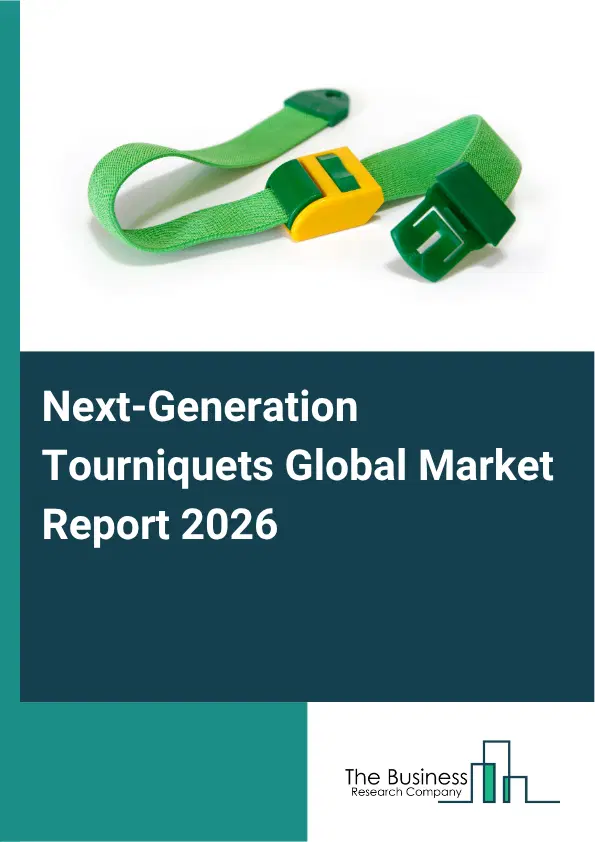
Next-Generation Tourniquets Market Report 2026
Global Outlook – By Product Type (Mechanical Windlass Tourniquets, Ratchet Based Tourniquets, Pneumatic Tourniquets, Electronic Or Smart Tourniquets, Junctional Tourniquets), By Technology (Manual Tourniquets, Pressure Regulated Tourniquets, Sensor Enabled Tourniquets, Electronic Or Digital Tourniquets), By Distribution Channel (Direct Sales, Medical Device Distributors, Online Sales, Retail Pharmacies And Medical Supply Stores), By Application (Trauma And Emergency Hemorrhage Control, Surgical Procedures, Military And Combat Casualty Care, Disaster And Mass Casualty Management), By End User (Hospitals, Ambulatory Surgical Centers, Emergency Medical Services, Military And Defense Organizations, Law Enforcement Agencies) – Market Size, Trends, Strategies, and Forecast to 2030
Next-Generation Tourniquets Market Report 2026 Market Overview
• Next-Generation Tourniquets Market Report 2026 market size has reached to $0.19 billion in 2025 • Expected to grow to $0.27 billion in 2030 at a compound annual growth rate (CAGR) of 7.2% • Growth Driver: Rising Incidence Of Traumatic Injuries Fueling The Growth Of The Market Due To Increasing Demand For Rapid Hemorrhage Control And Emergency Trauma Care • Market Trend: Advancements In Sensor Enabled Electronic Tourniquets Enhancing Real Time Trauma Care • North America was the largest region in 2025 and Asia-Pacific is the fastest growing region.What Is Covered Under Next-Generation Tourniquets Market?
Next-generation tourniquets refer to advanced hemorrhage control devices equipped with mechanical precision mechanisms, such as windlass systems, ratchets, or electronic pressure sensors, designed to rapidly occlude arterial blood flow to an injured limb. Used in combat and emergency medicine, these modern tourniquets emphasize intuitive, rapid one-handed application to prevent catastrophic exsanguination from severe trauma while minimizing localized nerve and tissue damage through optimized pressure distribution. The main product types of next-generation tourniquets include mechanical windlass tourniquets, ratchet based tourniquets, pneumatic tourniquets, electronic or smart tourniquets, and junctional tourniquets. Mechanical windlass tourniquets refer to manually operated hemorrhage control devices that use a windlass mechanism to apply controlled pressure and restrict blood flow during emergency situations. These tourniquets are available as manual tourniquets, pressure regulated tourniquets, sensor enabled tourniquets, and electronic or digital tourniquets and are distributed through direct sales, medical device distributors, online sales, and retail pharmacies and medical supply stores. They find applications in trauma and emergency hemorrhage control, surgical procedures, military and combat casualty care, and disaster and mass casualty management, serving end users including hospitals, ambulatory surgical centers, emergency medical services, military and defense organizations, and law enforcement agencies.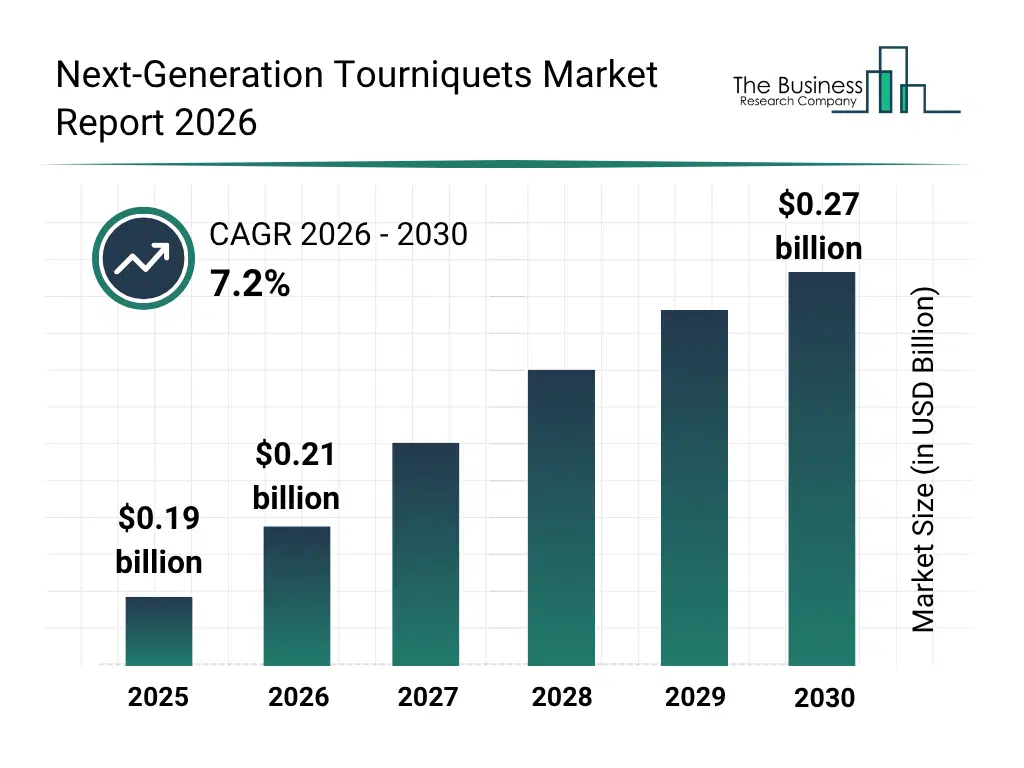
What Is The Next-Generation Tourniquets Market Size and Share 2026?
The next-generation tourniquets market size has grown strongly in recent years. It will grow from $0.19 billion in 2025 to $0.21 billion in 2026 at a compound annual growth rate (CAGR) of 7.0%. The growth in the historic period can be attributed to rising military modernization programs, increasing incidence of traumatic injuries, expanding emergency medical services infrastructure, growing awareness of hemorrhage control techniques, higher adoption of prehospital trauma care equipment.What Is The Next-Generation Tourniquets Market Growth Forecast?
The next-generation tourniquets market size is expected to see strong growth in the next few years. It will grow to $0.27 billion in 2030 at a compound annual growth rate (CAGR) of 7.2%. The growth in the forecast period can be attributed to advancements in smart pressure monitoring technologies, increasing investments in tactical medical equipment, growing disaster preparedness initiatives, expanding adoption in civilian emergency response, rising demand for advanced minimally damaging hemorrhage control devices. Major trends in the forecast period include increasing adoption of one-handed rapid application tourniquets, rising focus on lightweight and ergonomic hemorrhage control devices, expansion of civilian trauma preparedness and bleeding control programs, growing demand for advanced junctional hemorrhage management solutions, standardization of tactical combat casualty care and emergency response protocols.
Global Next-Generation Tourniquets Market Segmentation
1) By Product Type: Mechanical Windlass Tourniquets, Ratchet Based Tourniquets, Pneumatic Tourniquets, Electronic Or Smart Tourniquets, Junctional Tourniquets 2) By Technology: Manual Tourniquets, Pressure Regulated Tourniquets, Sensor Enabled Tourniquets, Electronic Or Digital Tourniquets 3) By Distribution Channel: Direct Sales, Medical Device Distributors, Online Sales, Retail Pharmacies And Medical Supply Stores 4) By Application: Trauma And Emergency Hemorrhage Control, Surgical Procedures, Military And Combat Casualty Care, Disaster And Mass Casualty Management 5) By End User: Hospitals, Ambulatory Surgical Centers, Emergency Medical Services, Military And Defense Organizations, Law Enforcement Agencies Subsegments: 1) By Mechanical Windlass Tourniquets: Aluminum Windlass Tourniquets, Polymer Windlass Tourniquets, Single Routing Windlass Tourniquets, Dual Routing Windlass Tourniquets 2) By Ratchet Based Tourniquets: Single Ratchet Tourniquets, Dual Ratchet Tourniquets, Quick Release Ratchet Tourniquets, Adjustable Ratchet Tourniquets 3) By Pneumatic Tourniquets: Single Cuff Pneumatic Tourniquets, Dual Cuff Pneumatic Tourniquets, Surgical Pneumatic Tourniquets, Portable Pneumatic Tourniquets 4) By Electronic Or Smart Tourniquets: Pressure Sensor Based Tourniquets, Automated Pressure Regulated Tourniquets, Bluetooth Enabled Wireless Connected Tourniquets 5) By Junctional Tourniquets: Pelvic Junctional Tourniquets, Axillary Junctional Tourniquets, Inguinal Junctional Tourniquets, Multi Site Junctional TourniquetsWhat Are The Drivers Of The Next-Generation Tourniquets Market?
The rising incidence of traumatic injuries is expected to propel the growth of the next-generation tourniquets market going forward. Traumatic injuries are physical injuries caused by external forces such as road traffic crashes, falls, industrial accidents, sports injuries, or violence, and they frequently result in severe bleeding that requires immediate hemorrhage control. The increase in traumatic injuries is primarily driven by growing vehicle ownership, rapid urbanization, higher traffic density, and greater exposure to high-speed transportation, which collectively raise the likelihood of serious accidents. Next-generation tourniquets support trauma care by enabling rapid arterial occlusion, minimizing blood loss, improving survival rates, and reducing the risk of permanent tissue damage during prehospital emergency response and battlefield medicine. For instance, in April 2026, according to the Centers for Disease Control and Prevention (CDC), a US-based national public health agency, 68,663 traumatic brain injury (TBI)-related deaths occurred in the United States in 2023, averaging approximately 190 deaths per day. The agency also reported approximately 214,110 TBI-related hospitalizations, highlighting the substantial burden of traumatic injuries. Therefore, the rising incidence of traumatic injuries is driving the growth of the next-generation tourniquets industry. The rising awareness of preventable trauma deaths is expected to propel the growth of the next-generation tourniquets market going forward. Preventable trauma deaths refer to fatalities from injury-related causes, including road accidents and severe hemorrhage, that could have been avoided through timely medical intervention and better access to healthcare. Awareness of this issue is increasing as health authorities and policymakers place greater scrutiny on avoidable mortality rates as a benchmark of healthcare system performance. Next-generation tourniquets address this concern directly by giving both trained responders and untrained bystanders a faster, more reliable way to stop life-threatening bleeding before a patient reaches definitive care. For instance, in November 2025, according to the Organization for Economic Co-operation and Development (OECD), a France-based intergovernmental body, preventable mortality in the United States stood at 217 deaths per 100,000 population, notably higher than the OECD average of 145 deaths per 100,000, underscoring the continued burden of avoidable, injury-related deaths across health systems. Therefore, the rising awareness of preventable trauma deaths is driving the growth of the next-generation tourniquets industry.Key Players In The Global Next-Generation Tourniquets Market
Major companies operating in the next-generation tourniquets market report are Zimmer Biomet Holdings Inc., ViTAC Solutions LLC, Rudolf Riester GmbH, SAM Medical Products, Aero Healthcare Pty Ltd, Rescue Essentials LLC, WASIP Ltd., VBM Medizintechnik GmbH, Hunan ShineArk Medical Technology Co. Ltd., Narang Medical Limited, RevMedx Inc., Chinook Medical Gear Inc., Anetic Aid Limited, DiaMedical USA, GPC Medical Ltd., Advin Health Care, Apothecaries Sundries Manufacturing Co. Pvt. Ltd., Prasaditi Medical Equipment Pvt. Ltd., Medilivescare Manufacturing Pvt. Ltd., DS Medical Co. Ltd., Medi Electronics, DAESUNG MAREF Co. Ltd., Hospital Equipment Manufacturing Company (HEMC), Dessillons & Dutrillaux S.A., Doctroid India Private Limited, AGM Orthopaedics, Girish Surgical Works
This chart is for illustrative purposes; the full report includes a detailed competitor analysis and comprehensive overview of the top 10 companies in the market.
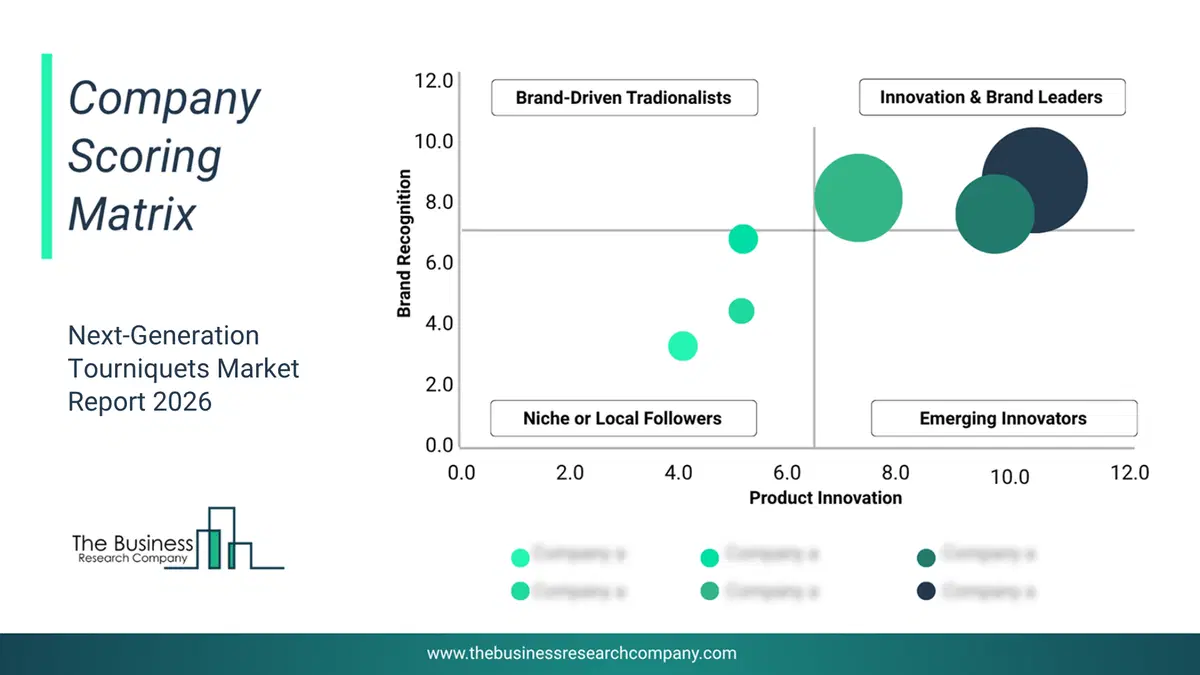
This chart maps companies by product innovation and brand strength, with bubble size indicating relative revenue, helping identify market leaders, challengers, and niche players. This is an illustrative chart; the full report provides a complete and accurate competitive analysis.
Global Next-Generation Tourniquets Market Trends and Insights
Major companies operating in the next-generation tourniquets market are focusing on developing advanced solutions, such as sensor-enabled electronic tourniquets with real-time monitoring and connectivity features, to improve hemorrhage control accuracy and patient outcomes. Sensor-enabled electronic tourniquets are advanced automated tourniquet systems that use integrated sensors to continuously monitor limb pressure, blood flow, or occlusion status and automatically adjust cuff pressure to ensure safe and effective vascular occlusion during surgery or emergency care. For instance, in April 2025, Auric Innovations, a US-based medical technology company, introduced Tele-TQ, its next-generation tourniquet built on smart telemedicine technology. The device incorporates an AI-enabled wearable sensor that tracks blood pressure, heart rate, and oxygen saturation and relays this data to emergency medical services for faster triage, alongside GPS and cellular connectivity that enables two-way communication and real-time location tracking during a trauma event.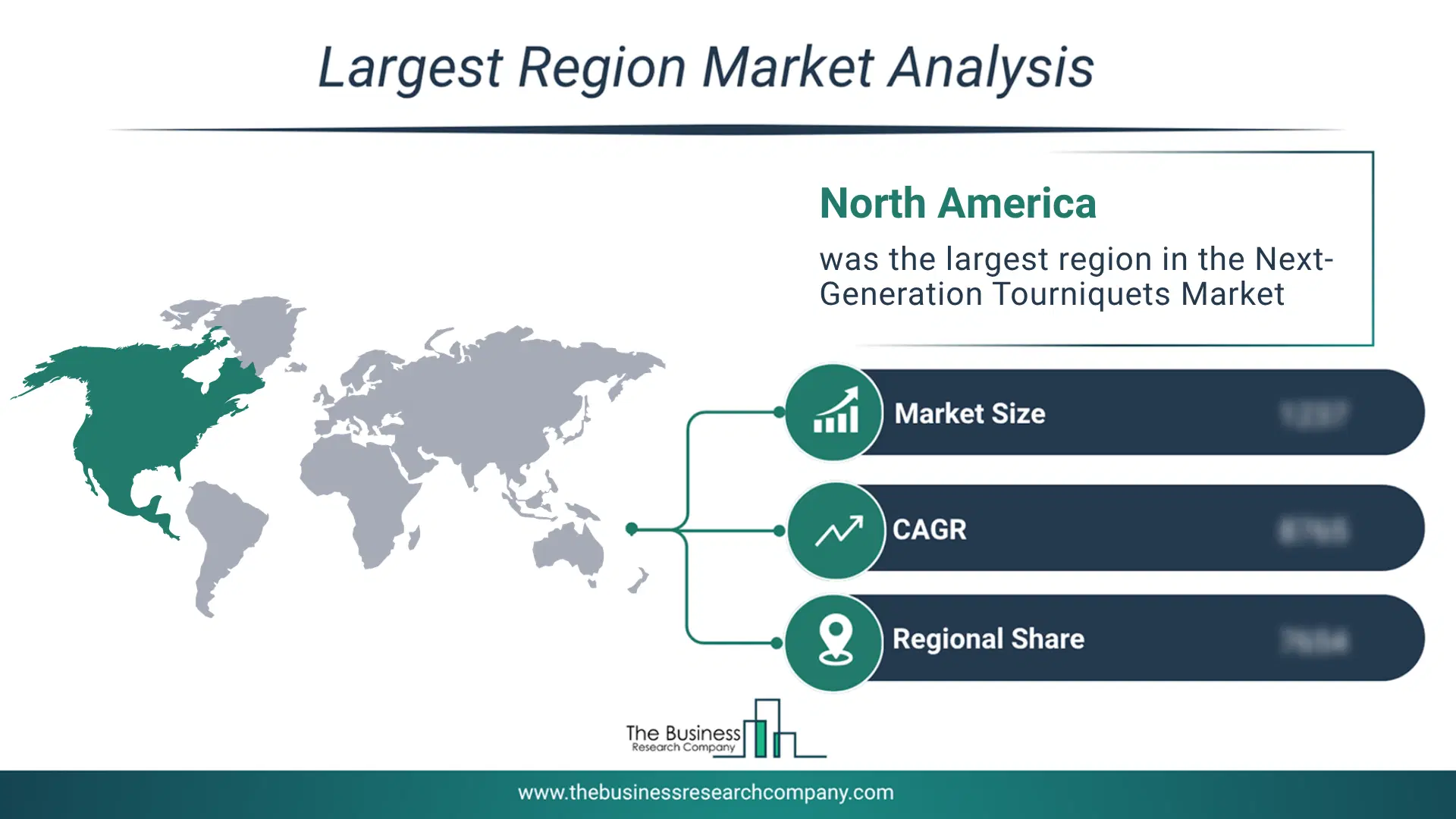
Regional Outlook
North America was the largest region in the next-generation tourniquets market in 2025. Asia-Pacific is expected to be the fastest-growing region in the forecast period. The regions covered in this market report are Asia-Pacific, South East Asia, Western Europe, Eastern Europe, North America, South America, Middle East, Africa. The countries covered in this market report are Australia, Brazil, China, France, Germany, India, Indonesia, Japan, Taiwan, Russia, South Korea, UK, USA, Canada, Italy, Spain.What Defines the Next-Generation Tourniquets Market?
The next-generation tourniquets market consists of sales of automated tourniquet cuffs, portable tourniquet devices, and related accessories. Values in this market are ‘factory gate’ values, that is the value of goods sold by the manufacturers or creators of the goods, whether to other entities (including downstream manufacturers, wholesalers, distributors and retailers) or directly to end customers. The value of goods in this market includes related services sold by the creators of the goods.How is Market Value Defined and Measured?
The market value is defined as the revenues that enterprises gain from the sale of goods and/or services within the specified market and geography through sales, grants, or donations in terms of the currency (in USD unless otherwise specified). The revenues for a specified geography are consumption values that are revenues generated by organizations in the specified geography within the market, irrespective of where they are produced. It does not include revenues from resales along the supply chain, either further along the supply chain or as part of other products.
This chart presents market attractiveness based on a quantitative evaluation of growth, competition, strategic alignment, and risk, offering a clear view of opportunity areas for decision-making. This chart is for illustrative purposes; the full report contains the complete analysis.

This chart highlights the Total Addressable Market (TAM) by estimating the maximum revenue opportunity using an assumption-driven approach, supporting strategic planning and opportunity sizing across markets. The chart is illustrative; the full report provides a more comprehensive analysis.
What Key Data and Analysis Are Included in the Next-Generation Tourniquets Market Report 2026?
The next-generation tourniquets market research report is one of a series of new reports from The Business Research Company that provides market statistics, including industry global market size, regional shares, competitors with the market share, detailed market segments, market trends and opportunities, and any further data you may need to thrive in the next-generation tourniquets industry. The market research report delivers a complete perspective of everything you need, with an in-depth analysis of the current and future state of the industry.Next-Generation Tourniquets Market Report Forecast Analysis
| Report Attribute | Details |
|---|---|
| Market Size Value In 2026 | $0.21 billion |
| Revenue Forecast In 2030 | $0.27 billion |
| Growth Rate | CAGR of 7.2% from 2026 to 2030 |
| Base Year For Estimation | 2025 |
| Actual Estimates/Historical Data | 2020-2025 |
| Forecast Period | 2026 - 2030 |
| Market Representation | Revenue in USD Billion and CAGR from 2026 to 2030 |
| Segments Covered | Product Type, Technology, Distribution Channel, Application, End User |
| Regional Scope | Asia-Pacific, Western Europe, Eastern Europe, North America, South America, Middle East, Africa |
| Country Scope | The countries covered in the report are Australia, Brazil, China, France, Germany, India, Indonesia, Japan, Taiwan, Russia, South Korea, UK, USA, Canada, Italy, Spain. |
| Key Companies Profiled | Zimmer Biomet Holdings Inc., ViTAC Solutions LLC, Rudolf Riester GmbH, SAM Medical Products, Aero Healthcare Pty Ltd, Rescue Essentials LLC, WASIP Ltd., VBM Medizintechnik GmbH, Hunan ShineArk Medical Technology Co. Ltd., Narang Medical Limited, RevMedx Inc., Chinook Medical Gear Inc., Anetic Aid Limited, DiaMedical USA, GPC Medical Ltd., Advin Health Care, Apothecaries Sundries Manufacturing Co. Pvt. Ltd., Prasaditi Medical Equipment Pvt. Ltd., Medilivescare Manufacturing Pvt. Ltd., DS Medical Co. Ltd., Medi Electronics, DAESUNG MAREF Co. Ltd., Hospital Equipment Manufacturing Company (HEMC), Dessillons & Dutrillaux S.A., Doctroid India Private Limited, AGM Orthopaedics, Girish Surgical Works |
| Customization Scope | Request for Customization |
| Pricing And Purchase Options | Explore Purchase Options |