
Nighttime Lights Analytics Market Report 2026
Global Outlook – By Component (Software, Hardware, Services), By Data Source (Satellite Imagery, Aerial Imagery, Ground-Based Sensors, Other Data Sources), By Application (Urban Planning, Environmental Monitoring, Disaster Response, Economic Analysis, Defense And Security, Other Applications), By End User (Government And Public Sector, Research Institutions And Academia, Defense And Intelligence Agencies, Commercial Enterprises, Non-Governmental Organizations (NGOs) And Development Organizations) – Market Size, Trends, Strategies, and Forecast to 2030
Nighttime Lights Analytics Market Overview
• Nighttime Lights Analytics market size has reached to $1.43 billion in 2025 • Expected to grow to $2.77 billion in 2030 at a compound annual growth rate (CAGR) of 14.1% • Growth Driver: Rising Satellite Imagery Adoption Driving The Market Growth Due To Real-Time, Accurate Earth Observation • Market Trend: Advancements In High-Revisit Satellite Imaging Strengthen Nighttime Lights Analytics And Rapid Intelligence Delivery • North America was the largest region in 2025 and Asia-Pacific is the fastest growing region.What Is Covered Under Nighttime Lights Analytics Market?
The nighttime lights analytics focuses on solutions that capture and analyze satellite or aerial imagery of nighttime lights to provide insights into economic activity, urban development, and energy consumption. It includes software and tools that process light intensity data to identify patterns, trends, and anomalies over time. The main components of nighttime lights analytics include software, hardware, and services. Software refers to applications that enable organizations to process and analyze nighttime light data from multiple sources to derive insights for planning, monitoring, and decision-making. These solutions utilize data sources such as satellite imagery, aerial imagery, ground-based sensors, and other data sources. The various applications involved are urban planning, environmental monitoring, disaster response, economic analysis, defense and security, and other applications. The end users of nighttime lights analytics solutions include government and public sector organizations, research institutions and academia, defense and intelligence agencies, commercial enterprises, and non-governmental organizations and development organizations leveraging light-based data analytics for strategic planning and monitoring.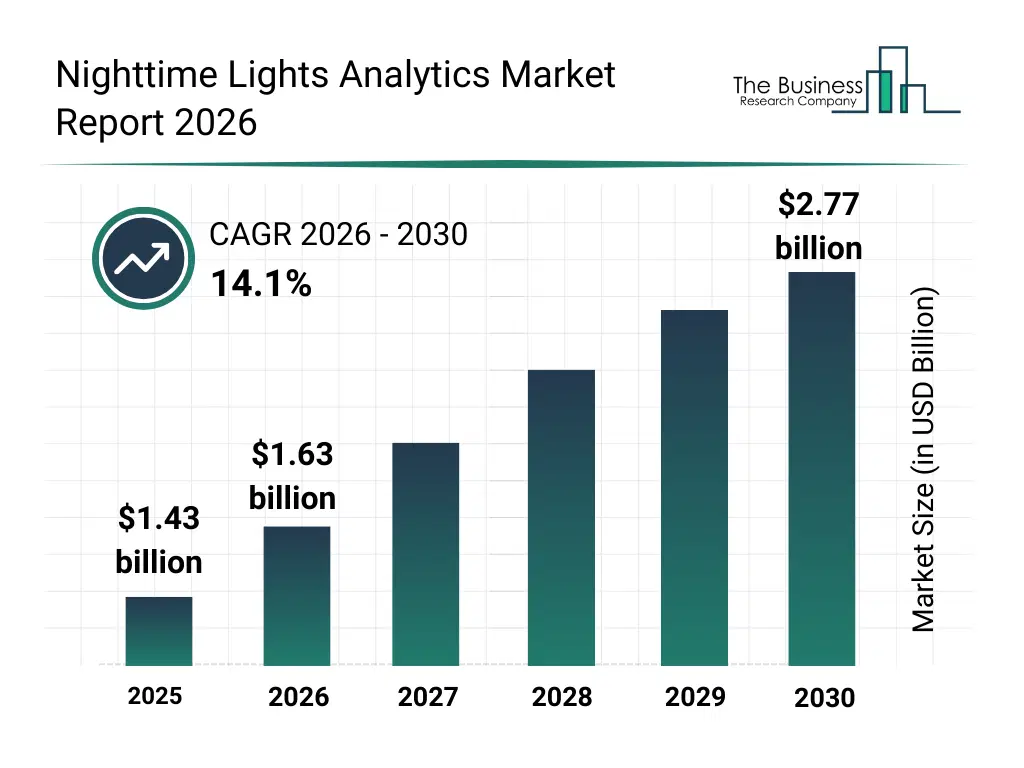
What Is The Nighttime Lights Analytics Market Size and Share 2026?
The nighttime lights analytics market size has grown rapidly in recent years. It will grow from $1.43 billion in 2025 to $1.63 billion in 2026 at a compound annual growth rate (CAGR) of 13.9%. The growth in the historic period can be attributed to rise in satellite imaging programs, expansion of urbanization across developing economies, increased government use of geospatial intelligence, growth in disaster monitoring initiatives, demand for economic proxy indicators in data-scarce regions.What Is The Nighttime Lights Analytics Market Growth Forecast?
The nighttime lights analytics market size is expected to see rapid growth in the next few years. It will grow to $2.77 billion in 2030 at a compound annual growth rate (CAGR) of 14.1%. The growth in the forecast period can be attributed to advancements in high-resolution night-sensing satellites, growth in smart city programs, increasing need for energy consumption tracking, rising climate and environmental monitoring mandates, adoption of geospatial analytics by commercial enterprises. Major trends in the forecast period include increasing use of nighttime light data for economic activity estimation, rising adoption of nighttime analytics in urban expansion monitoring, growing application in energy infrastructure and electrification mapping, expanding role in disaster impact and recovery assessment, integration of multi-source geospatial datasets for temporal change detection.
Global Nighttime Lights Analytics Market Segmentation
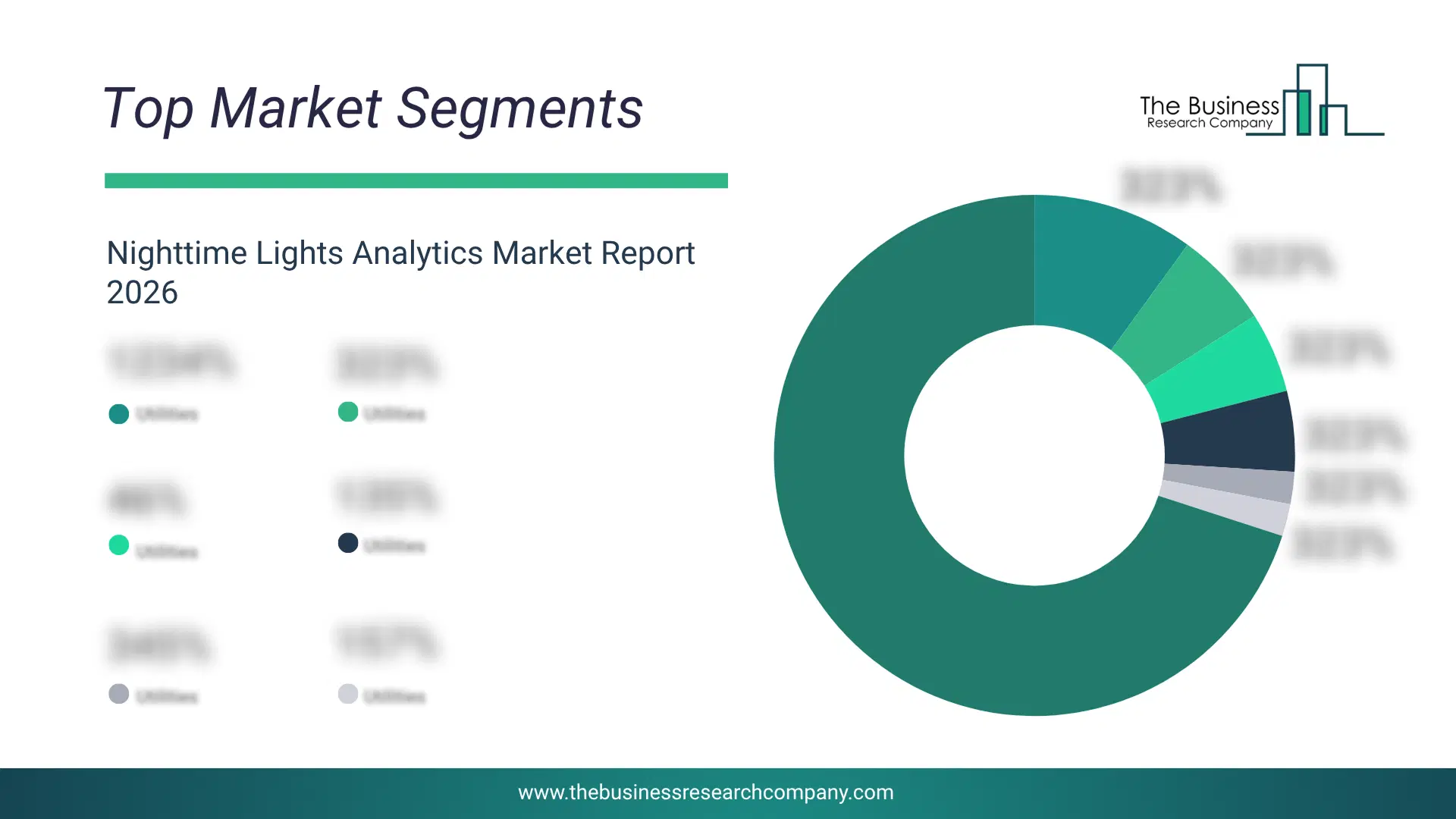
1) By Component: Software, Hardware, Services 2) By Data Source: Satellite Imagery, Aerial Imagery, Ground-Based Sensors, Other Data Sources 3) By Application: Urban Planning, Environmental Monitoring, Disaster Response, Economic Analysis, Defense And Security, Other Applications 4) By End User: Government And Public Sector, Research Institutions And Academia, Defense And Intelligence Agencies, Commercial Enterprises, Non-Governmental Organizations (NGOs) And Development Organizations Subsegments: 1) By Software: Robot Operating Systems And Firmware, Simulation And Digital-Twin Software, Motion Planning And Path Optimization, Artificial Intelligence (AI) And Machine Learning Software, Vision And Perception Software, Cell And Fleet Management Software, Manufacturing Execution System (MES) Or Enterprise Resource Planning (ERP) Integration Software, Predictive Maintenance And Analytics, Cybersecurity Software, Low-Code Or No-Code Programming Tools 2) By Hardware: Robot Arms And Manipulators, Collaborative Robots, End-Effectors And Grippers, Sensors And Perception Hardware, Actuators And Drives, Machine Vision Systems, Controllers And Programmable Logic Controllers (PLCs), Autonomous Mobile Robots (Autonomous Mobile Robots) And Automated Guided Vehicles (AGVs), Safety Systems And Fencing, Power And Cabling Infrastructure 3) By Services: System Design And Engineering, Integration And Commissioning, Maintenance And Field Support, Training And Skill Development, Retrofit And Modernization Services, Custom Application Development, Robotics-As-A-Service (RaaS), Validation And Testing Services, Consulting And Return On Investment (ROI) Analysis, Research And Development And Co-Innovation ServicesWhat Are The Drivers Of The Nighttime Lights Analytics Market?
The rising satellite imagery adoption is expected to propel the growth of the nighttime lights analytics market going forward. Satellite imagery is the collection of images of Earth or other planets captured by satellites from space for observation, analysis, and mapping. The adoption of satellite imagery is rising due to its providing accurate, real-time data that enables businesses and governments to monitor changes on Earth and respond faster to environmental, agricultural, and urban planning needs. Nighttime lights analytics tracks artificial illumination from space to map human activity that enables insights into development levels, energy availability, disaster effects, and population trends, especially in data-scarce regions. For instance, in June 2025, according to the UK Space Agency, a UK-based government department, there was a $12.34 million (£2 million) funding initiative announced, providing up to $478,524 (£400,000) per project to support pilot projects commercializing space solutions. Therefore, rising satellite imagery adoption is driving the growth of the nighttime lights analytics industry. The rising use in infrastructure development is expected to propel the growth of the nighttime lights analytics market going forward. Infrastructure development refers to the construction and improvement of fundamental facilities and systems necessary for societal and economic functioning, including transportation networks, utilities, and public amenities. The growing emphasis on infrastructure development is largely driven by rapid urbanization, as expanding urban populations and economic growth necessitate substantial investments in roads, bridges, energy grids, and other critical infrastructure to support sustainable development and improved quality of life. Urbanization increases the demand for nighttime lights analytics, as these tools provide crucial satellite-based insights for monitoring urban expansion, infrastructure projects, and electricity access patterns in real time. For instance, in July 2025, according to the Office for National Statistics, a UK-based government department, total investment in the infrastructure sector reached £20.3 billion ($23.64 billion) in 2024, marking a 16.9% increase compared to 2023. Therefore, the rising use in infrastructure development is driving the growth of the nighttime lights analytics industry.Key Players In The Global Nighttime Lights Analytics Market
Major companies operating in the nighttime lights analytics market are Google LLC, BlackSky Technology Inc., Airbus Defence and Space GmbH, L3Harris Technologies Inc., World Bank Group, Environmental Systems Research Institute Inc., Marble Imaging GmbH, CARTO Inc., SpaceKnow Inc., Kayrros SAS, Skylight Digital Inc., SatSure Analytics India Private Limited, New Light Technologies Inc., Ursa Space Systems Inc., Kontur Inc., Atlas AI PBC, Geoinfotech Resources Limited, Sparkgeo Consulting Inc., GeoIQ, and Sentinel Hub.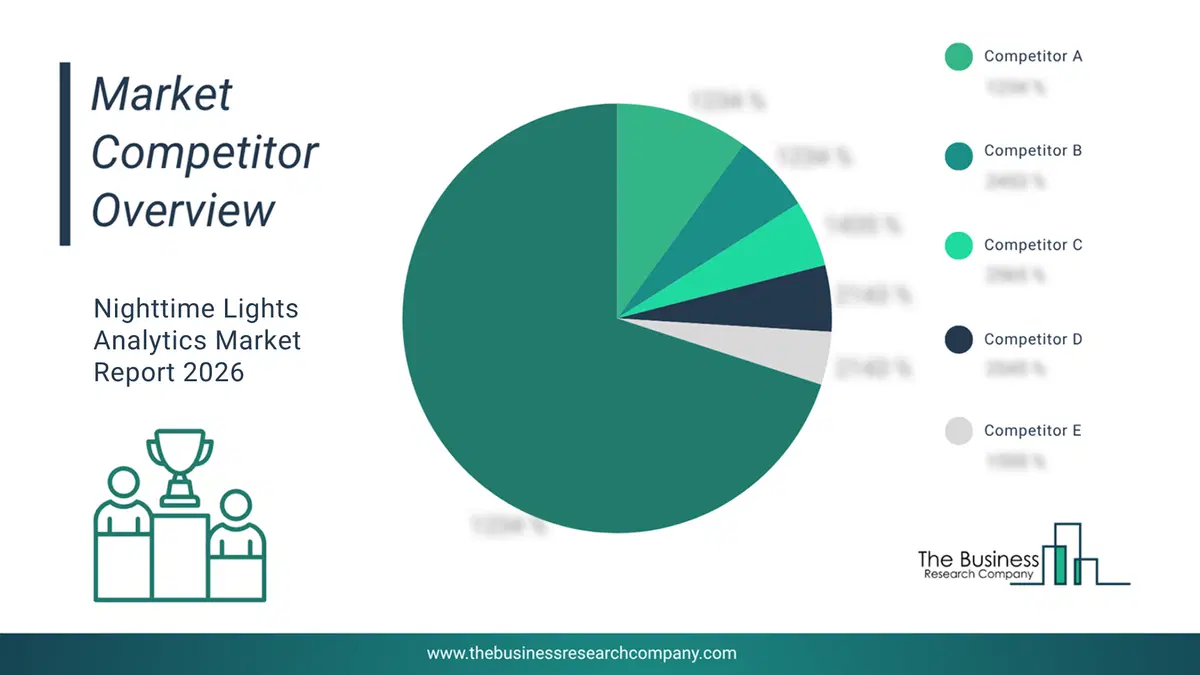
This chart is for illustrative purposes; the full report includes a detailed competitor analysis and comprehensive overview of the top 10 companies in the market.
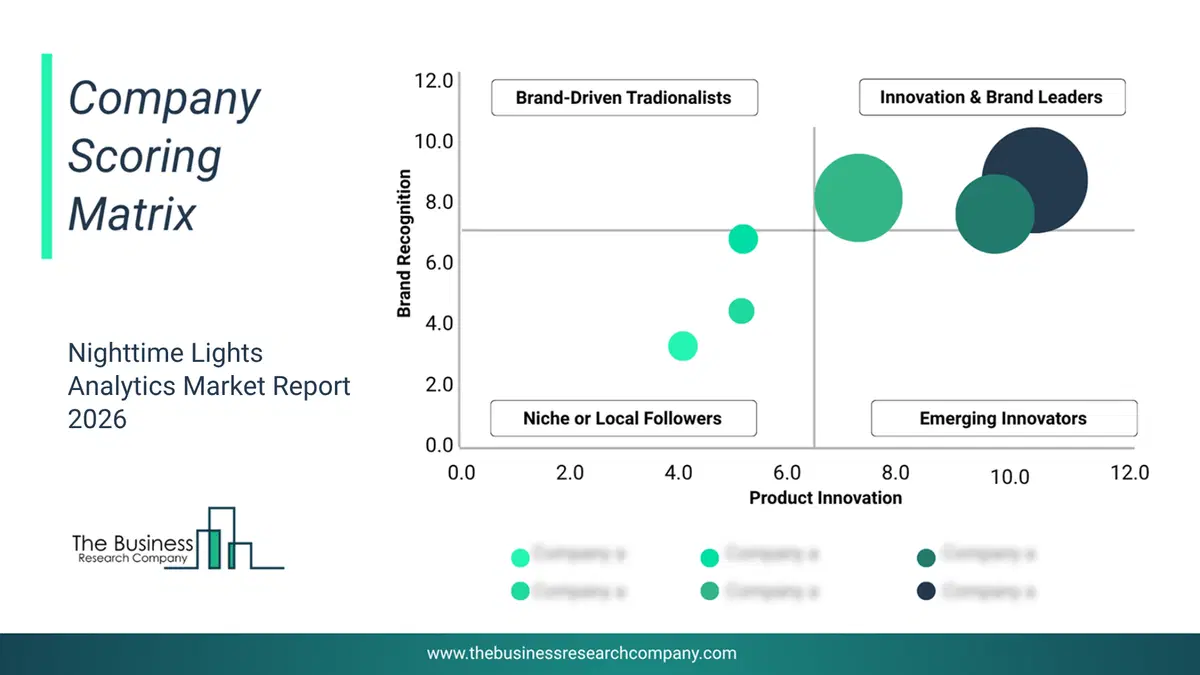
This chart maps companies by product innovation and brand strength, with bubble size indicating relative revenue, helping identify market leaders, challengers, and niche players. This is an illustrative chart; the full report provides a complete and accurate competitive analysis.
Global Nighttime Lights Analytics Market Trends and Insights
Major companies operating in the nighttime lights analytics market are focusing on deploying next-generation satellite constellations to enhance nighttime lights analytics, accelerate data availability, and improve monitoring of human and economic activity. Next-generation satellite constellations consist of advanced groups of compact, high-capability satellites built for fast deployment, frequent Earth coverage, and near real-time data access to support Earth observation, communication services, and intelligence operations. For instance, in December 2025, BlackSky Technology Inc., a US-based provider of real-time geospatial intelligence, announced that its third-generation Gen-3 satellite entered commercial operations within just three weeks of launch. The rapid commissioning highlights BlackSky’s capability to quickly deliver high-resolution, high-frequency imagery, including enhanced low-light and nighttime imaging, enabling faster analytics-driven intelligence for applications such as economic activity monitoring, security assessments, and infrastructure analysis.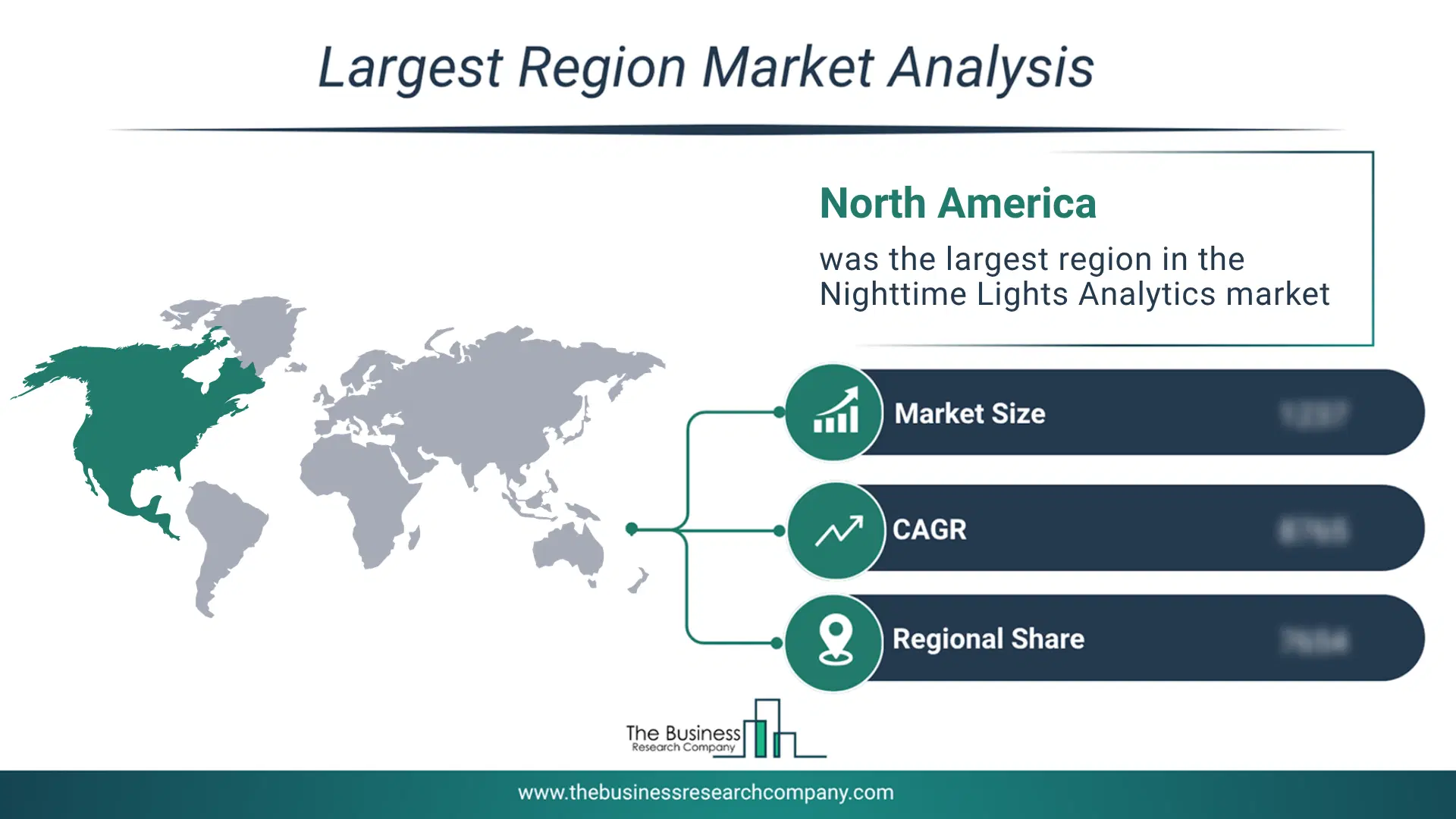
Regional Outlook
North America was the largest region in the nighttime lights analytics market in 2025. Asia-Pacific is expected to be the fastest-growing region in the forecast period. The regions covered in this market report are Asia-Pacific, South East Asia, Western Europe, Eastern Europe, North America, South America, Middle East, Africa. The countries covered in this market report are Australia, Brazil, China, France, Germany, India, Indonesia, Japan, Taiwan, Russia, South Korea, UK, USA, Canada, Italy, Spain.What Defines the Nighttime Lights Analytics Market?
The nighttime lights analytics market consists of sales of satellite data processing, geospatial data analytics, remote sensing analysis, urban activity monitoring, energy consumption analysis, and disaster impact assessment. The market value includes the value of related goods sold by the service provider or included within the service offering. Only goods and services traded between entities or sold to end consumers are included.How is Market Value Defined and Measured?
The market value is defined as the revenues that enterprises gain from the sale of goods and/or services within the specified market and geography through sales, grants, or donations in terms of the currency (in USD unless otherwise specified). The revenues for a specified geography are consumption values that are revenues generated by organizations in the specified geography within the market, irrespective of where they are produced. It does not include revenues from resales along the supply chain, either further along the supply chain or as part of other products.
This chart presents market attractiveness based on a quantitative evaluation of growth, competition, strategic alignment, and risk, offering a clear view of opportunity areas for decision-making. This chart is for illustrative purposes; the full report contains the complete analysis.

This chart highlights the Total Addressable Market (TAM) by estimating the maximum revenue opportunity using an assumption-driven approach, supporting strategic planning and opportunity sizing across markets. The chart is illustrative; the full report provides a more comprehensive analysis.
What Key Data and Analysis Are Included in the Nighttime Lights Analytics Market Report 2026?
The nighttime lights analytics market research report is one of a series of new reports from The Business Research Company that provides market statistics, including industry global market size, regional shares, competitors with the market share, detailed market segments, market trends and opportunities, and any further data you may need to thrive in the nighttime lights analytics industry. The market research report delivers a complete perspective of everything you need, with an in-depth analysis of the current and future state of the industry.Nighttime Lights Analytics Market Report Forecast Analysis
| Report Attribute | Details |
|---|---|
| Market Size Value In 2026 | $1.63 billion |
| Revenue Forecast In 2030 | $2.77 billion |
| Growth Rate | CAGR of 14.1% from 2026 to 2030 |
| Base Year For Estimation | 2025 |
| Actual Estimates/Historical Data | 2020-2025 |
| Forecast Period | 2026 - 2030 |
| Market Representation | Revenue in USD Billion and CAGR from 2026 to 2030 |
| Segments Covered | Component, Data Source, Application, End User |
| Regional Scope | Asia-Pacific, Western Europe, Eastern Europe, North America, South America, Middle East, Africa |
| Country Scope | The Countries Covered In This Market Report Are Australia, Brazil, China, France, Germany, India, Indonesia, Japan, Taiwan, Russia, South Korea, Uk, Usa, Canada, Italy, Spain. |
| Key Companies Profiled | Google LLC, BlackSky Technology Inc., Airbus Defence and Space GmbH, L3Harris Technologies Inc., World Bank Group, Environmental Systems Research Institute Inc., Marble Imaging GmbH, CARTO Inc., SpaceKnow Inc., Kayrros SAS, Skylight Digital Inc., SatSure Analytics India Private Limited, New Light Technologies Inc., Ursa Space Systems Inc., Kontur Inc., Atlas AI PBC, Geoinfotech Resources Limited, Sparkgeo Consulting Inc., GeoIQ, and Sentinel Hub. |
| Customization Scope | Request for Customization |
| Pricing And Purchase Options | Explore Purchase Options |