
Noise, Vibration, and Harness (NVH) Materials Market Report 2026
Global Outlook – By Material Type (Foam, Fibre And Fibre-Based, Barrier Film, Non-Woven, Coating, Other Material Types), By Function (Noise Reduction, Vibration Damping, Acoustic Insulation, Vibration Isolation, Shock Absorption, Structural Reinforcement), By Sales Channel (Original Equipment Manufacturer (OEM), Aftermarket), By Application (Interior, Exterior, Powertrain, Undercarriage, Floor, Roof, Door Or Window), By End Use Industry (Automotive, Aerospace, Railway, Marine, Other End Use Industries) – Market Size, Trends, Strategies, and Forecast to 2030
Noise, Vibration, and Harness (NVH) Materials Market Overview
• Noise, Vibration, and Harness (NVH) Materials market size has reached to $9.09 billion in 2025 • Expected to grow to $13.38 billion in 2030 at a compound annual growth rate (CAGR) of 8% • Growth Driver: Stricter Government Regulations On Vehicle Noise And Vibration Control Driving Market Growth Through Enhanced Compliance Requirements • North America was the largest region in 2025 and Asia-Pacific is the fastest growing region.What Is Covered Under Noise, Vibration, and Harness (NVH) Materials Market?
The noise, vibration, and harshness (NVH) materials are specialized materials used to reduce unwanted sound, vibration, and structural harshness in vehicles, machinery, and industrial equipment. They absorb, dampen, or isolate mechanical and acoustic energy to improve comfort, performance, and durability. Common NVH materials include foams, elastomers, acoustic barriers, damping sheets, and composite structures designed for automotive, aerospace, and manufacturing applications. The main material types of noise, vibration, and harness (NVH) materials include foam, fiber and fiber-based materials, barrier films, non-woven materials, coatings, and others. Foam refers to lightweight, porous materials used to absorb sound, reduce vibrations, and provide cushioning in various applications. The functions include noise reduction, vibration damping, acoustic insulation, vibration isolation, shock absorption, and structural reinforcement. The sales channels include original equipment manufacturers (OEMs) and the aftermarket. The applications include interior, exterior, powertrain, undercarriage, floor, roof, and door or window components. The key end use industries include automotive, aerospace, railway, marine, and others.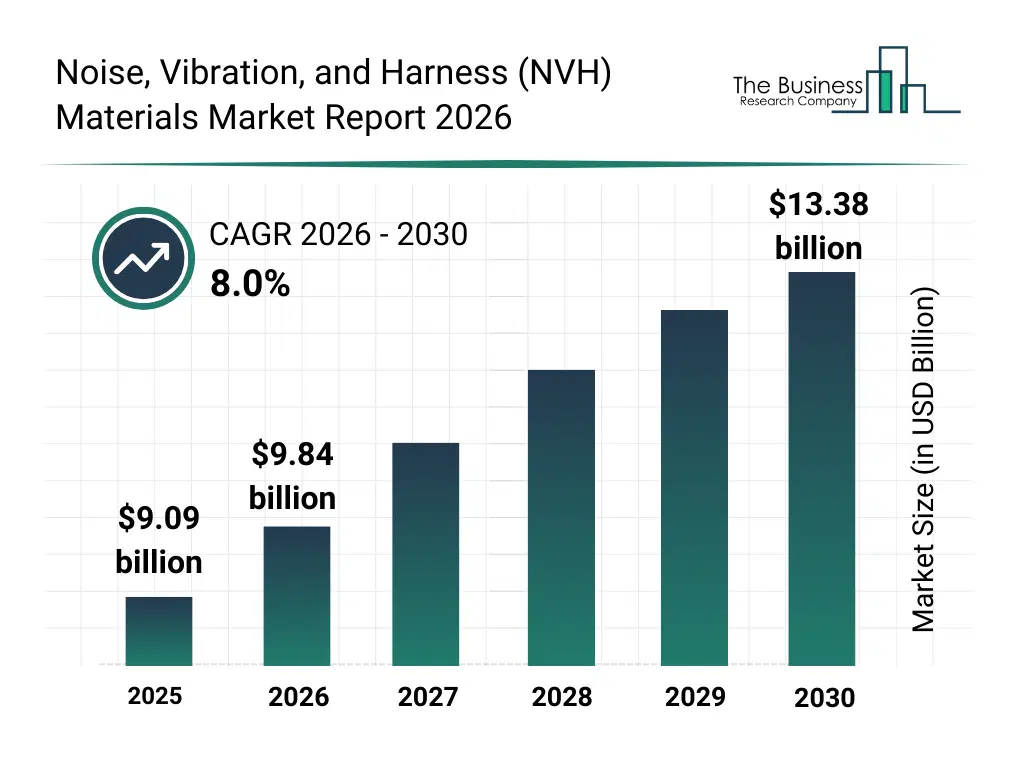
What Is The Noise, Vibration, and Harness (NVH) Materials Market Size and Share 2026?
The noise, vibration, and harshness (NVH) materials market size has grown strongly in recent years. It will grow from $9.09 billion in 2025 to $9.84 billion in 2026 at a compound annual growth rate (CAGR) of 8.3%. The growth in the historic period can be attributed to growing automotive production, increasing focus on cabin comfort, rising adoption of lightweight materials, expanding regulations on vehicle noise levels, growing demand for premium vehicles.What Is The Noise, Vibration, and Harness (NVH) Materials Market Growth Forecast?
The noise, vibration, and harshness (NVH) materials market size is expected to see strong growth in the next few years. It will grow to $13.38 billion in 2030 at a compound annual growth rate (CAGR) of 8.0%. The growth in the forecast period can be attributed to increasing electric vehicle manufacturing, growing emphasis on vibration reduction, rising investment in acoustic insulation, expanding use of sustainable materials, increasing demand for lightweight NVH solutions. Major trends in the forecast period include technology advancements in acoustic modeling, innovations in lightweight composite materials, developments in eco-friendly foam solutions, research and developments in vibration damping systems, advancements in digital simulation tools.
Global Noise, Vibration, and Harness (NVH) Materials Market Segmentation
1) By Material Type: Foam, Fibre And Fibre-Based, Barrier Film, Non-Woven, Coating, Other Material Types 2) By Function: Noise Reduction, Vibration Damping, Acoustic Insulation, Vibration Isolation, Shock Absorption, Structural Reinforcement 3) By Sales Channel: Original Equipment Manufacturer (OEM), Aftermarket 4) By Application: Interior, Exterior, Powertrain, Undercarriage, Floor, Roof, Door Or Window 5) By End Use Industry: Automotive, Aerospace, Railway, Marine, Other End Use Industries Subsegments: 1) By Foam: Polyurethane Foam, Polyethylene Foam, Ethylene Vinyl Acetate Foam, Melamine Foam, Polypropylene Foam 2) By Fibre And Fibre-Based: Glass Fibre, Polyester Fibre, Natural Fibre, Mineral Wool Fibre, Polypropylene Fibre 3) By Barrier Film: Polyethylene Film, Polypropylene Film, Polyvinyl Chloride Film, Thermoplastic Polyurethane Film, Multi-Layer Composite Film 4) By Non-Woven: Polyester Non-Woven, Polypropylene Non-Woven, Needle-Punched Non-Woven, Spunbond Non-Woven, Meltblown Non-Woven 5) By Coating: Water-Based Coating, Solvent-Based Coating, Rubber-Based Coating, Polyurethane Coating, Thermoplastic Coating 6) By Other Material Types: Elastomers, Thermoplastics, Adhesives, Sealants, Composite MaterialsWhat Are The Drivers Of The Noise, Vibration, And Harness (NVH) Materials Market?
The stricter government regulations on vehicle noise and vibration control are expected to propel the growth of the noise, vibration, and harshness (NVH) materials market going forward. Government noise and vibration control regulations are legally mandated limits on vehicle noise emissions set by national authorities to protect public health and reduce environmental noise pollution. The government regulations on vehicle noise and vibration control are rising as governments are enforcing compliance more strictly in response to growing concerns about traffic noise and its impact on communities. Noise, vibration, and harshness (NVH) materials support vehicle manufacturers and service providers by providing sound absorption, damping, and insulation solutions that ensure vehicles meet legal noise limits. For instance, in July 2023, according to the Ministry of Commerce and Industry, a Qatar-based government authority, cars and motorcycles are required to comply with prescribed noise level limits measured while the engine is running and the vehicle is in motion, with violations considered breaches of Articles 5, 6 and 13 of Law Number 8 of 2008 on Consumer Protection and subject to penalties including fines of up to Qatari Riyal 1 million, imprisonment for up to two years and administrative closure of businesses for up to three months. Therefore, stricter government regulations on vehicle noise and vibration control are driving the growth of the noise, vibration, and harshness (NVH) materials market. The increasing adoption of electric and hybrid vehicles is expected to propel the growth of the noise, vibration, and harness (NVH) materials market going forward. Electric and hybrid vehicles refer to automobiles powered by electric motors, either fully or in combination with internal combustion engines, which produce different acoustic and vibration profiles compared to conventional vehicles. The rise in adoption of electric vehicles is due to growing government incentives and tighter emission regulations that make zero tailpipe emission cars more financially attractive and environmentally necessary for consumers and fleets. Noise, vibration, and harness (NVH) materials support electric and hybrid vehicles by providing specialized solutions for reducing noise, vibration, and harshness in vehicle cabins, enhancing passenger comfort, and improving overall driving experience. rt–stop conditions. For instance, in May 2025, according to the International Energy Agency (IEA), a France-based intergovernmental organization, electric car sales exceeded 17 million globally in 2024, representing more than 20 percent of total car sales with an additional 3.5 million electric cars sold compared to 2023. Therefore, the increasing adoption of electric and hybrid vehicles is driving the growth of the noise, vibration, and harness (NVH) materials industry.Key Players In The Global Noise, Vibration, and Harness (NVH) Materials Market
Major companies operating in the noise, vibration, and harness (nvh) materials market are BASF SE, Compagnie de Saint-Gobain, 3M Company, Henkel AG & Co. KGaA, Parker-Hannifin Corporation., Covestro AG, Sika AG, DuPont de Nemours Inc., Sekisui Chemical Co. Ltd., Avery Dennison Corporation, Toyoda Gosei Co. Ltd., Nitto Denko Corporation, Huntsman Corporation, Sumitomo Riko Company Limited, Cabot Corporation, Trelleborg AB, Autoneum Holding AG, Greiner AG, ElringKlinger AG, Morgan Advanced Materials plc, Freudenberg Performance Materials, Armacell International S.A., Rogers Corporation, Roush Enterprises, Recticel SA
This chart is for illustrative purposes; the full report includes a detailed competitor analysis and comprehensive overview of the top 10 companies in the market.
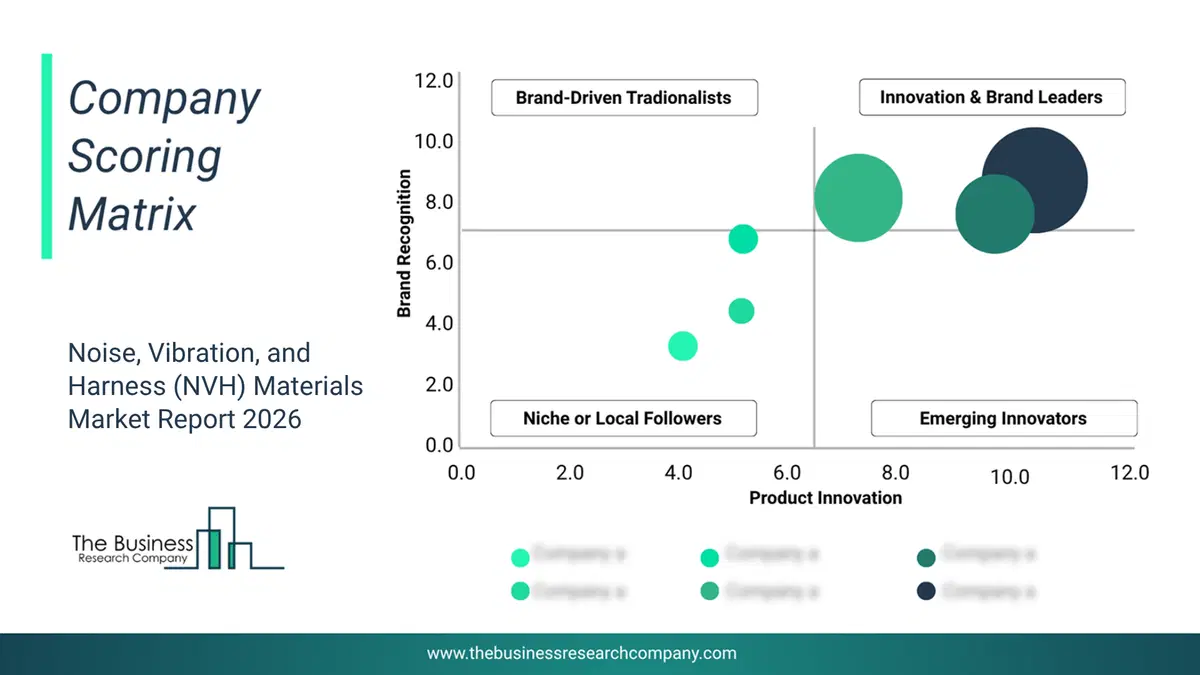
This chart maps companies by product innovation and brand strength, with bubble size indicating relative revenue, helping identify market leaders, challengers, and niche players. This is an illustrative chart; the full report provides a complete and accurate competitive analysis.
Regional Insights
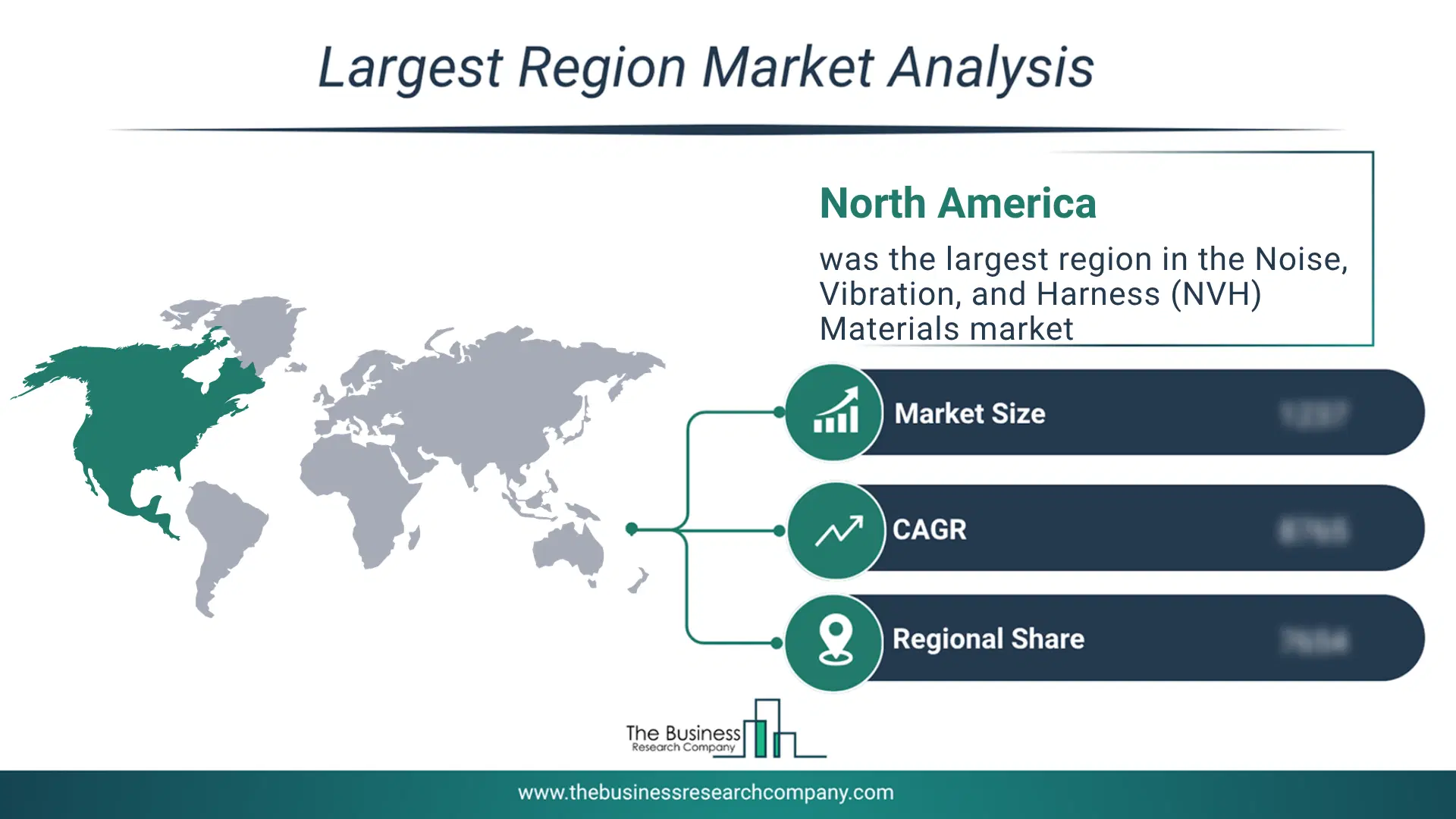
North America was the largest region in the noise, vibration, and harshness (NVH) materials market in 2025. Asia-Pacific is expected to be the fastest-growing region in the forecast period. The regions covered in this market report are Asia-Pacific, South East Asia, Western Europe, Eastern Europe, North America, South America, Middle East, Africa. The countries covered in this market report are Australia, Brazil, China, France, Germany, India, Indonesia, Japan, Taiwan, Russia, South Korea, UK, USA, Canada, Italy, Spain.What Defines the Noise, Vibration, and Harness (NVH) Materials Market?
The noise, vibration, and harshness (NVH) materials market consists of sales of acoustic foams, damping sheets, vibration isolators, sound barriers, insulating mats and sealing gaskets. Values in this market are ‘factory gate’ values, that is, the value of goods sold by the manufacturers or creators of the goods, whether to other entities (including downstream manufacturers, wholesalers, distributors, and retailers) or directly to end customers. The value of goods in this market includes related services sold by the creators of the goods.How is Market Value Defined and Measured?
The market value is defined as the revenues that enterprises gain from the sale of goods and/or services within the specified market and geography through sales, grants, or donations in terms of the currency (in USD unless otherwise specified). The revenues for a specified geography are consumption values that are revenues generated by organizations in the specified geography within the market, irrespective of where they are produced. It does not include revenues from resales along the supply chain, either further along the supply chain or as part of other products.
This chart presents market attractiveness based on a quantitative evaluation of growth, competition, strategic alignment, and risk, offering a clear view of opportunity areas for decision-making. This chart is for illustrative purposes; the full report contains the complete analysis.

This chart highlights the Total Addressable Market (TAM) by estimating the maximum revenue opportunity using an assumption-driven approach, supporting strategic planning and opportunity sizing across markets. The chart is illustrative; the full report provides a more comprehensive analysis.
What Key Data and Analysis Are Included in the Noise, Vibration, and Harness (NVH) Materials Market Report 2026?
The noise, vibration, and harness (nvh) materials market research report is one of a series of new reports from The Business Research Company that provides market statistics, including industry global market size, regional shares, competitors with the market share, detailed market segments, market trends and opportunities, and any further data you may need to thrive in the noise, vibration, and harness (nvh) materials industry. The market research report delivers a complete perspective of everything you need, with an in-depth analysis of the current and future state of the industry.Noise, Vibration, And Harness (NVH) Materials Market Report Forecast Analysis
| Report Attribute | Details |
|---|---|
| Market Size Value In 2026 | $9.84 billion |
| Revenue Forecast In 2030 | $13.38 billion |
| Growth Rate | CAGR of 8.3% from 2026 to 2030 |
| Base Year For Estimation | 2025 |
| Actual Estimates/Historical Data | 2020-2025 |
| Forecast Period | 2026 - 2030 |
| Market Representation | Revenue in USD Billion and CAGR from 2026 to 2030 |
| Segments Covered | Material Type, Function, Sales Channel, Application, End Use Industry |
| Regional Scope | Asia-Pacific, Western Europe, Eastern Europe, North America, South America, Middle East, Africa |
| Country Scope | The countries covered in this market report are Australia, Brazil, China, France, Germany, India, Indonesia, Japan, Taiwan, Russia, South Korea, UK, USA, Canada, Italy, Spain |
| Key Companies Profiled | BASF SE, Compagnie de Saint-Gobain, 3M Company, Henkel AG & Co. KGaA, Parker-Hannifin Corporation., Covestro AG, Sika AG, DuPont de Nemours Inc., Sekisui Chemical Co. Ltd., Avery Dennison Corporation, Toyoda Gosei Co. Ltd., Nitto Denko Corporation, Huntsman Corporation, Sumitomo Riko Company Limited, Cabot Corporation, Trelleborg AB, Autoneum Holding AG, Greiner AG, ElringKlinger AG, Morgan Advanced Materials plc, Freudenberg Performance Materials, Armacell International S.A., Rogers Corporation, Roush Enterprises, Recticel SA |
| Customization Scope | Request for Customization |
| Pricing And Purchase Options | Explore Purchase Options |