
Non-Dispersive Infrared (NDIR) Market Report 2026
Global Outlook – By Gas Type ( Carbon Dioxide, Hydrocarbons, Carbon Monoxide, Other Gas Type), By Application ( HVAC, Monitoring, Detection And Analysis), By End User ( Automotive And Transportation, Chemicals, Oil And Gas, Medical, Industrial And Manufacturing, Environmental, Food Processing And Storage, Other End-Users) – Market Size, Trends, Strategies, and Forecast to 2030
Non-Dispersive Infrared (NDIR) Market Overview
• Non-Dispersive Infrared (NDIR) market size has reached to $0.49 billion in 2025 • Expected to grow to $0.74 billion in 2030 at a compound annual growth rate (CAGR) of 8.6% • Growth Driver: Surge In Urbanization Fueling The Growth Of The Ndir Market Due To Rising Demand For Air Quality Monitoring In Expanding Cities • Market Trend: Advanced NDIR Solutions Help Companies Comply With EU Methane Regulations • Asia-Pacific was the largest region in 2025 and North America is the fastest growing region.What Is Covered Under Non-Dispersive Infrared (NDIR) Market?
A non-dispersive infrared (NDIR) sensor is defined as a simple spectroscopic sensor often used as a gas detector. An NDIR sensor is used in gas analysis to evaluate the concentration of gases such as carbon dioxide, hydrocarbons, and carbon monoxide. It detects the type of gas measuring the amount of absorbed infrared at the necessary frequency. The main types of gasses involved in the non-dispersive infrared (NDIR) market include carbon dioxide, hydrocarbons, carbon monoxide, and others. A carbon dioxide sensor monitors the amount of infrared (IR) radiation absorbed by carbon dioxide molecules to determine gaseous carbon dioxide levels. Automobiles utilize CO2 sensors with non-dispersive infrared (NDIR) technology to monitor cabin air quality, CO2 concentration in vehicle exhaust, and refrigerant levels. It is used in HVAC, monitoring, detection, and analysis and is implemented in various verticals such as automotive and transportation, chemicals, oil and gas, medical, industrial and manufacturing, environmental, food processing and storage, others.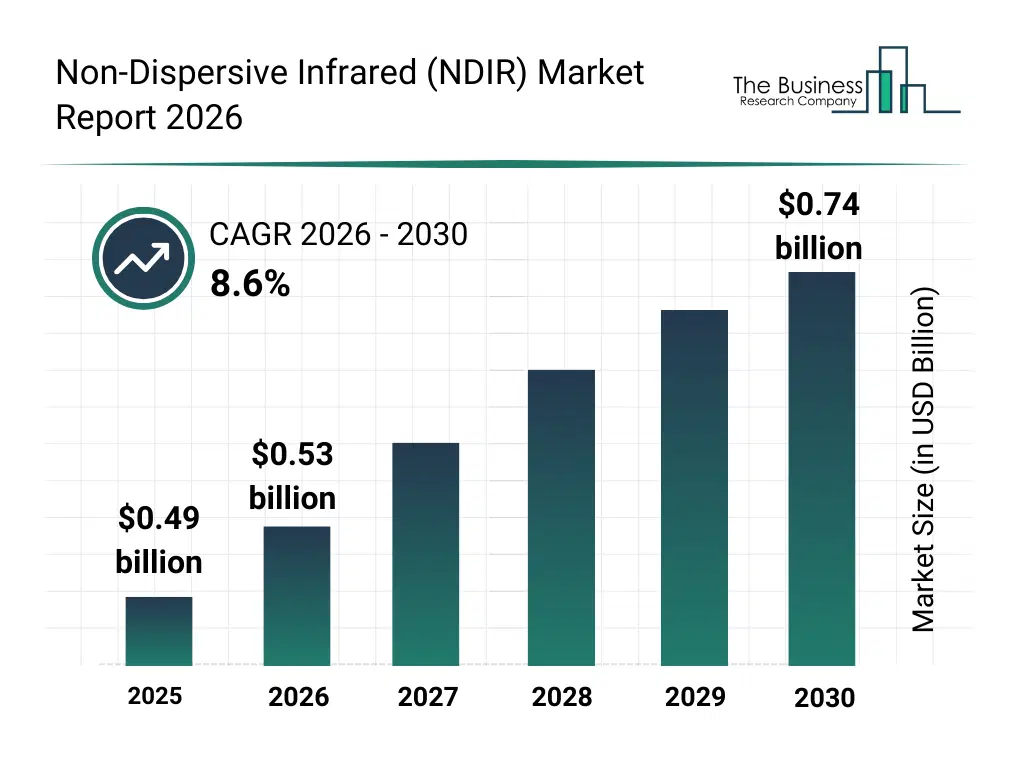
What Is The Non-Dispersive Infrared (NDIR) Market Size 2026 And Growth Rate?
The non-dispersive infrared (ndir) market size has grown strongly in recent years. It will grow from $0.49 billion in 2025 to $0.53 billion in 2026 at a compound annual growth rate (CAGR) of 8.7%. The growth in the historic period can be attributed to initial deployment in automotive monitoring, early adoption in chemical industry, reliance on manual detection methods, growth in environmental monitoring, expansion in HVAC applications.What Is The Non-Dispersive Infrared (NDIR) Market Growth Forecast?
The non-dispersive infrared (ndir) market size is expected to see strong growth in the next few years. It will grow to $0.74 billion in 2030 at a compound annual growth rate (CAGR) of 8.6%. The growth in the forecast period can be attributed to increasing use of multi-gas sensors, integration with AI-based analytics, expansion in industrial and manufacturing monitoring, adoption in medical and healthcare sectors, development of portable high-precision detectors. Major trends in the forecast period include integration of advanced gas detection modules, development of portable ndir sensors, implementation of IoT-enabled gas monitoring, adoption of high-sensitivity infrared sensors, expansion of multi-gas detection systems.
Global Non-Dispersive Infrared (NDIR) Market Segmentation
1) By Gas Type: Carbon Dioxide, Hydrocarbons, Carbon Monoxide, Other Gas Type 2) By Application: HVAC, Monitoring, Detection And Analysis 3) By End User: Automotive And Transportation, Chemicals, Oil And Gas, Medical, Industrial And Manufacturing, Environmental, Food Processing And Storage, Other End-Users Subsegments: 1) By Carbon Dioxide (CO2): Low-Concentration CO2 Sensors, High-Concentration CO2 Sensors 2) By Hydrocarbons: Methane (CH4) Sensors, Propane (C3H8) Sensors, Benzene (C6H6) Sensors 3) By Carbon Monoxide (CO): Portable CO Sensors, Fixed CO Sensors 4) By Other Gas Types: Nitrous Oxide (N2O) Sensors, Ammonia (NH3) Sensors, Hydrogen Sulfide (H2S) SensorsWhat Is The Driver Of The Non-Dispersive Infrared (NDIR) Market?
The increasing urbanization is expected to drive the growth of the Non-Dispersive Infrared (NDIR) market going forward. Urbanization is the process where an increasing share of a population moves from rural areas to cities, leading to the growth of urban centers and infrastructure development. Economic opportunities drive rising urbanization, as people migrate to cities in search of better jobs, higher incomes, and improved living standards, leading to the expansion of urban areas. Non-Dispersive Infrared (NDIR) sensors support urbanization by enabling accurate monitoring of air quality in growing cities, helping manage pollution levels, and ensuring healthier living environments for expanding urban populations. For instance, in February 2024, according to the United Nations Organization, a US-based international organization, as of 2024, approximately 58% of the global population resides in urban areas, with projections indicating that this share will rise to 60% by 2030 and could surpass 68% by 2050. Therefore, increasing urbanization is fueling the growth of the Non-Dispersive Infrared (NDIR) industry.Key Players In The Global Non-Dispersive Infrared (NDIR) Market
Major companies operating in the non-dispersive infrared (ndir) market are Emerson Electric Co., ABB Group, Honeywell International Inc., Senseair AB, Dynament Ltd., Mipex Technology AB, Gas Sensing Solutions Ltd., S+S Regeltechnik GmbH, Nano Environmental Technology S.r.l., Sensirion AG, Vaisala Corporation, Teledyne API, ELT SENSOR Corp., Axetris AG, Edinburgh Sensors Ltd., Alphasense Ltd., Figaro Engineering Inc., AMETEK Inc., E+E Elektronik GmbH, Winsen Electronics Technology Co. Ltd., Hanwei Electronics Group Corporation, SGX Sensortech (IS) Ltd., Cubic Sensor and Instrument Co. Ltd.
This chart is for illustrative purposes; the full report includes a detailed competitor analysis and comprehensive overview of the top 10 companies in the market.
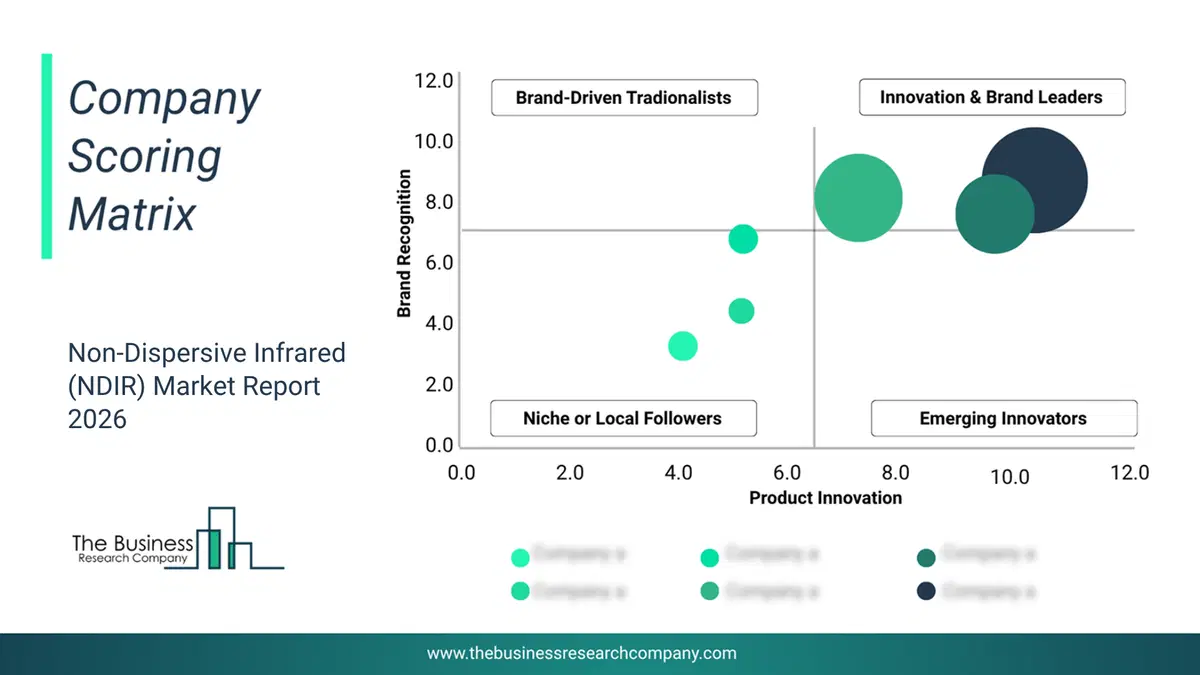
This chart maps companies by product innovation and brand strength, with bubble size indicating relative revenue, helping identify market leaders, challengers, and niche players. This is an illustrative chart; the full report provides a complete and accurate competitive analysis.
Global Non-Dispersive Infrared (NDIR) Market Trends and Insights
Major companies operating in the non-dispersive infrared (NDIR) market are focusing on advanced solutions, such as high-sensitivity detection, to assist industrial companies in complying with new EU regulations on methane emissions, thereby contributing to environmental sustainability and the reduction of greenhouse gases. High sensitivity detection is due to the ability of NDIR sensors to accurately measure low concentrations of target gases by detecting specific infrared absorption wavelengths without the need for dispersive elements, thus allowing for precise gas concentration analysis. For instance, in May 2024, ABB Ltd., a Switzerland-based engineering company, announced OA-ICOS technology aimed at helping industrial companies comply with the upcoming EU Methane Regulation. This features sensitivity over 1,000 times greater than conventional technologies and detects leaks 10 times faster than traditional equipment, enabling precise location, attribution, and quantification of gas leak sources. This innovation is significant as it empowers industrial companies to identify and prioritize necessary repairs, ensuring compliance with stringent EU regulations on methane emissions and contributing to global efforts to reduce greenhouse gases.What Are Latest Mergers And Acquisitions In The Non-Dispersive Infrared (NDIR) Market?
In May 2023, smartGAS Mikrosensorik GmbH, a Germany-based manufacturer of high-precision NDIR gas sensors and analyzers used in various industrial applications, merged with ShanghAI Industrial Gas Analytical Systems Co., Ltd. (SIGAS) for an undisclosed amount. Through this merger, the two companies aim to optimize the upstream and downstream industrial chains. SIGAS is a China-based company engaged in industrial gas analysis equipment and provides complete gas monitoring systems.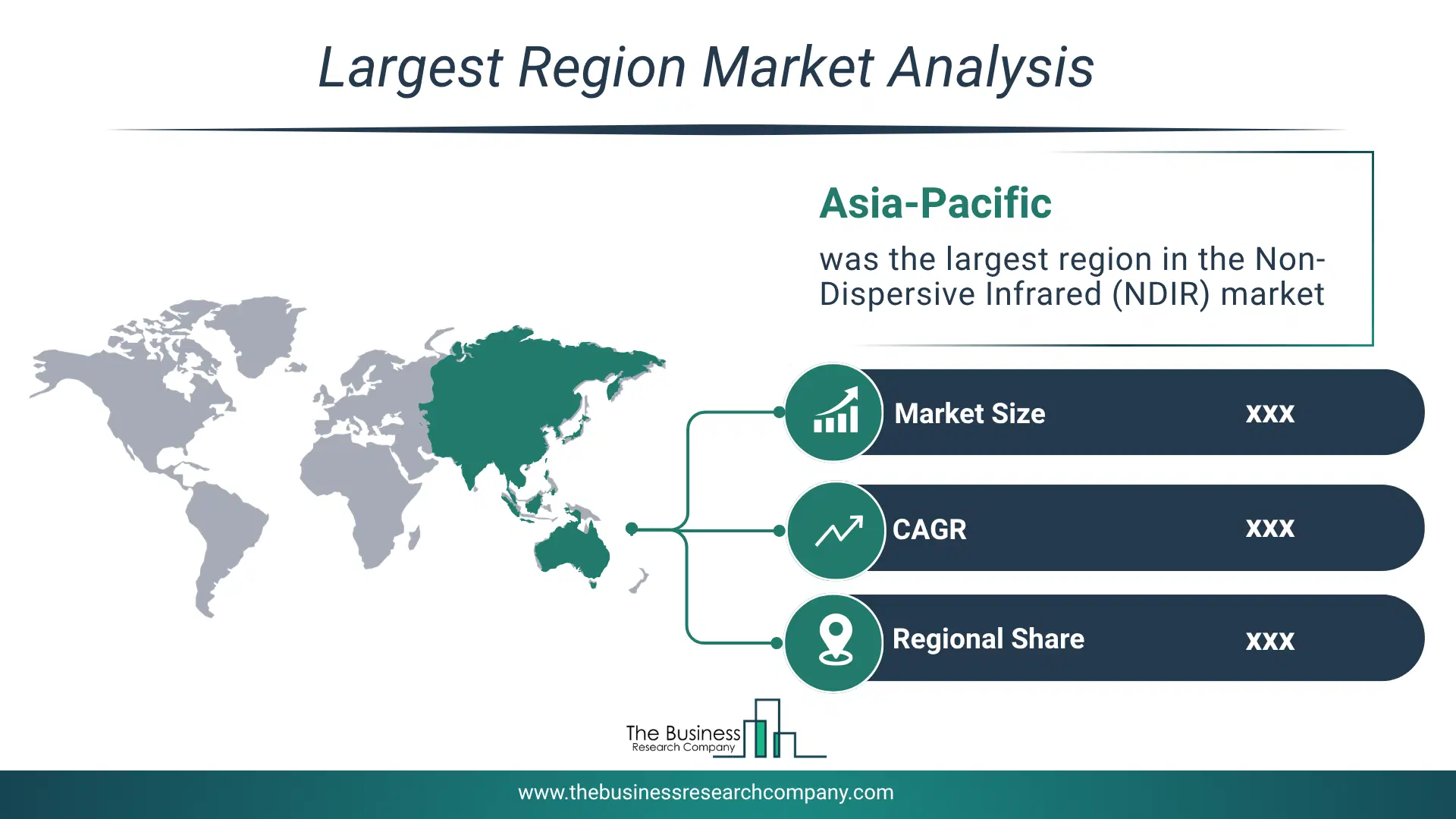
Regional Outlook
Asia-Pacific was the largest region in the non-dispersive infrared (NDIR) market in 2025. North America was the second-largest region in the non-dispersive infrared (NDIR) market. The regions covered in this market report are Asia-Pacific, South East Asia, Western Europe, Eastern Europe, North America, South America, Middle East, Africa. The countries covered in this market report are Australia, Brazil, China, France, Germany, India, Indonesia, Japan, Taiwan, Russia, South Korea, UK, USA, Canada, Italy, Spain.What Defines the Non-Dispersive Infrared (NDIR) Market?
The non-dispersive infrared (NDIR) market consists of sales of NDIR carbon dioxide (co2) sensors, NDIR carbon monoxide sensors, NDIR ethylene sensors, and other non-dispersive infrared (NDIR) sensors. Values in this market are ‘factory gate’ values, that is the value of goods sold by the manufacturers or creators of the goods, whether to other entities (including downstream manufacturers, wholesalers, distributors, and retailers) or directly to end customers. The value of goods in this market includes related services sold by the creators of the goods.How is Market Value Defined and Measured?
The market value is defined as the revenues that enterprises gain from the sale of goods and/or services within the specified market and geography through sales, grants, or donations in terms of the currency (in USD unless otherwise specified). The revenues for a specified geography are consumption values that are revenues generated by organizations in the specified geography within the market, irrespective of where they are produced. It does not include revenues from resales along the supply chain, either further along the supply chain or as part of other products.
This chart presents market attractiveness based on a quantitative evaluation of growth, competition, strategic alignment, and risk, offering a clear view of opportunity areas for decision-making. This chart is for illustrative purposes; the full report contains the complete analysis.

This chart highlights the Total Addressable Market (TAM) by estimating the maximum revenue opportunity using an assumption-driven approach, supporting strategic planning and opportunity sizing across markets. The chart is illustrative; the full report provides a more comprehensive analysis.
What Key Data and Analysis Are Included in the Non-Dispersive Infrared (NDIR) Market Report 2026?
The non-dispersive infrared (ndir) market research report is one of a series of new reports from The Business Research Company that provides market statistics, including industry global market size, regional shares, competitors with the market share, detailed market segments, market trends and opportunities, and any further data you may need to thrive in the non-dispersive infrared (ndir) industry. The market research report delivers a complete perspective of everything you need, with an in-depth analysis of the current and future state of the industry.Non-Dispersive Infrared (NDIR) Market Report Forecast Analysis
| Report Attribute | Details |
|---|---|
| Market Size Value In 2026 | $0.53 billion |
| Revenue Forecast In 2030 | $0.74 billion |
| Growth Rate | CAGR of 8.6% from 2026 to 2030 |
| Base Year For Estimation | 2025 |
| Actual Estimates/Historical Data | 2020-2025 |
| Forecast Period | 2026 - 2030 |
| Market Representation | Revenue in USD Billion and CAGR from 2026 to 2030 |
| Segments Covered | Gas Type, Application, End User |
| Regional Scope | Asia-Pacific, Western Europe, Eastern Europe, North America, South America, Middle East, Africa |
| Country Scope | The countries covered in the report are Australia, Brazil, China, France, Germany, India, Indonesia, Japan, Taiwan, Russia, South Korea, UK, USA, Canada, Italy, Spain. |
| Key Companies Profiled | Emerson Electric Co., ABB Group, Honeywell International Inc., Senseair AB, Dynament Ltd., Mipex Technology AB, Gas Sensing Solutions Ltd., S+S Regeltechnik GmbH, Nano Environmental Technology S.r.l., Sensirion AG, Vaisala Corporation, Teledyne API, ELT SENSOR Corp., Axetris AG, Edinburgh Sensors Ltd., Alphasense Ltd., Figaro Engineering Inc., AMETEK Inc., E+E Elektronik GmbH, Winsen Electronics Technology Co. Ltd., Hanwei Electronics Group Corporation, SGX Sensortech (IS) Ltd., Cubic Sensor and Instrument Co. Ltd. |
| Customization Scope | Request for Customization |
| Pricing And Purchase Options | Explore Purchase Options |