
Non-Ferrous Metal Recycling Market Report 2026
Global Outlook – By Recycling Process Type (Mechanical Recycling, Pyrometallurgical Recycling, Hydrometallurgical Recycling, Biotechnology-Based Recycling), By Type Of Non-Ferrous Metal (Copper, Aluminum, Lead, Zinc, Nickel, Graphite, Precious Metals), By Source Of Scrap Material (Industrial Scrap, End-Of-Life Vehicles, Construction And Demolition Debris, Consumer Electronics, Household Appliances), By End-Use Industry (Automotive, Building And Construction, Electrical And Electronics, Industrial Machinery, Other End Users) – Market Size, Trends, Strategies, and Forecast to 2030
Non-Ferrous Metal Recycling Market Overview
• Non-Ferrous Metal Recycling market size has reached to $236.92 billion in 2025 • Expected to grow to $301.77 billion in 2030 at a compound annual growth rate (CAGR) of 4.9% • Growth Driver: Increasing Demand For Sustainable Practices Fueling The Growth Of The Market Due To Resource Conservation And Regulatory Compliance • Market Trend: Leading Companies Drive Innovation In Non-Ferrous Metal Recycling With Certified Recycled Metal Brands • Asia-Pacific was the largest region in 2025 and North America is the fastest growing region.What Is Covered Under Non-Ferrous Metal Recycling Market?
Non-ferrous metal recycling refers to the process of collection, processing, and repurposing of metals that do not contain iron. These metals are separated, cleaned, and melted down for reuse in various industries. Non-ferrous metal recycling conserves natural resources, reduces energy consumption, and minimizes environmental impact by reusing valuable non-ferrous materials. The main recycling process types in the non-ferrous metal recycling include mechanical recycling, pyrometallurgical recycling, hydrometallurgical recycling, and biotechnology-based recycling. Mechanical recycling is the process of physically breaking down and reprocessing waste materials, like plastics, into new products without changing their chemical structure. It is categorized by type of non-ferrous metal into copper, aluminum, lead, zinc, nickel, graphite, and precious metals and is further segmented by source of scrap material, such as industrial scrap, end-of-life vehicles, construction and demolition debris, consumer electronics, and household appliances. These recycled materials serve various end-use industries, including automotive, building and construction, electrical and electronics, industrial machinery, and others.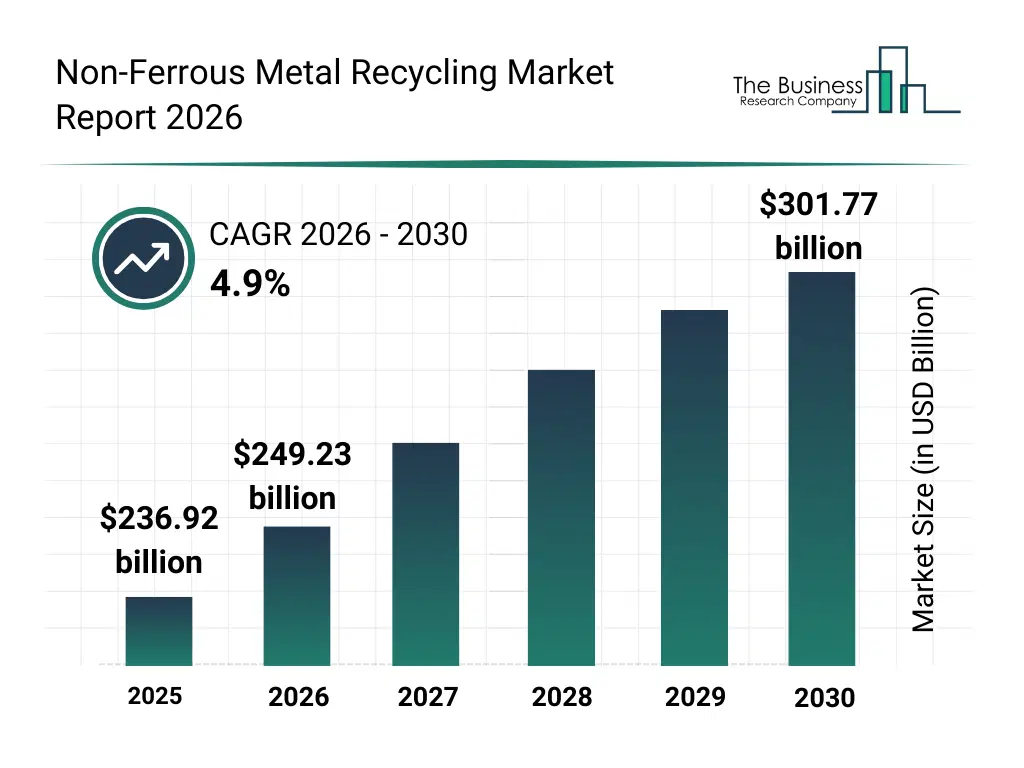
What Is The Non-Ferrous Metal Recycling Market Size and Share 2026?
The non-ferrous metal recycling market size has grown strongly in recent years. It will grow from $236.92 billion in 2025 to $249.23 billion in 2026 at a compound annual growth rate (CAGR) of 5.2%. The growth in the historic period can be attributed to increasing industrial demand for aluminum, copper, and other recycled non-ferrous metals, rising scrap collection and processing capabilities expanding recycling output, growing adoption of recycling to reduce energy consumption compared to primary metal production, expansion of automotive and construction sectors driving demand for recycled metal products, advancements in sorting and separation technologies improving recovery efficiency.What Is The Non-Ferrous Metal Recycling Market Growth Forecast?
The non-ferrous metal recycling market size is expected to see steady growth in the next few years. It will grow to $301.77 billion in 2030 at a compound annual growth rate (CAGR) of 4.9%. The growth in the forecast period can be attributed to growing emphasis on circular economy practices encouraging higher recycling rates, rising demand for high-purity recycled metals in electronics and renewable energy sectors, expansion of urban mining initiatives to recover valuable non-ferrous materials from waste streams, increasing investment in automated and AI-enabled recycling systems, accelerating regulatory pressure to reduce carbon emissions boosting adoption of recycled non-ferrous metals. Major trends in the forecast period include increasing scrap collection from end-of-life vehicles and consumer electronics, expansion of dedicated non-ferrous sorting and pre-processing facilities, shift toward higher-purity recycled metal grades to meet tighter quality specifications, growing vertical integration between scrap collectors, recyclers, and metal producers, regional diversification of scrap sourcing to reduce supply and price volatility.
Global Non-Ferrous Metal Recycling Market Segmentation
1) By Recycling Process Type: Mechanical Recycling, Pyrometallurgical Recycling, Hydrometallurgical Recycling, Biotechnology-Based Recycling 2) By Type Of Non-Ferrous Metal: Copper, Aluminum, Lead, Zinc, Nickel, Graphite, Precious Metals 3) By Source Of Scrap Material: Industrial Scrap, End-Of-Life Vehicles, Construction And Demolition Debris, Consumer Electronics, Household Appliances 4) By End-Use Industry: Automotive, Building And Construction, Electrical And Electronics, Industrial Machinery, Other End Users Subsegments: 1) By Mechanical Recycling, Shredding, Sorting, Baling, Dismantling 2) By Pyrometallurgical Recycling, Smelting, Refining, Incineration, Thermal Treatment 3) By Hydrometallurgical Recycling, Leaching, Solvent Extraction, Precipitation, Electro-Winning 4) By Biotechnology-Based Recycling, Bioleaching, Biosorption, Bioprecipitation, Enzymatic TreatmentWhat Is Driver Of The Non-Ferrous Metal Recycling Market?
The increasing demand for sustainable practices is expected to propel the growth of the non-ferrous metal recycling market going forward. Sustainable practices are approaches that balance economic growth, environmental protection, and social well-being to ensure resources are used responsibly and preserved for the future. The demand for sustainable practices is increasing due to stricter government regulations and policies as they enforce compliance and promote responsible resource management. Non-ferrous metal recycling enhances sustainable practices by conserving natural resources and reducing energy consumption, making it essential for eco-friendly manufacturing and waste management. It minimizes environmental impact by lowering emissions and landfill waste, supporting a circular economy. For instance, in April 2024, according to the survey of over 1,200 US consumers by PDI Technologies, a US-based software solutions company, 80% of the consumers showed interest in buying sustainable products, reflecting an increase from 66% in 2022 to 68% in 2023. Therefore, the increasing demand for sustainable practices is driving the growth of the non-ferrous metal recycling industry.Key Players In The Global Non-Ferrous Metal Recycling Market
Major companies operating in the non-ferrous metal recycling market are Aurubis Aktiengesellschaft, Gerdau North America Corporation, Novelis Inc., Dowa Holdings Co. Ltd., Sims Limited, Chiho Environmental Group Limited, OmniSource Corporation, Alter Trading Corporation, SA Recycling Limited Liability Company, Triple M Metal LP, Harmony Enterprises Inc., MS Enterprises, STEINERT GmbH, Quest Resource Management Group LLC, Jansen Recycling Group B.V., Jain Metal Group, ASM Recycling Inc., Aruhya Enterprises, Stena Metall Aktiebolag, GLE Scrap Metal Inc.
This chart is for illustrative purposes; the full report includes a detailed competitor analysis and comprehensive overview of the top 10 companies in the market.
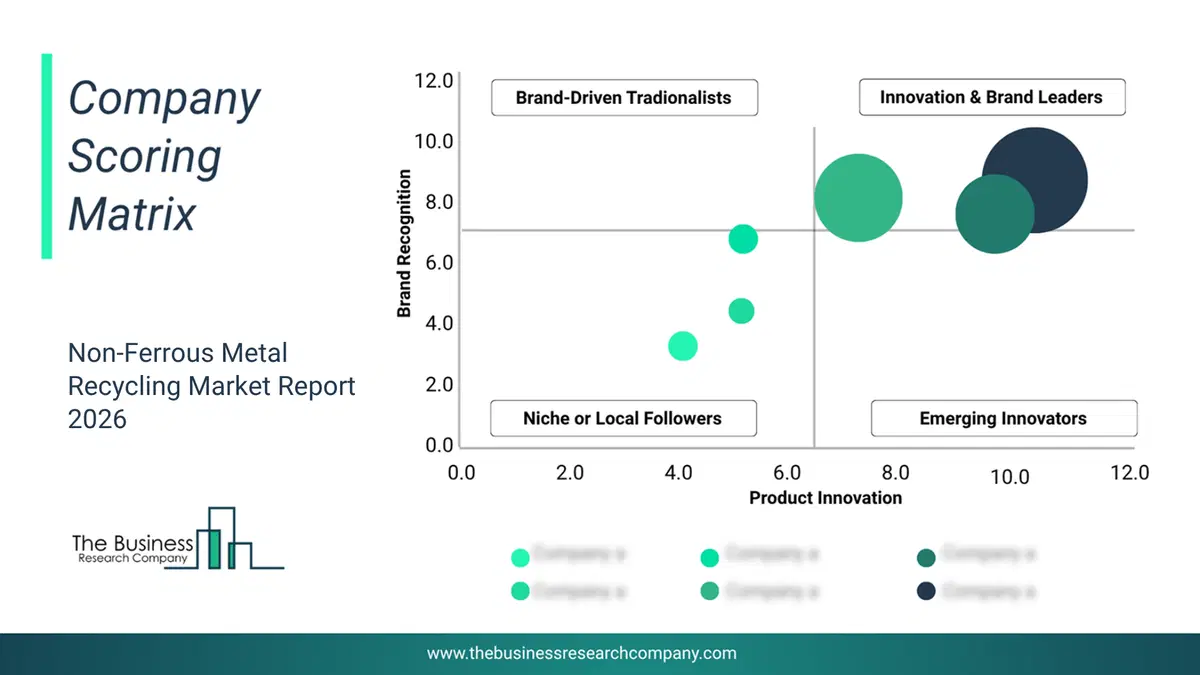
This chart maps companies by product innovation and brand strength, with bubble size indicating relative revenue, helping identify market leaders, challengers, and niche players. This is an illustrative chart; the full report provides a complete and accurate competitive analysis.
Global Non-Ferrous Metal Recycling Market Trends and Insights
Major companies operating in the non-ferrous metal recycling market are focusing on developing innovative products, such as recycled metal, to enhance product credibility, meet regulatory requirements, and appeal to environmentally conscious customers. Recycled metal refers to metal that has been recovered from used products, scrap, or industrial waste and then reprocessed for reuse in manufacturing. It includes ferrous metals (like steel and iron) and non-ferrous metals (like aluminum, copper, and brass). For instance, in January 2024, Mitsubishi Materials Corporation, a Japan-based cement manufacturing company, launched REMINE, a recycled metal brand that specifies and certifies the recycled content in non-ferrous metal products such as refined tin and lead. This initiative enhances transparency, traceability, and sustainability by following certified environmental labeling and utilizing advanced recycling technologies.What Are Latest Mergers And Acquisitions In The Non-Ferrous Metal Recycling Market? Cronimet Expands Central Europe Presence With MetallPlast Acquisition
In September 2024, Cronimet Holding GmbH, a Germany-based metal recycling company, acquired MetallPlast Recykling spol. s r.o. for an undisclosed amount. With this acquisition, Cronimet aims to strengthen its market position in Central Europe by integrating MetallPlast Recykling’s expertise, expanding its site network and product portfolio, and leveraging synergies to enhance service offerings and support long-term growth. MetallPlast Recykling spol. s r.o. is a Czech Republic-based processor and recycler company of ferrous and non-ferrous scrap metal.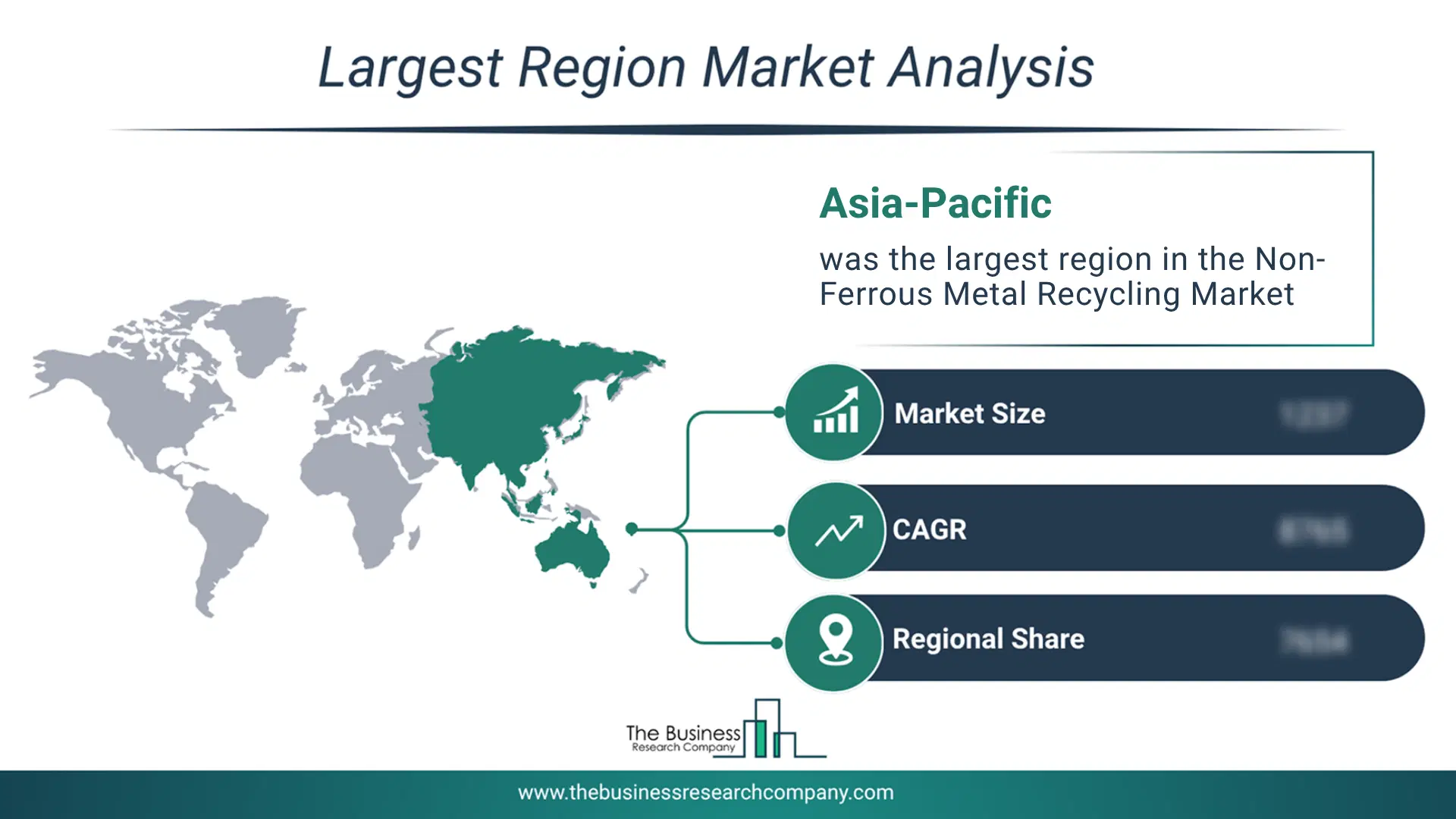
Regional Insights
Asia-Pacific was the largest region in the non-ferrous metal recycling market in 2025. North America is expected to be the fastest-growing region in the forecast period. The regions covered in this market report are Asia-Pacific, South East Asia, Western Europe, Eastern Europe, North America, South America, Middle East, Africa. The countries covered in this market report are Australia, Brazil, China, France, Germany, India, Indonesia, Japan, Taiwan, Russia, South Korea, UK, USA, Canada, Italy, SpainWhat Defines the Non-Ferrous Metal Recycling Market?
The non-ferrous metal recycling market consists of sales of recycled metal ingots or billets, metal sheets, plates, wires, rods, castings and components. Values in this market are ‘factory gate’ values, that is the value of goods sold by the manufacturers or creators of the goods, whether to other entities (including downstream manufacturers, wholesalers, distributors and retailers) or directly to end customers. The value of goods in this market includes related services sold by the creators of the goods.How is Market Value Defined and Measured?
The market value is defined as the revenues that enterprises gain from the sale of goods and/or services within the specified market and geography through sales, grants, or donations in terms of the currency (in USD unless otherwise specified). The revenues for a specified geography are consumption values that are revenues generated by organizations in the specified geography within the market, irrespective of where they are produced. It does not include revenues from resales along the supply chain, either further along the supply chain or as part of other products.
This chart presents market attractiveness based on a quantitative evaluation of growth, competition, strategic alignment, and risk, offering a clear view of opportunity areas for decision-making. This chart is for illustrative purposes; the full report contains the complete analysis.

This chart highlights the Total Addressable Market (TAM) by estimating the maximum revenue opportunity using an assumption-driven approach, supporting strategic planning and opportunity sizing across markets. The chart is illustrative; the full report provides a more comprehensive analysis.
What Key Data and Analysis Are Included in the Non-Ferrous Metal Recycling Market Report 2026?
The non-ferrous metal recycling market research report is one of a series of new reports from The Business Research Company that provides market statistics, including industry global market size, regional shares, competitors with the market share, detailed market segments, market trends and opportunities, and any further data you may need to thrive in the non-ferrous metal recycling industry. The market research report delivers a complete perspective of everything you need, with an in-depth analysis of the current and future state of the industry.Non-Ferrous Metal Recycling Market Report Forecast Analysis
| Report Attribute | Details |
|---|---|
| Market Size Value In 2026 | $249.23 billion |
| Revenue Forecast In 2030 | $301.77 billion |
| Growth Rate | CAGR of 4.9% from 2026 to 2030 |
| Base Year For Estimation | 2025 |
| Actual Estimates/Historical Data | 2020-2025 |
| Forecast Period | 2026 - 2030 |
| Market Representation | Revenue in USD Billion and CAGR from 2026 to 2030 |
| Segments Covered | Recycling Process Type, Type Of Non-Ferrous Metal, Source Of Scrap Material, End-Use Industry |
| Regional Scope | Asia-Pacific, Western Europe, Eastern Europe, North America, South America, Middle East, Africa |
| Country Scope | The countries covered in the non-ferrous metal recycling market report are Australia, Brazil, China, France, Germany, India, Indonesia, Japan, Taiwan, Russia, South Korea, UK, USA, Canada, Italy, Spain |
| Key Companies Profiled | Aurubis Aktiengesellschaft, Gerdau North America Corporation, Novelis Inc., Dowa Holdings Co. Ltd., Sims Limited, Chiho Environmental Group Limited, OmniSource Corporation, Alter Trading Corporation, SA Recycling Limited Liability Company, Triple M Metal LP, Harmony Enterprises Inc., MS Enterprises, STEINERT GmbH, Quest Resource Management Group LLC, Jansen Recycling Group B.V., Jain Metal Group, ASM Recycling Inc., Aruhya Enterprises, Stena Metall Aktiebolag, GLE Scrap Metal Inc. |
| Customization Scope | Request for Customization |
| Pricing And Purchase Options | Explore Purchase Options |