
Non-injectable Insulin Market Report 2026
Global Outlook – By Insulin Type (Oral Insulin, Inhaled Insulin, Nasal Insulin, Buccal Or Sublingual Insulin, Transdermal Insulin), By Product (Pills, Sprays, Other Products), By Distribution Channel (Hospital Pharmacies, Online Pharmacies, Drug Stores) – Market Size, Trends, Strategies, and Forecast to 2030
Non-injectable Insulin Market Overview
• Non-injectable Insulin market size has reached to $2.14 billion in 2025 • Expected to grow to $3.41 billion in 2030 at a compound annual growth rate (CAGR) of 9.8% • Growth Driver: Expanding Non-Injectable Insulin Market Fueled by Escalating Obesity and Diabetes Epidemics • Market Trend: Innovative Advancements In Non-Injectable Insulin Delivery • North America was the largest region in 2025 and Asia-Pacific is the fastest growing region.What Is Covered Under Non-injectable Insulin Market?
Non-injectable insulin is a type of insulin that can be administered into the body without the need for injection. These non-injectable forms of insulin aim to offer alternatives to traditional injections, making diabetes management more accessible and potentially improving the overall quality of life for individuals with diabetes. The main types of non-injectable insulin are synthetic insulin and semi-synthetic insulin. Synthetic insulin refers to artificially produced insulin that is created through biotechnological methods rather than being extracted from animal sources. These can be found in various product types, such as pills, sprays, and other products, and they are distributed through hospital pharmacies, online pharmacies, and drug stores.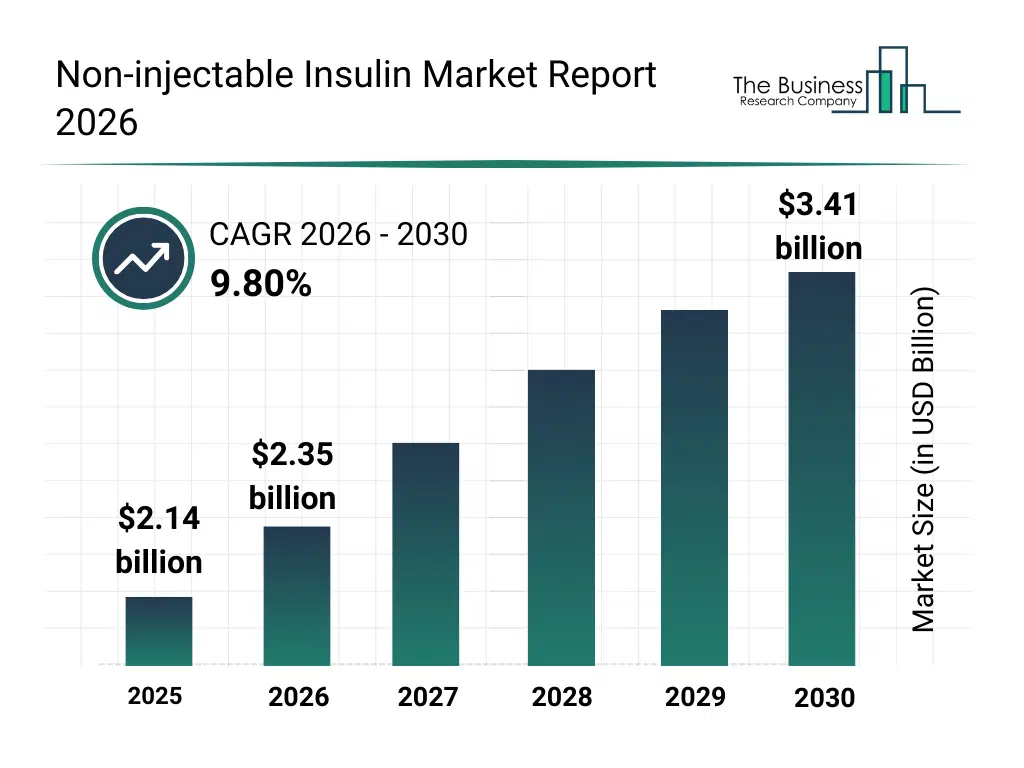
What Is The Non-injectable Insulin Market Size and Share 2026?
The non-injectable insulin market size has grown strongly in recent years. It will grow from $2.14 billion in 2025 to $2.35 billion in 2026 at a compound annual growth rate (CAGR) of 9.9%. The growth in the historic period can be attributed to increasing prevalence of diabetes, rising patient preference for non-injective therapies, advancements in insulin formulation, government initiatives promoting diabetes care, growing awareness about diabetes complications.What Is The Non-injectable Insulin Market Growth Forecast?
The non-injectable insulin market size is expected to see strong growth in the next few years. It will grow to $3.41 billion in 2030 at a compound annual growth rate (CAGR) of 9.8%. The growth in the forecast period can be attributed to technological advancements in oral and inhalable insulin, integration of digital health solutions, rising geriatric population, expansion of healthcare infrastructure in emerging markets, personalized medicine approaches for diabetes. Major trends in the forecast period include oral insulin delivery systems, pulmonary insulin inhalers, patient-centric diabetes management, non-invasive monitoring & dosing, formulation innovations for improved bioavailability.
Global Non-injectable Insulin Market Segmentation
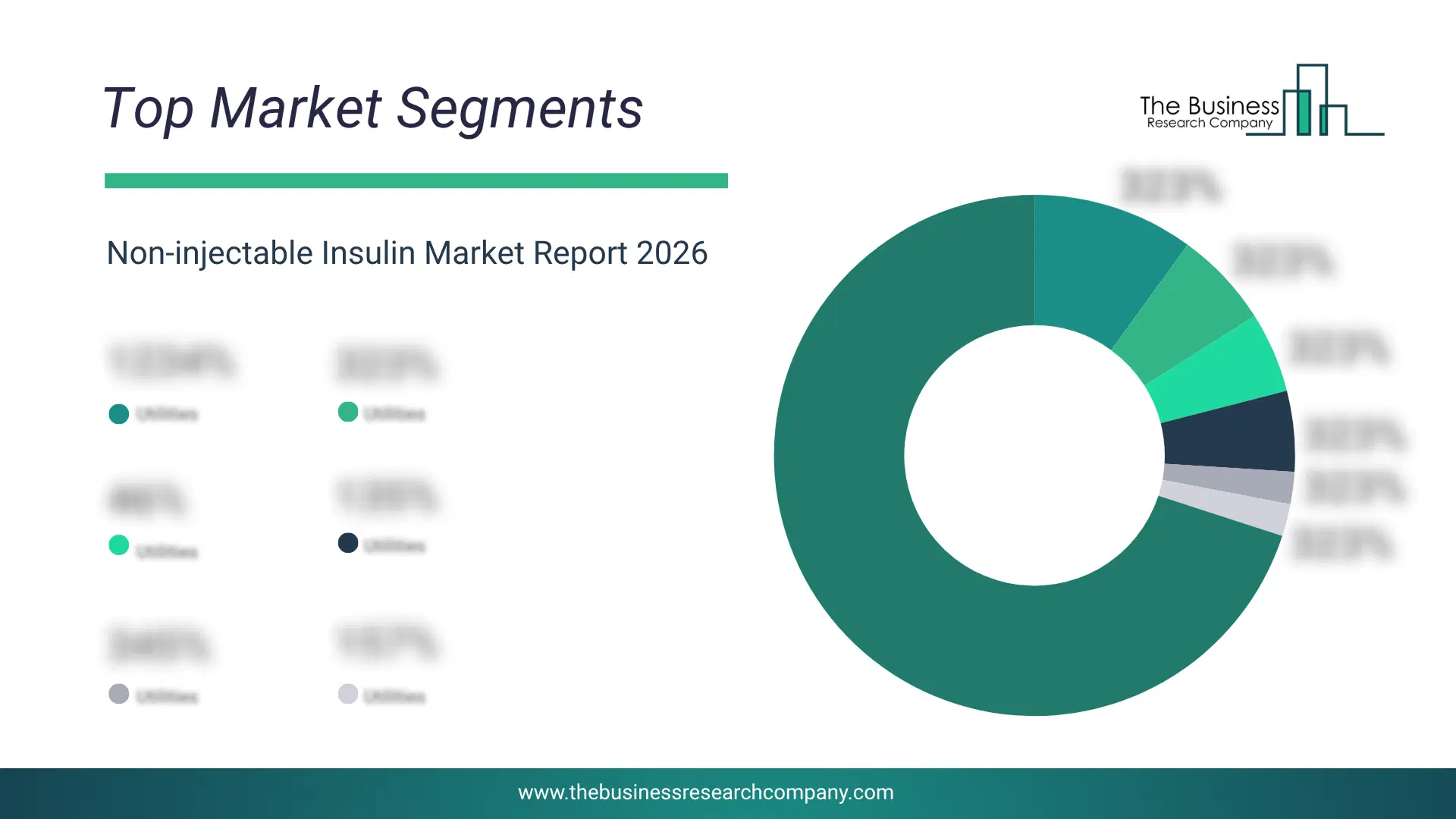
1) By Insulin Type: Oral Insulin, Inhaled Insulin, Nasal Insulin, Buccal Or Sublingual Insulin, Transdermal Insulin 2) By Product: Pills, Sprays, Other Products 3) By Distribution Channel: Hospital Pharmacies, Online Pharmacies, Drug Stores Subsegments: 1) By Oral Insulin: Oral Insulin Tablets, Oral Insulin Capsules, Enteric-Coated Oral Insulin, Nanoparticle-Based Oral Insulin 2) By Inhaled Insulin: Dry Powder Inhaled Insulin, Aerosolized Insulin, Pulmonary Insulin Delivery Systems 3) By Nasal Insulin: Nasal Spray Insulin, Nasal Gel Insulin, Nasal Powder Insulin 4) By Buccal Or Sublingual Insulin: Buccal Spray Insulin, Sublingual Insulin Films, Oral Mucosal Insulin Drops 5) By Transdermal Insulin: Insulin Patches, Microneedle-Free Transdermal Systems, Iontophoresis-Based Insulin DeliveryWhat Is The Driver Of The Non-injectable Insulin Market?
The rising obesity and diabetes issues are expected to propel the growth of the non-injectable insulin market going forward. Obesity is a condition characterized by excessive accumulation of body fat, usually resulting from an imbalance between energy intake (calories consumed) and energy expenditure, while diabetes mellitus, often referred to simply as diabetes, is a group of metabolic disorders characterized by high blood sugar levels over a prolonged period. Non-injectable insulin is used to treat diabetes and obesity, with the potential to improve management by addressing barriers to insulin therapy, offering potential weight management benefits, and providing more convenient treatment options. For instance, in June 2023, according to the Institute for Health Metrics and Evaluation, a US-based public health research institute, reported that over half a billion people globally were living with diabetes. This number is expected to more than double, reaching 1.3 billion people by 2050. Therefore, rising obesity and diabetes issues are driving the growth of the non-injectable insulin industry.Key Players In The Global Non-injectable Insulin Market
Major companies operating in the non-injectable insulin market are Novo Nordisk A/S, Eli Lilly and Company, Sanofi S.A., Pfizer Inc., Novartis AG, Merck & Co. Inc., AstraZeneca, Takeda Pharmaceutical, Abbott Laboratories, MannKind Corporation, Biocon Limited, Sun Pharmaceutical Industries Ltd., Dr. Reddy's Laboratories Limited, Cipla Limited, Lupin Pharmaceuticals, Glenmark Pharmaceuticals, Torrent Pharmaceuticals, Wockhardt Limited, Teva Pharmaceutical Industries Ltd., F. Hoffmann-La Roche Ltd.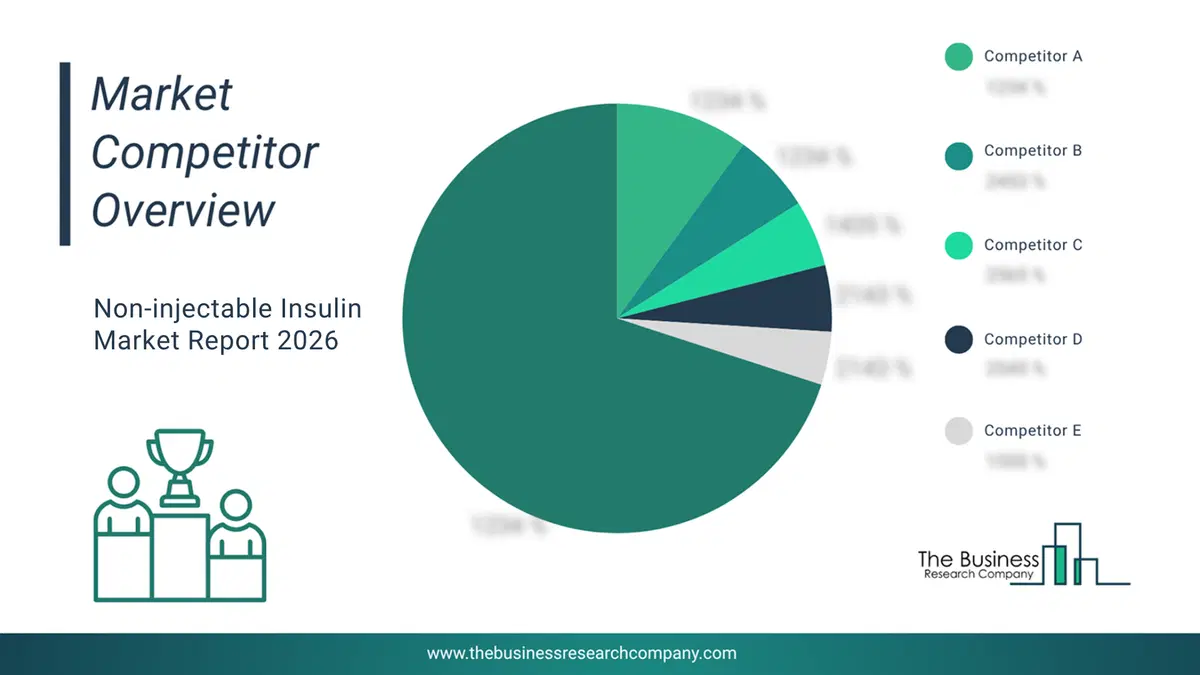
This chart is for illustrative purposes; the full report includes a detailed competitor analysis and comprehensive overview of the top 10 companies in the market.
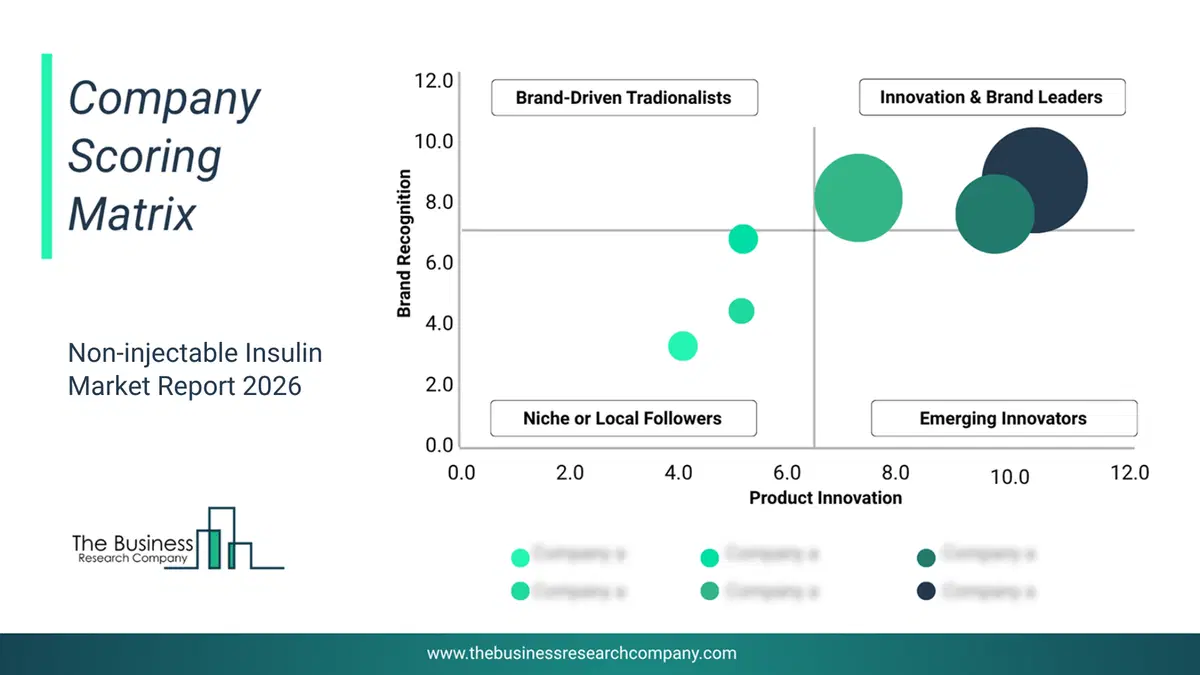
This chart maps companies by product innovation and brand strength, with bubble size indicating relative revenue, helping identify market leaders, challengers, and niche players. This is an illustrative chart; the full report provides a complete and accurate competitive analysis.
Global Non-injectable Insulin Market Trends and Insights
Major companies operating in the non-injectable insulin market are focusing on innovative advancements in drug delivery technologies, such as needle-free oral insulin spray, to improve the lives of people who manage their diabetes with multiple insulin injections. A needle-free insulin spray is a painless and needle-free alternative for regulating blood glucose, offering a convenient option as the doses can be sprayed directly into the mouth. For instance, in November 2023, NiedlFree Technologies, an India-based technology platform, introduced Ozulin, an oral insulin spray. This oral insulin spray is intended to provide a more user-friendly solution for individuals with diabetes, particularly those who may find traditional injectable insulin methods challenging. If approved, Ozulin has the potential to be a game-changer for diabetics, offering a more convenient and pain-free alternative to insulin injections.What Are Latest Mergers And Acquisitions In The Non-injectable Insulin Market?
In September 2023, Abbott Laboratories, a US-based medical device company, acquired Bigfoot Biomedical Inc. for an undisclosed amount. This acquisition combines Abbott's expertise in continuous glucose monitoring with Bigfoot's smart insulin management systems and strengthens Abbott's position as a leader in comprehensive diabetes care, aligning with the commitment to advancing connected solutions for precise diabetes management. Bigfoot Biomedical Inc., a US-based medical technology company, offers intelligent insulin administration systems for diabetes care.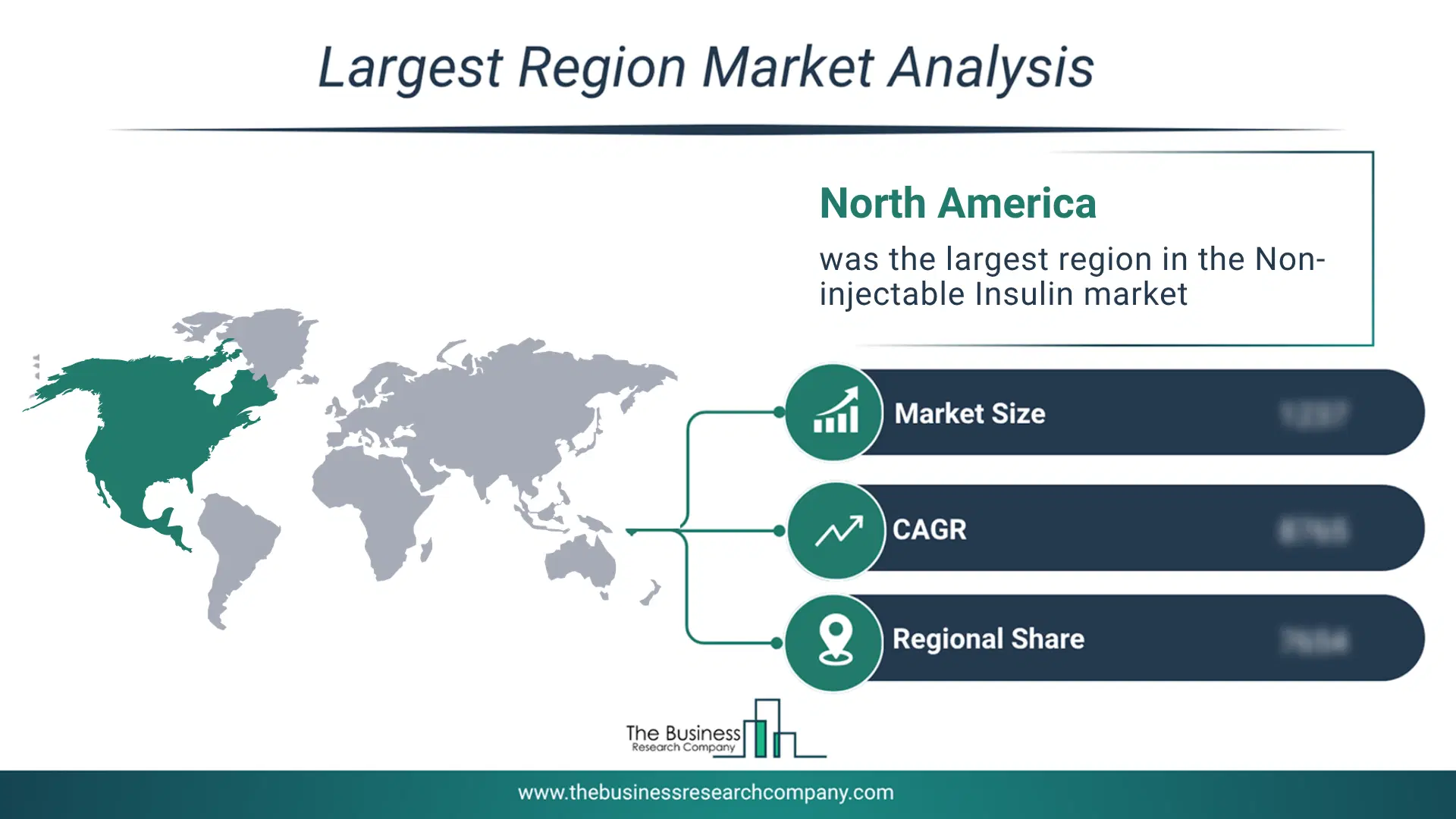
Regional Insights
North America was the largest region in the non-injectable insulin market in 2025. Asia-Pacific is expected to be the fastest-growing region in the forecast period. The regions covered in this market report are Asia-Pacific, South East Asia, Western Europe, Eastern Europe, North America, South America, Middle East, Africa. The countries covered in this market report are Australia, Brazil, China, France, Germany, India, Indonesia, Japan, Taiwan, Russia, South Korea, UK, USA, Canada, Italy, Spain.What Defines the Non-injectable Insulin Market?
The non-injectable insulin market consists of sales of oral insulin, inhaled insulin, nasal insulin, carrier agents, and stabilizers. Values in this market are ‘factory gate’ values, that is, the value of goods sold by the manufacturers or creators of the goods, whether to other entities (including downstream manufacturers, wholesalers, distributors, and retailers) or directly to end customers. The value of goods in this market includes related services sold by the creators of the goods.How is Market Value Defined and Measured?
The market value is defined as the revenues that enterprises gain from the sale of goods and/or services within the specified market and geography through sales, grants, or donations in terms of the currency (in USD unless otherwise specified). The revenues for a specified geography are consumption values that are revenues generated by organizations in the specified geography within the market, irrespective of where they are produced. It does not include revenues from resales along the supply chain, either further along the supply chain or as part of other products.
This chart presents market attractiveness based on a quantitative evaluation of growth, competition, strategic alignment, and risk, offering a clear view of opportunity areas for decision-making. This chart is for illustrative purposes; the full report contains the complete analysis.

This chart highlights the Total Addressable Market (TAM) by estimating the maximum revenue opportunity using an assumption-driven approach, supporting strategic planning and opportunity sizing across markets. The chart is illustrative; the full report provides a more comprehensive analysis.
What Key Data and Analysis Are Included in the Non-injectable Insulin Market Report 2026?
The non-injectable insulin market research report is one of a series of new reports from The Business Research Company that provides market statistics, including industry global market size, regional shares, competitors with the market share, detailed market segments, market trends and opportunities, and any further data you may need to thrive in the non-injectable insulin industry. The market research report delivers a complete perspective of everything you need, with an in-depth analysis of the current and future state of the industry.Non-injectable Insulin Market Report Forecast Analysis
| Report Attribute | Details |
|---|---|
| Market Size Value In 2026 | $2.35 billion |
| Revenue Forecast In 2030 | $3.41 billion |
| Growth Rate | CAGR of 9.9% from 2026 to 2030 |
| Base Year For Estimation | 2025 |
| Actual Estimates/Historical Data | 2020-2025 |
| Forecast Period | 2026 - 2030 |
| Market Representation | Revenue in USD Billion and CAGR from 2026 to 2030 |
| Segments Covered | Insulin Type, Product, Distribution Channel |
| Regional Scope | Asia-Pacific, Western Europe, Eastern Europe, North America, South America, Middle East, Africa |
| Country Scope | The countries covered in the report are Australia, Brazil, China, France, Germany, India, Indonesia, Japan, Taiwan, Russia, South Korea, UK, USA, Canada, Italy, Spain. |
| Key Companies Profiled | Novo Nordisk A/S, Eli Lilly and Company, Sanofi S.A., Pfizer Inc., Novartis AG, Merck & Co. Inc., AstraZeneca, Takeda Pharmaceutical, Abbott Laboratories, MannKind Corporation, Biocon Limited, Sun Pharmaceutical Industries Ltd., Dr. Reddy's Laboratories Limited, Cipla Limited, Lupin Pharmaceuticals, Glenmark Pharmaceuticals, Torrent Pharmaceuticals, Wockhardt Limited, Teva Pharmaceutical Industries Ltd., F. Hoffmann-La Roche Ltd. |
| Customization Scope | Request for Customization |
| Pricing And Purchase Options | Explore Purchase Options |