
Non-Ionic Surfactants Market Report 2026
Global Outlook – By Type (Fatty Alcohol Ethoxylates, Fatty Acid Ethoxylates, Alkyl Phenol Ethoxylates, Sorbitan Esters, Alkyl Polyglucosides, Polymer-Based Non-Ionic Surfactants), By Function (Cleaning Agent, Emulsifier, Wetting Agent, Dispersing Agent, Solubilizer), By Form (Liquid, Powder, Gel), By Substrate (Synthetic, Bio-Based), By Application (Household Detergents And Cleaners, Personal Care Products, Industrial Cleaning, Agriculture Chemicals, Textile Processing, Oil And Gas Applications, Pharmaceuticals) – Market Size, Trends, Strategies, and Forecast to 2030
Non-Ionic Surfactants Market Overview
• Non-Ionic Surfactants market size has reached to $25.1 billion in 2025 • Expected to grow to $36.13 billion in 2030 at a compound annual growth rate (CAGR) of 7.5% • Growth Driver: Personal Care And Cosmetics Industry Growth Driving The Market Expansion Due To Rising Demand For Mild, Stable, And Skin-Friendly Formulations • Market Trend: Advancements In Renewable-Resource-Based Surfactants Enhancing Product Performance And Biodegradability • North America was the largest region in 2025 and Asia-Pacific is the fastest growing region.What Is Covered Under Non-Ionic Surfactants Market?
Non-ionic surfactants are surface-active agents that do not ionize or carry any electrical charge when dissolved in water, making them stable across a wide range of conditions. They consist of both hydrophilic and hydrophobic components, enabling them to reduce surface tension and improve the interaction between different phases without forming ions. The main types of non-ionic surfactants include fatty alcohol ethoxylates, fatty acid ethoxylates, alkyl phenol ethoxylates, sorbitan esters, alkyl polyglucosides, and polymer-based non-ionic surfactants. Fatty alcohol ethoxylates refer to non-ionic surfactants produced by reacting fatty alcohols with ethylene oxide, offering excellent detergency, emulsification, wetting, and low-foaming properties across various industrial and consumer applications. These surfactants function as cleaning agents, emulsifiers, wetting agents, dispersing agents, and solubilizers and are available in different forms such as liquid, powder, and gel. They are substrated using synthetic and bio-based substrates and find application in household detergents and cleaners, personal care products, industrial cleaning, agriculture chemicals, textile processing, oil and gas applications, and pharmaceuticals.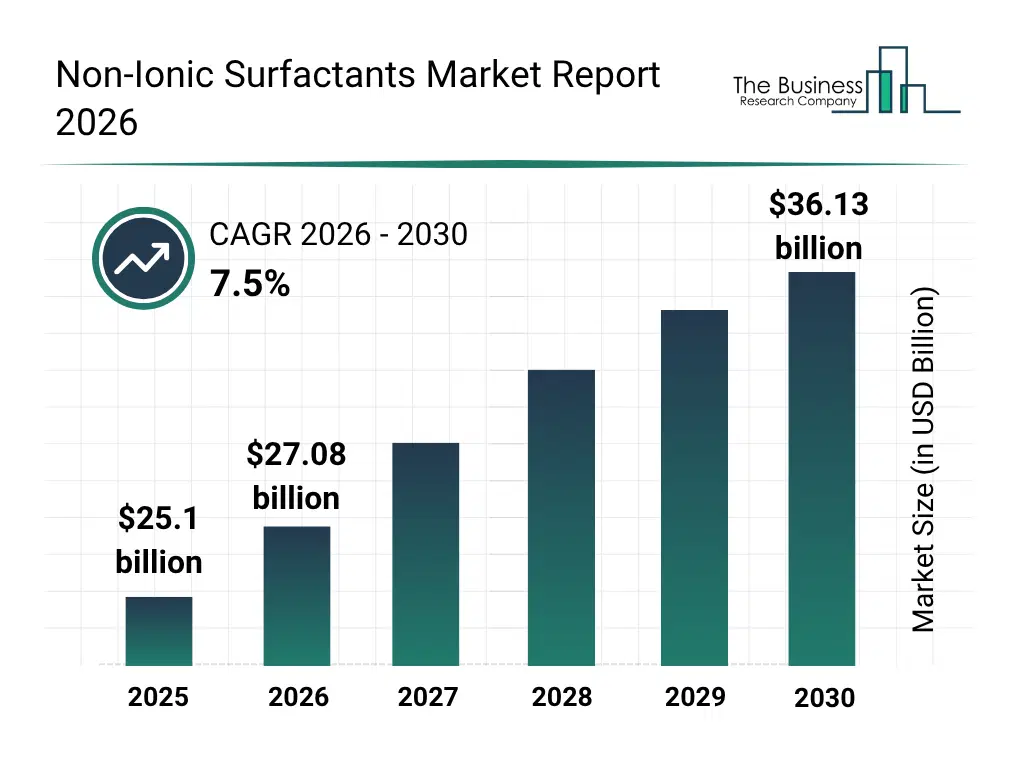
What Is The Non-Ionic Surfactants Market Size and Share 2026?
The non-ionic surfactants market size has grown strongly in recent years. It will grow from $25.1 billion in 2025 to $27.08 billion in 2026 at a compound annual growth rate (CAGR) of 7.9%. The growth in the historic period can be attributed to increasing demand for household cleaning products, rising consumption of personal care products, growing industrial cleaning activities, expanding textile processing applications, increasing use of surfactants in chemical formulations.What Is The Non-Ionic Surfactants Market Growth Forecast?
The non-ionic surfactants market size is expected to see strong growth in the next few years. It will grow to $36.13 billion in 2030 at a compound annual growth rate (CAGR) of 7.5%. The growth in the forecast period can be attributed to increasing demand for environmentally friendly surfactants, rising adoption of bio-based surfactant alternatives, growing applications in pharmaceutical formulations, increasing demand from emerging economies, expanding use in specialty chemical industries. Major trends in the forecast period include increasing demand for bio based non ionic surfactants, growing preference for mild and sustainable surfactant solutions, rising adoption of advanced surfactant formulations, increasing demand for high performance cleaning ingredients, expansion of specialty surfactant applications.
Global Non-Ionic Surfactants Market Segmentation
1) By Type: Fatty Alcohol Ethoxylates, Fatty Acid Ethoxylates, Alkyl Phenol Ethoxylates, Sorbitan Esters, Alkyl Polyglucosides, Polymer-Based Non-Ionic Surfactants 2) By Function: Cleaning Agent, Emulsifier, Wetting Agent, Dispersing Agent, Solubilizer 3) By Form: Liquid, Powder, Gel 4) By Substrate: Synthetic, Bio-Based 5) By Application: Household Detergents And Cleaners, Personal Care Products, Industrial Cleaning, Agriculture Chemicals, Textile Processing, Oil And Gas Applications, Pharmaceuticals Subsegments: 1) By Fatty Alcohol Ethoxylates: Linear Fatty Alcohol Ethoxylates, Branched Fatty Alcohol Ethoxylates, Low Ethoxylate Alcohols (1–5 Ethylene Oxide Units), Medium Ethoxylate Alcohols (6–10 Ethylene Oxide Units) 2) By Fatty Acid Ethoxylates: Oleic Acid Ethoxylates, Stearic Acid Ethoxylates, Lauric Acid Ethoxylates, Coconut Fatty Acid Ethoxylates 3) By Alkyl Phenol Ethoxylates: Nonylphenol Ethoxylates, Octylphenol Ethoxylates, Dodecylphenol Ethoxylates, Low Ethylene Oxide Alkyl Phenol Ethoxylates 4) By Sorbitan Esters: Sorbitan Monolaurate, Sorbitan Monopalmitate, Sorbitan Monostearate, Sorbitan Monooleate 5) By Alkyl Polyglucosides: Decyl Glucoside, Lauryl Glucoside, Coco Glucoside, Caprylyl Or Capryl Glucoside 6) By Polymer-Based Non-Ionic Surfactants: Block Copolymer Surfactants, Polyethylene Glycol-Based Surfactants, Polypropylene Glycol-Based SurfactantsWhat Is The Driver Of The Non-Ionic Surfactants Market?
The expansion of the personal care and cosmetics industry is expected to propel the growth of the non-ionic surfactants market going forward. The personal care and cosmetics industry is a sector that focuses on the manufacturing and sale of products used for personal hygiene, skincare, haircare, grooming, and enhancing appearance. The personal care and cosmetics industry is growing mainly due to rising consumer awareness of personal hygiene and appearance, driven by social media influence and changing lifestyle habits that increase demand for grooming and self-care products. Non-ionic surfactants help the personal care and cosmetics industry by acting as mild cleansing, emulsifying, and stabilizing agents that improve product texture, formulation stability, and skin compatibility without causing irritation. For instance, in December 2024, according to the Bureau of Labor Statistics, a US-based government agency, in 2023, expenditure on personal care products and services rose by 9.7%, while spending on personal insurance and pensions grew by 9.3%. Therefore, the expansion of the personal care and cosmetics industry is driving the growth of the non-ionic surfactants industry.Key Players In The Global Non-Ionic Surfactants Market
Major companies operating in the non-ionic surfactants market are BASF SE, Dow Inc., LG Chem Ltd., Wilmar International Limited, Evonik Industries AG, Kao Corporation, Arkema S.A., Syensqo SA, Huntsman Corporation, KL-Kepong Oleomas Sdn. Bhd., Lion Corporation, Stepan Company, Croda International Plc, Godrej Industries Limited, Innospec Inc., Pilot Chemical Company, Galaxy Surfactants Limited, India Glycols Limited, Nouryon Chemicals B.V., Clariant AG, Oleon NV, Sasol Limited, Emery Oleochemicals LLC, Ashland Inc., INEOS AG
This chart is for illustrative purposes; the full report includes a detailed competitor analysis and comprehensive overview of the top 10 companies in the market.
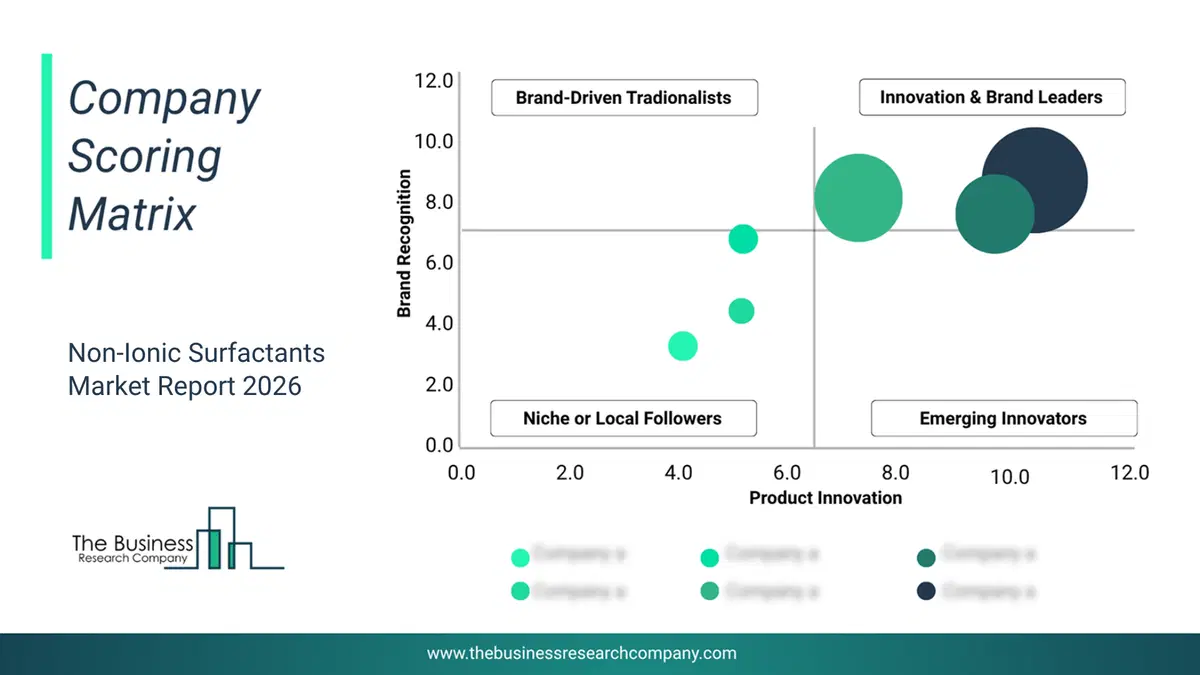
This chart maps companies by product innovation and brand strength, with bubble size indicating relative revenue, helping identify market leaders, challengers, and niche players. This is an illustrative chart; the full report provides a complete and accurate competitive analysis.
Global Non-Ionic Surfactants Market Trends and Insights
Major companies operating in the nonionic surfactants market are focusing on developing innovative solutions, such as bio-based surfactants, to enhance sustainability, reduce environmental impact, and meet stringent regulatory requirements while improving biodegradability and performance efficiency. Bio-based surfactants are environmentally friendly surface-active agents produced from renewable resources such as plants and microorganisms that offer an alternative to conventional petrochemical-based surfactants. For instance, in March 2026, Sironix Renewables Inc., a US-based chemical company, launched Furasoft-LFS and Furasoft-SF, two bio-based surfactants for personal care. It is designed to enhance mildness, biodegradability, and high-performance cleansing efficiency in personal care formulations. It also strengthens the company’s bio-based surfactant portfolio by supporting sustainable ingredient sourcing and reducing dependence on petrochemical-derived raw materials in cosmetic and personal care applications.What Are Latest Mergers And Acquisitions In The Non-Ionic Surfactants Market?
In March 2026, BASF SE, a Germany-based chemicals company, partnered with Hannong Chemicals Inc. to establish and expand a joint venture for the production of non-ionic surfactants in Seosan, South Korea. With this partnership, the companies aim to enhance non-ionic surfactant production capacity, improve supply reliability in the Asia-Pacific region, and strengthen their position in the specialty chemicals market. Hannong Chemicals Inc. is a South Korea-based manufacturing company that produces nonionic surfactants.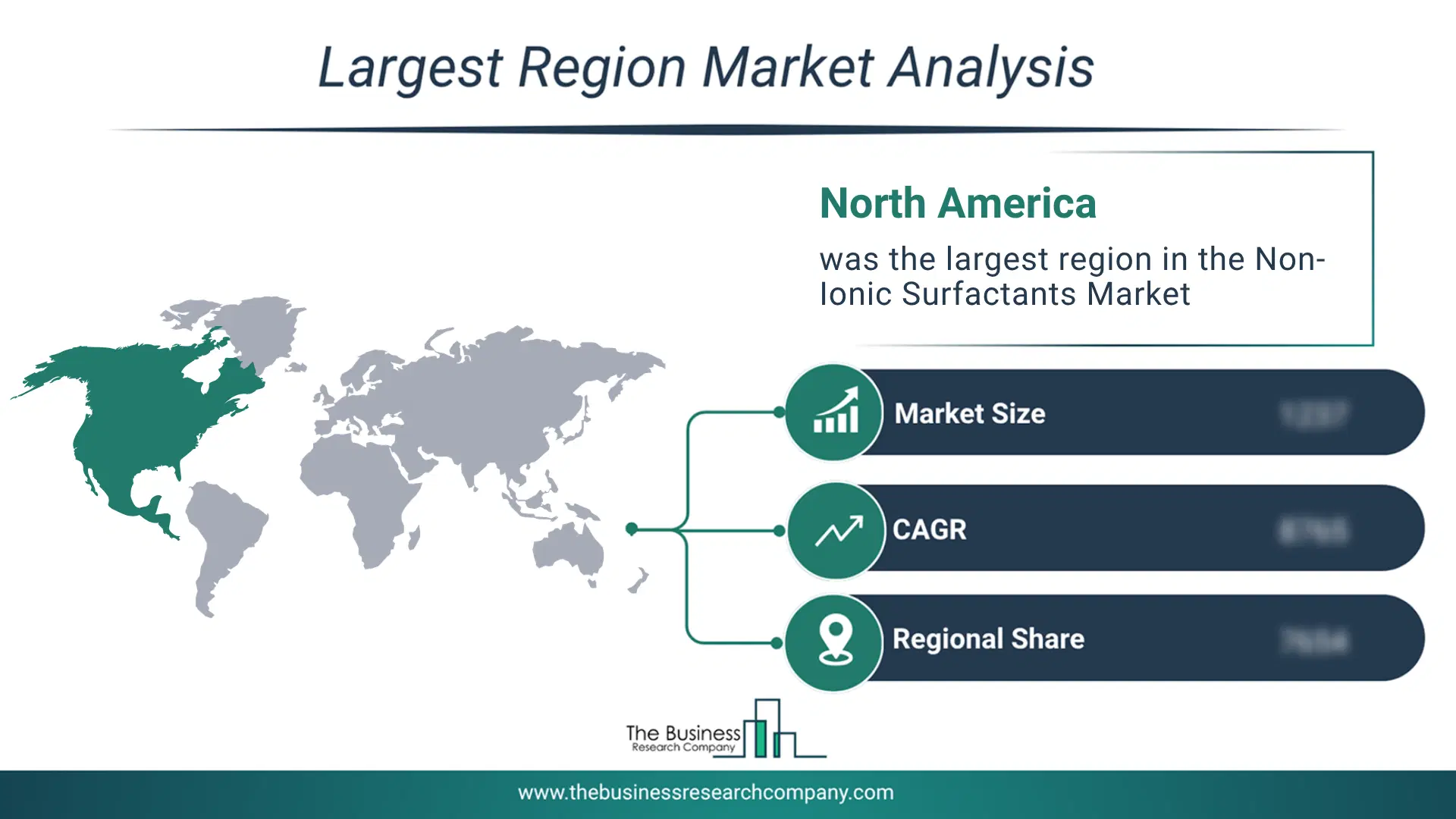
Regional Outlook
North America was the largest region in the non-ionic surfactants market in 2025. Asia-Pacific is expected to be the fastest-growing region in the forecast period. The regions covered in this market report are Asia-Pacific, South East Asia, Western Europe, Eastern Europe, North America, South America, Middle East, Africa. The countries covered in this market report are Australia, Brazil, China, France, Germany, India, Indonesia, Japan, Taiwan, Russia, South Korea, UK, USA, Canada, Italy, Spain.What Defines the Non-Ionic Surfactants Market?
The non-ionic surfactants market consists of sales of fatty amine ethoxylates, ethoxylated castor oil, alkanolamides, and sucrose esters. Values in this market are ‘factory gate’ values, that is, the value of goods sold by the manufacturers or creators of the goods, whether to other entities (including downstream manufacturers, wholesalers, distributors, and retailers) or directly to end customers. The value of goods in this market includes related services sold by the creators of the goods.How is Market Value Defined and Measured?
The market value is defined as the revenues that enterprises gain from the sale of goods and/or services within the specified market and geography through sales, grants, or donations in terms of the currency (in USD unless otherwise specified). The revenues for a specified geography are consumption values that are revenues generated by organizations in the specified geography within the market, irrespective of where they are produced. It does not include revenues from resales along the supply chain, either further along the supply chain or as part of other products.
This chart presents market attractiveness based on a quantitative evaluation of growth, competition, strategic alignment, and risk, offering a clear view of opportunity areas for decision-making. This chart is for illustrative purposes; the full report contains the complete analysis.

This chart highlights the Total Addressable Market (TAM) by estimating the maximum revenue opportunity using an assumption-driven approach, supporting strategic planning and opportunity sizing across markets. The chart is illustrative; the full report provides a more comprehensive analysis.
What Key Data and Analysis Are Included in the Non-Ionic Surfactants Market Report 2026?
The non-ionic surfactants market research report is one of a series of new reports from The Business Research Company that provides market statistics, including industry global market size, regional shares, competitors with the market share, detailed market segments, market trends and opportunities, and any further data you may need to thrive in the non-ionic surfactants industry. The market research report delivers a complete perspective of everything you need, with an in-depth analysis of the current and future state of the industry.Non-Ionic Surfactants Market Report Forecast Analysis
| Report Attribute | Details |
|---|---|
| Market Size Value In 2026 | $27.08 billion |
| Revenue Forecast In 2030 | $36.13 billion |
| Growth Rate | CAGR of 7.5% from 2026 to 2030 |
| Base Year For Estimation | 2025 |
| Actual Estimates/Historical Data | 2020-2025 |
| Forecast Period | 2026 - 2030 |
| Market Representation | Revenue in USD Billion and CAGR from 2026 to 2030 |
| Segments Covered | Type, Function, Form, Substrate, Application |
| Regional Scope | Asia-Pacific, Western Europe, Eastern Europe, North America, South America, Middle East, Africa |
| Country Scope | The countries covered in the report are Australia, Brazil, China, France, Germany, India, Indonesia, Japan, Taiwan, Russia, South Korea, UK, USA, Canada, Italy, Spain. |
| Key Companies Profiled | BASF SE, Dow Inc., LG Chem Ltd., Wilmar International Limited, Evonik Industries AG, Kao Corporation, Arkema S.A., Syensqo SA, Huntsman Corporation, KL-Kepong Oleomas Sdn. Bhd., Lion Corporation, Stepan Company, Croda International Plc, Godrej Industries Limited, Innospec Inc., Pilot Chemical Company, Galaxy Surfactants Limited, India Glycols Limited, Nouryon Chemicals B.V., Clariant AG, Oleon NV, Sasol Limited, Emery Oleochemicals LLC, Ashland Inc., INEOS AG |
| Customization Scope | Request for Customization |
| Pricing And Purchase Options | Explore Purchase Options |