
Non-Lethal Biochemical Weapons Market Report 2026
Global Outlook – By Product Type (Directed Energy, Direct Contact), By Operation Type (Defensive, Offensive), By End User (Military Forces, Law Enforcement Agencies) – Market Size, Trends, Strategies, and Forecast to 2030
Non-Lethal Biochemical Weapons Market Overview
• Non-Lethal Biochemical Weapons market size has reached to $2.32 billion in 2025 • Expected to grow to $3.41 billion in 2030 at a compound annual growth rate (CAGR) of 7.9% • Growth Driver: Surge In Military Expenditure Boosts Growth In Non-Lethal Biochemical Weapons Market • Market Trend: Advancements In Non-Lethal Biochemical Weapons Transform Security Measures • North America was the largest region in 2025.What Is Covered Under Non-Lethal Biochemical Weapons Market?
Non-lethal biochemical weapons refer to weapons, designed to incapacitate persons or equipment without causing injuries. These are designed to disable persons or equipment without hurting anyone. The main product types of the non-lethal biochemical weapons include directed energy and direct contact. Directed energy refers to non-lethal biochemical weapon technologies that use controlled energy emissions or dispersal mechanisms to temporarily incapacitate targets by affecting biological or sensory functions without causing permanent harm, enabling forces to manage threats while minimizing fatalities. These systems are further categorized by operation type into defensive and offensive uses, and they are used by several end users such as military forces and law enforcement agencies.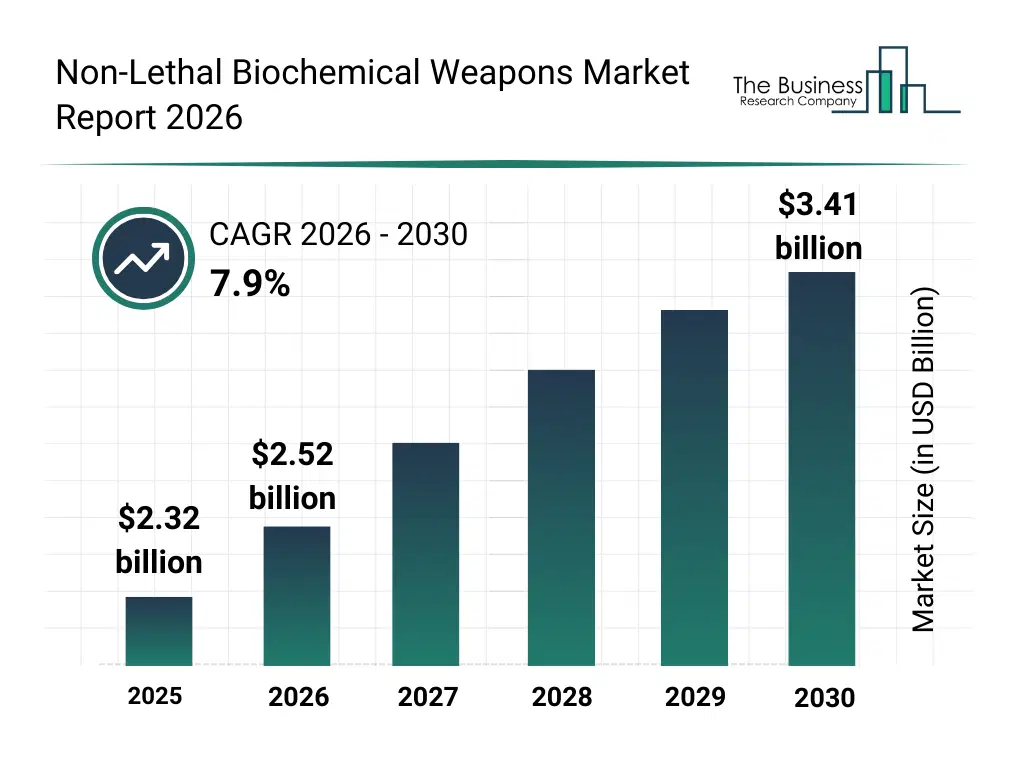
What Is The Non-Lethal Biochemical Weapons Market Size and Share 2026?
The non-lethal biochemical weapons market size has grown strongly in recent years. It will grow from $2.32 billion in 2025 to $2.52 billion in 2026 at a compound annual growth rate (CAGR) of 8.9%. The growth in the historic period can be attributed to increasing demand for incapacitating systems supporting crowd control and peacekeeping operations, early development of scent-based agents designed to disrupt hostile personnel without causing injury, adoption of acoustic deterrent devices by military and law enforcement agencies, rising need for non-lethal options to minimize collateral damage in urban environments, growth in research on biochemical mechanisms enabling temporary incapacitation.What Is The Non-Lethal Biochemical Weapons Market Growth Forecast?
The non-lethal biochemical weapons market size is expected to see strong growth in the next few years. It will grow to $3.41 billion in 2030 at a compound annual growth rate (CAGR) of 7.9%. The growth in the forecast period can be attributed to growing investment in advanced non-lethal technologies enhancing precision and controllability, increasing adoption of directed acoustic systems for perimeter security and area denial, rising requirement for scalable non-lethal solutions in asymmetric and humanitarian missions, development of next-generation biochemical formulations with improved safety and effectiveness, expanding integration of non-lethal capabilities into military and law enforcement modernization programs. Major trends in the forecast period include growth in scent-based (olfactory) crowd-management technologies, rising deployment of acoustic and directed-energy deterrent systems for perimeter security, integration of sensors and telemetry for remote monitoring and effect control, demand for modular, non-lethal payloads for unmanned platforms (uav/ugv integration), emphasis on legal-compliance, humane-use features, and traceability in product design.
Global Non-Lethal Biochemical Weapons Market Segmentation
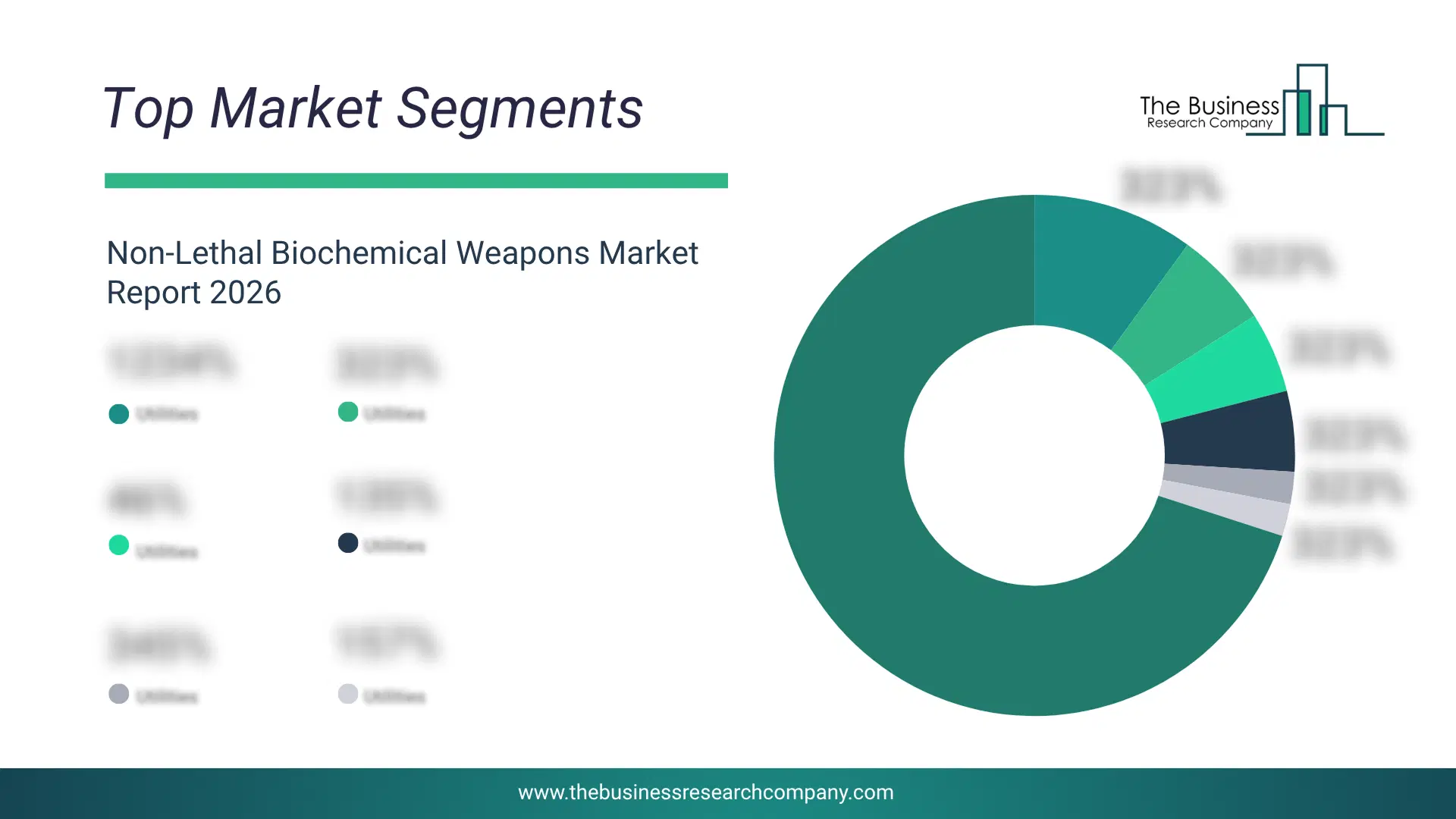
1) By Product Type: Directed Energy, Direct Contact 2) By Operation Type: Defensive, Offensive 3) By End User: Military Forces, Law Enforcement Agencies Subsegments: 1) By Directed Energy: Laser Weapons, Microwave Weapons, Acoustic Weapons 2) By Direct Contact: Chemical Agents, Riot Control AgentsWhat Is Driver Of The Non-Lethal Biochemical Weapons Market?
The terrorist attacks are expected to propel the growth of the non-lethal biochemical weapons market going forward. Terrorist attacks are deliberate, violent acts aimed at instilling fear, often involving the use of force or threats against civilians or governments, to advance political, ideological, or religious goals. Non-lethal biochemical weapons are used in terrorist attacks to incapacitate or create panic rather than cause immediate fatalities that pose a threat to public safety and security. For instance, in September 2025, according to the Home Office, a UK government department, in the year ending 30 June 2025, 83 people were prosecuted for terrorism-related offenses, an increase of five compared to the year ending 30 June 2024. Therefore, possible terrorist attacks are driving the non-lethal biochemical weapons industry.Key Players In The Global Non-Lethal Biochemical Weapons Market
Major companies operating in the non-lethal biochemical weapons market are Lamperd Less Lethal Inc., BAE Systems Inc., QinetiqGroup Inc., General Dynamics Corporation, Raytheon Company, Chemring Group plc, Textron Systems Corp., ALS Less-Lethal Systems Inc., ASP Inc., Combined Systems Inc., Condor Non-Lethal Technologies, ISPRA by Ei Ltd., Rheinmentall AG, Safariland LLC, Zarc International Inc., Genasys Inc., Axon Enterprise Inc., Bruzer Less Lethal, PACEM Solutions International, Mace Security International Inc., Fabrique Nationale Herstal, Mission Less Lethal Technologies, NonLethal Technologies Inc., Herstal SA, PepperBall Technologies Inc., AMTEC Less-Lethal Systems Inc., Byrna Technologies Inc., UTS United Tactical Systems LLC, Fiocchi Munizioni S.p.A., RUAG International Holding Ltd.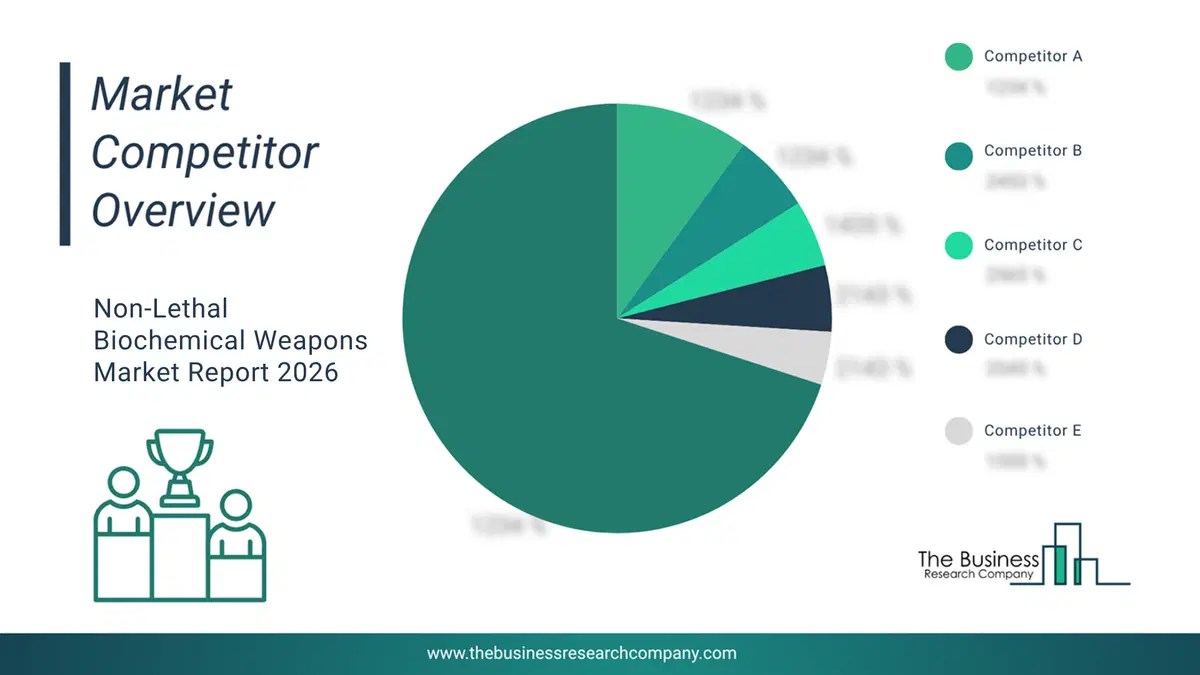
This chart is for illustrative purposes; the full report includes a detailed competitor analysis and comprehensive overview of the top 10 companies in the market.
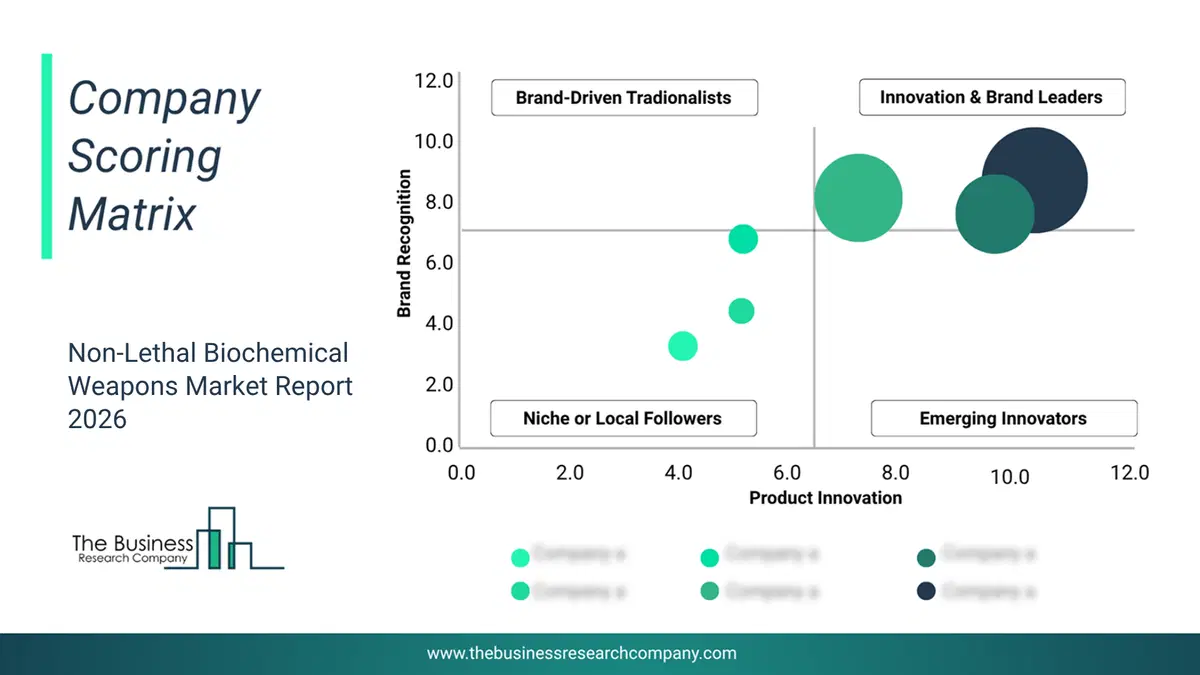
This chart maps companies by product innovation and brand strength, with bubble size indicating relative revenue, helping identify market leaders, challengers, and niche players. This is an illustrative chart; the full report provides a complete and accurate competitive analysis.
Global Non-Lethal Biochemical Weapons Market Trends and Insights
Major companies operating in the non-lethal biochemical weapons market focus on introducing non-lethal pepper bullet guns to enhance crowd control measures and provide law enforcement with safer options for subduing suspects. Non-lethal pepper bullet gun refers to a type of firearm or launcher that is designed to fire projectiles filled with a pepper-based irritant, such as oleoresin capsicum (OC), which is derived from hot peppers. For instance, in March 2023, Guard Dog Security, a US-based Company, launched a non-lethal pepper bullet gun. The system is capable of delivering projectiles accurately at distances of up to 150 feet, allowing users to maintain a safe distance from potential threats. This non-lethal gun can fire multiple rounds without needing to reload frequently, enhancing its utility in dynamic situations. It features a quick puncture CO2 system that allows for rapid firing and easy reloading, ensuring that users can respond swiftly to incidents.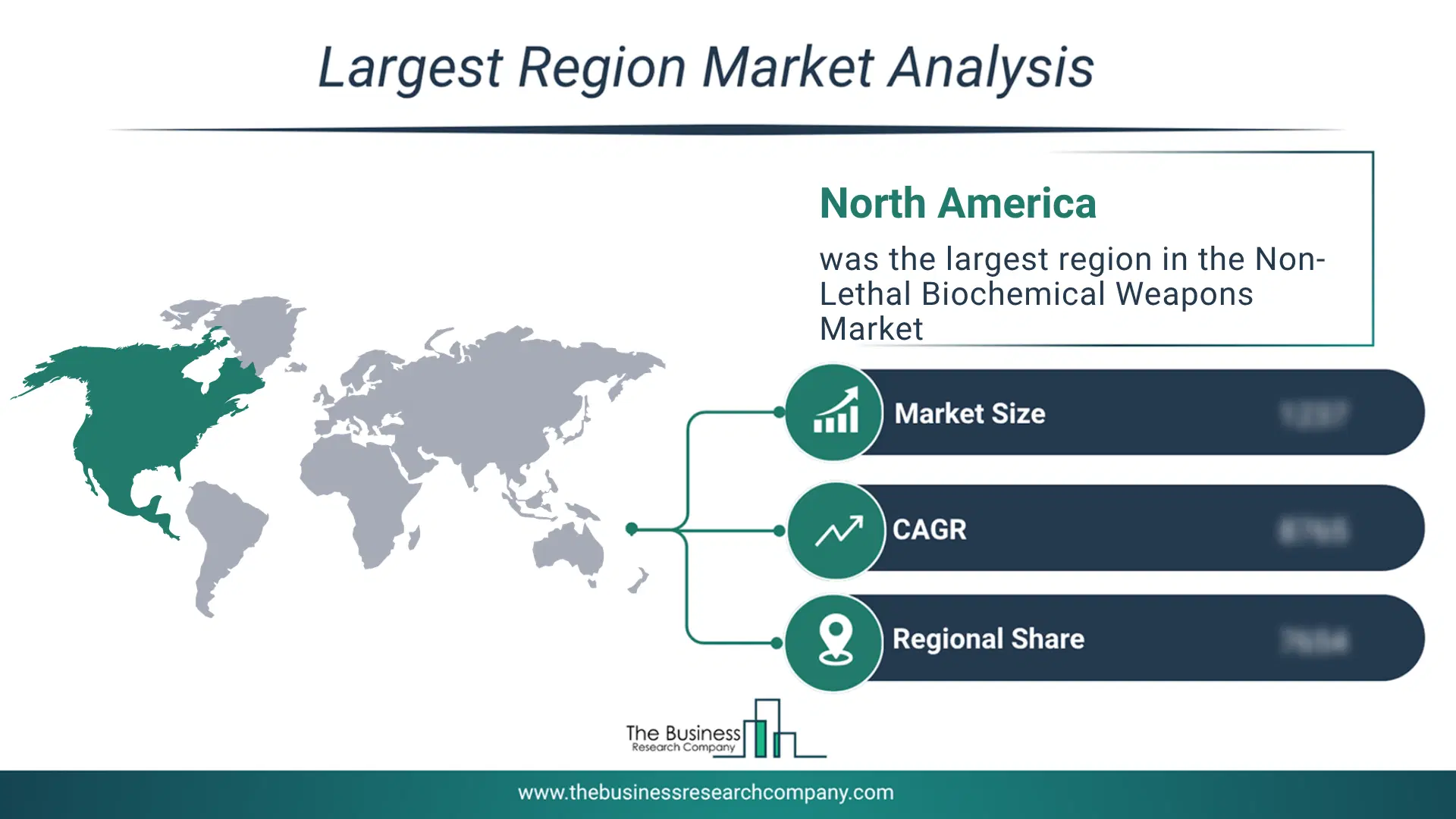
Regional Insights
North America was the largest region in the non-lethal biochemical weapons market in 2025. The regions covered in this market report are Asia-Pacific, South East Asia, Western Europe, Eastern Europe, North America, South America, Middle East, Africa. The countries covered in this market report are Australia, Brazil, China, France, Germany, India, Indonesia, Japan, Taiwan, Russia, South Korea, UK, USA, Canada, Italy, SpainWhat Defines the Non-Lethal Biochemical Weapons Market?
The non-lethal biochemical weapons market consists of sales of scent-based weapons and acoustic weapons. Values in this market are ‘factory gate’ values, that is the value of goods sold by the manufacturers or creators of the goods, whether to other entities (including downstream manufacturers, wholesalers, distributors, and retailers) or directly to end customers. The value of goods in this market includes related services sold by the creators of the goods.How is Market Value Defined and Measured?
The market value is defined as the revenues that enterprises gain from the sale of goods and/or services within the specified market and geography through sales, grants, or donations in terms of the currency (in USD unless otherwise specified). The revenues for a specified geography are consumption values that are revenues generated by organizations in the specified geography within the market, irrespective of where they are produced. It does not include revenues from resales along the supply chain, either further along the supply chain or as part of other products.
This chart presents market attractiveness based on a quantitative evaluation of growth, competition, strategic alignment, and risk, offering a clear view of opportunity areas for decision-making. This chart is for illustrative purposes; the full report contains the complete analysis.

This chart highlights the Total Addressable Market (TAM) by estimating the maximum revenue opportunity using an assumption-driven approach, supporting strategic planning and opportunity sizing across markets. The chart is illustrative; the full report provides a more comprehensive analysis.
What Key Data and Analysis Are Included in the Non-Lethal Biochemical Weapons Market Report 2026?
The non-lethal biochemical weapons market research report is one of a series of new reports from The Business Research Company that provides market statistics, including industry global market size, regional shares, competitors with the market share, detailed market segments, market trends and opportunities, and any further data you may need to thrive in the non-lethal biochemical weapons industry. The market research report delivers a complete perspective of everything you need, with an in-depth analysis of the current and future state of the industry.Non-Lethal Biochemical Weapons Market Report Forecast Analysis
| Report Attribute | Details |
|---|---|
| Market Size Value In 2026 | $2.52 billion |
| Revenue Forecast In 2030 | $3.41 billion |
| Growth Rate | CAGR of 7.9% from 2026 to 2030 |
| Base Year For Estimation | 2025 |
| Actual Estimates/Historical Data | 2020-2025 |
| Forecast Period | 2026 - 2030 |
| Market Representation | Revenue in USD Billion and CAGR from 2026 to 2030 |
| Segments Covered | Product Type, Operation Type, End User |
| Regional Scope | Asia-Pacific, Western Europe, Eastern Europe, North America, South America, Middle East, Africa |
| Country Scope | The countries covered in the non-lethal biochemical weapons market report are Australia, Brazil, China, France, Germany, India, Indonesia, Japan, Taiwan, Russia, South Korea, UK, USA, Canada, Italy, Spain |
| Key Companies Profiled | Lamperd Less Lethal Inc., BAE Systems Inc., QinetiqGroup Inc., General Dynamics Corporation, Raytheon Company, Chemring Group plc, Textron Systems Corp., ALS Less-Lethal Systems Inc., ASP Inc., Combined Systems Inc., Condor Non-Lethal Technologies, ISPRA by Ei Ltd., Rheinmentall AG, Safariland LLC, Zarc International Inc., Genasys Inc., Axon Enterprise Inc., Bruzer Less Lethal, PACEM Solutions International, Mace Security International Inc., Fabrique Nationale Herstal, Mission Less Lethal Technologies, NonLethal Technologies Inc., Herstal SA, PepperBall Technologies Inc., AMTEC Less-Lethal Systems Inc., Byrna Technologies Inc., UTS United Tactical Systems LLC, Fiocchi Munizioni S.p.A., RUAG International Holding Ltd. |
| Customization Scope | Request for Customization |
| Pricing And Purchase Options | Explore Purchase Options |