
Non-Marking Forklift Tires Market Report 2026
Global Outlook – By Product Type (Solid Tires, Pneumatic Tires, Cushion Tires, Other Product Types ), By Tire Material (Rubber, Polyurethane, Other Tire Materials ), By Tire Size (Small, Medium, Large ), By Sales Channel (Original Equipment Manufacturer (OEM) Sales, Aftermarket Sales, Direct Sales, Distributor And Dealer Sales, Other Sales Channels ), By Application (Warehousing, Manufacturing, Retail, Logistics, Food And Beverage, Pharmaceuticals, Other Applications ) – Market Size, Trends, Strategies, and Forecast to 2030
Non-Marking Forklift Tires Market Overview
• Non-Marking Forklift Tires market size has reached to $1.44 billion in 2025 • Expected to grow to $2.01 billion in 2030 at a compound annual growth rate (CAGR) of 6.9% • Growth Driver: Growth In Logistics Operations Driving The Market Growth Due To Expansion Of Warehousing And Material Handling Activities • Market Trend: Advanced Solid Non-Marking Forklift Tire Innovations Enhance Durability And Performance In Heavy-Duty Industrial Applications • North America was the largest region in 2025 and Asia-Pacific is the fastest growing region.What Is Covered Under Non-Marking Forklift Tires Market?
Non-marking forklift Tires are specially engineered industrial tires that eliminate black scuff marks and rubber stains on flooring during material handling activities. They are manufactured using light-colored rubber compounds without carbon black, the component that typically causes surface discoloration. Non-marking forklift tires are ideal for applications where maintaining cleanliness and protecting floor aesthetics is essential. The main product types of non-marking forklift tires include solid tires, pneumatic tires, cushion tires, and other product types. Solid tires are designed for durability and long service life, providing puncture resistance and consistent performance for industrial and warehouse operations. They are made of rubber, polyurethane, and other tire materials and are available in small, medium, and large sizes. They are sold through original equipment manufacturer (OEM) sales, aftermarket sales, direct sales, distributor and dealer sales, and other sales channels and they are used for various applications includes warehousing, manufacturing, retail, logistics, food and beverage, pharmaceuticals, and other applications.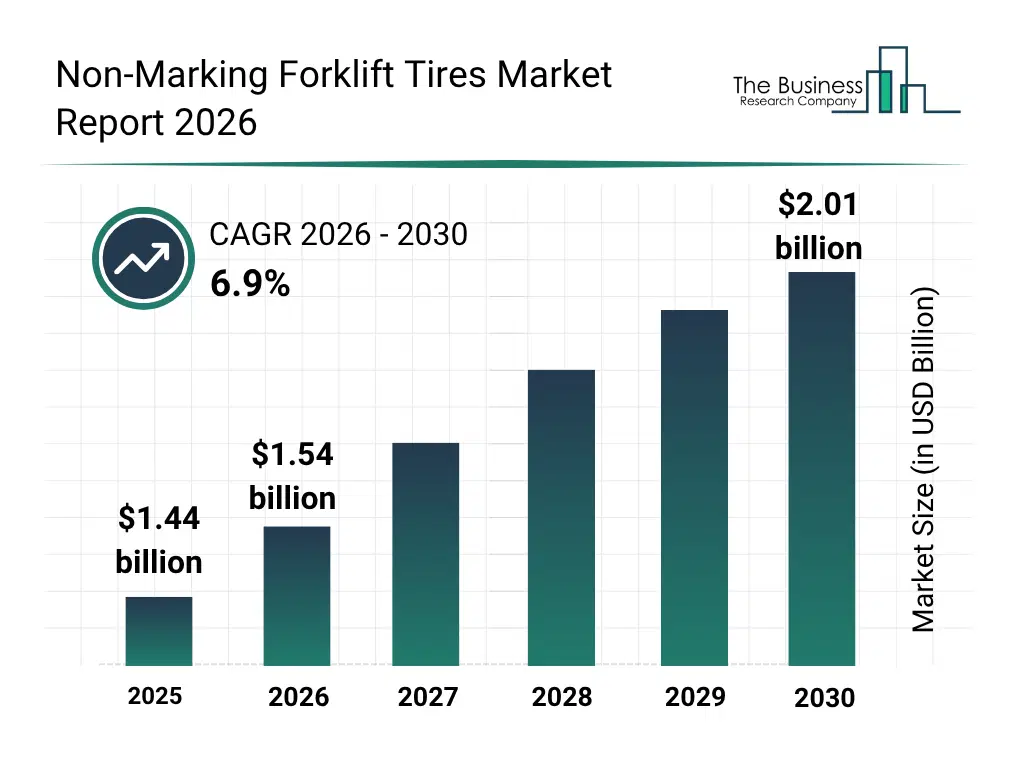
What Is The Non-Marking Forklift Tires Market Size and Share 2026?
The non-marking forklift tires market size has grown strongly in recent years. It will grow from $1.44 billion in 2025 to $1.54 billion in 2026 at a compound annual growth rate (CAGR) of 6.6%. The growth in the historic period can be attributed to increasing warehouse and logistics operations, growth of retail and manufacturing sectors, rising forklift fleet sizes, demand for safer material handling solutions, expansion of industrial infrastructure.What Is The Non-Marking Forklift Tires Market Growth Forecast?
The non-marking forklift tires market size is expected to see strong growth in the next few years. It will grow to $2.01 billion by 2030 at a compound annual growth rate (CAGR) of 6.9%. The growth in the forecast period can be attributed to adoption of automation in warehouses and manufacturing, increasing preference for floor-protective non-marking tires, growth in e-commerce and retail logistics, rising investments in clean and hygienic facilities, technological advancements in tire materials and customization. Major trends in the forecast period include rising demand for non-marking forklift tires in clean environments, increasing adoption of polyurethane and hybrid tire materials, growth in warehouse automation and material handling efficiency, focus on floor protection and aesthetic preservation, expansion of aftermarket sales and tire customization options.
Global Non-Marking Forklift Tires Market Segmentation
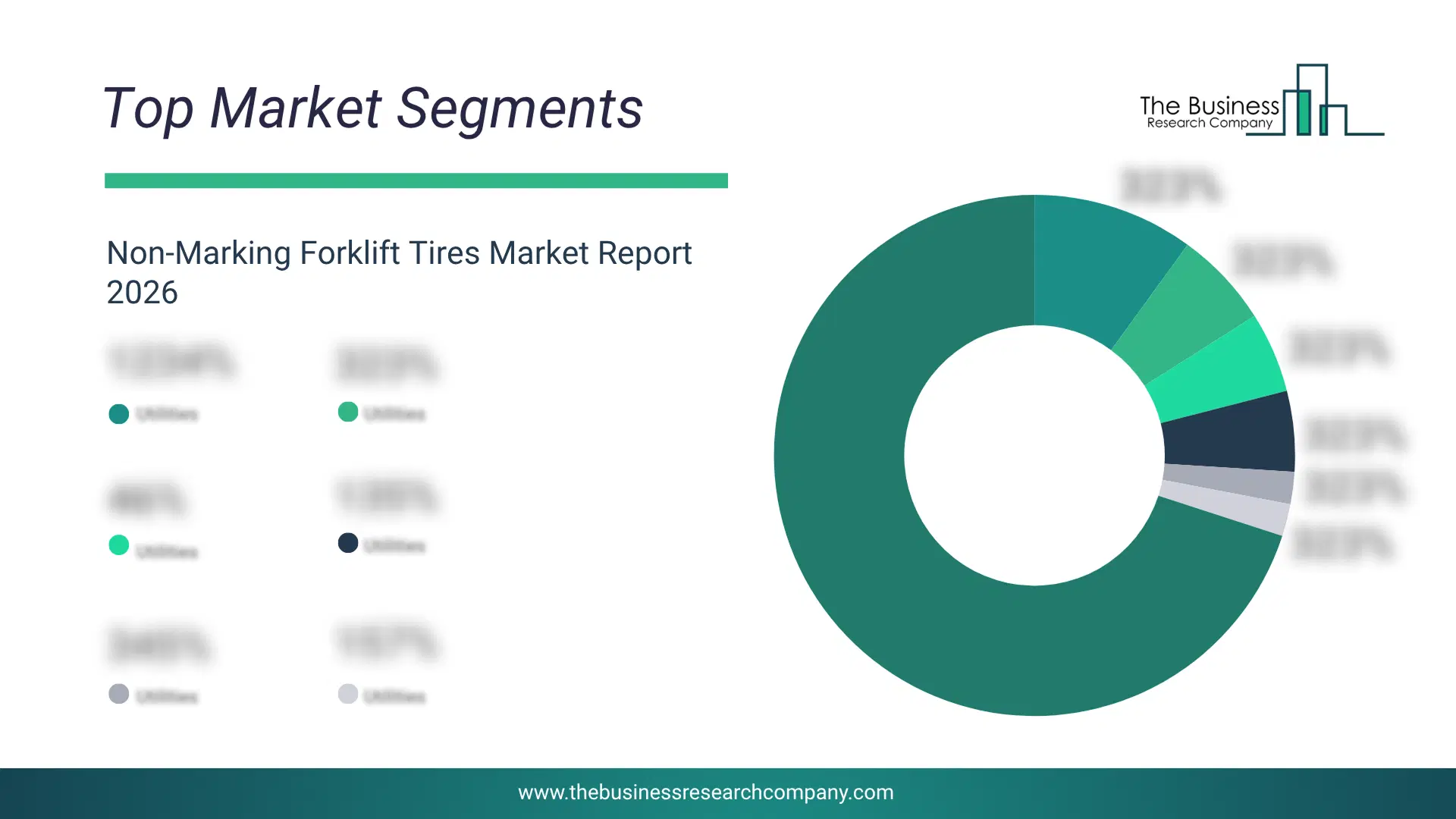
1) By Product Type: Solid Tires, Pneumatic Tires, Cushion Tires, Other Product Types 2) By Tire Material: Rubber, Polyurethane, Other Tire Materials 3) By Tire Size: Small, Medium, Large 4) By Sales Channel: Original Equipment Manufacturer (OEM) Sales, Aftermarket Sales, Direct Sales, Distributor And Dealer Sales, Other Sales Channels 5) By Application: Warehousing, Manufacturing, Retail, Logistics, Food And Beverage, Pharmaceuticals, Other Applications Subsegments: 1) By Solid Tires: Solid Rubber Tires, Solid Polyurethane Tires, Solid Composite Tires, Other Solid Variants 2) By Pneumatic Tires: Air Filled Pneumatic Tires, Foam Filled Pneumatic Tires, Tubeless Pneumatic Tires, Other Pneumatic Variants 3) By Cushion Tires: Smooth Cushion Tires, Treaded Cushion Tires, High Resilience Cushion Tires, Other Cushion Variants 4) By Other Product Types: Rubber And Polyurethane Blend Tires, Hybrid Non Marking Tires, Custom Engineered Non Marking Tires, Other Specialized VariantsWhat Are The Drivers Of The Non-Marking Forklift Tires Market?
The growth in logistics operations is expected to propel the growth of the non-marking forklift tires market going forward. Logistics operations refer to the coordinated processes of storing, handling, and transporting goods across warehouses, distribution centers, and supply chain networks. The surge in logistics operations due to the rapid expansion of e-commerce is primarily driven by rising online order volumes, which require expanded warehousing capacity and advanced fulfillment infrastructure to meet growing consumer delivery expectations. The rise in logistics activities drives greater use of forklifts across distribution centers and storage facilities, thereby increasing the need for non-marking tires that protect floor surfaces and meet hygiene standards in sensitive logistics environments. For instance, in February 2024, according to the Bureau of Transportation Statistics (BTS), a U.S.-based government agency under the Department of Transportation that monitors and reports national transportation trends, the U.S. Freight Transportation Services Index (TSI) rose from 136.6 in December 2022 to 139.1 in December 2023, reflecting an increase of 1.8%. Therefore, growth in logistics operations is driving the growth of the non-marking forklift tires industry. The increasing use of automated robotics in warehouses is expected to propel the growth of the non-marking forklift tires market going forward. Automated robotics in warehouses refers to the deployment of self-operating machines such as autonomous mobile robots (AMRs) and automated guided vehicles (AGVs) to perform material handling tasks such as picking, sorting, and transportation with minimal human involvement. The growing adoption of automated robotics in warehouses is largely driven by the rapid expansion of e-commerce, which has created unprecedented demand for faster and more accurate order fulfillment, compelling distribution centers to integrate automated systems to manage high-volume operations efficiently. As warehouse environments shift toward automation, the demand for non-marking forklift tires rises, since these tires are essential for maintaining clean, uncontaminated floor surfaces in precision-driven, automated facilities where surface integrity is critical to equipment performance. For instance, in November 2024, according to the International Federation of Robotics (IFR), a Germany-based non-profit organization representing the global robotics industry, the robot density in the United States increased from 285 units per 10,000 employees in 2022 to 295 units per 10,000 employees in 2023, reflecting a consistent rise in industrial automation adoption across manufacturing and logistics sectors. Therefore, the increasing use of automated robotics in warehouses is driving the growth of the non-marking forklift tires industry.Key Players In The Global Non-Marking Forklift Tires Market
Major companies operating in the non-marking forklift tires market are Continental AG, Michelin, Bridgestone Corporation, The Yokohama Rubber Co Ltd, Trelleborg AB, Camso Inc, Balkrishna Industries Limited, Marangoni S.p.A., TVS Srichakra Limited, Magna Tyres Group B.V., Velox Tyres Private Limited, Maxam Tire International Limited, Solideal, Global Rubber Industries Pvt Ltd, Apexway Products Corp, Sentry Tire and Rubber LLC, Royal Tyres Private Limited, Shandong Forlander Tyre Co Ltd, Stradrex Rubber Industries, Nimsa Enterprises.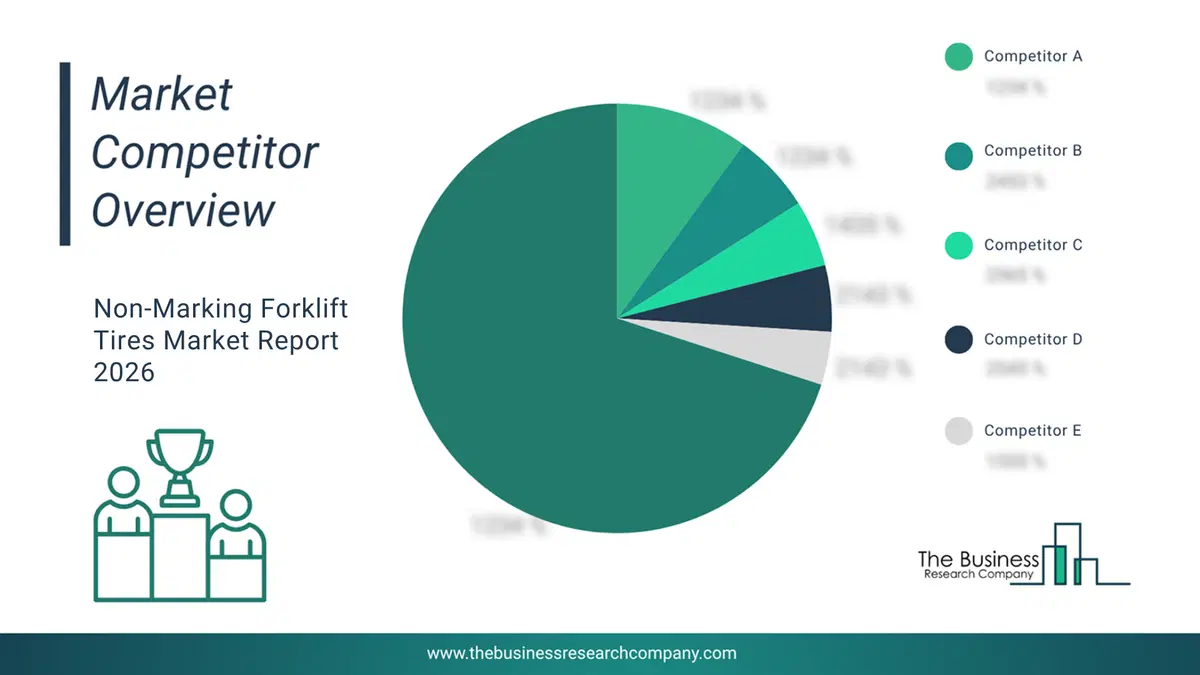
This chart is for illustrative purposes; the full report includes a detailed competitor analysis and comprehensive overview of the top 10 companies in the market.
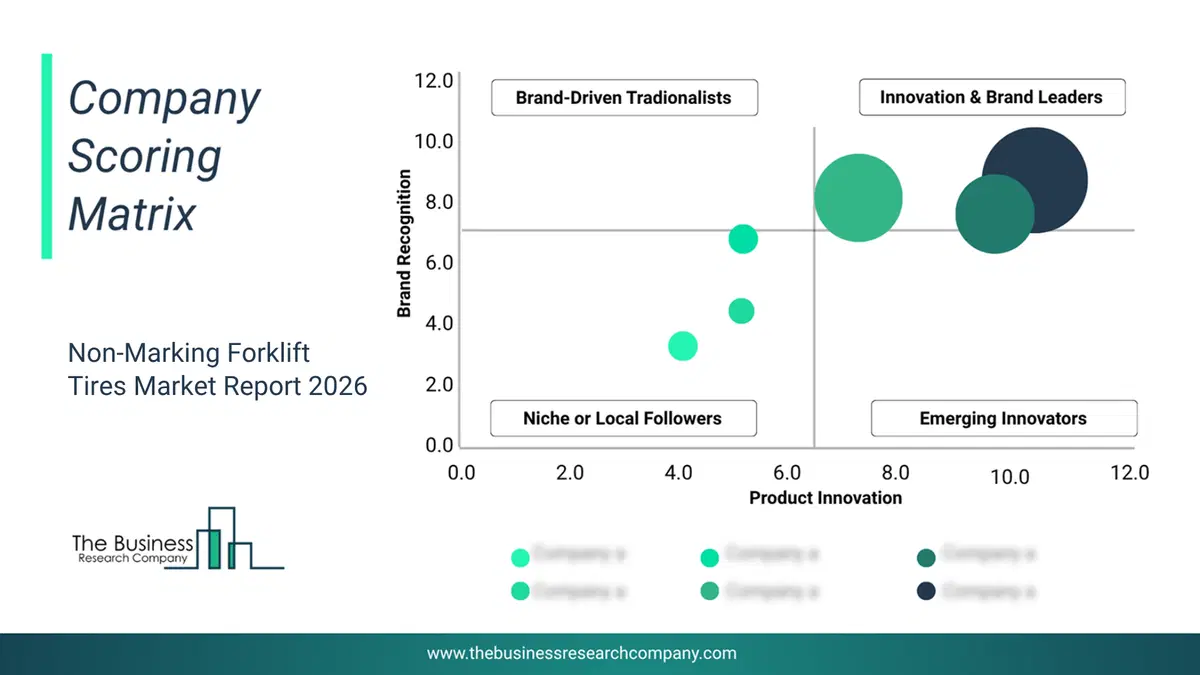
This chart maps companies by product innovation and brand strength, with bubble size indicating relative revenue, helping identify market leaders, challengers, and niche players. This is an illustrative chart; the full report provides a complete and accurate competitive analysis.
Global Non-Marking Forklift Tires Market Trends and Insights
Major companies operating in the non-marking forklift tires market are focusing on developing advanced products, such as forklift solid tires, to improve load-bearing capacity and extend service life in demanding industrial environments. Forklift solid tires are heavy-duty, airless rubber tires engineered to resist punctures while delivering superior load-bearing strength, enhanced stability, and extended operational lifespan in rigorous material handling environments. For instance, in February 2023, Yokohama Off-Highway Tires, an India-based manufacturer of industrial and off-highway tires, introduced the Galaxy MFS 101 SDS, a solid tire designed for forklift operations. This puncture-proof tire features a three-layer construction, a durable base for stability, a cushion layer for reduced vibration and enhanced comfort, and a wear-resistant tread with more rubber above the 60J wear limit for extended life and better traction on indoor/outdoor hard surfaces. It is designed for 24/7 heavy-duty operations in warehouses, ports, and loading docks. It includes a zig-zag tread pattern for heat dissipation, improved steering, and anti-slip steel beads, available initially in 28 sizes for 8- to 15-inch rims.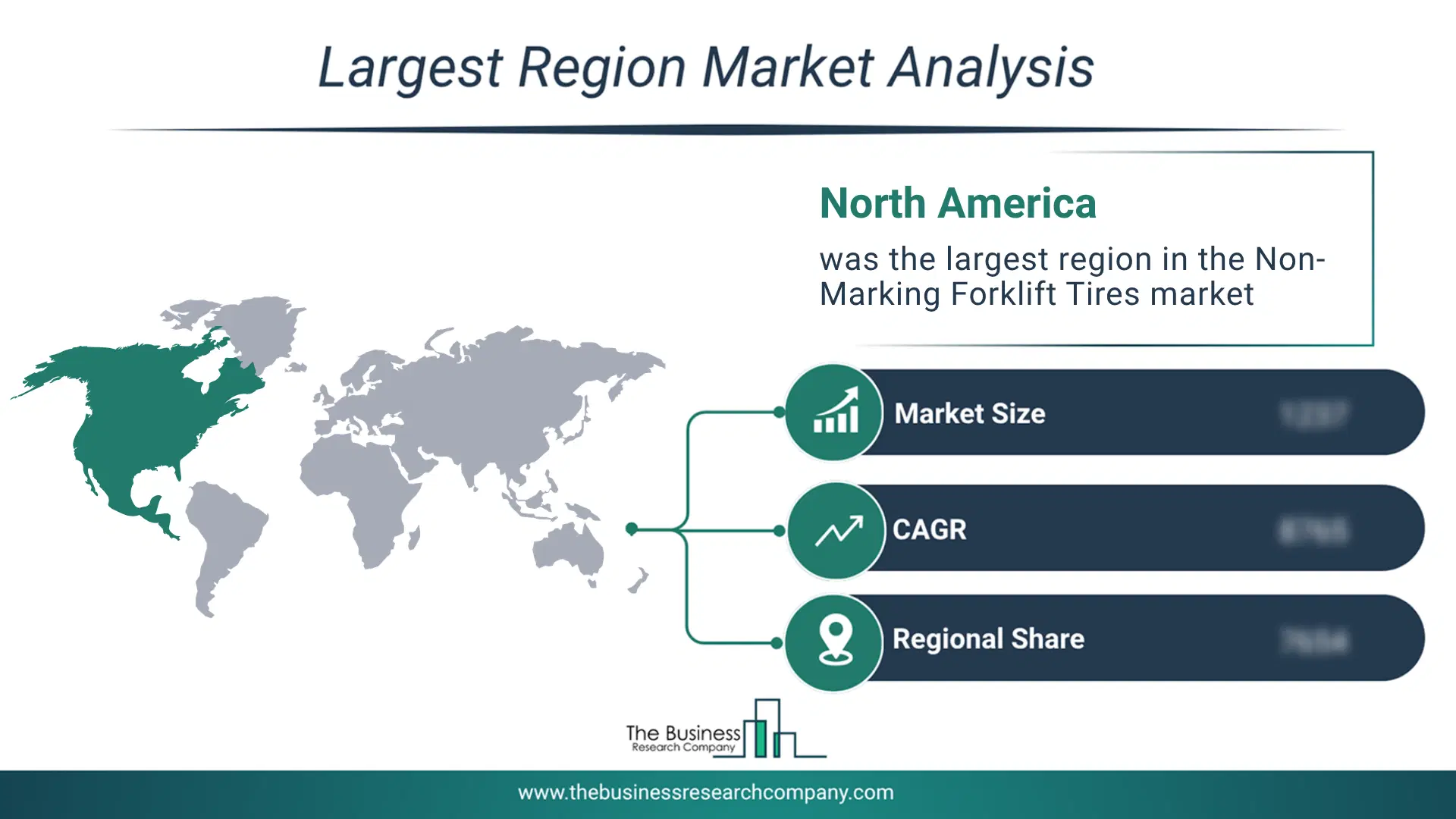
Regional Insights
North America was the largest region in the non-marking forklift tires market in 2025. Asia-Pacific is expected to be the fastest-growing region in the forecast period. The regions covered in this market report are Asia-Pacific, South East Asia, Western Europe, Eastern Europe, North America, South America, Middle East, Africa. The countries covered in this market report are Australia, Brazil, China, France, Germany, India, Indonesia, Japan, Taiwan, Russia, South Korea, UK, USA, Canada, Italy, Spain.What Defines the Non-Marking Forklift Tires Market?
The non-marking forklift tires market consists of sales of press-on band tires, polyurethane forklift wheels, load roller wheels, and skid steer non-marking tires. Values in this market are ‘factory gate’ values, that is, the value of goods sold by the manufacturers or creators of the goods, whether to other entities (including downstream manufacturers, wholesalers, distributors, and retailers) or directly to end customers. The value of goods in this market includes related services sold by the creators of the goods.How is Market Value Defined and Measured?
The market value is defined as the revenues that enterprises gain from the sale of goods and/or services within the specified market and geography through sales, grants, or donations in terms of the currency (in USD unless otherwise specified). The revenues for a specified geography are consumption values that are revenues generated by organizations in the specified geography within the market, irrespective of where they are produced. It does not include revenues from resales along the supply chain, either further along the supply chain or as part of other products.
This chart presents market attractiveness based on a quantitative evaluation of growth, competition, strategic alignment, and risk, offering a clear view of opportunity areas for decision-making. This chart is for illustrative purposes; the full report contains the complete analysis.

This chart highlights the Total Addressable Market (TAM) by estimating the maximum revenue opportunity using an assumption-driven approach, supporting strategic planning and opportunity sizing across markets. The chart is illustrative; the full report provides a more comprehensive analysis.
What Key Data and Analysis Are Included in the Non-Marking Forklift Tires Market Report 2026?
The non-marking forklift tires market research report is one of a series of new reports from The Business Research Company that provides market statistics, including industry global market size, regional shares, competitors with the market share, detailed market segments, market trends and opportunities, and any further data you may need to thrive in the non-marking forklift tires industry. The market research report delivers a complete perspective of everything you need, with an in-depth analysis of the current and future state of the industry.Non-Marking Forklift Tires Market Report Forecast Analysis
| Report Attribute | Details |
|---|---|
| Market Size Value In 2026 | $1.54 billion |
| Revenue Forecast In 2030 | $2.01 billion |
| Growth Rate | CAGR of 6.6% from 2026 to 2030 |
| Base Year For Estimation | 2025 |
| Actual Estimates/Historical Data | 2020-2025 |
| Forecast Period | 2026 - 2030 |
| Market Representation | Revenue in USD Billion and CAGR from 2026 to 2030 |
| Segments Covered | Product Type, Tire Material, Tire Size, Sales Channel, Application |
| Regional Scope | Asia-Pacific, Western Europe, Eastern Europe, North America, South America, Middle East, Africa |
| Country Scope | The countries covered in the report are Australia, Brazil, China, France, Germany, India, Indonesia, Japan, Taiwan, Russia, South Korea, UK, USA, Canada, Italy, Spain. |
| Key Companies Profiled | Continental AG, Michelin, Bridgestone Corporation, The Yokohama Rubber Co Ltd, Trelleborg AB, Camso Inc, Balkrishna Industries Limited, Marangoni S.p.A., TVS Srichakra Limited, Magna Tyres Group B.V., Velox Tyres Private Limited, Maxam Tire International Limited, Solideal, Global Rubber Industries Pvt Ltd, Apexway Products Corp, Sentry Tire and Rubber LLC, Royal Tyres Private Limited, Shandong Forlander Tyre Co Ltd, Stradrex Rubber Industries, Nimsa Enterprises. |
| Customization Scope | Request for Customization |
| Pricing And Purchase Options | Explore Purchase Options |