
Non-Terrestrial Network (NTN) User Equipment (UE) Protocol Stack Market Report 2026
Global Outlook – By Component (Software, Hardware, Services), By Frequency Band (L Band, S Band, C Band, Ku Band, Ka Band, X Band), By Connectivity Technology (Fifth Generation New Radio Non Terrestrial Network, Narrowband Internet Of Things Non Terrestrial Network, Long Term Evolution Non Terrestrial Network, Satellite Internet Of Things, Hybrid Terrestrial Non Terrestrial Network Connectivity), By Orbit Type (Geostationary Earth Orbit, Medium Earth Orbit, Low Earth Orbit), By Application (Satellite Communication, Fifth Generation Or Sixth Generation Networks, Internet Of Things Connectivity, Defense And Aerospace, Maritime, Automotive, Other Applications) – Market Size, Trends, Strategies, and Forecast to 2030
Non-Terrestrial Network (NTN) User Equipment (UE) Protocol Stack Market Overview
• Non-Terrestrial Network (NTN) User Equipment (UE) Protocol Stack market size has reached to $8.28 billion in 2025 • Expected to grow to $20.34 billion in 2030 at a compound annual growth rate (CAGR) of 19.6% • Growth Driver: Growing Deployment Of 5G Services Fueling The Growth Of The Market Due To Increasing Demand For Seamless Satellite-enabled 5G Connectivity And Extended Network Coverage • Market Trend: Standards-Based Interoperability Accelerates Next-Generation Direct-To-Device Satellite Connectivity Ecosystem Readiness • North America was the largest region in 2025 and Asia-Pacific is the fastest growing region.What Is Covered Under Non-Terrestrial Network (NTN) User Equipment (UE) Protocol Stack Market?
Non-terrestrial network (NTN) user equipment (UE) protocol stack is the set of communication protocols that enables user devices, to establish, manage, and maintain connectivity with non-terrestrial networks, including satellites and high-altitude platform systems. Its purpose is to ensure reliable, standardized, and efficient data transmission, mobility management, and interoperability between user equipment and NTN infrastructure. The main components of the non-terrestrial network (NTN) user equipment (UE) protocol stack include software, hardware, and services. Software refers to the programs and protocols that enable user equipment to process, manage, and communicate data across non-terrestrial networks. The frequency bands include L band, S band, C band, Ku band, Ka band, and X band, while the connectivity technologies include fifth generation new radio non-terrestrial network, narrowband internet of things non-terrestrial network, long term evolution non-terrestrial network, satellite internet of things, and hybrid terrestrial non-terrestrial network connectivity. The orbit types include geostationary earth orbit, medium earth orbit, and low earth orbit, and the applications include satellite communication, fifth generation or sixth generation networks, internet of things connectivity, defense and aerospace, maritime, automotive, and others.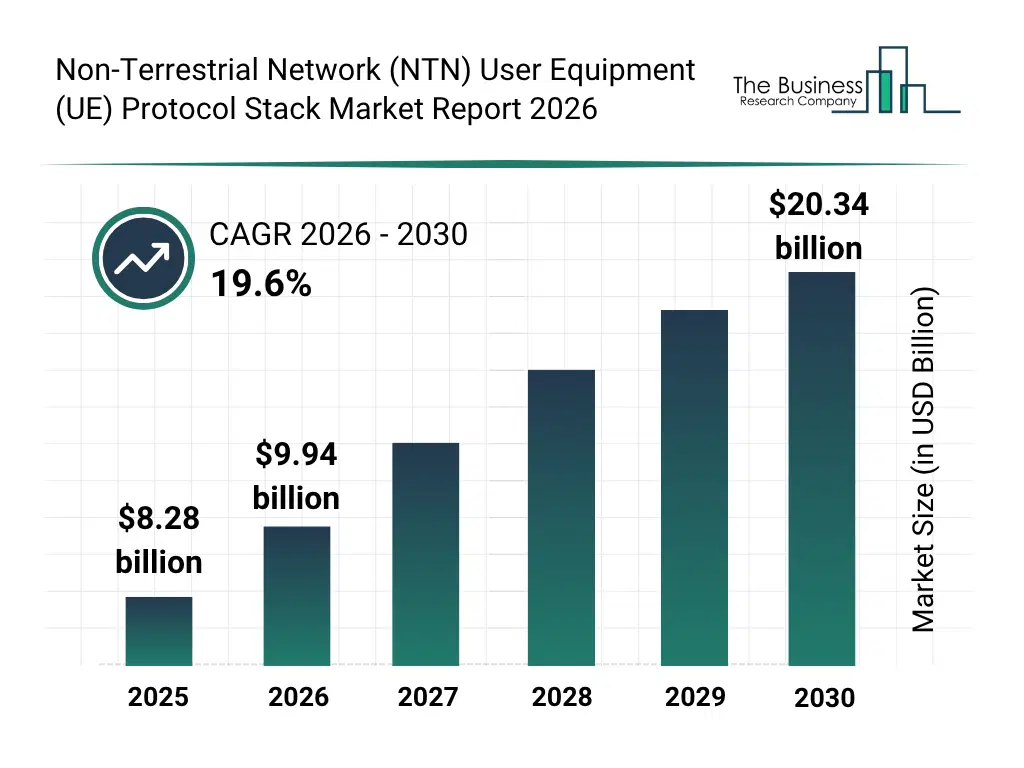
What Is The Non-Terrestrial Network (NTN) User Equipment (UE) Protocol Stack Market Size and Share 2026?
The non-terrestrial network (ntn) user equipment (ue) protocol stack market size has grown exponentially in recent years. It will grow from $8.28 billion in 2025 to $9.94 billion in 2026 at a compound annual growth rate (CAGR) of 20.0%. The growth in the historic period can be attributed to increasing satellite communication adoption, expansion of mobile connectivity coverage, development of 5G NTN standards, rising demand for remote connectivity, increasing deployment of LEO satellite constellations.What Is The Non-Terrestrial Network (NTN) User Equipment (UE) Protocol Stack Market Growth Forecast?
The non-terrestrial network (ntn) user equipment (ue) protocol stack market size is expected to see rapid growth in the next few years. It will grow to $20.34 billion in 2030 at a compound annual growth rate (CAGR) of 19.6%. The growth in the forecast period can be attributed to growing 5G and 6G NTN integration, expansion of satellite IoT connectivity, increasing demand for ubiquitous broadband coverage, rising adoption of direct-to-device satellite services, increasing defense and aerospace connectivity requirements. Major trends in the forecast period include 3GPP NTN protocol stack standardization, satellite-terrestrial network interoperability, NTN mobility and handover optimization, low-latency NTN protocol development, multi-orbit connectivity support.Tariff Impact On Non-Terrestrial Network (NTN) User Equipment (UE) Protocol Stack Market
Tariffs are impacting the non-terrestrial network (NTN) user equipment (UE) protocol stack market by increasing the cost of imported semiconductor chipsets, radio frequency components, satellite communication modules, antenna systems, and networking hardware required for NTN user equipment. This is slowing the deployment of software, hardware, and services across satellite communication, IoT connectivity, 5G and 6G networks, defense and aerospace, maritime, and automotive applications, particularly in regions dependent on imported telecommunications components such as Asia-Pacific, North America, and Europe. Hardware-intensive segments such as user equipment chipsets, RF front-end components, and antenna systems are most affected due to global supply chain dependencies. However, tariffs are also encouraging regional manufacturing, supplier diversification, and increased investment in domestic satellite communication and telecommunications ecosystems, creating long-term resilience in the market.
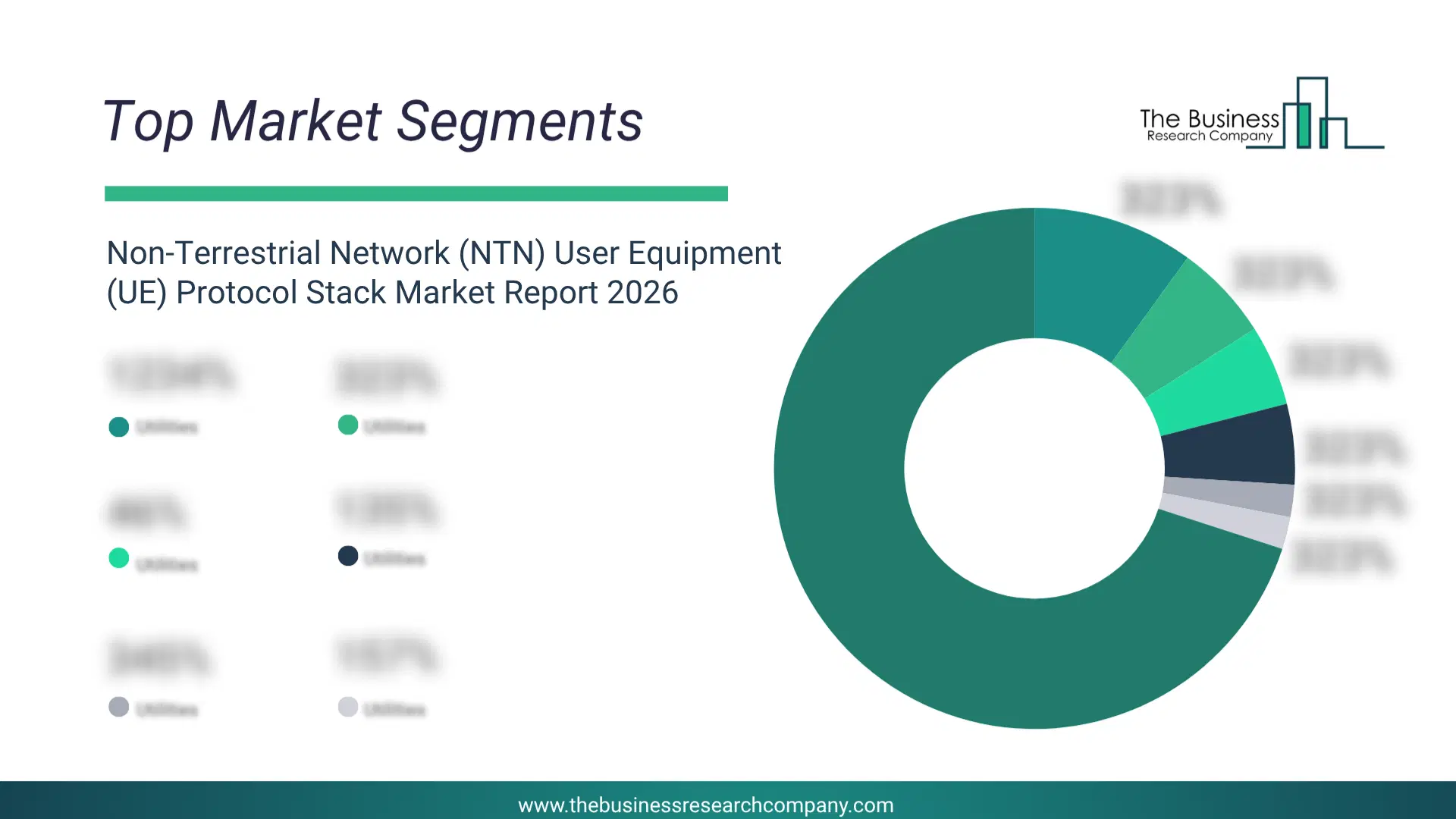
Global Non Terrestrial Network NTN User Equipment UE Protocol Stack Market Segmentation
1) By Component: Software, Hardware, Services 2) By Frequency Band: L Band, S Band, C Band, Ku Band, Ka Band, X Band 3) By Connectivity Technology: Fifth Generation New Radio Non Terrestrial Network, Narrowband Internet Of Things Non Terrestrial Network, Long Term Evolution Non Terrestrial Network, Satellite Internet Of Things, Hybrid Terrestrial Non Terrestrial Network Connectivity 4) By Orbit Type: Geostationary Earth Orbit, Medium Earth Orbit, Low Earth Orbit 5) By Application: Satellite Communication, Fifth Generation Or Sixth Generation Networks, Internet Of Things Connectivity, Defense And Aerospace, Maritime, Automotive, Other Applications Subsegments: 1) By Software: Protocol Stack Software Modules, Radio Resource Control And Non Access Stratum Software Components, Physical Layer Software Implementations, Network Management And Optimization Software 2) By Hardware: User Equipment Chipsets, Satellite Communication Modules, Antenna Systems, Radio Frequency Front End Components 3) By Services: System Integration Services, Network Deployment Services, Testing And Validation Services, Managed Non Terrestrial Network Connectivity ServicesWhat Is The Driver Of The Non-Terrestrial Network (NTN) User Equipment (UE) Protocol Stack Market?
The growing deployment of 5G services is expected to propel the growth of the non-terrestrial network (NTN) user equipment (UE) protocol stack market going forward. 5G services refer to the fifth generation of mobile communication networks that provide high-speed data transmission, ultra-low latency, massive device connectivity, and enhanced network reliability for consumer and enterprise applications. The deployment of 5G services is increasing primarily due to the growing demand for high-speed, low-latency wireless connectivity across consumer and enterprise applications. Non-Terrestrial Network (NTN) User Equipment (UE) protocol stacks support the deployment of 5G services by enabling seamless communication between user devices and satellite networks, extending 5G coverage to remote, rural, maritime, aviation, and disaster-affected areas where terrestrial infrastructure is limited or unavailable. For instance, in February 2025, according to the Global System for Mobile Communications Association, a UK-based non-profit industry organization, global 5G connections reached 1.6 billion by the end of 2024 and are projected to increase to 5.5 billion by 2030, accounting for more than half of all mobile connections worldwide. Therefore, the growing deployment of 5G services is driving the growth of the non-terrestrial network (NTN) user equipment (UE) protocol stack industry.Key Players In The Global Non-Terrestrial Network (NTN) User Equipment (UE) Protocol Stack Market
Major companies operating in the non-terrestrial network (ntn) user equipment (ue) protocol stack market are Apple Inc., Samsung Electronics Co. Ltd., Huawei Technologies Co. Ltd., Airbus SE, Qualcomm Incorporated, Telefonaktiebolaget LM Ericsson, Nokia Corporation, Thales SA, ZTE Corporation, STMicroelectronics NV, MediaTek Inc., NXP Semiconductors NV, Keysight Technologies Inc., Viasat Inc., Rohde & Schwarz GmbH & Co KG, Sony Group Corporation, Viavi Solutions Inc., Nordic Semiconductor ASA, Iridium Communications Inc., Anritsu Corporation, Globalstar Inc., CEVA Inc., Mavenir Systems Inc., Skylo Technologies Inc., Sequans Communications SA, Elveo Mobile, GCT Semiconductor Inc.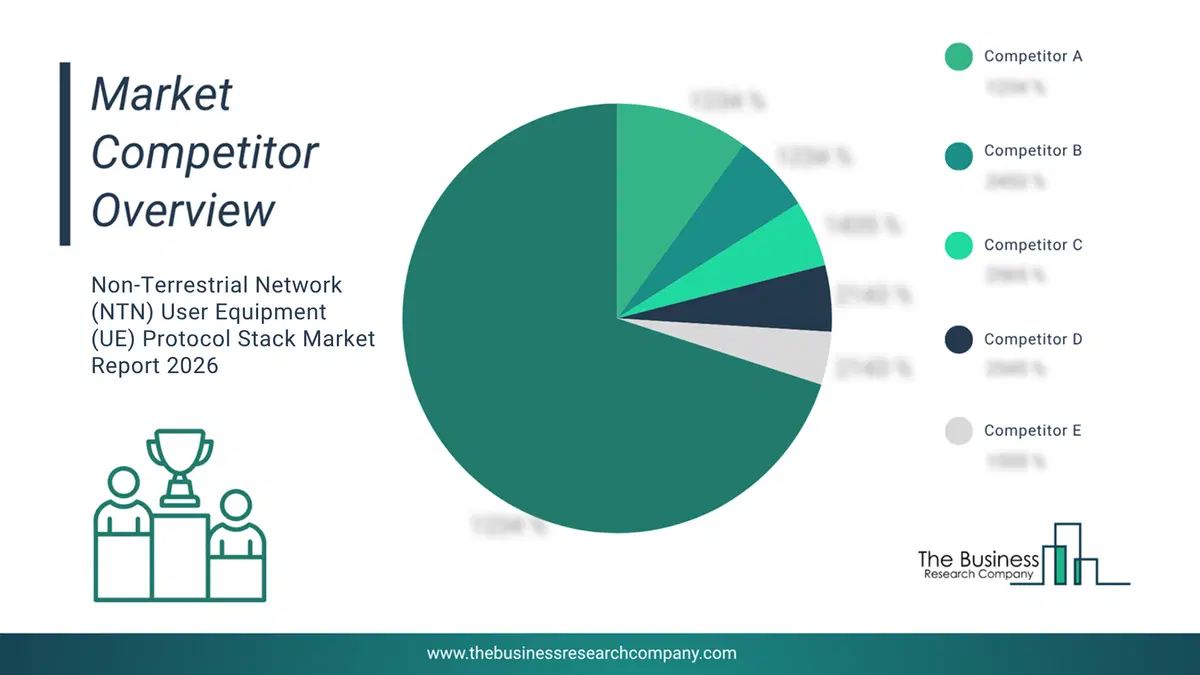
This chart is for illustrative purposes; the full report includes a detailed competitor analysis and comprehensive overview of the top 10 companies in the market.
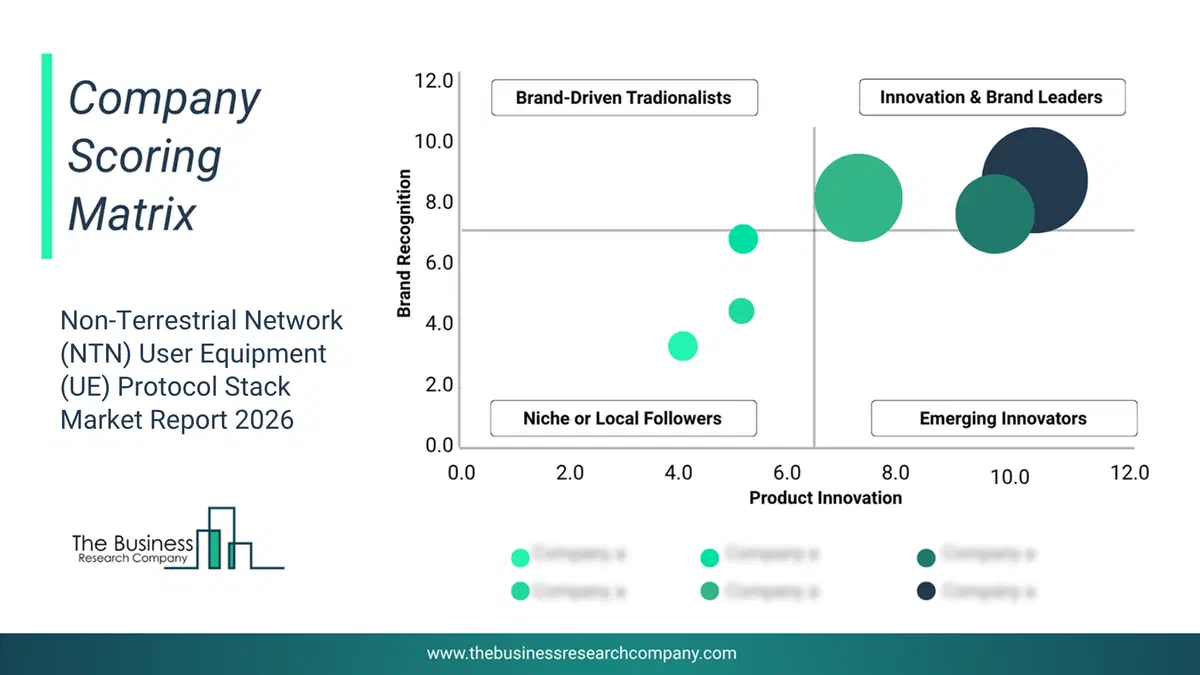
This chart maps companies by product innovation and brand strength, with bubble size indicating relative revenue, helping identify market leaders, challengers, and niche players. This is an illustrative chart; the full report provides a complete and accurate competitive analysis.
Global Non-Terrestrial Network (NTN) User Equipment (UE) Protocol Stack Market Trends and Insights
Major companies operating in the non-terrestrial network (NTN) user equipment (UE) protocol stack market are focusing on developing innovative advancements, such as satellite network protocol stacks to enable standards-based interoperability and accelerate commercial direct-to-device satellite communications. A satellite network protocol stack is software that implements standardized communication protocols to enable reliable connectivity and interoperability between terrestrial user equipment and satellite-based radio access networks. For instance, in February 2026, Celeste Technologies, an Italy-based developer of satellite communication software and non-terrestrial network technologies, successfully completed a 5G Non-Terrestrial Network interoperability test campaign using its SmartgNB satellite network protocol stack. The solution successfully demonstrated end-to-end interoperability with a 5G Non-Terrestrial Network-capable user equipment protocol stack using 3rd Generation Partnership Project Release 17 standards across geostationary Earth orbit and low Earth orbit satellite environments. Operating entirely in software without dedicated hardware acceleration, the platform highlights scalable deployment for regenerative satellite payloads and strengthens the readiness of commercial direct-to-device non-terrestrial network ecosystems.What Are Latest Mergers And Acquisitions In The Non-Terrestrial Network (NTN) User Equipment (UE) Protocol Stack Market?
In January 2026, Keysight Technologies, a US-based provider of electronic test and measurement equipment, network emulation solutions, wireless testing platforms, and design simulation software, partnered with Samsung Electronics to demonstrate live end-to-end 3GPP Release 19 New Radio Non-Terrestrial Network (NR-NTN) connectivity in the new n252 S-band, including satellite-to-satellite mobility using Samsung's next-generation modem chipset. With this partnership, the companies aim to accelerate the commercialization of direct-to-cell satellite communications by validating interoperability, mobility, standards compliance, and end-to-end performance across commercial-grade NR-NTN devices, thereby reducing development risk and shortening time-to-market for next-generation satellite connectivity solutions. Samsung Electronics is a South Korea-based provider of semiconductor solutions, mobile device chipsets, wireless communication technologies, consumer electronics, and advanced modem platforms for terrestrial and non-terrestrial network applications.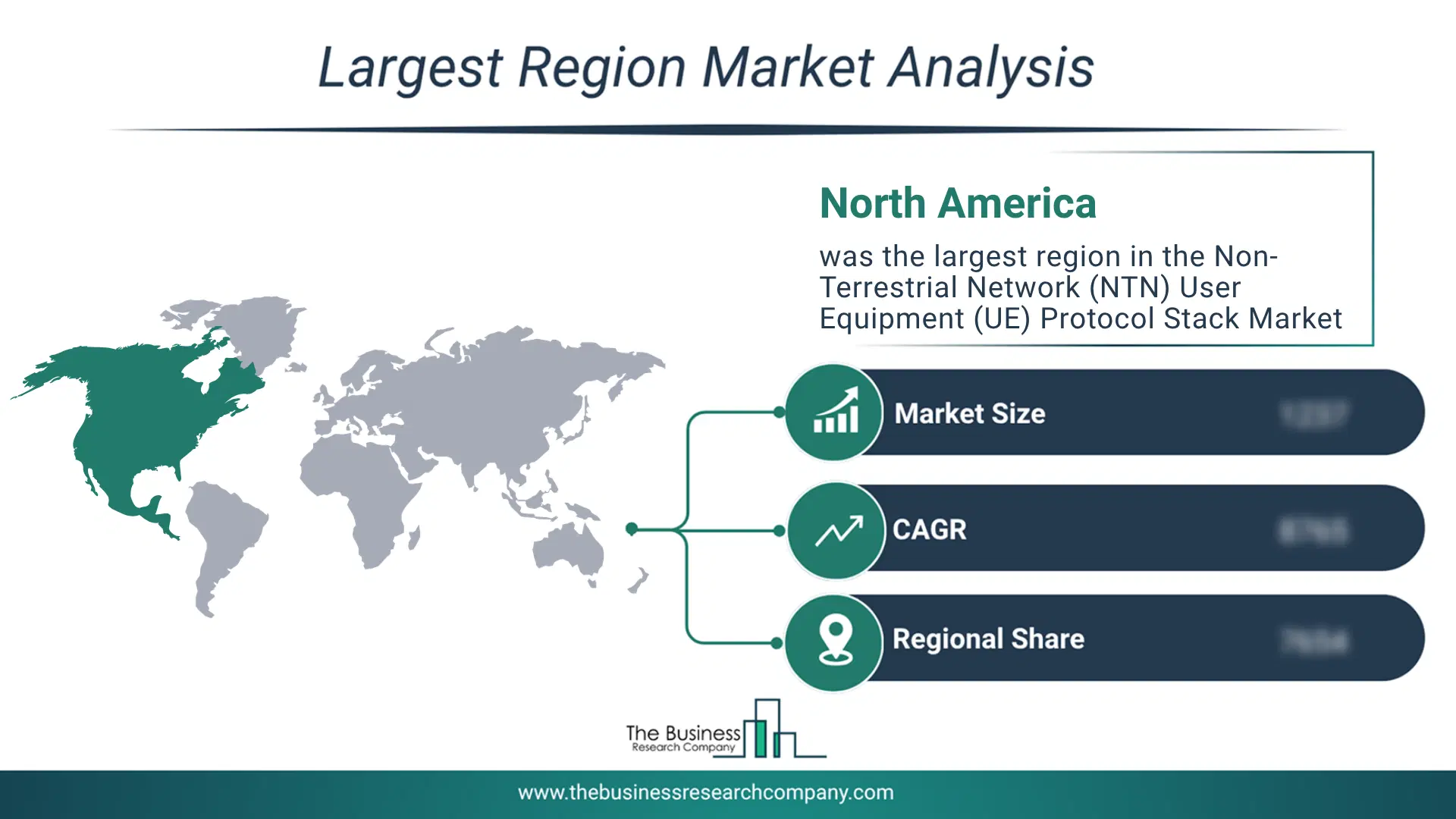
Regional Outlook
North America was the largest region in the non-terrestrial network (ntn) user equipment (ue) protocol stack market in 2025. Asia-Pacific is expected to be the fastest-growing region in the forecast period. The regions covered in this market report are Asia-Pacific, South East Asia, Western Europe, Eastern Europe, North America, South America, Middle East, Africa. The countries covered in this market report are Australia, Brazil, China, France, Germany, India, Indonesia, Japan, Taiwan, Russia, South Korea, UK, USA, Canada, Italy, Spain.What Defines the Non-Terrestrial Network (NTN) User Equipment (UE) Protocol Stack Market?
The non-terrestrial network (NTN) user equipment (UE) protocol stack market includes revenues earned by entities by services such as protocol integration services, network optimization services, protocol testing services, interoperability services, firmware update services, satellite connectivity services, consulting services, deployment services, maintenance services, and managed services. The market value includes the value of related goods sold by the service provider or included within the service offering. The non-terrestrial network (NTN) user equipment (UE) protocol stack market also includes sales of modem modules, user equipment devices, antenna modules, radio frequency transceivers, embedded communication processors, and communication routers. Values in this market are ‘factory gate’ values, that is, the value of goods sold by the manufacturers or creators of the goods, whether to other entities (including downstream manufacturers, wholesalers, distributors, and retailers) or directly to end customers. The value of goods in this market includes related services sold by the creators of the goods.How is Market Value Defined and Measured?
The market value is defined as the revenues that enterprises gain from the sale of goods and/or services within the specified market and geography through sales, grants, or donations in terms of the currency (in USD unless otherwise specified). The revenues for a specified geography are consumption values that are revenues generated by organizations in the specified geography within the market, irrespective of where they are produced. It does not include revenues from resales along the supply chain, either further along the supply chain or as part of other products.
This chart presents market attractiveness based on a quantitative evaluation of growth, competition, strategic alignment, and risk, offering a clear view of opportunity areas for decision-making. This chart is for illustrative purposes; the full report contains the complete analysis.

This chart highlights the Total Addressable Market (TAM) by estimating the maximum revenue opportunity using an assumption-driven approach, supporting strategic planning and opportunity sizing across markets. The chart is illustrative; the full report provides a more comprehensive analysis.
What Key Data and Analysis Are Included in the Non-Terrestrial Network (NTN) User Equipment (UE) Protocol Stack Market Report 2026?
The non-terrestrial network (ntn) user equipment (ue) protocol stack market research report is one of a series of new reports from The Business Research Company that provides market statistics, including industry global market size, regional shares, competitors with the market share, detailed market segments, market trends and opportunities, and any further data you may need to thrive in the non-terrestrial network (ntn) user equipment (ue) protocol stack industry. The market research report delivers a complete perspective of everything you need, with an in-depth analysis of the current and future state of the industry.Non-Terrestrial Network (NTN) User Equipment (UE) Protocol Stack Market Report Forecast Analysis
| Report Attribute | Details |
|---|---|
| Market Size Value In 2026 | $9.94 billion |
| Revenue Forecast In 2030 | $20.34 billion |
| Growth Rate | CAGR of 19.6% from 2026 to 2030 |
| Base Year For Estimation | 2025 |
| Actual Estimates/Historical Data | 2020-2025 |
| Forecast Period | 2026 - 2030 |
| Market Representation | Revenue in USD Billion and CAGR from 2026 to 2030 |
| Segments Covered | Component, Frequency Band, Connectivity Technology, Orbit Type, Application |
| Regional Scope | Asia-Pacific, Western Europe, Eastern Europe, North America, South America, Middle East, Africa |
| Country Scope | The countries covered in the report are Australia, Brazil, China, France, Germany, India, Indonesia, Japan, Taiwan, Russia, South Korea, UK, USA, Canada, Italy, Spain. |
| Key Companies Profiled | Apple Inc., Samsung Electronics Co. Ltd., Huawei Technologies Co. Ltd., Airbus SE, Qualcomm Incorporated, Telefonaktiebolaget LM Ericsson, Nokia Corporation, Thales SA, ZTE Corporation, STMicroelectronics NV, MediaTek Inc., NXP Semiconductors NV, Keysight Technologies Inc., Viasat Inc., Rohde & Schwarz GmbH & Co KG, Sony Group Corporation, Viavi Solutions Inc., Nordic Semiconductor ASA, Iridium Communications Inc., Anritsu Corporation, Globalstar Inc., CEVA Inc., Mavenir Systems Inc., Skylo Technologies Inc., Sequans Communications SA, Elveo Mobile, GCT Semiconductor Inc. |
| Customization Scope | Request for Customization |
| Pricing And Purchase Options | Explore Purchase Options |