
Non-UV Dicing Tapes Market Report 2026
Global Outlook – By Material Type (Polyolefin, Polyethylene Terephthalate, Polyvinyl Chloride, Other Materials), By Adhesive Type (Acrylic, Silicone, Rubber, Other Adhesives), By Thickness (Up To 100 Micrometers, 101 To 150 Micrometers, Above 150 Micrometers), By Application (Semiconductor Manufacturing, Electronics, Optoelectronics, Other Applications) – Market Size, Trends, Strategies, and Forecast to 2035
Non-UV Dicing Tapes Market Overview
• Non-UV Dicing Tapes market size has reached to $0.99 billion in 2025 • Expected to grow to $1.55 billion in 2030 at a compound annual growth rate (CAGR) of 9.5% • Growth Driver: Growing Demand For Consumer Electronics Fueling The Growth Of The Market Due To Increasing Adoption Of Smart Devices And Technological Advancements • Market Trend: Advancements In Pressure-Sensitive Adhesive Materials Enhance Precision And Enable Superior Control in Semiconductor Dicing • North America was the largest region in 2025 and Asia-Pacific is the fastest growing region.What Is Covered Under Non-UV Dicing Tapes Market?
Non-UV dicing tapes are specialized adhesive films used in semiconductor wafer dicing processes to securely hold wafers in place during cutting and singulation. Unlike UV dicing tapes, they do not require ultraviolet light exposure for adhesive strength reduction, instead offering consistent adhesion and reliable performance throughout the dicing process. These tapes are designed to ensure precision, minimize chip damage, and maintain cleanliness in high-precision electronic manufacturing environments. The main material types of non-UV dicing tapes include polyolefin, polyethylene terephthalate, polyvinyl chloride, and other materials. Polyolefin refers to a type of non-UV sensitive dicing tape material used in semiconductor wafer processing to provide secure adhesion during dicing operations. These tapes are based on adhesive types such as acrylic, silicone, rubber, and other adhesives and are available in thickness ranges including up to 100 micrometers, 101 to 150 micrometers, and above 150 micrometers. They are used in applications such as semiconductor manufacturing, electronics, optoelectronics, and others.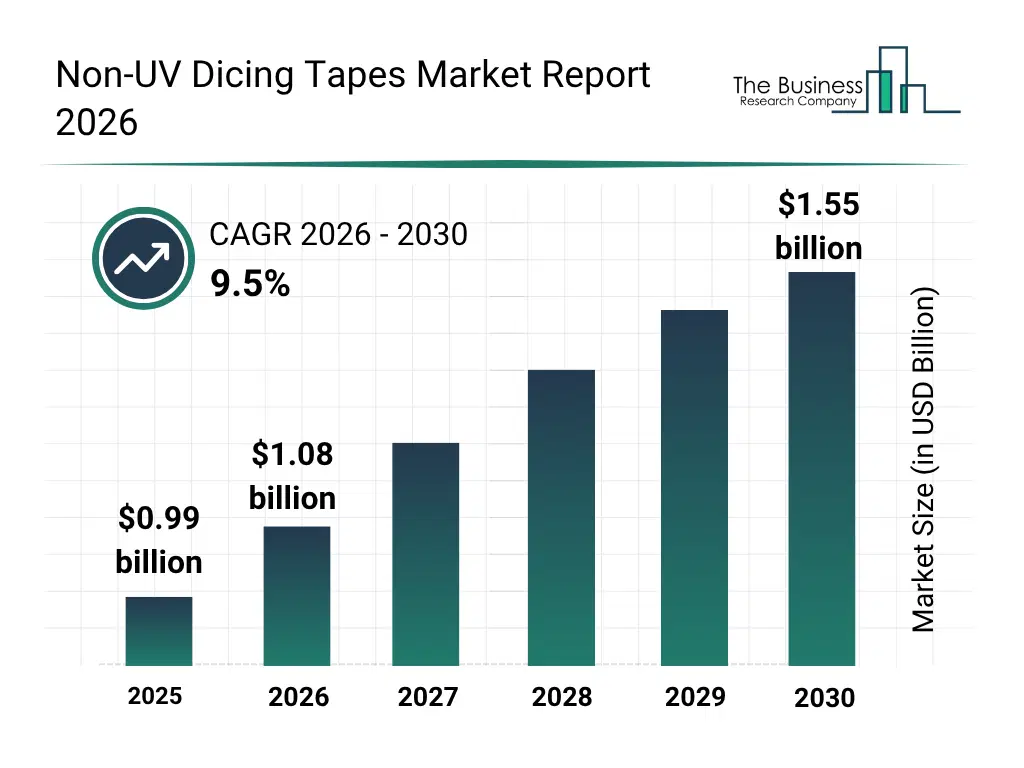
What Is The Non-UV Dicing Tapes Market Size and Share 2026?
The non-UV dicing tapes market size has grown strongly in recent years. It will grow from $0.99 billion in 2025 to $1.08 billion in 2026 at a compound annual growth rate (CAGR) of 9.2%. The growth in the historic period can be attributed to growth in semiconductor manufacturing capacity, rising demand for consumer electronics devices, increasing adoption of precision wafer processing, expansion of integrated circuit production, advancements in adhesive film technologies.What Is The Non-UV Dicing Tapes Market Growth Forecast?
The non-UV dicing tapes market size is expected to see strong growth in the next few years. It will grow to $1.55 billion in 2030 at a compound annual growth rate (CAGR) of 9.5%. The growth in the forecast period can be attributed to increasing investment in advanced chip fabrication facilities, rising demand for miniaturized electronic components, growing adoption of AI-enabled semiconductor devices, expansion of electric vehicle electronics manufacturing, increasing focus on defect-free wafer dicing processes. Major trends in the forecast period include increasing demand for ultra-thin dicing tapes, rising adoption of high precision wafer singulation processes, growing focus on low residue adhesive technologies, expansion of advanced semiconductor packaging applications, increasing use of high cleanliness dicing materials.
Global Non-UV Dicing Tapes Market Segmentation
1) By Material Type: Polyolefin, Polyethylene Terephthalate, Polyvinyl Chloride, Other Materials 2) By Adhesive Type: Acrylic, Silicone, Rubber, Other Adhesives 3) By Thickness: Up To 100 Micrometers, 101 To 150 Micrometers, Above 150 Micrometers 4) By Application: Semiconductor Manufacturing, Electronics, Optoelectronics, Other Applications Subsegments: 1) By Polyolefin: High Density Polyolefin, Low Density Polyolefin, Linear Low Density Polyolefin, Crosslinked Polyolefin 2) By Polyethylene Terephthalate: Amorphous Polyethylene Terephthalate, Crystalline Polyethylene Terephthalate, Biaxially Oriented Polyethylene Terephthalate, Blended Polyethylene Terephthalate 3) By Polyvinyl Chloride: Rigid Polyvinyl Chloride, Flexible Polyvinyl Chloride, Plasticized Polyvinyl Chloride, Unplasticized Polyvinyl Chloride 4) By Other Materials: Polyimide, Polysulfone, Polycarbonate, Composite FilmsWhat Are The Drivers Of The Non-UV Dicing Tapes Market?
The growing demand for consumer electronics is expected to propel the growth of the non-ultraviolet dicing tapes market going forward. Consumer electronics demand refers to the increasing purchase and usage of electronic devices such as smartphones, tablets, laptops, and wearable devices for personal and professional applications. The growing demand for consumer electronics is increasing because of rising digitalization, increasing disposable incomes, rapid technological advancements, and the growing adoption of smart and connected devices. Non-ultraviolet dicing tapes support the growing demand for consumer electronics by enabling precise wafer dicing, protecting semiconductor components during manufacturing, and improving yield and efficiency in chip production, thereby enhancing the reliability and performance of electronic devices. For instance, in February 2026, according to the International Trade Administration, a UK-based government organization, In 2024–2025, UK eCommerce sales increased by nearly 30%, with electronics being one of the key product categories driving this growth. Therefore, the growing demand for consumer electronics is driving the growth of the non-ultraviolet dicing tapes market. The rising investments in 5G infrastructure are expected to propel the growth of the non-ultraviolet dicing tapes market going forward. 5G infrastructure refer to the increasing allocation of funds by governments, telecom operators, and private enterprises to build, expand, and upgrade 5G networks, including towers, base stations, and supporting semiconductor technology. The rising investments in 5G infrastructure are increasing because of the global push for high-speed connectivity, the growing adoption of IoT devices, and the need for low-latency, high-reliability communication networks. Non-ultraviolet dicing tapes support the rising investments in 5G infrastructure by enabling precise wafer dicing, protecting semiconductor components during the production of 5G chips and modules, and improving yield and efficiency in semiconductor manufacturing, thereby ensuring the performance, reliability, and scalability of 5G-enabled devices and networks. For instance, in April 2023, according to Department for Science, Innovation and Technology a UK-based government statistics source, the UK unveiled an investment package worth almost £150 million, with up to £100 million allocated for future research and £40 million specifically to boost 5G technology take-up. Therefore, the rising investments in 5G infrastructure are driving the growth of the non-ultraviolet dicing tapes market.Key Players In The Global Non-UV Dicing Tapes Market
Major companies operating in the non-uv dicing tapes market are 3M Company, Henkel AG & Co. KGaA, Mitsui Chemicals Inc., Resonac Holdings Corporation, Sekisui Chemical Co. Ltd., Furukawa Electric Co. Ltd., Nitto Denko Corporation, Denka Company Limited, Sumitomo Bakelite Co. Ltd., Lintec Corporation, Maxell Ltd., Shanghai Sinyang Semiconductor Materials Co. Ltd., Teraoka Seisakusho Co. Ltd., Daehyun ST Co. Ltd., Toyo Adtec Co. Ltd., AI Technology Inc., S3 Alliance GmbH, Daest Coating India Pvt. Ltd., Loadpoint Limited, KGK Chemical CorporationGlobal Non-UV Dicing Tapes Market Trends and Insights
Major companies operating in the non‑UV dicing tapes market are focusing on developing innovative solutions, such as advancements in pressure‑sensitive adhesive materials, to meet the rising demand for high‑precision wafer handling and advanced semiconductor packaging processes. Pressure‑sensitive adhesive materials for non‑UV dicing tapes are engineered polymer films designed to provide strong and stable adhesion during wafer singulation without requiring ultraviolet curing. This offers advantages over traditional UV‑based tapes by reducing process complexity, eliminating the need for UV exposure equipment, and minimizing the risk of wafer warpage or damage. For instance, in October 2024, Furukawa Electric Co., Ltd., a Japan‑based semiconductor materials company, filed a patent application (PCT/JP2024/009977) for Pressure‑Sensitive Adhesive Tape for Dicing and published as WO/2024/203387. This innovative adhesive tape is engineered for ultra‑thin wafers, providing consistent debonding, reduced wafer warpage, and precise die separation, making it suitable for next‑generation AI and fan‑out packaging applications where mechanical stability and clean release are critical. The development demonstrates how pressure‑sensitive adhesives are evolving to support complex semiconductor manufacturing by ensuring controlled release without UV exposure, thereby improving yield and reliability in high-volume production.Regional Outlook/Insights
North America was the largest region in the non-ultraviolet dicing tapes market in 2025. Asia-Pacific is expected to be the fastest-growing region in the forecast period. The regions covered in this market report are Asia-Pacific, South East Asia, Western Europe, Eastern Europe, North America, South America, Middle East, Africa. The countries covered in this market report are Australia, Brazil, China, France, Germany, India, Indonesia, Japan, Taiwan, Russia, South Korea, UK, USA, Canada, Italy, Spain.What Defines the Non-UV Dicing Tapes Market?
The non-UV dicing tapes market consists of sales of polyolefin-based dicing tapes, PVC dicing tapes, polyethylene dicing tapes, pressure-sensitive adhesive tapes, high-adhesion dicing tapes, low-adhesion dicing tapes, and specialty non-UV tapes for semiconductor and electronic component applications. Values in this market are ‘factory gate’ values, that is, the value of goods sold by the manufacturers or creators of the goods, whether to other entities (including downstream manufacturers, wholesalers, distributors, and retailers) or directly to end customers. The value of goods in this market includes related services sold by the creators of the goods.How is Market Value Defined and Measured?
The market value is defined as the revenues that enterprises gain from the sale of goods and/or services within the specified market and geography through sales, grants, or donations in terms of the currency (in USD unless otherwise specified). The revenues for a specified geography are consumption values that are revenues generated by organizations in the specified geography within the market, irrespective of where they are produced. It does not include revenues from resales along the supply chain, either further along the supply chain or as part of other products.What Key Data and Analysis Are Included in the Non-UV Dicing Tapes Market Report 2026?
The non-uv dicing tapes market research report is one of a series of new reports from The Business Research Company that provides market statistics, including industry global market size, regional shares, competitors with the market share, detailed market segments, market trends and opportunities, and any further data you may need to thrive in the non-uv dicing tapes industry. The market research report delivers a complete perspective of everything you need, with an in-depth analysis of the current and future state of the industry.Non-UV Dicing Tapes Market Report Forecast Analysis
| Report Attribute | Details |
|---|---|
| Market Size Value In 2026 | $1.08 billion |
| Revenue Forecast In 2035 | $1.55 billion |
| Growth Rate | CAGR of 9.5% from 2026 to 2035 |
| Base Year For Estimation | 2025 |
| Actual Estimates/Historical Data | 2020-2025 |
| Forecast Period | 2026 - 2030 - 2035 |
| Market Representation | Revenue in USD Billion and CAGR from 2026 to 2035 |
| Segments Covered | Material Type, Adhesive Type, Thickness, Application |
| Regional Scope | Asia-Pacific, Western Europe, Eastern Europe, North America, South America, Middle East, Africa |
| Country Scope | The countries covered in the report are Australia, Brazil, China, France, Germany, India, Indonesia, Japan, Taiwan, Russia, South Korea, UK, USA, Canada, Italy, Spain. |
| Key Companies Profiled | 3M Company, Henkel AG & Co. KGaA, Mitsui Chemicals Inc., Resonac Holdings Corporation, Sekisui Chemical Co. Ltd., Furukawa Electric Co. Ltd., Nitto Denko Corporation, Denka Company Limited, Sumitomo Bakelite Co. Ltd., Lintec Corporation, Maxell Ltd., Shanghai Sinyang Semiconductor Materials Co. Ltd., Teraoka Seisakusho Co. Ltd., Daehyun ST Co. Ltd., Toyo Adtec Co. Ltd., AI Technology Inc., S3 Alliance GmbH, Daest Coating India Pvt. Ltd., Loadpoint Limited, KGK Chemical Corporation |
| Customization Scope | Request for Customization |
| Pricing And Purchase Options | Explore Purchase Options |