

Non-Volatile Memory Market Report 2026
Global Outlook – By Type ( Flash Memory, EPROM, FRAM, 3D-X Point, NRAM, Other Types), By Wafer Size ( 200mm, 300mm, 450mm), By End User ( Consumer Electronics, Enterprise Storage, Automotive and Transportation, Military and Aerospace, Industrial, Telecommunication, Energy and Power, Healthcare, Agricultural, Retail) – Market Size, Trends, Strategies, and Forecast to 2030
Non-Volatile Memory Market Overview
• Non-Volatile Memory market size has reached to $110.45 billion in 2025 • Expected to grow to $219.11 billion in 2030 at a compound annual growth rate (CAGR) of 14.7% • Growth Driver: Rising Electronic Device Demand Boosts The Non-Volatile Memory Market • Market Trend: Advancement Of High-Performance NOR And NAND Flash Memory Driving Non-Volatile Memory Market • North America was the largest region in 2025 and Asia-Pacific is the fastest growing region.What Is Covered Under Non-Volatile Memory Market?
Non-volatile memory (NVM) refers to memory that retains stored information even when not powered. Its purpose is to provide persistent data storage for applications where retaining information through power outages or system shutdowns is crucial, such as in computers, smartphones, and embedded systems. The main types of non-volatile memory are flash memory, EPROM, FRAM, 3D-X Point, NRAM, and others. Flash memory refers to a type of non-volatile memory that can be electrically erased and reprogrammed. It is widely used in devices such as solid-state drives (SSDs), USB flash drives, memory cards, and embedded systems. The wafer sizes include 200mm, 300mm, and 450mm for end-user industries such as consumer electronics, enterprise storage, automotive and transportation, military and aerospace, industrial, telecommunication, energy and power, healthcare, agriculture, and retail.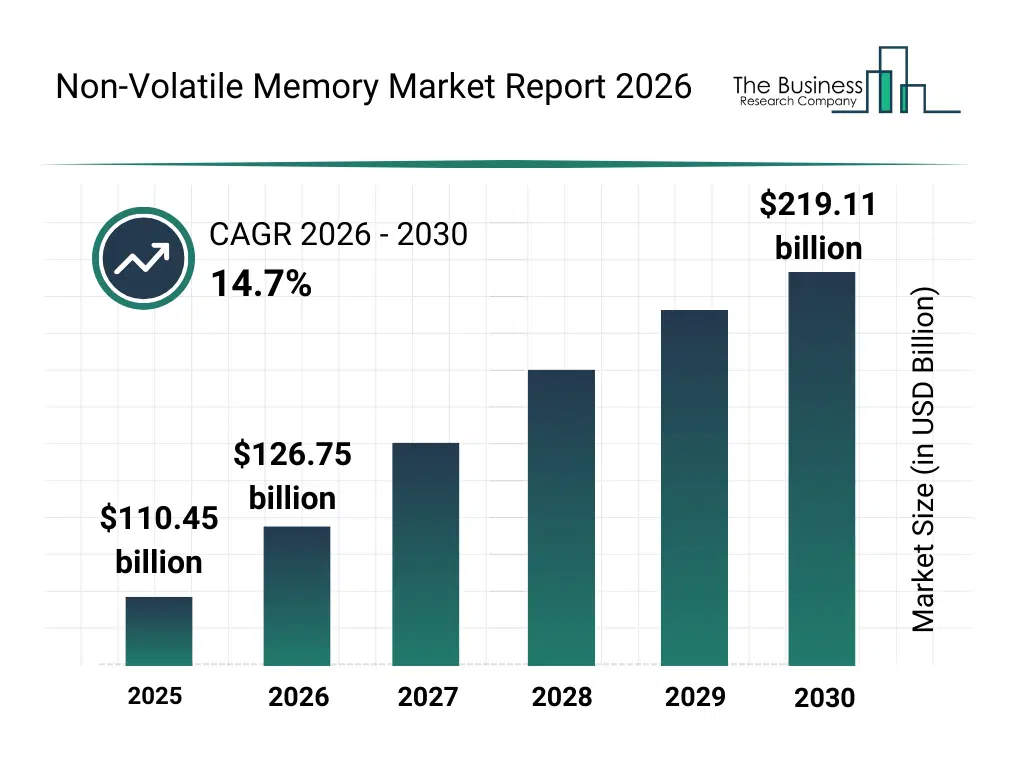
What Is The Non-Volatile Memory Market Size 2026 And Growth Rate?
The non-volatile memory market size has grown rapidly in recent years. It will grow from $110.45 billion in 2025 to $126.75 billion in 2026 at a compound annual growth rate (CAGR) of 14.8%. The growth in the historic period can be attributed to initial deployment in consumer electronics, use in enterprise storage systems, reliance on conventional flash memory, growth in automotive data storage, early adoption in military and aerospace applications.What Is The Non-Volatile Memory Market Growth Forecast?
The non-volatile memory market size is expected to see rapid growth in the next few years. It will grow to $219.11 billion in 2030 at a compound annual growth rate (CAGR) of 14.7%. The growth in the forecast period can be attributed to expansion in energy-efficient and high-capacity memory modules, integration with AI and IoT-enabled devices, adoption in healthcare and industrial sectors, development of low-power NVM solutions, rise of emerging non-volatile memory technologies. Major trends in the forecast period include adoption of embedded non-volatile memory modules, integration of high-performance nvm in electronics, expansion of 3d-xpoint and nram applications, development of energy-efficient memory solutions, implementation of AI-optimized data storage solutions.
Global Non-Volatile Memory Market Segmentation
1) By Type: Flash Memory, EPROM, FRAM, 3D-X Point, NRAM, Other Types 2) By Wafer Size: 200mm, 300mm, 450mm 3) By End User: Consumer Electronics, Enterprise Storage, Automotive and Transportation, Military and Aerospace, Industrial, Telecommunication, Energy and Power, Healthcare, Agricultural, Retail Subsegments: 1) By Flash Memory: NAND Flash Memory, NOR Flash Memory, Embedded MultiMediaCard (eMMC), Universal Flash Storage (UFS) 2) By Erasable Programmable Read-Only Memory (EPROM): Standard EPROM, Ultraviolet Erasable EPROM (UV EPROM), Electrically Erasable Programmable Read-Only Memory (EEPROM) 3) By Ferroelectric RAM (FRAM): Serial FRAM, Parallel FRAM 4) By 3D-XPoint: 3D-XPoint Memory Modules 5) By NRAM (Nano-RAM): Carbon Nanotube-Based NRAM, Other NRAM Technologies 6) By Other Types: Magnetoresistive RAM (MRAM), Phase Change RAM (PCRAM), Racetrack Memory, Other Emerging Non-Volatile MemoriesWhat Is The Driver Of The Non-Volatile Memory Market?
The increasing demand for electronic devices is expected to propel the growth of the non-volatile memory market going forward. Electronic devices refer to a wide range of devices that utilize electronic components for their functioning. Non-volatile memory technologies, such as NAND flash, are widely used in consumer electronics, including smartphones, tablets, and wearables, to provide fast, durable, and energy-efficient storage solutions for apps, media, and data retention. For instance, in May 2023, according to the Japan Electronics and Information Technology Industries Association, a Japan-based trade association, the total electronic device production in Japan accounted for $6,722 million (¥771,457 million). In addition, consumer electronics device production reached $280 million (¥32,099 million) in May 2023, compared to $230.9 million (¥25,268 million) in May 2022. Therefore, increasing demand for electronics devices will drive the growth of the non-volatile memory industry.Key Players In The Global Non-Volatile Memory Market
Major companies operating in the non-volatile memory market are Samsung Electronics Co. Ltd., Western Digital Corporation, Intel Corporation, Dell EMC, Hewlett Packard Enterprise Company, Kioxia Holdings Corporation, Micron Technology Inc., SK Hynix Inc., Microchip Technology Incorporated, ROHM Co. Ltd., Renesas Electronics Corporation, STMicroelectronics NV, Infineon Technologies AG, Nantero Inc., Crossbar Inc., Everspin Technologies Inc., Winbond Electronics Corporation, Pure Storage Inc., NetApp Inc., Seagate Technology Holdings plc, Toshiba Corporation, Huawei Technologies Co. Ltd., Fujitsu ltd., Intel Corporation, Honeywell International Inc., Maxim Integrated Products Inc., Micron technologies Inc., Avalanche Technologies Inc., Adesto Technologies Corporation, Viking Technology
This chart is for illustrative purposes; the full report includes a detailed competitor analysis and comprehensive overview of the top 10 companies in the market.
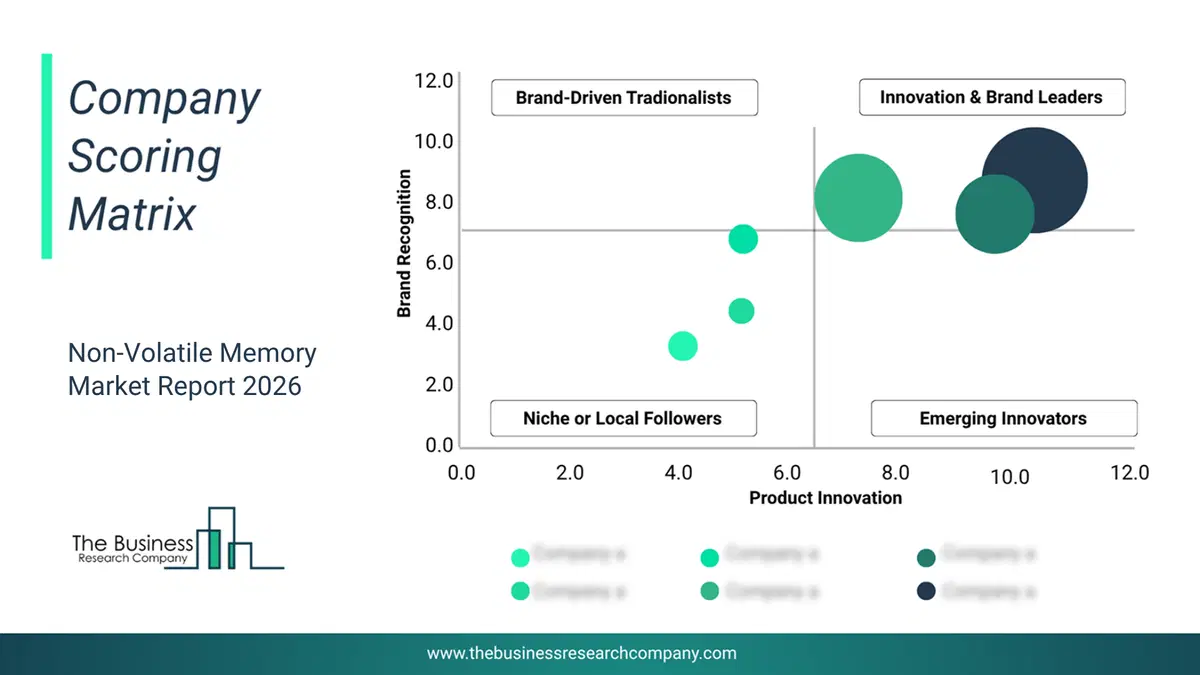
This chart maps companies by product innovation and brand strength, with bubble size indicating relative revenue, helping identify market leaders, challengers, and niche players. This is an illustrative chart; the full report provides a complete and accurate competitive analysis.
Global Non-Volatile Memory Market Trends and Insights
Major companies operating in the non-volatile memory market are focusing on high-performance NOR and NAND flash memory technologies, such as Octabus flash memory, to gain a competitive advantage. Flash memory is a type of non-volatile storage that retains data without power and allows rapid read and write access across applications. For instance, in April 2024, Macronix International Co., Ltd., a Taiwan-based integrated device manufacturer, introduced its 1 Gb OctaFlash memory (MX25UW1G45G) for STMicroelectronics N.V.’s STM32H7R/S MCU platform, featuring a 250 MHz clock, 500 MB/s read throughput, and execute-in-place (XIP) support for 3D-like GUI experiences. This trend accelerates adoption across automotive, industrial, and IoT systems that demand higher density, speed, and energy efficiency, but challenges include increased production complexity and rising cost pressures in mature flash segments.What Are Latest Mergers And Acquisitions In The Non-Volatile Memory Market?
In February 2023, GlobalFoundries, a US-based semiconductor manufacturer, acquired non-volatile resistive RAM (ReRAM) technology from Renesas Electronics Corporation for an undisclosed amount. This strategic move aims to enhance the company's capabilities in the Internet of Things (IoT) and 5G applications. This acquisition aligns with GlobalFoundries' commitment to driving innovation in semiconductor technologies, particularly for applications requiring efficient and reliable memory solutions. Renesas Electronics Corporation is a Japan-based semiconductor manufacturer specializing in nonvolatile memory technologies.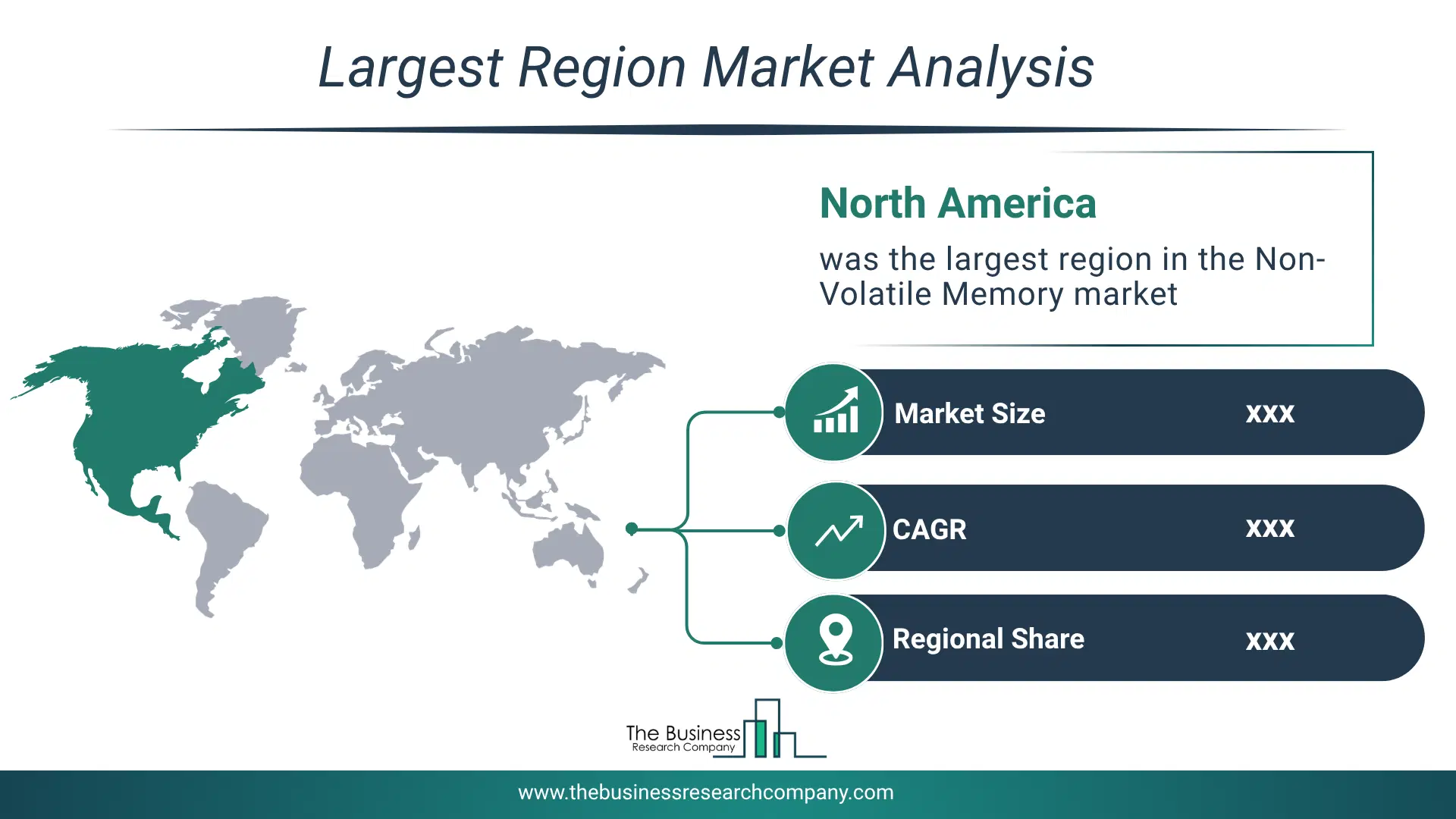
Regional Outlook
North America was the largest region in the non-volatile memory market in 2025. Asia-Pacific is expected to be the fastest-growing region in the forecast period. The regions covered in this market report are Asia-Pacific, South East Asia, Western Europe, Eastern Europe, North America, South America, Middle East, Africa. The countries covered in this market report are Australia, Brazil, China, France, Germany, India, Indonesia, Japan, Taiwan, Russia, South Korea, UK, USA, Canada, Italy, Spain.What Defines the Non-Volatile Memory Market?
The non-volatile memory market consists of revenues earned by entities by providing solutions and services for memory storage in an organization such as simple access control, data at rest protection, and purge-level erase to improve the performance of storage devices to accelerate the transfer speed of data between enterprise and client systems. The market value includes the value of related goods sold by the service provider or included within the service offering. Only goods and services traded between entities or sold to end consumers are included.How is Market Value Defined and Measured?
The market value is defined as the revenues that enterprises gain from the sale of goods and/or services within the specified market and geography through sales, grants, or donations in terms of the currency (in USD unless otherwise specified). The revenues for a specified geography are consumption values that are revenues generated by organizations in the specified geography within the market, irrespective of where they are produced. It does not include revenues from resales along the supply chain, either further along the supply chain or as part of other products.
This chart presents market attractiveness based on a quantitative evaluation of growth, competition, strategic alignment, and risk, offering a clear view of opportunity areas for decision-making. This chart is for illustrative purposes; the full report contains the complete analysis.

This chart highlights the Total Addressable Market (TAM) by estimating the maximum revenue opportunity using an assumption-driven approach, supporting strategic planning and opportunity sizing across markets. The chart is illustrative; the full report provides a more comprehensive analysis.
What Key Data and Analysis Are Included in the Non-Volatile Memory Market Report 2026?
The non-volatile memory market research report is one of a series of new reports from The Business Research Company that provides market statistics, including industry global market size, regional shares, competitors with the market share, detailed market segments, market trends and opportunities, and any further data you may need to thrive in the non-volatile memory industry. The market research report delivers a complete perspective of everything you need, with an in-depth analysis of the current and future state of the industry.Non-Volatile Memory Market Report Forecast Analysis
| Report Attribute | Details |
|---|---|
| Market Size Value In 2026 | $126.75 billion |
| Revenue Forecast In 2030 | $219.11 billion |
| Growth Rate | CAGR of 14.7% from 2026 to 2030 |
| Base Year For Estimation | 2025 |
| Actual Estimates/Historical Data | 2020-2025 |
| Forecast Period | 2026 - 2030 |
| Market Representation | Revenue in USD Billion and CAGR from 2026 to 2030 |
| Segments Covered | Type, Wafer Size, End User |
| Regional Scope | Asia-Pacific, Western Europe, Eastern Europe, North America, South America, Middle East, Africa |
| Country Scope | The countries covered in the report are Australia, Brazil, China, France, Germany, India, Indonesia, Japan, Taiwan, Russia, South Korea, UK, USA, Canada, Italy, Spain. |
| Key Companies Profiled | Samsung Electronics Co. Ltd., Western Digital Corporation, Intel Corporation, Dell EMC, Hewlett Packard Enterprise Company, Kioxia Holdings Corporation, Micron Technology Inc., SK Hynix Inc., Microchip Technology Incorporated, ROHM Co. Ltd., Renesas Electronics Corporation, STMicroelectronics NV, Infineon Technologies AG, Nantero Inc., Crossbar Inc., Everspin Technologies Inc., Winbond Electronics Corporation, Pure Storage Inc., NetApp Inc., Seagate Technology Holdings plc, Toshiba Corporation, Huawei Technologies Co. Ltd., Fujitsu ltd., Intel Corporation, Honeywell International Inc., Maxim Integrated Products Inc., Micron technologies Inc., Avalanche Technologies Inc., Adesto Technologies Corporation, Viking Technology |
| Customization Scope | Request for Customization |
| Pricing And Purchase Options | Explore Purchase Options |