
Nonresidential Green Buildings Market Report 2026
Global Outlook – By Product (Interior Products, Exterior Products ), By Component (Roofing, Insulation, Framing, Exterior Siding, Interior Finishing, Other Components), By Application (Office, Education, Hotels and Restaurants, Retail, Institutional/ Assembly, Healthcare, Warehouse ) – Market Size, Trends, Strategies, and Forecast to 2030
Nonresidential Green Buildings Market Overview
• Nonresidential Green Buildings market size has reached to $1290.83 billion in 2025 • Expected to grow to $2353.13 billion in 2030 at a compound annual growth rate (CAGR) of 12.8% • Growth Driver: Rising Demand For Sustainable And Eco-Friendly Nonresidential Green Buildings • Market Trend: Innovative Modular Solutions Driving Efficiency And Sustainability In The Nonresidential Green Buildings Market • Asia-Pacific was the largest region and fastest growing region.What Is Covered Under Nonresidential Green Buildings Market?
Non-residential green buildings construction is the process of building, altering, repairing, improving, or demolishing any non-residential housing structure which is built to be environmentally sustainable using a detailed design and plan. The main product types of non-residential green buildings are interior products and exterior products. Interior products are low-impact natural materials, including natural clay plaster, natural fibre flooring, paperless drywall, and low VOC content paints and coatings, that replace synthetic materials in the interior finishes of green buildings. The major components include roofing, insulation, framing, exterior siding, interior finishing, and others and are used in offices, education, hotels and restaurants, retail, institutional/assembly, healthcare, and warehouses.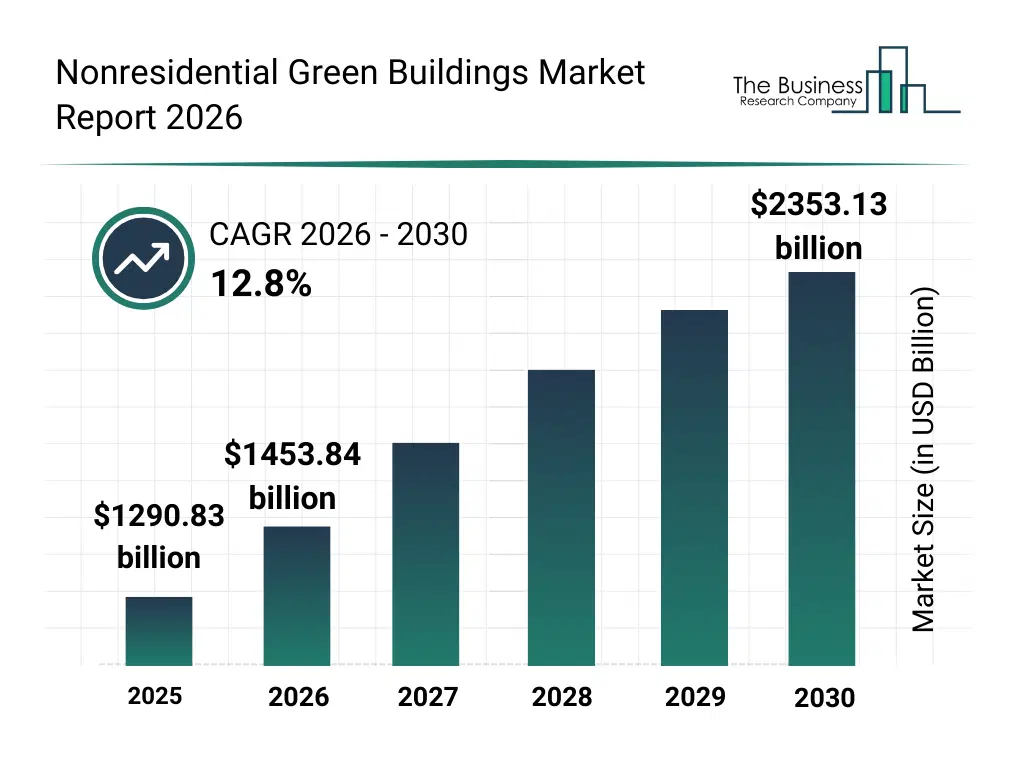
What Is The Nonresidential Green Buildings Market Size and Share 2026?
The nonresidential green buildings market size has grown rapidly in recent years. It will grow from $1290.83 billion in 2025 to $1453.84 billion in 2026 at a compound annual growth rate (CAGR) of 12.6%. The growth in the historic period can be attributed to early adoption of eco-friendly materials, growth in commercial green building certifications, rising awareness of environmental sustainability, increased investment in green retrofitting, expansion of regulatory incentives for sustainable construction.What Is The Nonresidential Green Buildings Market Growth Forecast?
The nonresidential green buildings market size is expected to see rapid growth in the next few years. It will grow to $2353.13 billion in 2030 at a compound annual growth rate (CAGR) of 12.8%. The growth in the forecast period can be attributed to increasing demand for smart green buildings, wider adoption of renewable energy integration, rising focus on carbon-neutral construction, growth in circular economy-based building practices, expanding investment in high-performance green materials. Major trends in the forecast period include growing adoption of green certified building designs, increased use of low-emission construction materials, rising demand for energy-efficient nonresidential structures, expansion of eco-friendly renovation and retrofit projects, higher investment in water conservation and waste reduction systems.
Global Nonresidential Green Buildings Market Segmentation
1) By Product: Interior Products, Exterior Products 2) By Component: Roofing, Insulation, Framing, Exterior Siding, Interior Finishing, Other Components 3) By Application: Office, Education, Hotels and Restaurants, Retail, Institutional/ Assembly, Healthcare, Warehouse Subsegments: 1) By Interior Products: Sustainable Flooring, Eco-Friendly Paints And Finishes, Energy-Efficient Lighting Fixtures, Green Insulation Materials, Low-VOC (Volatile Organic Compounds) Products 2) By Exterior Products: Green Roofing Systems, Sustainable Siding Materials, Energy-Efficient Windows And Doors, Rainwater Harvesting Systems, Solar Panels And Renewable Energy SolutionsWhat Is The Driver Of The Nonresidential Green Buildings Market?
An increasing need for sustainable and eco-friendly solutions has contributed to the growth of the nonresidential green buildings market. According to the USGBC (U.S. Green Building Council) report, green buildings can reduce carbon emissions by 34% and consume 25% less energy than conventional buildings. For instance, in April 2024, according to the National Association of Convenience Stores (NACS), a US-based trade association representing the convenience and fuel retailing industry, 2024 80% of consumers expressed concern about the environmental effects of their purchases, increasing from 68% in 2023 and 66% in 2022. Therefore, the increasing need for sustainable and eco-friendly solutions is driving the growth of the nonresidential green buildings industry.Key Players In The Global Nonresidential Green Buildings Market
Major companies operating in the nonresidential green buildings market are Turner Construction Company, AECOM Technical Services Inc., Balfour Beatty Construction Inc., Whiting-Turner Contracting Company, The Whiting-Turner Contracting Company, Lendlease Americas Inc., Gilbane Building Company, PCL Construction Enterprises Inc., Hensel Phelps Construction Co., DPR Construction Inc., HITT Contracting Inc., The Walsh Group LLC, Clark Construction Group, Holder Construction Company, JE Dunn Construction Group Inc., Swinerton Builders, McCarthy Holdings Inc., Suffolk Construction Company Inc., Consigli Construction Company Inc., The Haskell Company, Ryan Companies US Inc., Austin Industries Inc., Skanska USA Civil Inc., The Beck Group Inc., The Weitz Company Inc., Mortenson Inc., The Boldt Company, Webcor Builders Inc., The Opus Group, The Korte Company, The Christman Company, The Barton Malow Company
This chart is for illustrative purposes; the full report includes a detailed competitor analysis and comprehensive overview of the top 10 companies in the market.
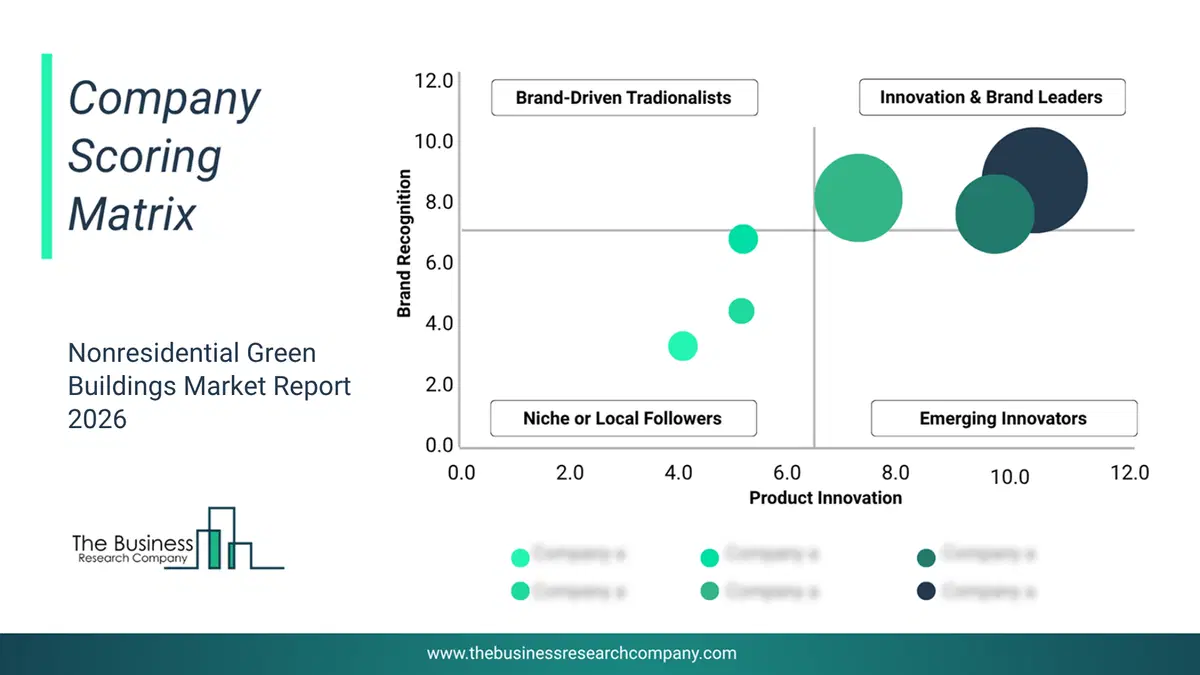
This chart maps companies by product innovation and brand strength, with bubble size indicating relative revenue, helping identify market leaders, challengers, and niche players. This is an illustrative chart; the full report provides a complete and accurate competitive analysis.
Global Nonresidential Green Buildings Market Trends and Insights
Major companies operating in the nonresidential green buildings market are focusing on developing innovative solutions, such as off-site manufactured room modules, to enhance construction efficiency, reduce project timelines, and improve overall cost-effectiveness. Off-site manufactured room modules refer to pre-engineered, fully or partially completed three-dimensional building units that are constructed in a controlled factory environment and then transported to the construction site for installation or assembly. For example, in November 2024, Module-T Prefabrik, a France-based manufacturer of prefabricated containers, announced its expansion into the U.S. market, introducing a wide range of modular solutions such as office, sanitary, locker, and dormitory containers, as well as modular office buildings designed for rapid deployment in non-residential settings. The product portfolio consists of factory-built modules adaptable for various uses, including labor accommodations, classrooms, dining halls, and temporary or permanent offices. Each unit integrates the structural frame, insulation, interior finishes, and MEP rough-ins, and is engineered for easy crane placement and on-site assembly. Its notable features include standardized container-format modules for design flexibility, an emphasis on sustainability through reduced material waste and lower transportation emissions, and quick installation that minimizes disruption to surrounding environments.What Are Latest Mergers And Acquisitions In The Nonresidential Green Buildings Market?
In April 2023, Kohlberg Kravis Roberts & Co (KKR), a US-based investment firm, acquired Namsan Green Building for $186.7 million. With this acquisition, KKR aims to expand its portfolio with Namsan Green Building’s expertise in green building projects. Namsan Green Building is a South Korea-based company that specializes in green building projects for premium commercial buildings.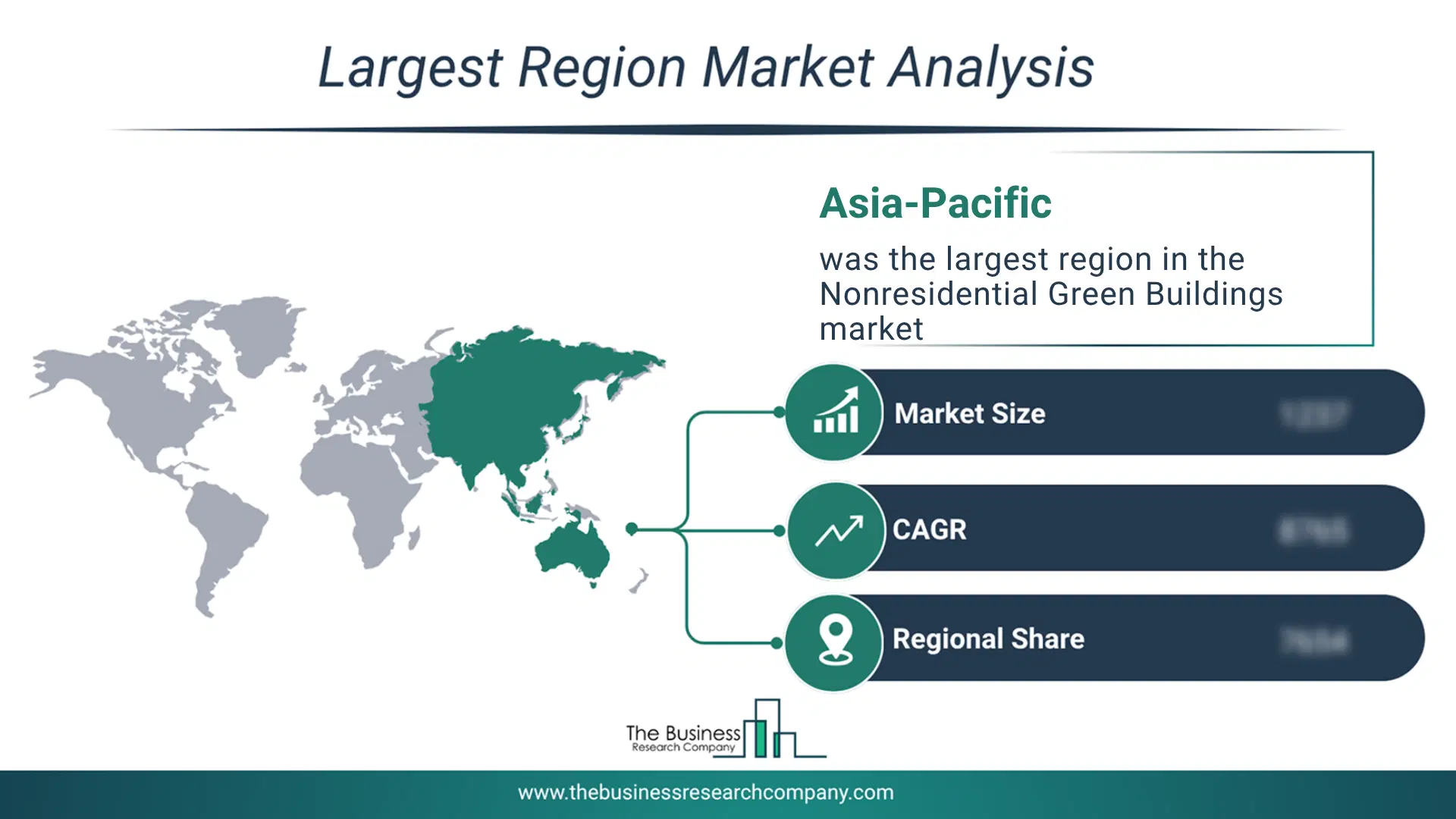
Regional Insights
Asia-Pacific was the largest region in the nonresidential green buildings market in 2025. Eastern Europe is expected to be the fastest-growing region in the global nonresidential green buildings market share during the forecast period. The regions covered in this market report are Asia-Pacific, South East Asia, Western Europe, Eastern Europe, North America, South America, Middle East, Africa. The countries covered in this market report are Australia, Brazil, China, France, Germany, India, Indonesia, Japan, Taiwan, Russia, South Korea, UK, USA, Canada, Italy, Spain.What Defines the Nonresidential Green Buildings Market?
The nonresidential green buildings market construction market includes revenues earned by entities by constructing non-residential green buildings such as offices, sports, college buildings, and other commercial buildings. The establishments in this market include non-residential general contractors, non-residential for-sale builders, non-residential design-build firms, and non-residential project construction management firms. The non-residential green building construction work performed includes new work, additions, alterations, maintenance, and repairs. A Green building is an environment sustainable building which is designed, constructed and operated to minimize the environmental impacts. The market value includes the value of related goods sold by the service provider or included within the service offering. Only goods and services traded between entities or sold to end consumers are included.How is Market Value Defined and Measured?
The market value is defined as the revenues that enterprises gain from the sale of goods and/or services within the specified market and geography through sales, grants, or donations in terms of the currency (in USD unless otherwise specified). The revenues for a specified geography are consumption values that are revenues generated by organizations in the specified geography within the market, irrespective of where they are produced. It does not include revenues from resales along the supply chain, either further along the supply chain or as part of other products.
This chart presents market attractiveness based on a quantitative evaluation of growth, competition, strategic alignment, and risk, offering a clear view of opportunity areas for decision-making. This chart is for illustrative purposes; the full report contains the complete analysis.

This chart highlights the Total Addressable Market (TAM) by estimating the maximum revenue opportunity using an assumption-driven approach, supporting strategic planning and opportunity sizing across markets. The chart is illustrative; the full report provides a more comprehensive analysis.
What Key Data and Analysis Are Included in theNonresidential Green Buildings Market Report 2026?
The nonresidential green buildings market research report is one of a series of new reports from The Business Research Company that provides market statistics, including industry global market size, regional shares, competitors with the market share, detailed market segments, market trends and opportunities, and any further data you may need to thrive in the nonresidential green buildings industry. The market research report delivers a complete perspective of everything you need, with an in-depth analysis of the current and future state of the industry.Nonresidential Green Buildings Market Report Forecast Analysis
| Report Attribute | Details |
|---|---|
| Market Size Value In 2026 | $1453.84 billion |
| Revenue Forecast In 2030 | $2353.13 billion |
| Growth Rate | CAGR of 12.6% from 2026 to 2030 |
| Base Year For Estimation | 2025 |
| Actual Estimates/Historical Data | 2020-2025 |
| Forecast Period | 2026 - 2030 |
| Market Representation | Revenue in USD Billion and CAGR from 2026 to 2030 |
| Segments Covered | Product, Component, Application |
| Regional Scope | Asia-Pacific, Western Europe, Eastern Europe, North America, South America, Middle East, Africa |
| Country Scope | The countries covered in this market report are Australia, Brazil, China, France, Germany, India, Indonesia, Japan, Taiwan, Russia, South Korea, UK, USA, Canada, Italy, Spain |
| Key Companies Profiled | Turner Construction Company, AECOM Technical Services Inc., Balfour Beatty Construction Inc., Whiting-Turner Contracting Company, The Whiting-Turner Contracting Company, Lendlease Americas Inc., Gilbane Building Company, PCL Construction Enterprises Inc., Hensel Phelps Construction Co., DPR Construction Inc., HITT Contracting Inc., The Walsh Group LLC, Clark Construction Group, Holder Construction Company, JE Dunn Construction Group Inc., Swinerton Builders, McCarthy Holdings Inc., Suffolk Construction Company Inc., Consigli Construction Company Inc., The Haskell Company, Ryan Companies US Inc., Austin Industries Inc., Skanska USA Civil Inc., The Beck Group Inc., The Weitz Company Inc., Mortenson Inc., The Boldt Company, Webcor Builders Inc., The Opus Group, The Korte Company, The Christman Company, The Barton Malow Company |
| Customization Scope | Request for Customization |
| Pricing And Purchase Options | Explore Purchase Options |