
Nuclear Battery Market Report 2026
Global Outlook – By Type (Radioisotope Thermoelectric Generators (RTGs), Betavoltaics Batteries, Thermophotovoltaic Cells, Diamond Nuclear Batteries), By Conversion (Thermal Conversion, Non-Thermal Conversion), By Power Output (Low-Power, Medium-Power, High-Power), By Application (Aerospace And Defense, Medical Devices, Consumer Electronics, Industrial Applications, Remote Power Systems), By End-User Industry (Automotive, Telecommunications, Healthcare, Military And Defense, Energy Sector) – Market Size, Trends, Strategies, and Forecast to 2030
Nuclear Battery Market Overview
• Nuclear Battery market size has reached to $73.28 billion in 2025 • Expected to grow to $110.53 billion in 2030 at a compound annual growth rate (CAGR) of 8.6% • Growth Driver: Expansion Of Defense And Military Applications Is Driving The Market Due To Increasing Defense Spending And Strategic Modernization • Market Trend: High-Efficiency Nuclear Battery Offers Long-Lasting Power For Critical Applications • North America was the largest region in 2025 and Asia-Pacific is the fastest growing region.Market Gains By 2030 – Top Opportunities By Segment
Market Gain identifies the most promising market opportunities by highlighting the segments or products expected to generate the highest incremental revenue growth over the next five years.
What Is Covered Under Nuclear Battery Market?
A nuclear battery is a device that converts energy released from radioactive decay into electricity. It provides a long-lasting and reliable power source, especially in remote or harsh environments where conventional batteries or fuel sources are impractical. The main types of nuclear battery are radioisotope thermoelectric generators (RTGs), betavoltaic batteries, thermophotovoltaic cells, and diamond nuclear batteries. Radioisotope thermoelectric generators refer to a device that converts the heat released by the natural decay of radioactive isotopes into electricity, providing long-lasting power for remote or space applications. It operates through thermal and non-thermal conversion methods and is available in low, medium, and high-power outputs. It is used in various applications such as aerospace and defense, medical devices, consumer electronics, industrial applications, and remote power systems, serving a wide range of end-use industries such as automotive, telecommunications, healthcare, military and defense, and energy sector.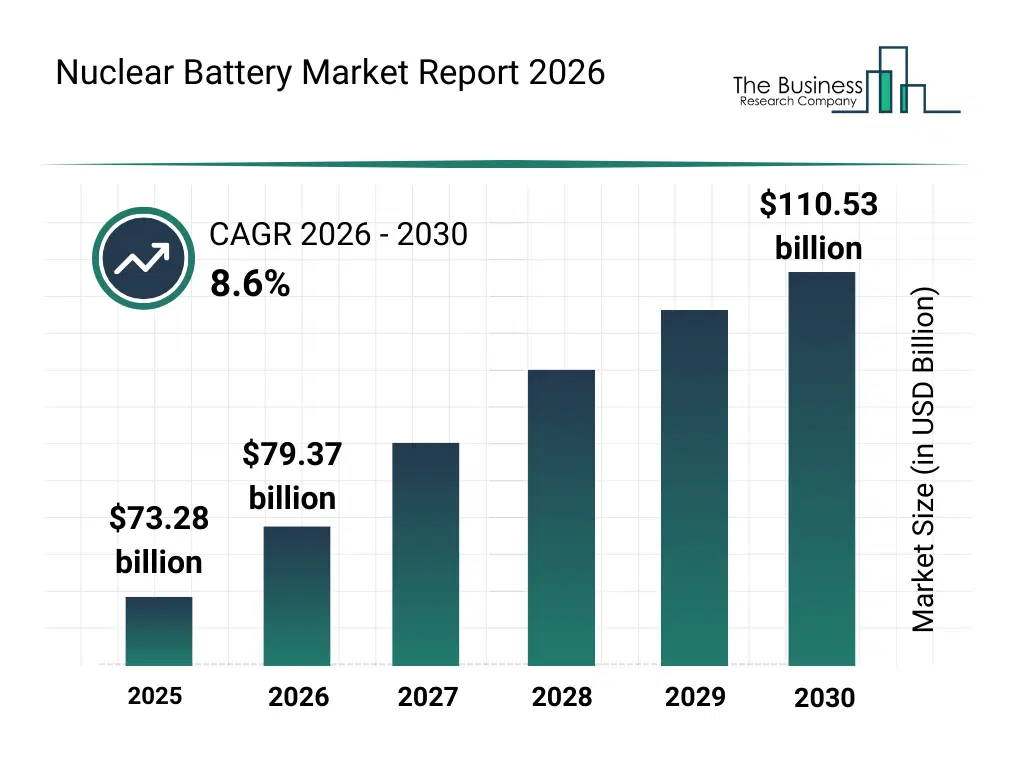
What Is The Nuclear Battery Market Size and Share 2026?
The nuclear battery market size has grown strongly in recent years. It will grow from $73.28 billion in 2025 to $79.37 billion in 2026 at a compound annual growth rate (CAGR) of 8.3%. The growth in the historic period can be attributed to advancements in radioisotope energy conversion, use of nuclear batteries in space missions, demand for long-duration remote power, early adoption in medical implants, availability of specialized radioactive materials.What Is The Nuclear Battery Market Growth Forecast?
The nuclear battery market size is expected to see strong growth in the next few years. It will grow to $110.53 billion in 2030 at a compound annual growth rate (CAGR) of 8.6%. The growth in the forecast period can be attributed to increasing investments in space exploration programs, rising demand for ultra-long-life power sources, expansion of autonomous remote monitoring systems, growing applications in defense and aerospace, advancements in safe nuclear material handling. Major trends in the forecast period include increasing development of long-life nuclear power sources, rising use of betavoltaic energy conversion, growing demand for maintenance-free power systems, expansion of micro-power applications, enhanced focus on radiation safety.
Global Nuclear Battery Market Segmentation
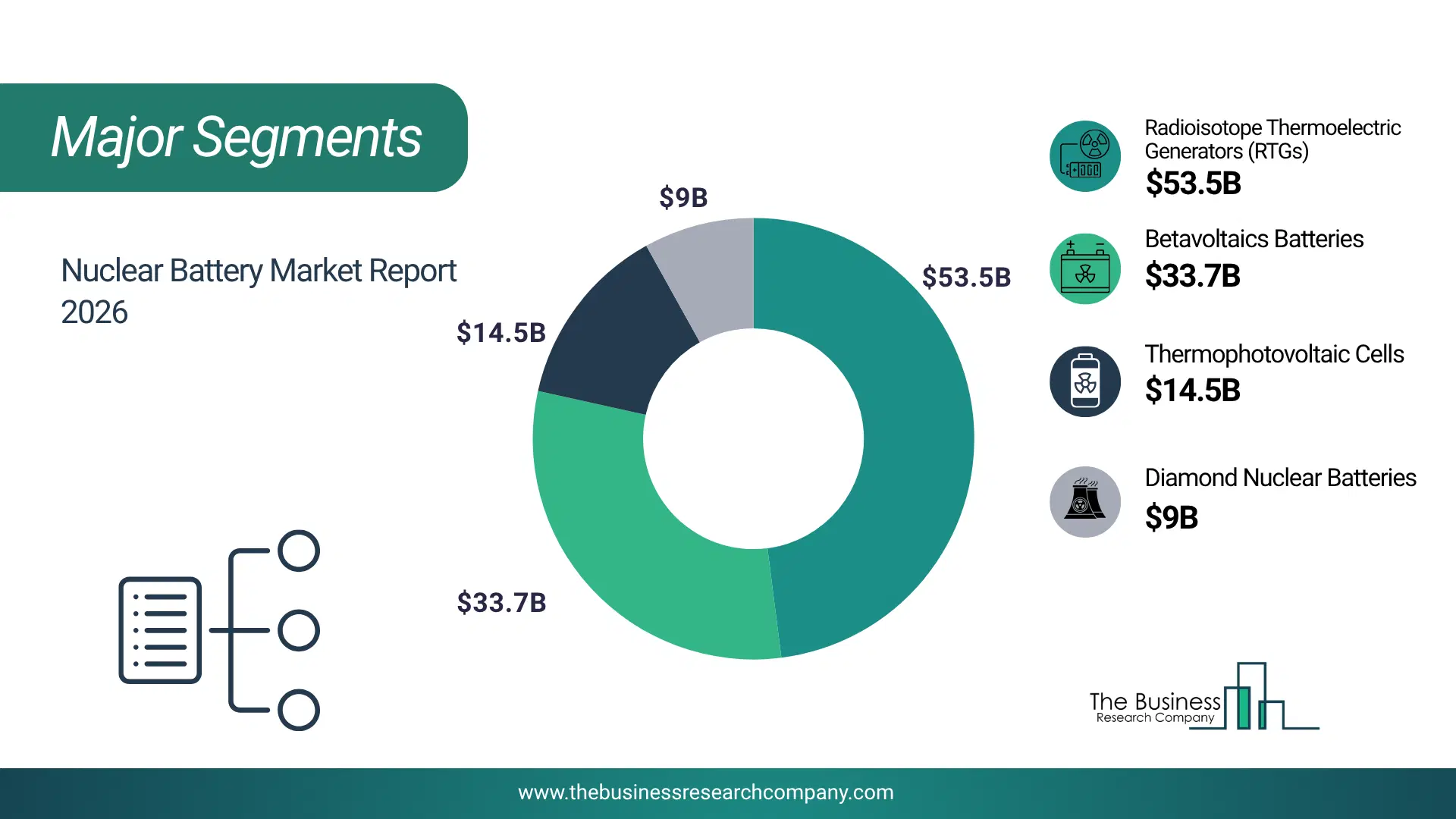
1) By Type: Radioisotope Thermoelectric Generators (RTGs), Betavoltaics Batteries, Thermophotovoltaic Cells, Diamond Nuclear Batteries 2) By Conversion: Thermal Conversion, Non-Thermal Conversion 3) By Power Output: Low-Power, Medium-Power, High-Power 4) By Application: Aerospace And Defense, Medical Devices, Consumer Electronics, Industrial Applications, Remote Power Systems 5) By End-User Industry: Automotive, Telecommunications, Healthcare, Military And Defense, Energy Sector Subsegments: 1) By Radioisotope Thermoelectric Generators (RTGs): Space Exploration Radioisotope Thermoelectric Generators, Remote Sensing Radioisotope Thermoelectric Generators, Deep Space Mission Radioisotope Thermoelectric Generators 2) By Betavoltaics Batteries: Medical Devices Betavoltaics, Aerospace Betavoltaics, Remote Sensor Betavoltaics, Military Applications Betavoltaics 3) By Thermophotovoltaic Cells: Industrial Thermophotovoltaic Cells, Space Applications Thermophotovoltaic Cells, Remote Sensing Thermophotovoltaic Cells, Military Thermophotovoltaic Cells 4) By Diamond Nuclear Batteries: Microelectronics Diamond Batteries, Aerospace Diamond Batteries, Medical Diamond Batteries, Deep-Space Diamond Batteries The top segments in the nuclear battery market will be: • Radioisotope Thermoelectric Generators (RTGs) will reach $53.49 billion by 2030. • Betavoltaics Batteries will reach $33.67 billion by 2030. • Thermophotovoltaic Cells will reach $14.42 billion by 2030. • Diamond Nuclear Batteries will reach $8.95 billion by 2030.What Is The Driver Of The Nuclear Battery Market?
The increasing expansion of defense and military applications is expected to drive the growth in the nuclear battery market going forward. Defense and military applications refer to the use of technologies, equipment, and systems specifically designed to support national security, combat operations, surveillance, intelligence gathering, and strategic defense missions. The rise in expansion of defense and military applications is driven by the need for enhanced national security, as advanced technologies improve surveillance, intelligence gathering, and operational efficiency in complex environments. Nuclear batteries help rise in the expansion of defense and military applications by providing a compact, reliable, and long-lasting power source that supports critical operations in remote, high-risk, and mission-critical environments. For instance, in April 2024, according to the Cabinet Office, a UK-based government department, defense spending will rise to £87 billion in 2030–31, representing a £23 billion ($28.65 billion) increase compared to the £64 billion ($79.68 billion) planned for 2024–25, with investment growing to 2.5% of GDP by 2030, marking one of the largest defense expansions in a generation. Therefore, increasing expansion of defense and military application is driving the growth of the nuclear battery industry.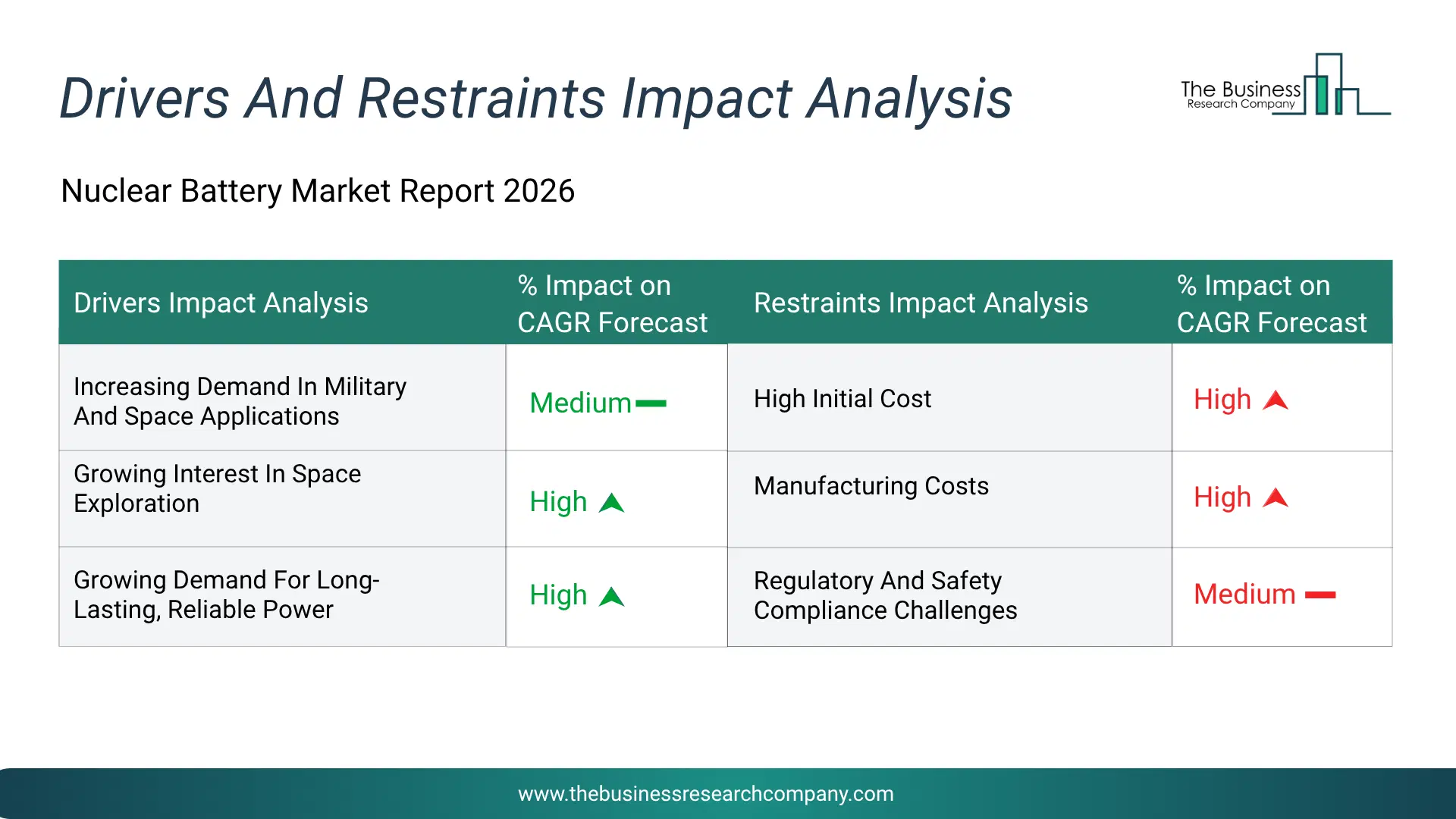
Infographic Chart Showing Key Market Drivers Analysis And Restraints For Nuclear Battery Market
The chart presents an impact analysis of key drivers and restraints, quantifying their relative influence on the market's growth rate and helping assess the balance between growth enablers and limiting factors. This chart offers a high-level perspective; the full report contains more detailed insights.
How Will The Drivers Impact Growth In The Global Nuclear Battery Market?
• Increasing Demand In Military And Space Applications (Medium) – During the forecast period, the increasing demand in military and space applications is expected to become a key growth driver for the nuclear battery market by 2030. Military and space systems require highly reliable and long-lasting power sources capable of operating in extreme and inaccessible environments where conventional batteries are not practical. Nuclear batteries provide continuous, maintenance-free power over extended periods, making them ideal for satellites, space probes, unmanned defense systems, and remote sensing equipment. Their compact size, durability, and ability to function under extreme temperature and radiation conditions further enhance their suitability for critical missions. Additionally, growing investments in advanced defense technologies and space infrastructure are accelerating the adoption of nuclear battery solutions. Collectively, these factors support steady market growth by directly linking defense and space modernization with increased nuclear battery deployment. • Growing Interest In Space Exploration (High) – During the forecast period, the growing interest in space exploration is expected to emerge as a major factor driving the expansion of the nuclear battery market by 2030. Space exploration missions require reliable, long-lasting power sources capable of operating for years without maintenance or replacement. Nuclear batteries are essential for powering spacecraft, planetary rovers, satellites, and deep-space probes, where solar and conventional battery solutions may be insufficient. The increasing number of government-led and private space missions, including lunar exploration and mars programs, is significantly increasing demand for advanced energy solutions. Furthermore, nuclear batteries enable extended mission durations and improved operational reliability, making them critical for future deep-space exploration initiatives. • Growing Demand For Long-Lasting, Reliable Power (High) – During the forecast period, the growing demand for long-lasting, reliable power is expected to act as a key growth catalyst for the nuclear battery market by 2030. Nuclear batteries provide continuous power for extended periods, often lasting several years without requiring maintenance or replacement. This capability makes them highly suitable for applications in remote, harsh, and mission-critical environments such as defense systems, space technologies, remote monitoring equipment, and specialized industrial devices. Their reliability reduces operational risks and maintenance costs while ensuring uninterrupted performance. Additionally, increasing reliance on autonomous systems and remote technologies is driving demand for dependable long-duration energy sources.How Will The Restraints Impact Growth In The Global Nuclear Battery Market?
• High Initial Cost (High) – During the forecast period, the high initial costs act as a significant restraint for the adoption of nuclear batteries because the production and handling of radioactive materials require advanced technology, strict safety protocols, and specialized infrastructure. These expenses make nuclear batteries less accessible for widespread commercial use compared to conventional energy sources. The upfront investment often deters smaller companies or research institutions from opting for these batteries. Additionally, regulatory compliance and long-term safety monitoring further increase the financial burden. As a result, despite their long lifespan and efficiency, the high initial cost limits market growth and adoption. • Manufacturing Costs (High) – During the forecast period, the high manufacturing costs significantly restrain the growth of the nuclear battery market. The production of nuclear batteries involves expensive radioactive materials, precision engineering, and strict safety compliance, which collectively drive up overall costs. These elevated costs make nuclear batteries less competitive compared to conventional energy sources. Additionally, the need for specialized facilities and skilled personnel further increases the financial burden. As a result, many potential applications, especially in commercial and consumer markets, are limited due to cost constraints. • Regulatory And Safety Compliance Challenges (Medium) – During the forecast period, the regulatory and safety compliance challenges act as a restraint for the nuclear battery market by creating strict approval requirements for the handling, transportation, and disposal of radioactive materials. These regulations demand extensive testing, certification, and continuous monitoring to ensure environmental and human safety. Meeting these standards increases development time and overall project costs for manufacturers. Additionally, varying regulations across regions make global commercialization more complex and slower. As a result, these compliance barriers limit large-scale adoption and slow market expansion.Key Players In The Global Nuclear Battery Market
Major companies operating in the nuclear battery market are City Labs Inc., BetaBatt Inc., Widetronix Inc., Nusano Inc., Qynergy Corporation, Atomiq Inc., Betavolt New Energy Technology, NDB Inc (Nano Diamond Batteries), Infinity Power, Zeno Power, Arkenlight, Thermo PV, II‑VI Incorporated, Gem Systems Inc., Front Edge Technology Inc., Alpha Omega Power Technologies LLC, Nuclear Battery Corporation, Tritium Pty Ltd, StarCore Nuclear, Advanced Diamond Technologies, TRIUMF Isotopes, L3Harris Technologies, Lockheed Martin Space, Northrop Grumman, Radioisotope Power Systems (NASA)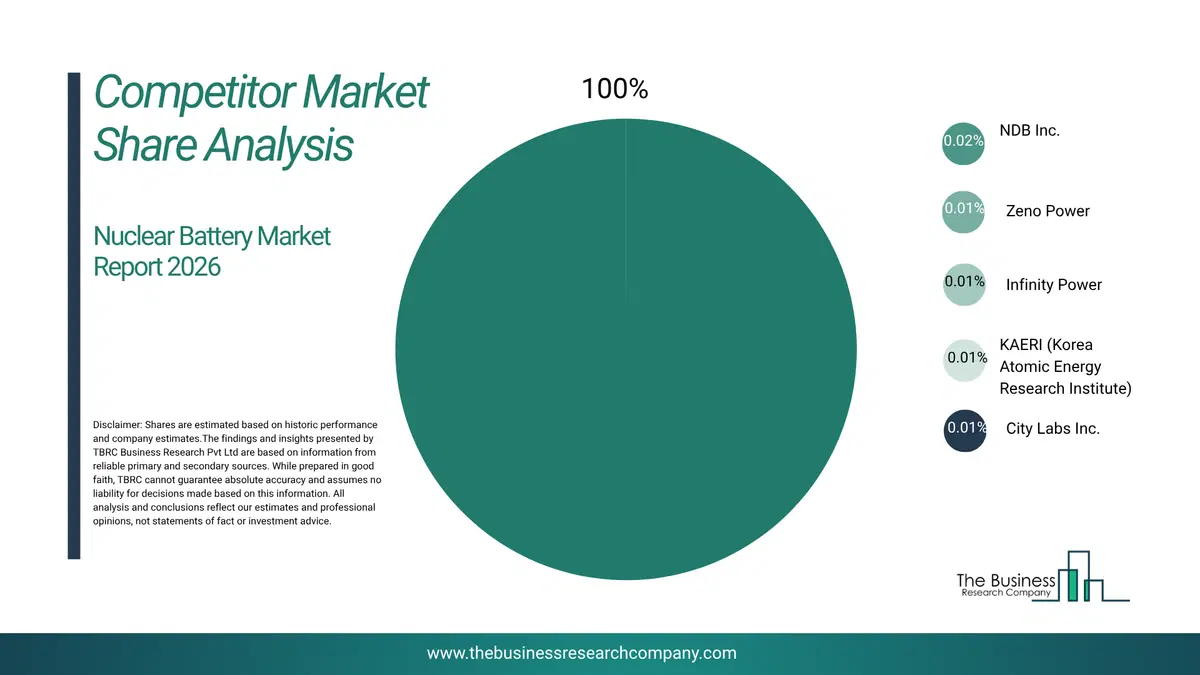
This chart is for illustrative purposes; the full report includes a detailed competitor analysis and comprehensive overview of the top 10 companies in the market.
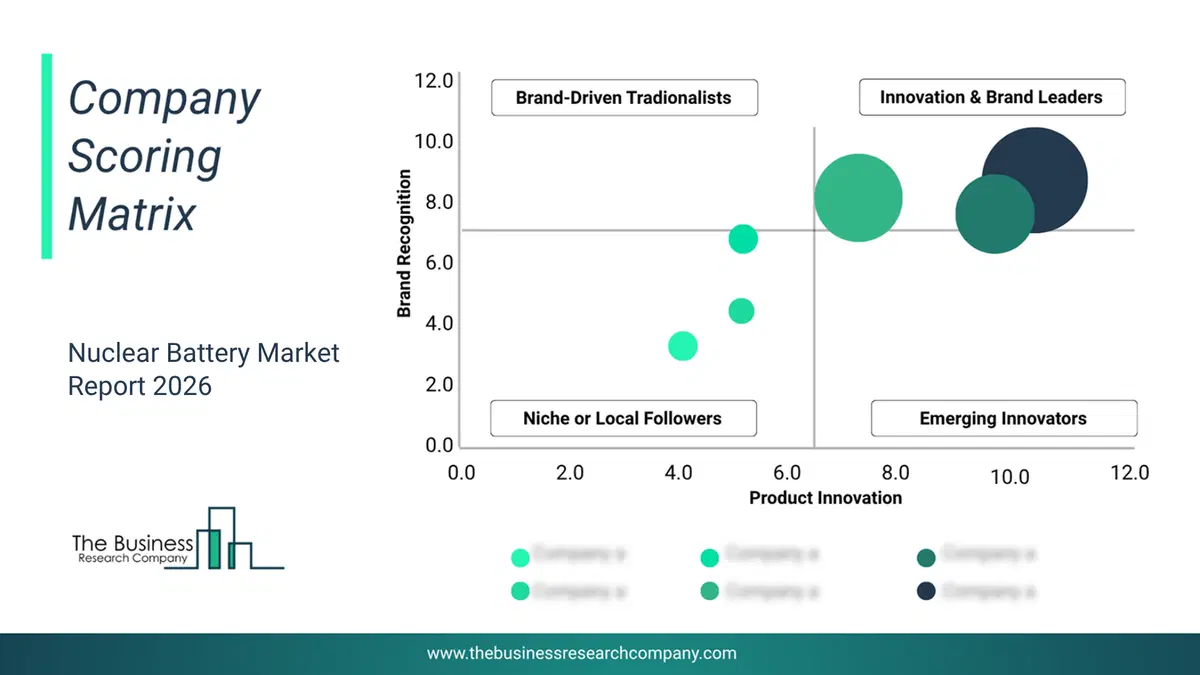
This chart maps companies by product innovation and brand strength, with bubble size indicating relative revenue, helping identify market leaders, challengers, and niche players. This is an illustrative chart; the full report provides a complete and accurate competitive analysis.
Global Nuclear Battery Market Trends and Insights
Major companies operating in the nuclear battery market are focusing on developing advanced products, such as radioisotope-based electrochemical systems, to deliver reliable and high-density energy for advanced applications. A radioisotope-based electrochemical system refers to a power generation device that uses the energy released from the decay of radioisotopes to drive an electrochemical process for producing electricity. For instance, in June 2024, Infinity Power Solutions Inc., a US-based electrical contracting company, launched a high-efficiency nuclear battery featuring a novel electrochemical energy conversion method with radioisotopes. The new battery is engineered to deliver compact and long-lasting power for remote sensors, medical implants, and aerospace equipment, ensuring stable energy output for decades without replacement or recharging. The innovation improves energy density while maintaining high safety standards, making it suitable for demanding and extreme environments. Its extended lifespan reduces maintenance requirements, providing uninterrupted performance for mission-critical applications.What Are Latest Mergers And Acquisitions In The Nuclear Battery Market?
In January 2025, Nano Nuclear Energy Inc., a US-based advanced technology company, acquired major assets of Ultra Safe Nuclear Corporation (USNC) for $8 million. With this acquisition, Nano Nuclear Energy aims to become a leading developer of advanced micro modular reactor technologies and accelerate the deployment of efficient, small-scale nuclear power solutions. Ultra Safe Nuclear Corporation is a US-based company developing radioisotope nuclear batteries for reliable long-term power.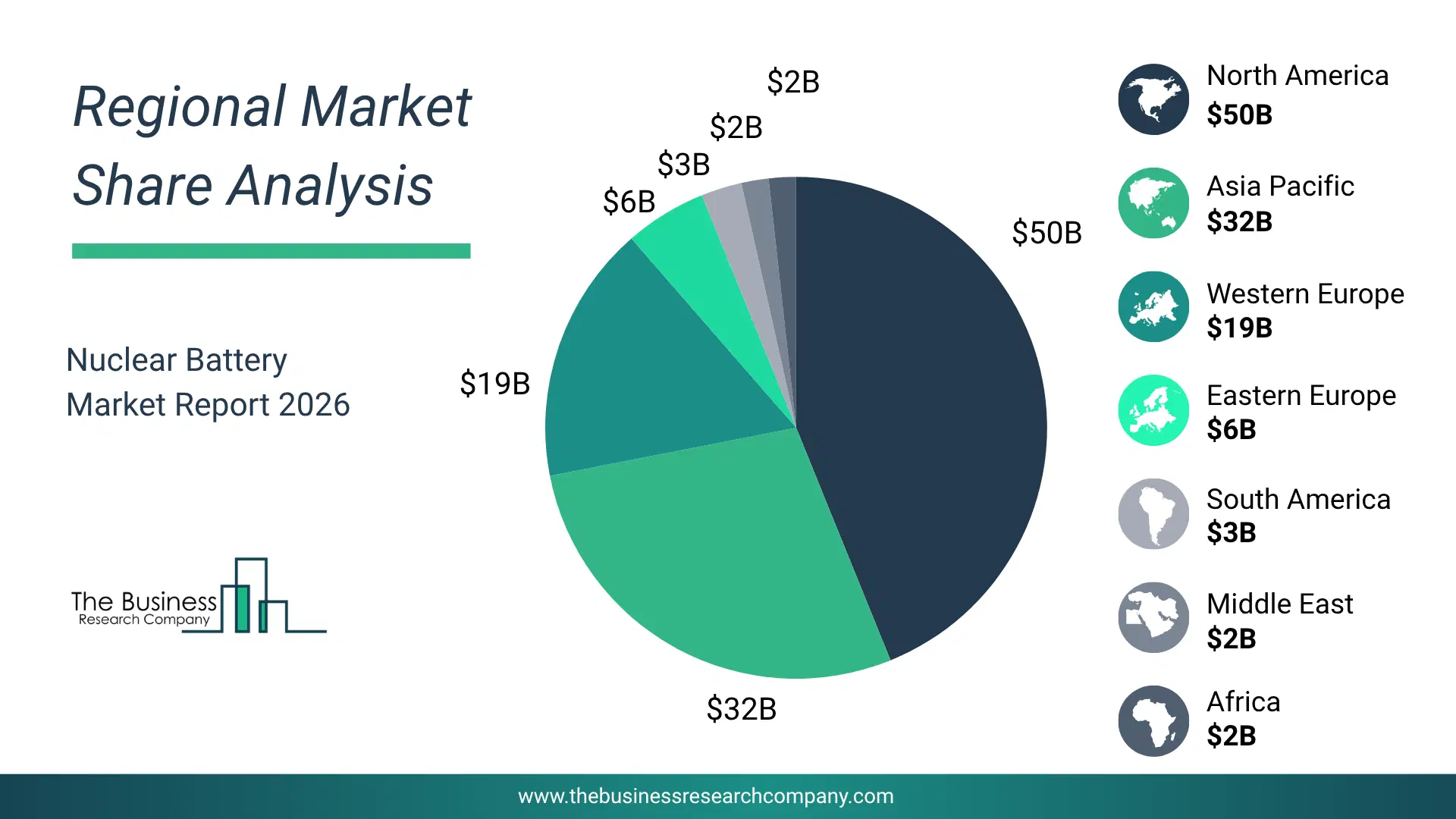
Regional Outlook
North America was the largest region in the nuclear battery market in 2025. Asia-Pacific is expected to be the fastest-growing region in the forecast period. The regions covered in this market report are Asia-Pacific, South East Asia, Western Europe, Eastern Europe, North America, South America, Middle East, Africa. The countries covered in this market report are Australia, Brazil, China, France, Germany, India, Indonesia, Japan, Taiwan, Russia, South Korea, UK, USA, Canada, Italy, SpainWhat Defines the Nuclear Battery Market?
The nuclear battery market consists of sales of radioisotope micro power sources, alpha voltaic cells, nuclear fuel cells, thin-film batteries, and micro batteries. Values in this market are ‘factory gate’ values, that is, the value of goods sold by the manufacturers or creators of the goods, whether to other entities (including downstream manufacturers, wholesalers, distributors, and retailers) or directly to end customers. The value of goods in this market includes related services sold by the creators of the goods.How is Market Value Defined and Measured?
The market value is defined as the revenues that enterprises gain from the sale of goods and/or services within the specified market and geography through sales, grants, or donations in terms of the currency (in USD unless otherwise specified). The revenues for a specified geography are consumption values that are revenues generated by organizations in the specified geography within the market, irrespective of where they are produced. It does not include revenues from resales along the supply chain, either further along the supply chain or as part of other products.
This chart presents market attractiveness based on a quantitative evaluation of growth, competition, strategic alignment, and risk, offering a clear view of opportunity areas for decision-making. This chart is for illustrative purposes; the full report contains the complete analysis.

This chart highlights the Total Addressable Market (TAM) by estimating the maximum revenue opportunity using an assumption-driven approach, supporting strategic planning and opportunity sizing across markets. The chart is illustrative; the full report provides a more comprehensive analysis.
What Key Data and Analysis Are Included in the Nuclear Battery Market Report 2026?
The nuclear battery market research report is one of a series of new reports from The Business Research Company that provides market statistics, including Market Report 2026?global market size, regional shares, competitors with the market share, detailed market segments, market trends and opportunities, and any further data you may need to thrive in the nuclear battery Market Report 2026? The market research report delivers a complete perspective of everything you need, with an in-depth analysis of the current and future state of the Market Report 2026?Nuclear Battery Market Report Forecast Analysis
| Report Attribute | Details |
|---|---|
| Market Size Value In 2026 | $79.37 billion |
| Revenue Forecast In 2030 | $110.53 billion |
| Growth Rate | CAGR of 8.6% from 2026 to 2030 |
| Base Year For Estimation | 2025 |
| Actual Estimates/Historical Data | 2020-2025 |
| Forecast Period | 2026 - 2030 |
| Market Representation | Revenue in USD Billion and CAGR from 2026 to 2030 |
| Segments Covered | Type, Conversion, Power Output, Application, End-User Industry |
| Regional Scope | Asia-Pacific, Western Europe, Eastern Europe, North America, South America, Middle East, Africa |
| Country Scope | The countries covered in the report are Australia, Brazil, China, France, Germany, India, ... |
| Key Companies Profiled | City Labs Inc., BetaBatt Inc., Widetronix Inc., Nusano Inc., Qynergy Corporation, Atomiq Inc., Betavolt New Energy Technology, NDB Inc (Nano Diamond Batteries), Infinity Power, Zeno Power, Arkenlight, Thermo PV, II‑VI Incorporated, Gem Systems Inc., Front Edge Technology Inc., Alpha Omega Power Technologies LLC, Nuclear Battery Corporation, Tritium Pty Ltd, StarCore Nuclear, Advanced Diamond Technologies, TRIUMF Isotopes, L3Harris Technologies, Lockheed Martin Space, Northrop Grumman, Radioisotope Power Systems (NASA) |
| Customization Scope | Request for Customization |
| Pricing And Purchase Options | Explore Purchase Options |