Contact Us
  Search
The Business Research Company Logo
Nuclear Fusion Market 2025
Published :May 2025
Pages :198
Format :PDF
Delivery Time :2-3 Business Days
Why 2-3 days? We update the report with the latest data and news before delivery. Let us know if you need us to expedite.
Report Price :$4,490.00

Nuclear Fusion Market 2025

By Technology (Inertial Confinement, Magnetic Confinement, Other Technologies), By Fuel (Deuterium, Deuterium/Tritium, Deuterium Helium-3, Proton-Boron, Other Fuels), And By Region, Opportunities And Strategies – Global Forecast To 2035

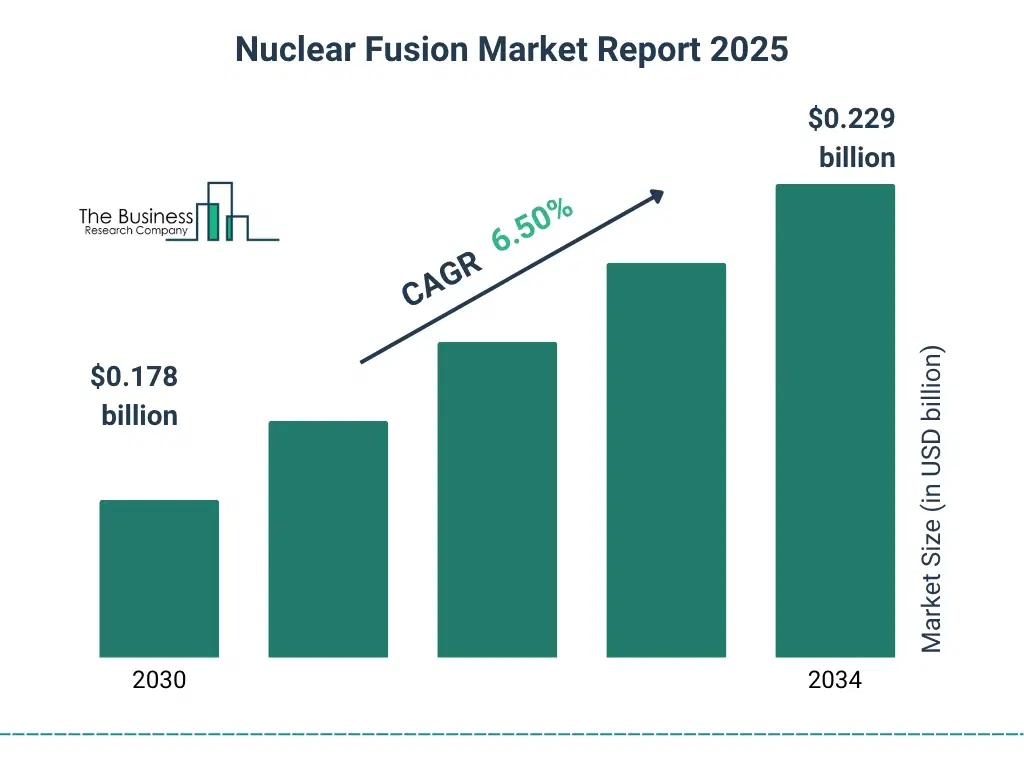
Nuclear Fusion Market Size and growth rate 2025 to 2029: Graph

Nuclear Fusion Market Definition

Nuclear fusion is a process in which two light atomic nuclei combine to form a heavier nucleus, releasing a significant amount of energy in the process. This reaction powers the sun and other stars, where immense gravitational pressure and high temperatures allow hydrogen nuclei to fuse into helium, producing vast amounts of energy. The primary purpose of nuclear fusion research is to develop a sustainable, clean and virtually limitless source of energy. The nuclear fusion market consists of sales, by entities (organizations, sole traders and partnerships) that are primarily used by research institutions, energy companies and governments aiming to develop sustainable energy solutions to meet growing global energy demands. The nuclear fusion market encompasses technologies, equipment and systems designed to replicate this process on Earth for commercial energy production. Nuclear fusion has the potential to produce energy without greenhouse gases and minimal nuclear waste, creating a resource that provides large amounts of energy without adding to global warming. Also, the fuels used for fusion are relatively easy to resource and virtually inexhaustible.

Research Expert

Book your 30 minutes free consultation with our research experts

Nuclear Fusion Market Size

The global nuclear fusion market is expected to grow from $178,022.19 million in 2030 to $229,032.03 million in 2034 at a rate of 6.50%. Going forward, increased government funding for nuclear energy, increasing adoption of renewable energy, rising urbanization and rapid industrialization will drive the growth. Factor that could hinder the growth of the nuclear fusion market in the future include negative impact of economic instabilities.

Nuclear Fusion Market Drivers

The key drivers of the nuclear fusion market include: Increased Government Funding For Nuclear Energy Increased government funding for nuclear energy is expected to propel the growth of the nuclear fusion market going forward. Nuclear energy is energy created by breaking atoms in a reactor to heat water into steam, operate a turbine and generate electricity. Several governments of developed countries are funding nuclear reactors, which increases the demand for the nuclear fusion market. For instance, in January 2024, the UK government reported a comprehensive plan to quadruple the country's nuclear capacity by 2050, aiming to reach 24 gigawatts (GW). This initiative is part of the Civil Nuclear Roadmap, which outlines strategies to enhance energy independence and security, reduce electricity bills and support job creation in the nuclear sector. The government plans to invest up to £300 ($389.5) million in the local production of high-assay low-enriched uranium (HALEU) and is committed to building new large-scale reactors and developing small modular reactors (SMRs) as part of this nuclear revival. Therefore, increased government funding for nuclear energy is driving the growth of the nuclear fusion market.

Nuclear Fusion Market Restraints

The key restraints on the nuclear fusion market include: Negative Impact Of Economic Instabilities Economic uncertainties are anticipated to adversely affect nuclear fusion in the forecast period. Fusion energy, while promising, is still in its experimental stages and the long-term return on investment is uncertain. Economic instability can lead to reduced funding from both public and private sectors, as governments may prioritize immediate needs and corporations may scale back investment in high-risk, high-cost projects. Additionally, shifting economic conditions could divert attention and resources away from clean energy initiatives like nuclear fusion, hindering progress in its commercialization. For instance, in October 2023, according to the International Monetary Fund (IMF), a US-based global organization that promotes economic stability and provides financial assistance to member countries, the projected slowdown in economic expansion anticipates a decline in global growth from 3.5% in 2022 to 3.0% in both 2023 and 2024. Therefore, economic uncertainties can create challenges for the nuclear fusion industry, hindering its expansion and adoption in the market.

Need data on a specific region in this market?

Opportunities And Recommendations In The Nuclear Fusion Market

Opportunities – Recommendations- To take advantage of the opportunities, The Business Research Company recommends the nuclear fusion companies to focus on digital twin technology to accelerate fusion energy development, focus on next-generation stellarator fusion technology, focus on magnetic confinement technology, focus on deuterium/tritium market growth, expand in emerging markets, focus on expanding distribution channels for market growth, focus on developing competitive and flexible pricing strategies, focus on targeted promotion to increase awareness and adoption, focus on building strategic partnerships for effective promotion and focus on targeting end-users across key industries.
Chat with us