

Nutrient Autoanalyzer Market Report 2026
Global Outlook – By Product Type (Continuous Flow Analyzers, Segmented Flow Analyzers, Discrete Analyzers, Portable Nutrient Autoanalyzers, Benchtop Nutrient Autoanalyzers), By Technology (Colorimetric Analysis, Photometric Analysis, Flow Injection Analysis, Spectrophotometric Analysis, Automated Wet Chemistry Analysis), By Distribution Channel (Direct Sales, Distributors), By Application (Environmental Testing, Food And Beverage, Pharmaceuticals, Agriculture, Other Applications), By End User (Research Laboratories, Academic Institutes, Industrial Laboratories, Other End Users) – Market Size, Trends, Strategies, and Forecast to 2030
Nutrient Autoanalyzer Market Overview
• Nutrient Autoanalyzer market size has reached to $1.22 billion in 2025 • Expected to grow to $1.89 billion in 2030 at a compound annual growth rate (CAGR) of 9.2% • Growth Driver: Surge In Industrial Wastewater Monitoring Requirements Fuelling Market Growth Due To Stricter Environmental Regulations And Compliance Needs • Market Trend: Innovations In Portable Nutrient Detection Systems Enhance Real-Time Nutrient Analysis And Agricultural Efficiency • North America was the largest region in 2025 and Asia-Pacific is the fastest growing region.What Is Covered Under Nutrient Autoanalyzer Market?
A nutrient autoanalyzer is an automated analytical instrument used to measure the concentration of nutrients such as nitrogen, phosphorus, silica, and ammonia in liquid samples. It operates through automated chemical analysis techniques that improve testing accuracy, consistency, and processing speed while reducing manual intervention. A nutrient autoanalyzer is widely utilized for monitoring water quality, environmental conditions, and chemical composition in laboratory and research applications. The main product types of nutrient autoanalyzer include continuous flow analyzers, segmented flow analyzers, discrete analyzers, portable nutrient autoanalyzers, and benchtop nutrient autoanalyzers. Continuous flow analyzers refer to automated laboratory instruments designed for high-throughput analysis of nutrient concentrations in various samples. These systems are based on technologies including colorimetric analysis, photometric analysis, flow injection analysis, spectrophotometric analysis, and automated wet chemistry analysis and are distributed through direct sales and distributors. They find application in environmental testing, food and beverage, pharmaceuticals, agriculture, and others, serving end users including research laboratories, academic institutes, industrial laboratories, and others.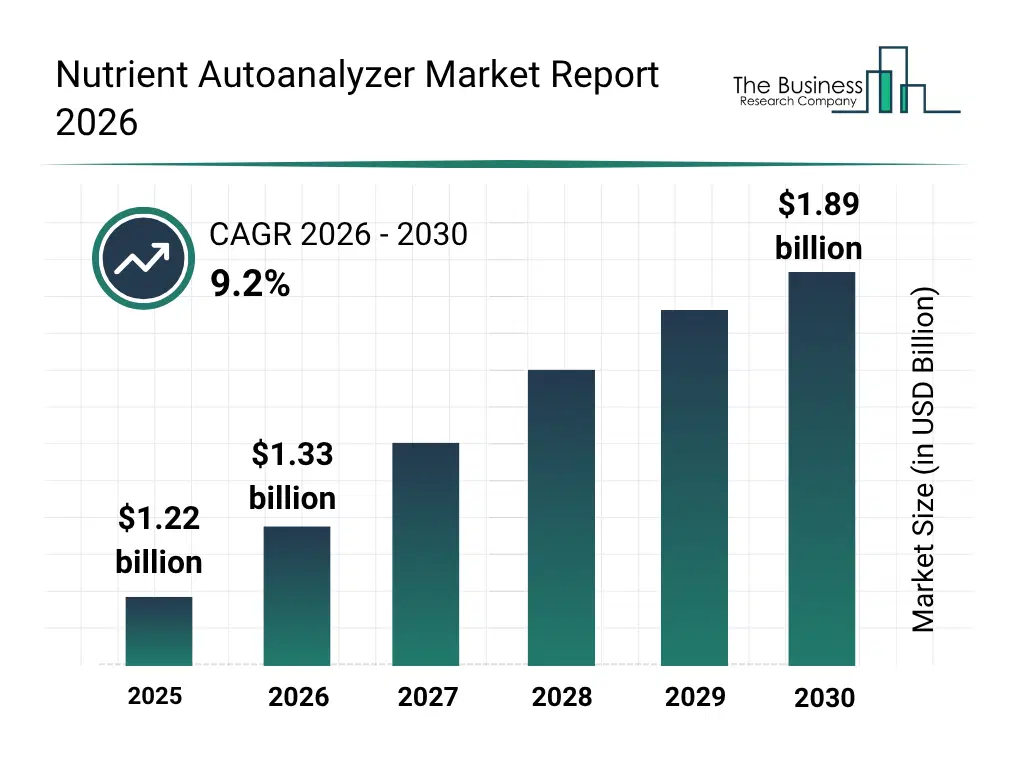
What Is The Nutrient Autoanalyzer Market Size and Share 2026?
The nutrient autoanalyzer market size has grown strongly in recent years. It will grow from $1.22 billion in 2025 to $1.33 billion in 2026 at a compound annual growth rate (CAGR) of 8.9%. The growth in the historic period can be attributed to increasing environmental monitoring regulations, growing investments in water quality assessment programs, rising adoption of laboratory automation technologies, expansion of academic and research laboratory activities, increasing demand for accurate nutrient concentration analysis.What Is The Nutrient Autoanalyzer Market Growth Forecast?
The nutrient autoanalyzer market size is expected to see strong growth in the next few years. It will grow to $1.89 billion in 2030 at a compound annual growth rate (CAGR) of 9.2%. The growth in the forecast period can be attributed to growing deployment of real-time nutrient monitoring systems, rising demand for portable and field-based analytical instruments, increasing integration of cloud-based laboratory data management platforms, expanding industrial wastewater monitoring requirements, growing focus on sustainable resource and ecosystem management. Major trends in the forecast period include increasing adoption of automated water quality monitoring programs, growing demand for high-throughput nutrient testing solutions, rising utilization of portable nutrient analyzers for field-based analysis, expanding focus on multi-parameter nutrient detection capabilities, increasing investments in environmental research and laboratory modernization.
Global Nutrient Autoanalyzer Market Segmentation
1) By Product Type: Continuous Flow Analyzers; Segmented Flow Analyzers; Discrete Analyzers; Portable Nutrient Autoanalyzers; Benchtop Nutrient Autoanalyzers 2) By Technology: Colorimetric Analysis; Photometric Analysis; Flow Injection Analysis; Spectrophotometric Analysis; Automated Wet Chemistry Analysis 3) By Distribution Channel: Direct Sales; Distributors 4) By Application: Environmental Testing; Food And Beverage; Pharmaceuticals; Agriculture; Other Applications 5) By End User: Research Laboratories; Academic Institutes; Industrial Laboratories; Other End Users Subsegments: 1) By Continuous Flow Analyzers: Air Segmented Continuous Flow Analyzers; High Throughput Colorimetric Continuous Flow Analyzers; Wet Chemistry Continuous Flow Analyzers 2) By Segmented Flow Analyzers: Air Segmented Flow Analyzers; Automated Segmented Flow Chemical Analyzers; High Sensitivity Segmented Flow Photometric Analyzers 3) By Discrete Analyzers: Random Access Discrete Analyzers; Batch Discrete Chemical Analyzers; Microplate Based Discrete Photometric Analyzers 4) By Portable Nutrient Autoanalyzers: Handheld Portable Nutrient Analyzers; Field Based Portable Photometric Analyzers; Battery Operated Portable Chemical Analyzers 5) By Benchtop Nutrient Autoanalyzers: Benchtop Photometric Nutrient Analyzers; Benchtop Ion Selective Nutrient Analyzers; Benchtop Multi Parameter Nutrient AnalyzersWhat Are The Drivers Of The Nutrient Autoanalyzer Market?
The growing industrial wastewater monitoring requirements are expected to propel the growth of the nutrient autoanalyzer market going forward. Industrial wastewater monitoring requirements refer to the regulatory standards and procedures for regularly testing and controlling wastewater discharged from industrial facilities to ensure compliance with environmental safety limits. The growing industrial wastewater monitoring requirements are driven by stricter environmental regulations, as governments enforce tighter discharge standards to reduce pollution and protect water quality. A nutrient autoanalyzer helps meet industrial wastewater monitoring requirements by enabling rapid and accurate detection of nutrient levels such as nitrogen and phosphorus in effluents, ensuring regulatory compliance and effective pollution control. For instance, in March 2026, according to the Environment Agency, a UK-based government department, strong performance was achieved in 7,906 onsite inspections by the third quarter (Q3) against a 7,000 target, reaching 113% achievement while progressing toward an annual goal of 10,000 inspections. Therefore, the growing industrial wastewater monitoring requirements are driving the growth of the nutrient autoanalyzer industry. The expansion of precision agriculture is expected to propel the growth of the nutrient autoanalyzer market going forward. Precision agriculture refers to a farming management approach that uses advanced technologies, data analytics, and automation to optimize crop production, improve efficiency, and reduce resource wastage. The expansion of precision agriculture is driven by the increasing adoption of data-driven farming technologies, as they enhance crop yield, optimize resource utilization, and improve overall agricultural efficiency. A nutrient autoanalyzer helps precision agriculture by providing accurate and rapid analysis of soil and water nutrient levels, enabling farmers to optimize fertilizer application, improve crop productivity, and reduce resource wastage. For instance, in January 2024, according to the Government Accountability Office, a US-based government agency, in 2023, 27% of U.S. farms and ranches implemented precision agriculture techniques to manage their crops or livestock. Therefore, the expansion of precision agriculture is driving the growth of the nutrient autoanalyzer industry.Key Players In The Global Nutrient Autoanalyzer Market
Major companies operating in the nutrient autoanalyzer market are Thermo Fisher Scientific Inc.; Xylem Inc.; Endress+Hauser Group Services AG; Shimadzu Corporation; HORIBA Ltd.; Hach Company; FOSS Analytical A/S; Metrohm AG; VELP Scientifica Srl; Skalar Analytical B.V.; AMS Alliance; Seal Analytical Limited; Aqualabo SAS; Systea S.p.A.; Astoria-Pacific International Inc.; Frankstar Technology Group Pte. Ltd.; Tokyo Instrument Co.; SubCtech GmbH; NT Sensors B.V.; EnviroTech Instruments LLCGlobal Nutrient Autoanalyzer Market Trends and Insights
Major companies operating in the nutrient autoanalyzer market are focusing on developing advanced solutions, such as portable nutrient detection systems, to enhance testing speed, improve measurement accuracy, and support real-time decision-making in agriculture and environmental monitoring applications. A portable nutrient detection system is a compact analytical device designed for rapid on-site measurement of nutrient levels in water, soil, or agricultural samples to support environmental monitoring, agriculture, and water quality management. For instance, in August 2025, Nordetect ApS, a US-based electronics company, launched Nora, a portable, calibration-free nutrient analyzer that delivers macronutrient testing results within three minutes using advanced spectrophotometry technology. The system combines the Nora Analyzer, AgroChip cartridges, and a cloud-based analytics platform to simultaneously measure six essential macronutrients, including nitrogen, phosphorus, potassium, calcium, magnesium, and sulfur. It helps growers optimize nutrient management, minimize operational delays, and enhance resource efficiency in controlled environment agriculture facilities.Regional Outlook
North America was the largest region in the nutrient autoanalyzer market in 2025. Asia-Pacific is expected to be the fastest-growing region in the forecast period. The regions covered in this market report are Asia-Pacific, South East Asia, Western Europe, Eastern Europe, North America, South America, Middle East, Africa. The countries covered in this market report are Australia, Brazil, China, France, Germany, India, Indonesia, Japan, Taiwan, Russia, South Korea, UK, USA, Canada, Italy, Spain.What Defines the Nutrient Autoanalyzer Market?
The nutrient autoanalyzer market consists of sales of laboratory cartridges, analyzer probes, sample trays, monitoring instruments, and portable testing devices. Values in this market are ‘factory gate’ values, that is, the value of goods sold by the manufacturers or creators of the goods, whether to other entities (including downstream manufacturers, wholesalers, distributors, and retailers) or directly to end customers. The value of goods in this market includes related services sold by the creators of the goods.How is Market Value Defined and Measured?
The market value is defined as the revenues that enterprises gain from the sale of goods and/or services within the specified market and geography through sales, grants, or donations in terms of the currency (in USD unless otherwise specified). The revenues for a specified geography are consumption values that are revenues generated by organizations in the specified geography within the market, irrespective of where they are produced. It does not include revenues from resales along the supply chain, either further along the supply chain or as part of other products.What Key Data and Analysis Are Included in the Nutrient Autoanalyzer Market Report 2026?
The nutrient autoanalyzer market research report is one of a series of new reports from The Business Research Company that provides market statistics, including industry global market size, regional shares, competitors with the market share, detailed market segments, market trends and opportunities, and any further data you may need to thrive in the nutrient autoanalyzer industry. The market research report delivers a complete perspective of everything you need, with an in-depth analysis of the current and future state of the industry.Nutrient Autoanalyzer Market Report Forecast Analysis
| Report Attribute | Details |
|---|---|
| Market Size Value In 2026 | $1.33 billion |
| Revenue Forecast In 2030 | $1.89 billion |
| Growth Rate | CAGR of 9.2% from 2026 to 2030 |
| Base Year For Estimation | 2025 |
| Actual Estimates/Historical Data | 2020-2025 |
| Forecast Period | 2026 - 2030 |
| Market Representation | Revenue in USD Billion and CAGR from 2026 to 2030 |
| Segments Covered | Product Type, Technology, Distribution Channel, Application, End User |
| Regional Scope | Asia-Pacific, Western Europe, Eastern Europe, North America, South America, Middle East, Africa |
| Country Scope | The countries covered in the report are Australia, Brazil, China, France, Germany, India, ... |
| Key Companies Profiled | Thermo Fisher Scientific Inc.; Xylem Inc.; Endress+Hauser Group Services AG; Shimadzu Corporation; HORIBA Ltd.; Hach Company; FOSS Analytical A/S; Metrohm AG; VELP Scientifica Srl; Skalar Analytical B.V.; AMS Alliance; Seal Analytical Limited; Aqualabo SAS; Systea S.p.A.; Astoria-Pacific International Inc.; Frankstar Technology Group Pte. Ltd.; Tokyo Instrument Co.; SubCtech GmbH; NT Sensors B.V.; EnviroTech Instruments LLC |
| Customization Scope | Request for Customization |
| Pricing And Purchase Options | Explore Purchase Options |