
Object Oriented Databases Market Report 2026
Global Outlook – By Type (Object-Relational Database Management System (DBMS), Pure Object Database Management System (DBMS), Object-Document Database Management System (DBMS), Graph Object Database Management System (DBMS), Other Types), By Deployment (On-Premise, Cloud-Based, Hybrid), By Data Model (Multimedia Data Storage, CAD Or Engineering Data, Scientific Or Research Data, Complex Nested Objects, Other Data Models), By Application (Multimedia Content Management, Engineering And Scientific Data Management, Enterprise Application Development, Analytics And Business Intelligence, Other Applications), By End User (Large Enterprises, Small And Medium Enterprises (SMEs), Government And Public Sector, Research And Academia, Healthcare And Life Sciences, Other End Users) – Market Size, Trends, Strategies, and Forecast to 2030
Object Oriented Databases Market Overview
• Object Oriented Databases market size has reached to $2.58 billion in 2025 • Expected to grow to $2.87 billion in 2030 at a compound annual growth rate (CAGR) of 11.4% • Growth Driver: Rising Adoption Of Cloud-Based Database Solutions Is Fueling The Growth Of The Market Due To Increasing Demand For Scalable And Cost-Efficient Data Management Systems • North America was the largest region in 2025 and Asia-Pacific is the fastest growing region.What Is Covered Under Object Oriented Databases Market?
Object-oriented databases are database management systems that integrate object-oriented programming principles with database technology, enabling the storage, retrieval, and management of complex data structures such as objects, classes, and inheritance hierarchies. They allow seamless handling of multimedia, engineering, and scientific data by supporting encapsulation, polymorphism, and object relationships, thus enhancing data modeling, application development efficiency, and system interoperability in enterprise and analytics environments. The main types of object-oriented databases include object-relational database management system (DBMS), pure object database management system (DBMS), object-document database management system (DBMS), graph object database management system (DBMS), and others. Object-relational database management system (DBMS) refers to a database model that combines relational database capabilities with object-oriented features, enabling the storage of complex data types and relationships within a structured schema. The deployment includes on-premise, cloud-based, and hybrid, and the data models include multimedia data storage, cad or engineering data, scientific or research data, complex nested objects, and others. The application areas include multimedia content management, engineering and scientific data management, enterprise application development, analytics and business intelligence, and others, and the key end users include large enterprises, small and medium enterprises (SMEs), government and public sector, research and academia, as well as healthcare and life sciences along with others.
What Is The Object Oriented Databases Market Size and Share 2026?
The object oriented databases market size has grown rapidly in recent years. It will grow from $2.58 billion in 2025 to $2.87 billion in 2026 at a compound annual growth rate (CAGR) of 11.1%. The growth in the historic period can be attributed to rise of relational database limitations for complex data, increasing demand for multimedia data storage systems, growth of enterprise application development needs, expansion of object oriented programming adoption, emergence of engineering and scientific data requirements.What Is The Object Oriented Databases Market Growth Forecast?
The object oriented databases market size is expected to see rapid growth in the next few years. It will grow to $4.42 billion by 2030 at a compound annual growth rate (CAGR) of 11.4%. The growth in the forecast period can be attributed to increasing demand for AI enabled data modeling systems, rapid adoption of cloud based database platforms, growth in big data and real time analytics workloads, rising need for interoperable and flexible data structures, expansion of graph and semantic data applications. Major trends in the forecast period include AI driven object data modeling and optimization, cloud native object database adoption, graph based object data management expansion, real time analytics on complex object structures, hybrid and multi model object database architectures.
Global Object Oriented Databases Market Segmentation
1) By Type: Object-Relational Database Management System (DBMS), Pure Object Database Management System (DBMS), Object-Document Database Management System (DBMS), Graph Object Database Management System (DBMS), Other Types 2) By Deployment: On-Premise, Cloud-Based, Hybrid 3) By Data Model: Multimedia Data Storage, CAD Or Engineering Data, Scientific Or Research Data, Complex Nested Objects, Other Data Models 4) By Application: Multimedia Content Management, Engineering And Scientific Data Management, Enterprise Application Development, Analytics And Business Intelligence, Other Applications 5) By End User: Large Enterprises, Small And Medium Enterprises (SMEs), Government And Public Sector, Research And Academia, Healthcare And Life Sciences, Other End Users Subsegments: 1) By Object-Relational Database Management System (DBMS): Relational Object Mapping Support, SQL Extension Objects, Table Inheritance Support, Complex Data Type Handling, Stored Procedure Integration 2) By Pure Object Database Management System (DBMS): Object Identity Management, Encapsulation Support, Persistent Object Storage, Class Inheritance Handling, Direct Object Query Processing 3) By Object-Document Database Management System (DBMS): Document Oriented Object Storage, JSON XML Object Mapping, Schema Flexible Object Handling, Nested Object Structure Support, Indexing of Document Objects 4) By Graph Object Database Management System (DBMS): Node Edge Object Modeling, Relationship-Centric Storage, Traversal Query Processing, Property Graph Support, Graph Indexing Mechanisms 5) By Other Types: Hybrid Object Storage Models, Distributed Object Databases, In-Memory Object Databases, Cloud Native Object Databases, Embedded Object Database SystemsWhat Are The Drivers Of The Object Oriented Databases Market?
The rising adoption of cloud-based database solutions is expected to propel the growth of the object-oriented databases market going forward. Cloud-based database solutions refer to database systems that organizations deploy, manage, and access through cloud computing platforms, enabling scalable, on-demand data storage and processing without reliance on on-premise infrastructure. Organizations are increasing cloud-based database solutions' adoption due to the need for cost efficiency and flexible scalability in handling growing volumes of structured and unstructured data. Object-oriented databases support cloud-based database solutions by enabling efficient management of complex and dynamic data structures that align with modern cloud-native applications. For instance, in January 2026, according to Eurostat, a Luxembourg-based statistical organization, 66.78% of medium-sized enterprises used cloud computing services in 2025 compared to 59.09% in 2023, indicating a substantial increase in cloud adoption among businesses. Therefore, the rising adoption of cloud-based database solutions is driving the growth of the object-oriented databases market. The rising demand for complex data modeling is expected to propel the growth of the object-oriented databases market going forward. Complex data modeling refers to the process of structuring and managing intricate and interrelated data elements such as objects, hierarchies, and relationships within a database system. The demand for complex data modeling is increasing due to the rapid growth of data-intensive applications such as artificial intelligence and real-time analytics. Object-oriented databases support complex data modeling by enabling direct representation of real-world entities through objects, classes, and inheritance, which improves data consistency and development efficiency. For instance, in October 2023, according to NetApp, a US-based cloud data company, 98% of organizations reported being impacted by increasing cloud and data complexity, highlighting the growing need for advanced data management and modeling solutions to handle interconnected and multi-structured data environments. Therefore, the rising demand for complex data modeling is driving the growth of the object-oriented databases market. The rising production of digital content is expected to propel the growth of the object-oriented databases market going forward. Digital content production refers to the creation, storage, and distribution of data-driven media such as videos, images, text, and interactive formats across online platforms. The growth in digital content production is largely driven by expanding global internet access, as more users come online across regions, generating exponentially larger volumes of content that must be stored, retrieved, and managed efficiently. The increasing scale and complexity of digitally produced content intensifies the need for flexible, high-performance database systems capable of handling diverse, unstructured data types natively. For instance, in February 2025, according to Canto, a US-based digital asset management solutions provider, 77% of content and creative professionals produced more digital content in 2025, highlighting the increasing volume of content that teams must manage. Therefore, the rising production of digital content is driving the growth of the object-oriented databases market.Key Players In The Global Object Oriented Databases Market
Major companies operating in the object oriented databases market are Microsoft Corporation; International Business Machines Corporation; Oracle Corporation; Fujitsu Limited; Versant Corporation; InterSystems Corporation; Progress Software Corporation; Zope Foundation; Cincom Systems Inc; Chetu Inc; Objective Corporation Limited; InfluxData Inc; Ardentisys Ltd.; Raima Inc; Objectivity Inc; GemTalk Systems LLC; ObjectDB Software Ltd; Itasca Systems Inc; Matisse Software Inc; PuppyGraph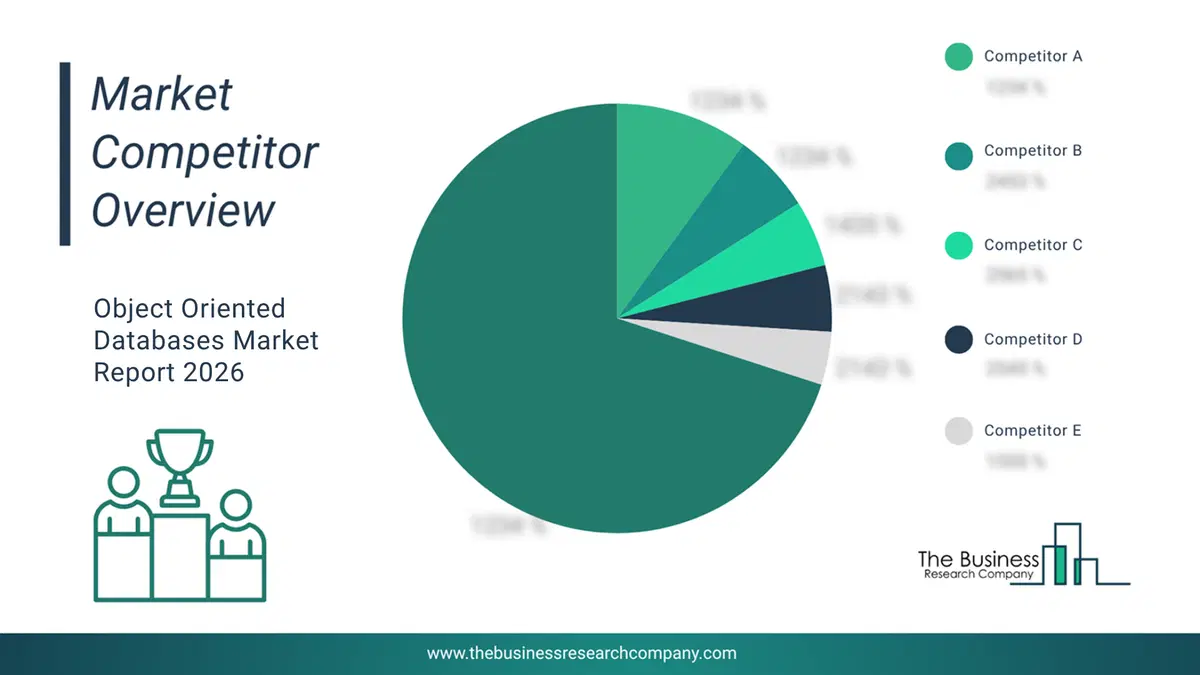
This chart is for illustrative purposes; the full report includes a detailed competitor analysis and comprehensive overview of the top 10 companies in the market.
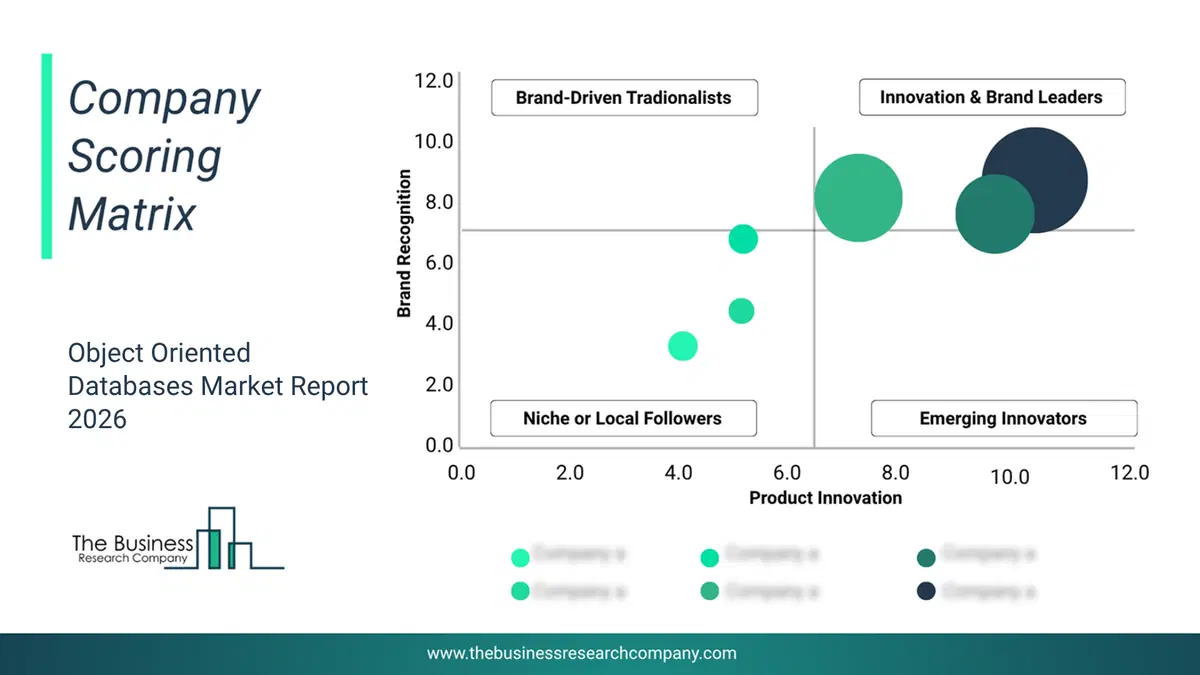
This chart maps companies by product innovation and brand strength, with bubble size indicating relative revenue, helping identify market leaders, challengers, and niche players. This is an illustrative chart; the full report provides a complete and accurate competitive analysis.
Regional Insights
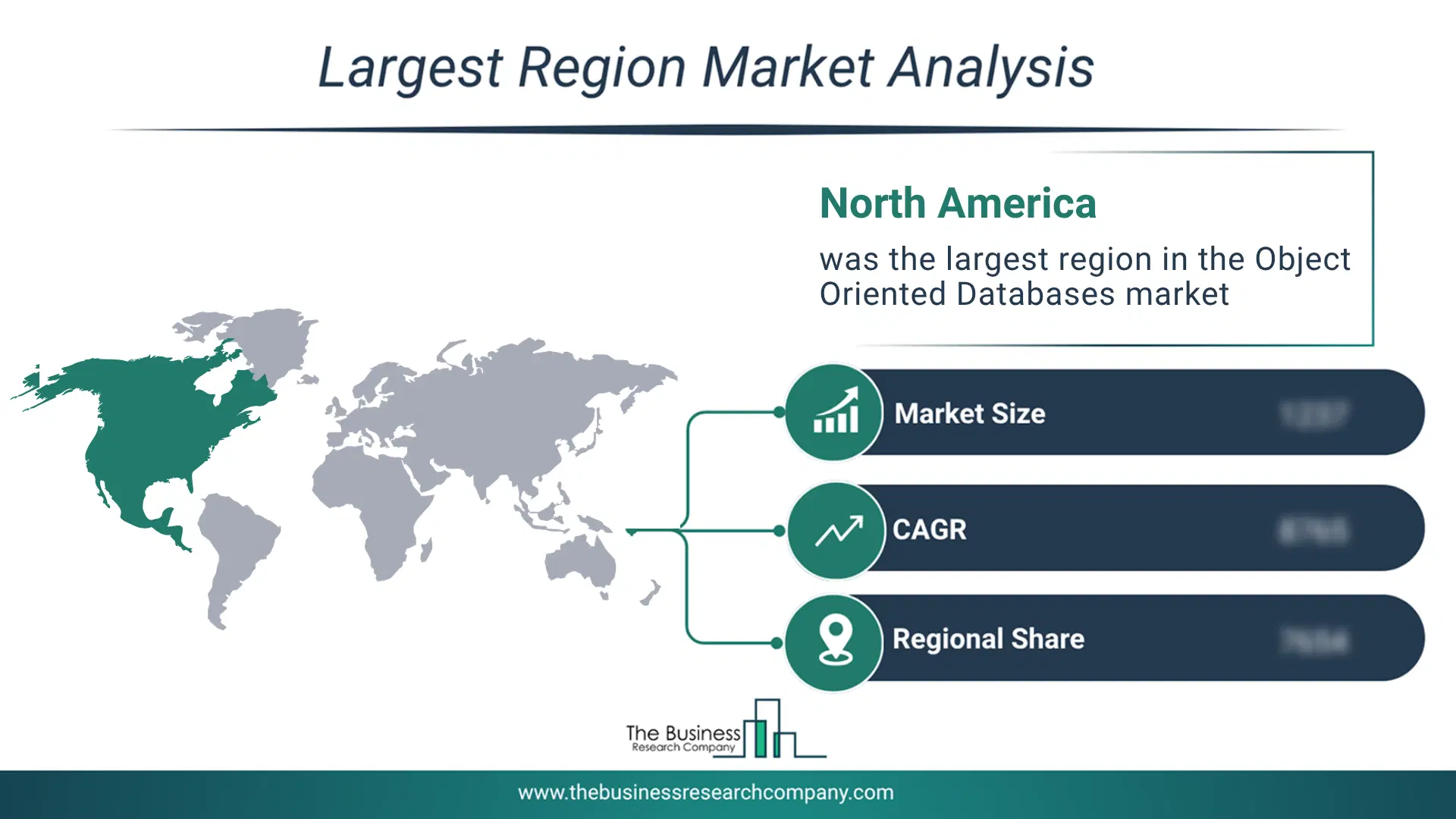
North America was the largest region in the object-oriented databases market in 2025. Asia-Pacific is expected to be the fastest-growing region in the forecast period. The regions covered in this market report are Asia-Pacific, South East Asia, Western Europe, Eastern Europe, North America, South America, Middle East, Africa. The countries covered in this market report are Australia, Brazil, China, France, Germany, India, Indonesia, Japan, Taiwan, Russia, South Korea, UK, USA, Canada, Italy, Spain.What Defines the Object Oriented Databases Market?
The object-oriented databases market consists of revenues earned by entities by providing services such as database design, development, implementation, integration, maintenance, performance optimization, and support. The market value includes the value of related software products sold by the service provider or included within the service offering. The market value includes the value of related goods sold by the service provider or included within the service offering. Only goods and services traded between entities or sold to end consumers are included.How is Market Value Defined and Measured?
The market value is defined as the revenues that enterprises gain from the sale of goods and/or services within the specified market and geography through sales, grants, or donations in terms of the currency (in USD unless otherwise specified). The revenues for a specified geography are consumption values that are revenues generated by organizations in the specified geography within the market, irrespective of where they are produced. It does not include revenues from resales along the supply chain, either further along the supply chain or as part of other products.
This chart presents market attractiveness based on a quantitative evaluation of growth, competition, strategic alignment, and risk, offering a clear view of opportunity areas for decision-making. This chart is for illustrative purposes; the full report contains the complete analysis.

This chart highlights the Total Addressable Market (TAM) by estimating the maximum revenue opportunity using an assumption-driven approach, supporting strategic planning and opportunity sizing across markets. The chart is illustrative; the full report provides a more comprehensive analysis.
What Key Data and Analysis Are Included in the Object Oriented Databases Market Report 2026?
The object oriented databases market research report is one of a series of new reports from The Business Research Company that provides market statistics, including industry global market size, regional shares, competitors with the market share, detailed market segments, market trends and opportunities, and any further data you may need to thrive in the object oriented databases industry. The market research report delivers a complete perspective of everything you need, with an in-depth analysis of the current and future state of the industry.Object Oriented Databases Market Report Forecast Analysis
| Report Attribute | Details |
|---|---|
| Market Size Value In 2026 | $2.87 billion |
| Revenue Forecast In 2030 | $4.42 billion |
| Growth Rate | CAGR of 11.4% from 2026 to 2030 |
| Base Year For Estimation | 2025 |
| Actual Estimates/Historical Data | 2020-2025 |
| Forecast Period | 2026 - 2030 |
| Market Representation | Revenue in USD Billion and CAGR from 2026 to 2030 |
| Segments Covered | Type, Deployment, Data Model, Application, End User |
| Regional Scope | Asia-Pacific, Western Europe, Eastern Europe, North America, South America, Middle East, Africa |
| Country Scope | The Countries Covered In This Market Report Are Australia, Brazil, China, France, Germany, India, Indonesia, Japan, Taiwan, Russia, South Korea, Uk, Usa, Canada, Italy, Spain. |
| Key Companies Profiled | Microsoft Corporation, International Business Machines Corporation, Oracle Corporation, Fujitsu Limited, Versant Corporation, InterSystems Corporation, Progress Software Corporation, Zope Foundation, Cincom Systems Inc, Chetu Inc, Objective Corporation Limited, InfluxData Inc, Ardentisys Ltd., Raima Inc, Objectivity Inc, GemTalk Systems LLC, ObjectDB Software Ltd, Itasca Systems Inc, Matisse Software Inc, PuppyGraph |
| Customization Scope | Request for Customization |
| Pricing And Purchase Options | Explore Purchase Options |