
OEKO-TEX Sustainable Textile And Leather Production (STeP) Certification Market Report 2026
Global Outlook – By Certification Type (Production Facilities Certification, Brands And Retailers Certification, Chemical Management Certification, Environmental Performance Certification, Social Responsibility Certification, Workplace Health And Safety Certification, Quality Management Certification), By Supply Chain Stage (Raw Material Processing, Wet Processing, Cut Make Trim Or Garment Assembly, Finished Product Branding And Retail), By Application (Textiles, Apparel, Footwear, Home Furnishings, Chemicals, Other Applications), By End User (Manufacturers, Brands And Retailers, Suppliers, Other End Users) – Market Size, Trends, Strategies, and Forecast to 2030
OEKO-TEX Sustainable Textile And Leather Production (STeP) Certification Market Overview
• OEKO-TEX Sustainable Textile And Leather Production (STeP) Certification market size has reached to $1.61 billion in 2025 • Expected to grow to $2.68 billion in 2030 at a compound annual growth rate (CAGR) of 10.6% • Growth Driver: The Rising Demand For Sustainable Textiles Driving The Growth Of The Market Due To Growing Environmental Concerns • Market Trend: Sustainability Certification Standards Expand To Integrate Biodiversity Protection And Circular Production Requirements In Textile And Leather Manufacturing • Europe was the largest region in 2025 and Asia-Pacific is the fastest growing region.What Is Covered Under OEKO-TEX Sustainable Textile And Leather Production (STeP) Certification Market?
OEKO-TEX sustainable textile and leather production (STeP) certification is a comprehensive, modular assessment and certification system that evaluates textile and leather manufacturing facilities based on environmental performance, chemical management, social responsibility, and quality management. It is designed to help companies demonstrate and improve sustainable production practices across their entire supply chain in compliance with internationally recognized sustainability standards. The main certification types of OEKO-TEX sustainable textile and leather production (STeP) certification include production facilities certification, brands and retailers certification, chemical management certification, environmental performance certification, social responsibility certification, workplace health and safety certification, and quality management certification. Production facilities certification refers to the evaluation and certification of textile and leather production units based on sustainable manufacturing practices, resource efficiency, environmental protection, and responsible working conditions. These certifications are applied across raw material processing, wet processing, cut make trim or garment assembly, and finished product branding and retail stages. The key applications of textiles, apparel, footwear, home furnishings, chemicals, and others, while the end-users manufacturers, brands and retailers, suppliers, and others.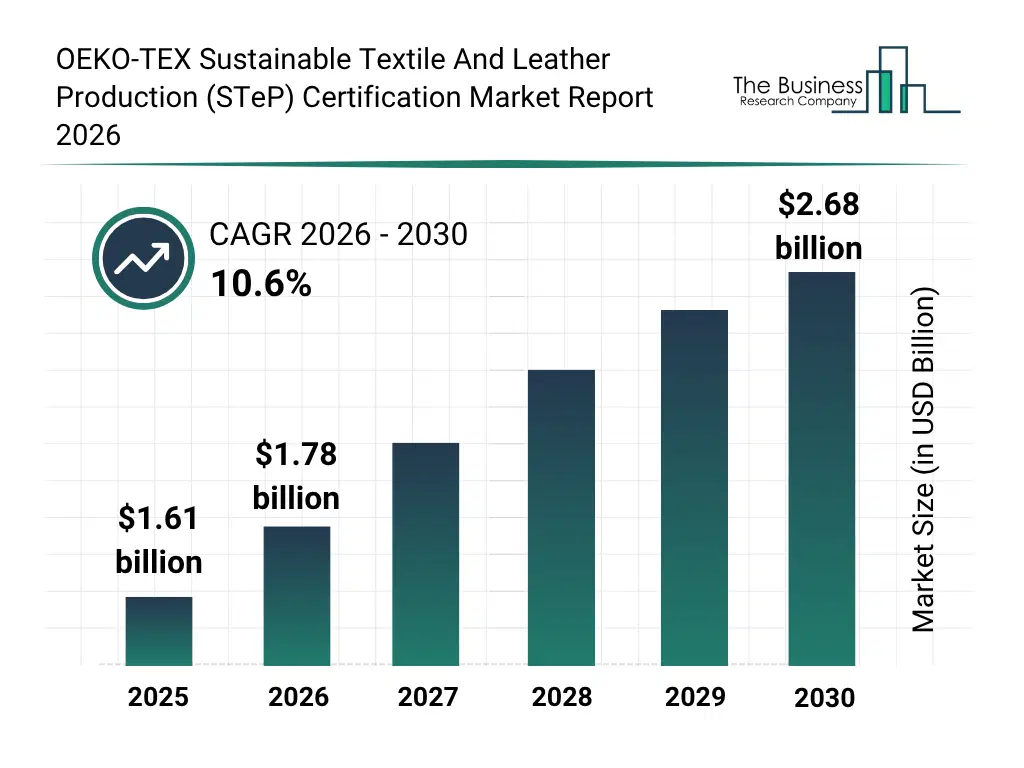
What Is The OEKO-TEX Sustainable Textile And Leather Production (STeP) Certification Market Size and Share 2026?
The oeko-tex sustainable textile and leather production (step) certification market size has grown rapidly in recent years. It will grow from $1.61 billion in 2025 to $1.78 billion in 2026 at a compound annual growth rate (CAGR) of 11.1%. The growth in the historic period can be attributed to increasing awareness of sustainable textile production, rising demand for environmentally responsible fashion products, growing adoption of international textile standards, increasing regulatory focus on chemical safety management, expanding sustainability initiatives among textile manufacturers.What Is The OEKO-TEX Sustainable Textile And Leather Production (STeP) Certification Market Growth Forecast?
The oeko-tex sustainable textile and leather production (step) certification market size is expected to see rapid growth in the next few years. It will grow to $2.68 billion in 2030 at a compound annual growth rate (CAGR) of 10.6%. The growth in the forecast period can be attributed to increasing demand for supply chain transparency, rising adoption of sustainable certification frameworks, growing preference for ethically produced textiles, increasing implementation of environmental compliance practices, expanding sustainability requirements from global brands and retailers. Major trends in the forecast period include increasing adoption of sustainable textile certification programs, growing demand for transparent textile supply chains, rising focus on ethical and responsible manufacturing practices, increasing preference for certified eco friendly textile products, expansion of sustainability compliance requirements in fashion industry.
Global OEKO-TEX Sustainable Textile And Leather Production (STeP) Certification Market Segmentation
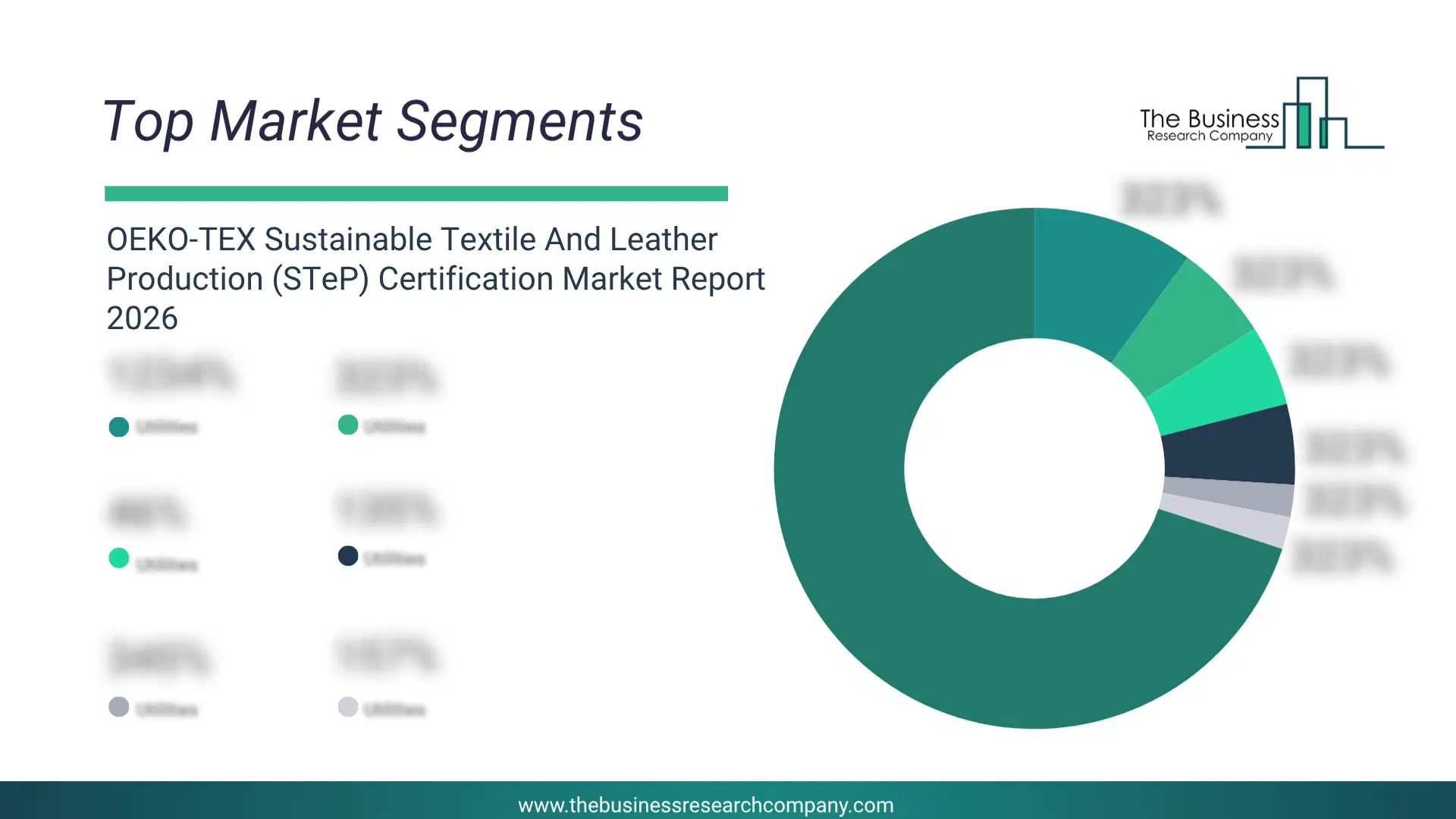
1) By Certification Type: Production Facilities Certification, Brands And Retailers Certification, Chemical Management Certification, Environmental Performance Certification, Social Responsibility Certification, Workplace Health And Safety Certification, Quality Management Certification 2) By Supply Chain Stage: Raw Material Processing, Wet Processing, Cut Make Trim Or Garment Assembly, Finished Product Branding And Retail 3) By Application: Textiles, Apparel, Footwear, Home Furnishings, Chemicals, Other Applications 4) By End User: Manufacturers, Brands And Retailers, Suppliers, Other End Users Subsegments: 1) By Production Facilities Certification: Textile Manufacturing Facilities, Garment Production Facilities, Dyeing And Finishing Facilities, Knitting And Weaving Facilities, Home Textile Production Facilities 2) By Brands And Retailers Certification: Apparel Brands, Footwear Brands, Home Textile Retailers, Fashion Retail Chains, Private Label Retailers 3) By Chemical Management Certification: Chemical Inventory Management, Restricted Substance Management, Chemical Risk Assessment, Chemical Storage Management, Sustainable Chemical Usage 4) By Environmental Performance Certification: Energy Efficiency Management, Water Resource Management, Waste Management Practices, Emissions Control Management, Environmental Compliance Management 5) By Social Responsibility Certification: Labor Rights Compliance, Fair Wage Practices, Employee Welfare Programs, Diversity And Inclusion Management, Community Engagement Practices 6) By Workplace Health And Safety Certification: Occupational Safety Management, Workplace Risk Prevention, Employee Health Protection, Emergency Preparedness Management, Accident Prevention Programs 7) By Quality Management Certification: Product Quality Assurance, Process Quality Control, Supplier Quality Management, Continuous Improvement Management, Customer Satisfaction ManagementWhat Is The Driver Of The OEKO-TEX Sustainable Textile And Leather Production (STeP) Certification Market?
The rising demand for sustainable textiles is expected to propel the growth of the Oeko-Tex sustainable textile and leather production (STEP) certification market going forward. Sustainable textiles refer to fabrics and textile products that are produced, used, and disposed of in ways that minimize environmental impact, conserve natural resources, and ensure social responsibility throughout the supply chain. Rising demand for sustainable textiles is primarily driven by growing environmental concerns about pollution and textile waste, along with increasing consumer awareness and pressure on brands to adopt eco-friendly and resource-efficient production practices. OEKO-TEX sustainable textile and leather production (STeP) Certification advances sustainable textiles by establishing a rigorous facility-level framework that promotes environmentally responsible practices, social compliance, and resource-efficient production across the textile and leather value chain. For instance, in March 2025, according to the United Nations Environment Programme (UNEP), a Kenya-based authority for the environment, in 2023 around 8% of textile fibres were produced from recycled materials. Therefore, the rising demand for sustainable textiles is driving the growth of the Oeko-Tex sustainable textile and leather production certification market.Key Players In The Global OEKO-TEX Sustainable Textile And Leather Production (STeP) Certification Market
Major companies operating in the oeko-tex sustainable textile and leather production (step) certification market are SGS SA, Bureau Veritas SA, TÜV Rheinland AG, QIMA Limited, TESTEX AG, Centexbel, FITI Testing and Research Institute, Shirley Technologies Limited, Bönningheimer Textilforschung Hohenstein e.V., Centro Tessile Cotoniero e Abbigliamento S.p.A., IDFL Laboratory and Institute Inc., CITEVE – Centro Tecnológico das Indústrias Têxtil e do Vestuário, MIRTEC S.A., OEKO-TEX Service GmbH, Prüf- und Forschungsinstitut Pirmasens e.V., INNOVATEXT Textilipari Műszaki Kutató és Vizsgáló Kft., VÚTCH-CHEMITEX spol. s r.o., FILK Freiberg Institute gGmbH, Intertek Group plc, Eurofins Product Testing, Cotecna Inspection SA, Kiwa NV, UL LLC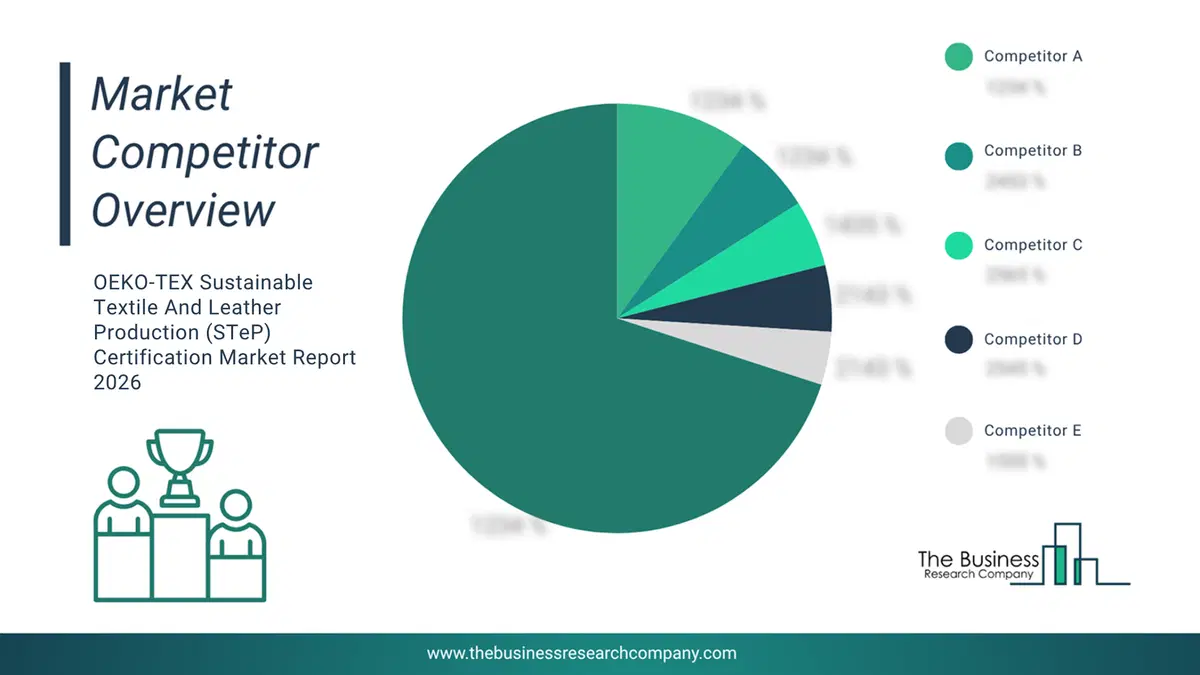
This chart is for illustrative purposes; the full report includes a detailed competitor analysis and comprehensive overview of the top 10 companies in the market.
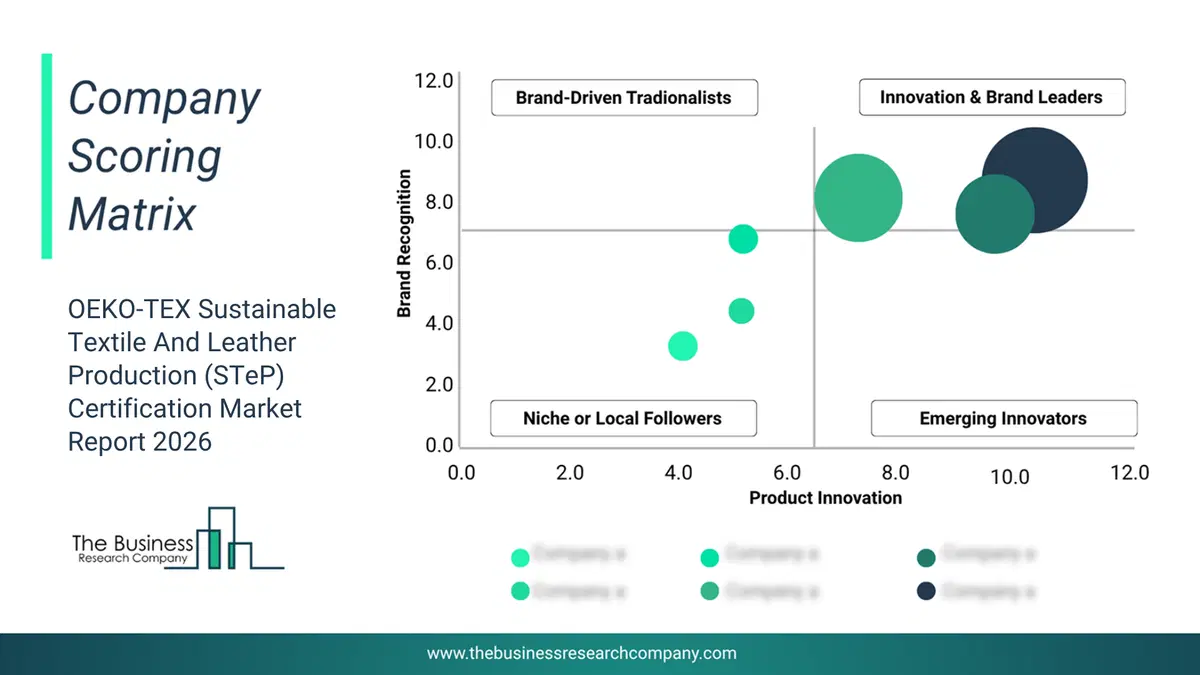
This chart maps companies by product innovation and brand strength, with bubble size indicating relative revenue, helping identify market leaders, challengers, and niche players. This is an illustrative chart; the full report provides a complete and accurate competitive analysis.
Global OEKO-TEX Sustainable Textile And Leather Production (STeP) Certification Market Trends and Insights
Major companies operating in the OEKO-TEX sustainable textile and leather production (Step) certification market are focusing on developing innovative solutions, such as sustainability criteria expansion to include biodiversity protection, circular production practices, and stricter environmental and social compliance across textile and leather supply chains. Sustainability criteria expansion refers to the process of broadening environmental, social, and governance requirements in standards or certifications to cover additional impacts such as biodiversity protection, carbon emissions, resource efficiency, and circular economy practices. For instance, in September 2025, OEKO-TEX, a Switzerland-based association, partnered with the Global Nature Fund (GNF), a Germany-based private nonprofit environmental foundation, and updated its STeP standard to add explicit biodiversity requirements for certified production sites. The revised standard requires textile and leather manufacturers to implement structured biodiversity management systems, including measurable conservation targets and monitoring frameworks. This update is aimed at reducing ecosystem degradation by integrating biodiversity protection directly into industrial sustainability certification requirements.What Are Latest Mergers And Acquisitions In The OEKO-TEX Sustainable Textile And Leather Production (STeP) Certification Market?
In May 2023, ZDHC Foundation, a Netherlands-based organization that promotes sustainable chemical management and environmental performance across the textile, apparel, and footwear industries, entered into a strengthened partnership with OEKO-TEX to provide independent testing, certification, and sustainability solutions for the textile and leather industry. Through this partnership, ZDHC Foundation and OEKO-TEX aim to align the ZDHC Supplier to Zero programme with OEKO-TEX STeP certification, helping manufacturers streamline sustainability assessments, improve chemical management practices, and reduce duplication in compliance verification activities. OEKO-TEX is a Switzerland-based international certification organization that develops standardized certification and testing systems for sustainable textile and leather production, product safety, and responsible supply chain management.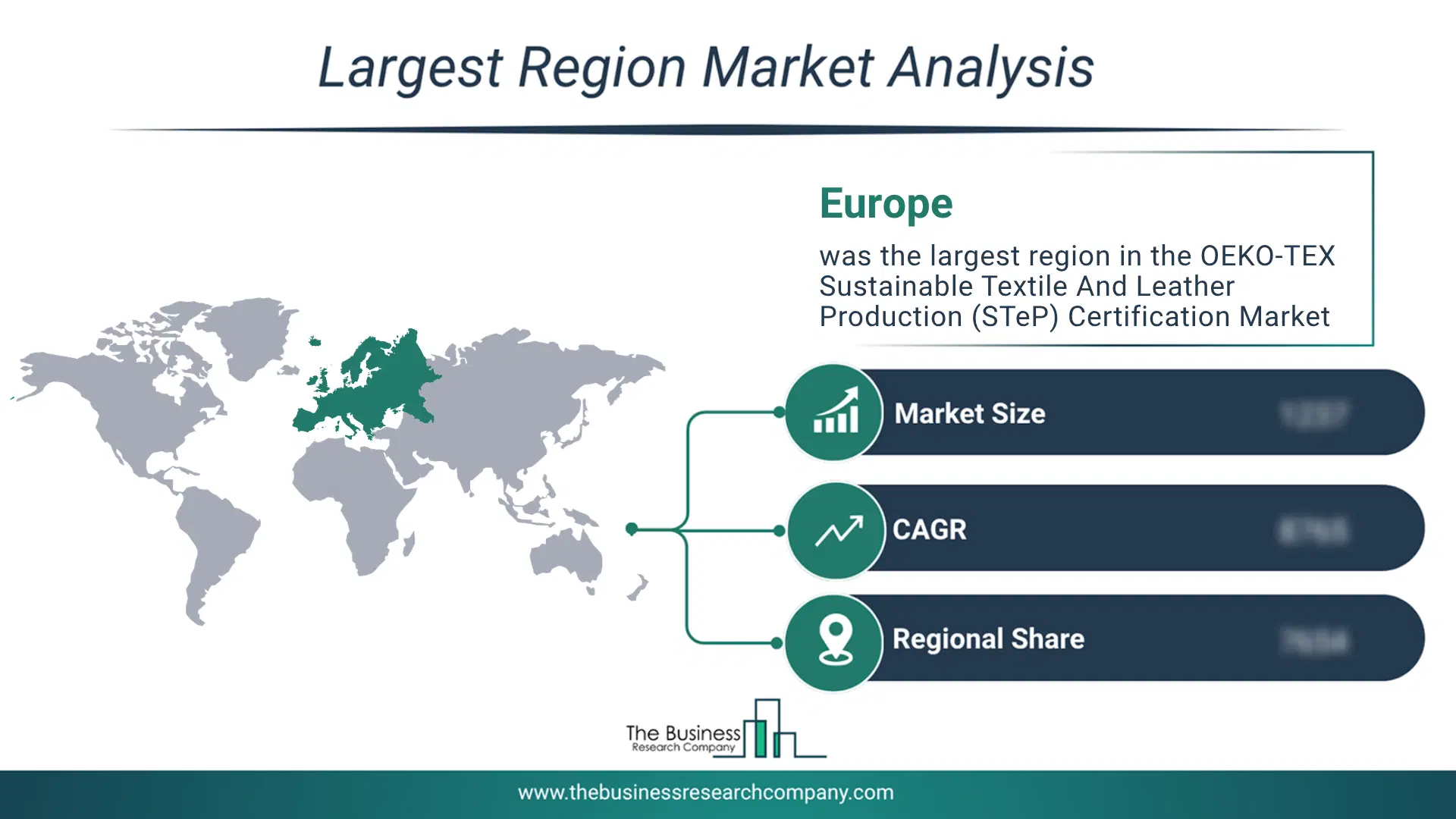
Regional Outlook
Europe was the largest region in the oeko-tex sustainable textile and leather production (STeP) certification market in 2025. Asia-Pacific is expected to be the fastest-growing region in the forecast period. The regions covered in this market report are Asia-Pacific, South East Asia, Western Europe, Eastern Europe, North America, South America, Middle East, Africa. The countries covered in this market report are Australia, Brazil, China, France, Germany, India, Indonesia, Japan, Taiwan, Russia, South Korea, UK, USA, Canada, Italy, Spain.What Defines the OEKO-TEX Sustainable Textile And Leather Production (STeP) Certification Market?
The OEKO-TEX sustainable textile and leather production (STeP) certification market includes revenues earned by entities through audit services, certification services, compliance assessment services, sustainability consulting services, environmental monitoring services. The market value includes the value of related goods sold by the service provider or included within the service offering. Only goods and services traded between entities or sold to end consumers are included.How is Market Value Defined and Measured?
The market value is defined as the revenues that enterprises gain from the sale of goods and/or services within the specified market and geography through sales, grants, or donations in terms of the currency (in USD unless otherwise specified). The revenues for a specified geography are consumption values that are revenues generated by organizations in the specified geography within the market, irrespective of where they are produced. It does not include revenues from resales along the supply chain, either further along the supply chain or as part of other products.
This chart presents market attractiveness based on a quantitative evaluation of growth, competition, strategic alignment, and risk, offering a clear view of opportunity areas for decision-making. This chart is for illustrative purposes; the full report contains the complete analysis.

This chart highlights the Total Addressable Market (TAM) by estimating the maximum revenue opportunity using an assumption-driven approach, supporting strategic planning and opportunity sizing across markets. The chart is illustrative; the full report provides a more comprehensive analysis.
What Key Data and Analysis Are Included in the OEKO-TEX Sustainable Textile And Leather Production (STeP) Certification Market Report 2026?
The oeko-tex sustainable textile and leather production (step) certification market research report is one of a series of new reports from The Business Research Company that provides market statistics, including industry global market size, regional shares, competitors with the market share, detailed market segments, market trends and opportunities, and any further data you may need to thrive in the oeko-tex sustainable textile and leather production (step) certification industry. The market research report delivers a complete perspective of everything you need, with an in-depth analysis of the current and future state of the industry.OEKO-TEX Sustainable Textile And Leather Production (STeP) Certification Market Report Forecast Analysis
| Report Attribute | Details |
|---|---|
| Market Size Value In 2026 | $1.78 billion |
| Revenue Forecast In 2030 | $2.68 billion |
| Growth Rate | CAGR of 10.6% from 2026 to 2030 |
| Base Year For Estimation | 2025 |
| Actual Estimates/Historical Data | 2020-2025 |
| Forecast Period | 2026 - 2030 |
| Market Representation | Revenue in USD Billion and CAGR from 2026 to 2030 |
| Segments Covered | Certification Type, Supply Chain Stage, Application, End User |
| Regional Scope | Asia-Pacific, Western Europe, Eastern Europe, North America, South America, Middle East, Africa |
| Country Scope | The countries covered in the report are Australia, Brazil, China, France, Germany, India, Indonesia, Japan, Taiwan, Russia, South Korea, UK, USA, Canada, Italy, Spain. |
| Key Companies Profiled | SGS SA, Bureau Veritas SA, TÜV Rheinland AG, QIMA Limited, TESTEX AG, Centexbel, FITI Testing and Research Institute, Shirley Technologies Limited, Bönningheimer Textilforschung Hohenstein e.V., Centro Tessile Cotoniero e Abbigliamento S.p.A., IDFL Laboratory and Institute Inc., CITEVE – Centro Tecnológico das Indústrias Têxtil e do Vestuário, MIRTEC S.A., OEKO-TEX Service GmbH, Prüf- und Forschungsinstitut Pirmasens e.V., INNOVATEXT Textilipari Műszaki Kutató és Vizsgáló Kft., VÚTCH-CHEMITEX spol. s r.o., FILK Freiberg Institute gGmbH, Intertek Group plc, Eurofins Product Testing, Cotecna Inspection SA, Kiwa NV, UL LLC |
| Customization Scope | Request for Customization |
| Pricing And Purchase Options | Explore Purchase Options |