
Off-Highway Electric Vehicle Market Report 2026
Global Outlook – By Type (Battery Electric Vehicle (BEV), Hybrid Electric Vehicle (HEV), Plug-In Hybrid Electric Vehicles (PHEV)), By Battery Type (Lithium-Ion, Lead-Acid, Other Batteries), By Application (Mining, Construction Agriculture (Gardening or Landscaping, Other Applications) – Market Size, Trends, Strategies, and Forecast to 2030
Off-Highway Electric Vehicle Market Overview
• Off-Highway Electric Vehicle market size has reached to $10.82 billion in 2025 • Expected to grow to $29.95 billion in 2030 at a compound annual growth rate (CAGR) of 22.5% • Growth Driver: Electric Vehicle Demand Fuels Growth In Off-Highway Electric Vehicle Market • Market Trend: Technology Advancements Driving Innovation In The Off-Highway Electric Vehicle Market • North America was the largest region in 2025.Market Gains By 2030 – Top Opportunities By Segment
Market Gain identifies the most promising market opportunities by highlighting the segments or products expected to generate the highest incremental revenue growth over the next five years.
What Is Covered Under Off-Highway Electric Vehicle Market?
An off-highway electric vehicle refers to a type of electric vehicle built for off-road use that utilizes electricity to operate on and off paved or gravel roads. The common characteristics of off-highway electric vehicles are front suspension, grip-suitable tires with deep, wide treads, underbody protection, low-range-gearing, and caterpillar tracks. The main types of off-highway electric vehicles include battery electric vehicles (BEV), hybrid electric vehicle (HEV), and plug-in hybrid electric vehicles (PHEV). BEV refers to battery electric vehicles. BEV is powered by electricity with no gas engine parts, fossil fuel engine, or generator, hence does not create any emissions. The different battery types include lithium-ion, lead-acid, and others that are used in mining, construction, agriculture, gardening or landscaping, others.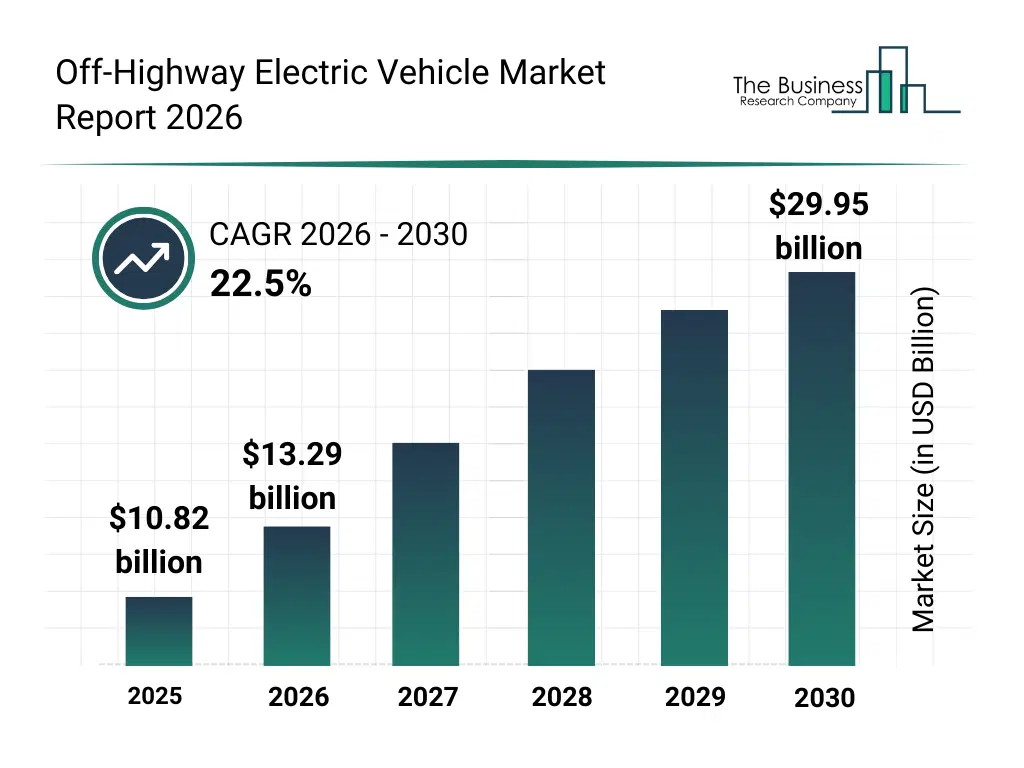
What Is The Off-Highway Electric Vehicle Market Size and Share 2026?
The off-highway electric vehicle market size has grown exponentially in recent years. It will grow from $10.82 billion in 2025 to $13.29 billion in 2026 at a compound annual growth rate (CAGR) of 22.8%. The growth in the historic period can be attributed to diesel powered off highway dominance, fuel cost volatility, early hybrid equipment adoption, mining automation trends, agricultural mechanization growth.What Is The Off-Highway Electric Vehicle Market Growth Forecast?
The off-highway electric vehicle market size is expected to see exponential growth in the next few years. It will grow to $29.95 billion in 2030 at a compound annual growth rate (CAGR) of 22.5%. The growth in the forecast period can be attributed to emission regulations for off road vehicles, battery energy density improvements, electrification of construction fleets, mining sustainability targets, total cost of ownership reduction. Major trends in the forecast period include electrification of off road equipment, high torque electric powertrains, ruggedized battery systems, low noise and zero emission operations, integration of advanced vehicle controls.
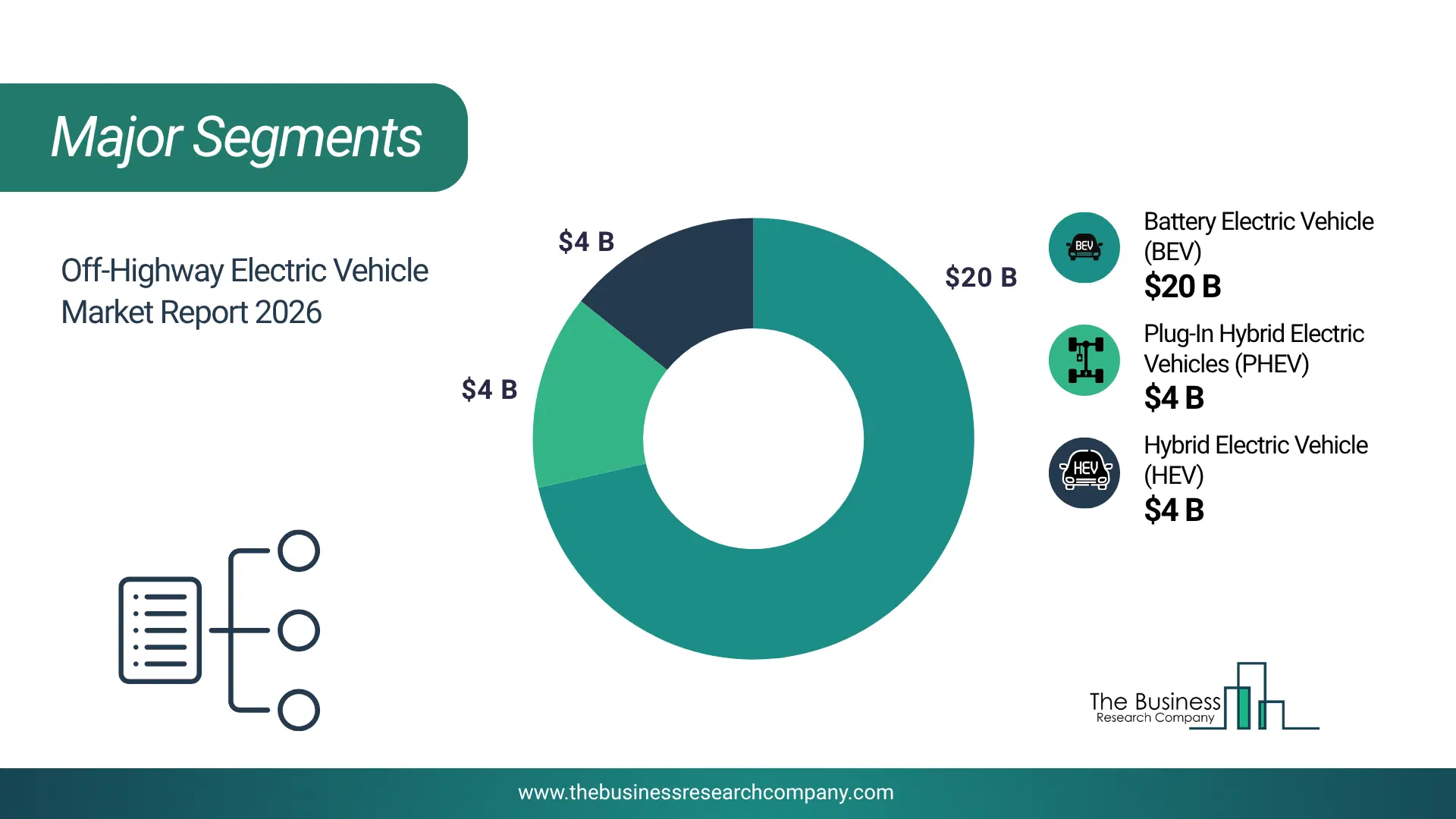
Global Off-Highway Electric Vehicle Market Segmentation
1) By Type: Battery Electric Vehicle (BEV), Hybrid Electric Vehicle (HEV), Plug-In Hybrid Electric Vehicles (PHEV) 2) By Battery Type: Lithium-Ion, Lead-Acid, Other Batteries 3) By Application: Mining, Construction Agriculture: Gardening or Landscaping, Other Applications Subsegments: 1) By Battery Electric Vehicle (BEV): Fully Electric Off-Highway Vehicles, Electric Forklifts, Electric Construction Equipment, Electric Agricultural Vehicles 2) By Hybrid Electric Vehicle (HEV): Diesel-Electric Hybrid Vehicles, Gasoline-Electric Hybrid Vehicles, Electric-Powered Hybrid Agricultural Equipment 3) By Plug-In Hybrid Electric Vehicles (PHEV): Plug-In Hybrid Construction Equipment, Plug-In Hybrid Agricultural Vehicles, Plug-In Hybrid Utility Vehicles The top segments in the off-highway electric vehicle market will be: • Battery Electric Vehicle (BEV) will reach $20.19 Billion by 2030. • Plug-In Hybrid Electric Vehicles (PHEV) will reach $4.4 Billion by 2030. • Hybrid Electric Vehicle (HEV) will reach $3.59 Billion by 2030.What Is The Driver Of The Off-Highway Electric Vehicle Market?
The increase in demand for electric vehicles is expected to propel the growth of the off-highway electric vehicle market going forward. Electric vehicles are referred to as automobiles that are powered partially or completely by electricity from a rechargeable battery. Electric vehicles are supplied by renewable energy that contributes to reduced CO2 emissions and air pollution, creates significant efficiency gains, and serves as a source of storage of renewable electricity, thereby increasing the demand for off-highway electric vehicles. For instance, in April 2024, according to International Energy Agency (IEA), a France-based energy-analysis organisation, nearly 14 million new electric cars were registered globally in 2023, electric car sales in 2023 were 3.5 million higher than in 2022, a 35 % year-on-year increase, and electric cars made up about 18 % of all cars sold in 2023, up from 14% in 2022, bringing the total number of electric cars on the world’s roads to roughly 40 million. Hence, increasing demand for electric vehicles is driving the demand in the off-highway electric vehicle industry.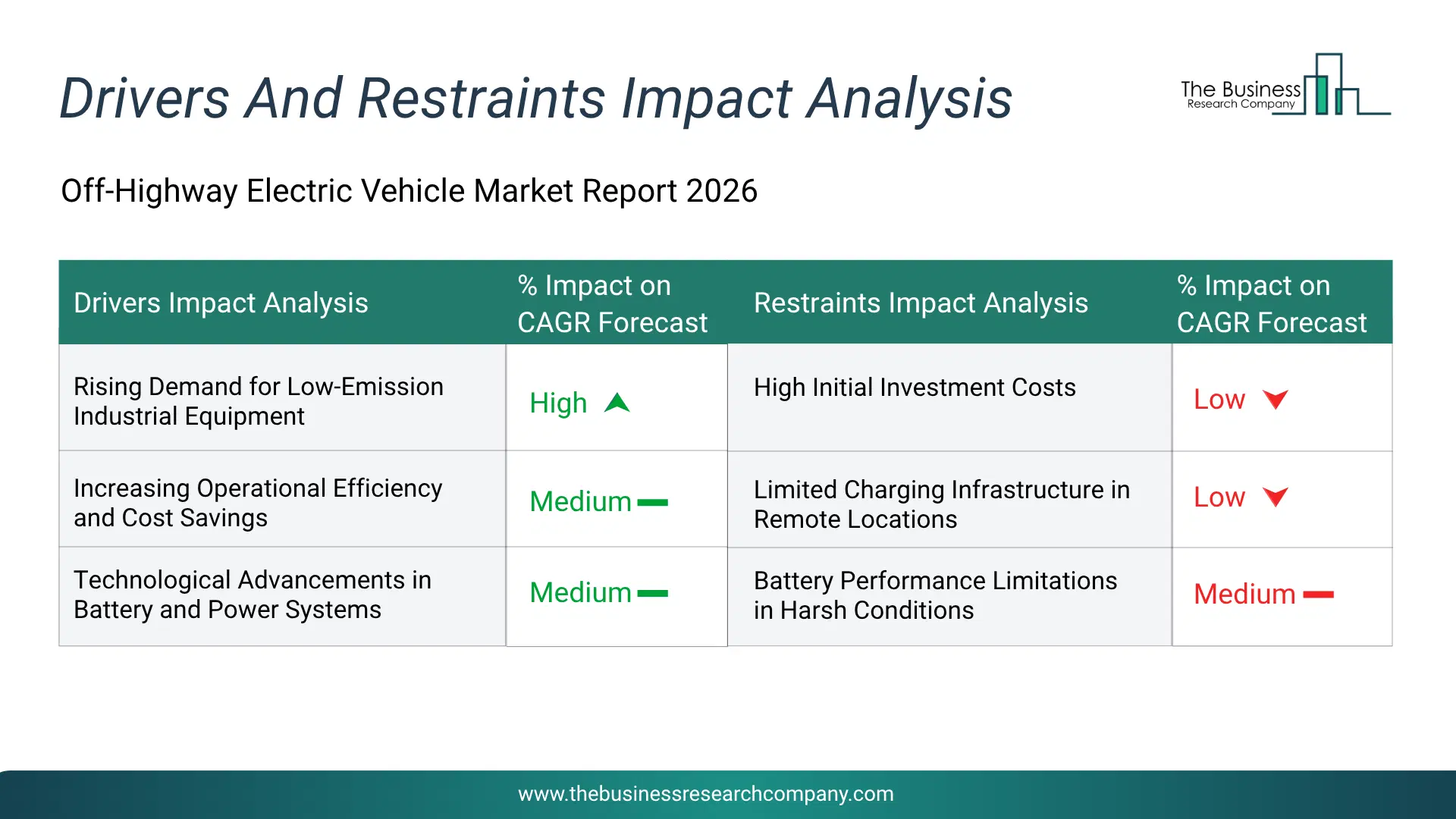
Infographic Chart Showing Key Market Drivers Analysis And Restraints For Off-Highway Electric Vehicle Market
The chart presents an impact analysis of key drivers and restraints, quantifying their relative influence on the market's growth rate and helping assess the balance between growth enablers and limiting factors. This chart offers a high-level perspective; the full report contains more detailed insights.
How Will The Drivers Impact Growth In The Global Off-Highway Electric Vehicle Market?
• Rising Demand for Low-Emission Industrial Equipment (High) – During the forecast period, the rising demand for low-emission industrial equipment is expected to become a key growth driver for the off-highway electric vehicle market by 2030. Industries such as construction, mining, and agriculture are increasingly transitioning toward cleaner equipment solutions to reduce environmental impact and comply with stricter emission norms. Electric off-highway vehicles eliminate tailpipe emissions and significantly lower noise levels, making them suitable for urban construction zones and enclosed mining environments. Equipment manufacturers are therefore accelerating the development of zero-emission machinery to meet evolving sustainability targets. This shift toward cleaner industrial operations is reinforcing strong market expansion. • Increasing Operational Efficiency and Cost Savings (Medium) – During the forecast period, the increasing operational efficiency and cost savings is expected to emerge as a major factor driving the expansion of the off-highway electric vehicle market by 2030. Electric powertrains offer higher energy efficiency compared to conventional diesel engines, resulting in lower fuel and maintenance costs over the equipment lifecycle. Reduced mechanical complexity, fewer moving parts, and lower servicing requirements further enhance equipment uptime and reliability. Fleet operators are increasingly adopting electric machinery to optimize long-term operating expenses and improve productivity. Additionally, advancements in energy management systems are enabling better utilization of battery power across demanding applications. • Technological Advancements in Battery and Power Systems (Medium) – During the forecast period, the technological advancements in battery and power systems is expected to act as a key growth catalyst for the off-highway electric vehicle market by 2030. Continuous improvements in lithium-ion battery technology, including higher energy density, faster charging capabilities, and longer lifecycle performance, are enhancing the feasibility of electrifying heavy-duty equipment. Innovations in power electronics, thermal management systems, and integrated drivetrains are further improving vehicle performance in demanding operating conditions. OEMs are investing heavily in next-generation battery architectures and modular power systems to support diverse off-highway applications. As these technologies mature, the adoption of electric equipment is expected to accelerate significantly.How Will The Restraints Impact Growth In The Global Off-Highway Electric Vehicle Market?
• High Initial Investment Costs (High) – During the forecast period, high initial investment costs are significantly restricting the growth of the off-highway electric vehicle market. The substantial capital required for electric drivetrains, battery systems, and supporting infrastructure is limiting adoption, particularly among small and medium-sized construction and mining operators. • Limited Charging Infrastructure in Remote Locations (Medium) – During the forecast period, limited charging infrastructure in remote locations is significantly restricting the growth of the off-highway electric vehicle market. Inadequate availability of fast-charging stations and grid connectivity in mining, agriculture, and construction sites is hindering operational feasibility and restricting large-scale deployment. • Battery Performance Limitations in Harsh Conditions (Medium) – During the forecast period, battery performance limitations in harsh conditions are significantly restricting the growth of the off-highway electric vehicle market. Extreme temperatures, heavy-duty workloads, and rugged operating environments reduce battery efficiency, lifespan, and reliability, thereby limiting adoption in demanding off-highway applications.Key Players In The Global Off-Highway Electric Vehicle Market
Major companies operating in the off-highway electric vehicle market report include Caterpillar Inc., Volvo Construction Equipment Ab, Deere And Company, Komatsu Ltd., Hitachi Construction Machinery Co. Ltd., Doosan Corporation, JC Bamford Excavators Ltd., Cnh Industrial NV, Kubota Corporation, Duetz AG, Sumitomo Heavy Industries Ltd., Stihl Holding AG and Co. Kg, Solectrac LLC, Terex Corporation, Liebherr Group, Xuzhou Construction Machinery Group Co. Ltd., Wacker Neuson SE, Sany Heavy Industry Co. Ltd., Manitou Group, Bell Equipment Ltd., ASV Holdings Inc., Epiroc AB, Hyundai Construction Equipment Co. Ltd.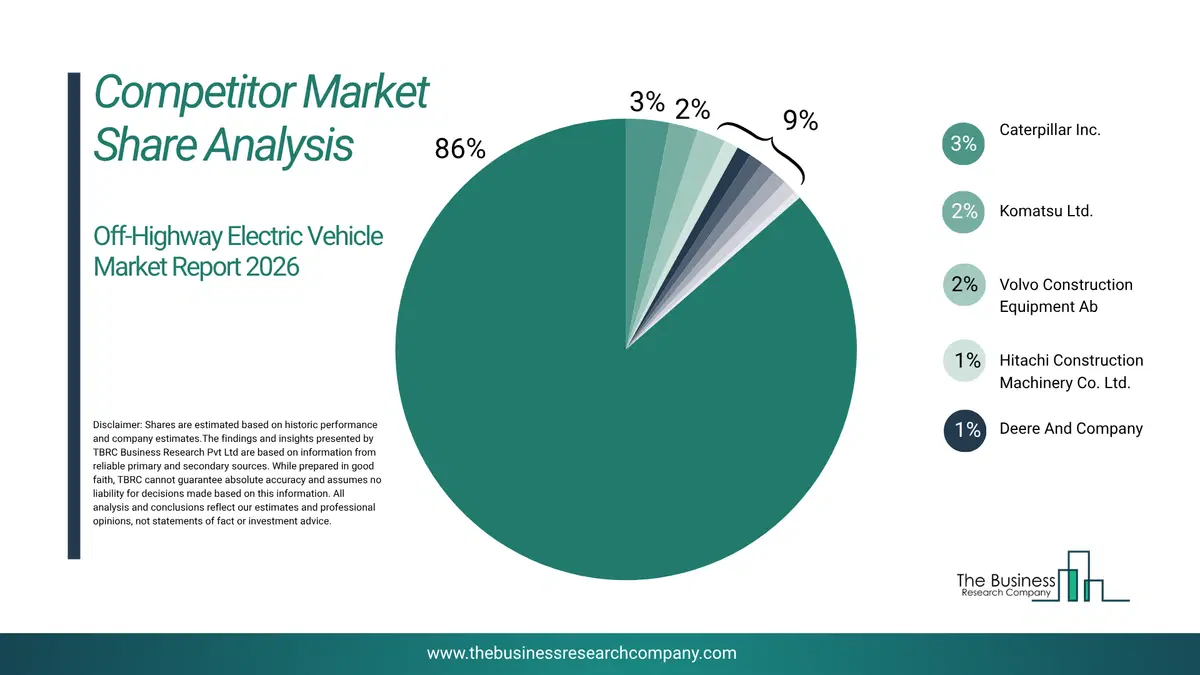
This chart is for illustrative purposes; the full report includes a detailed competitor analysis and comprehensive overview of the top 10 companies in the market.
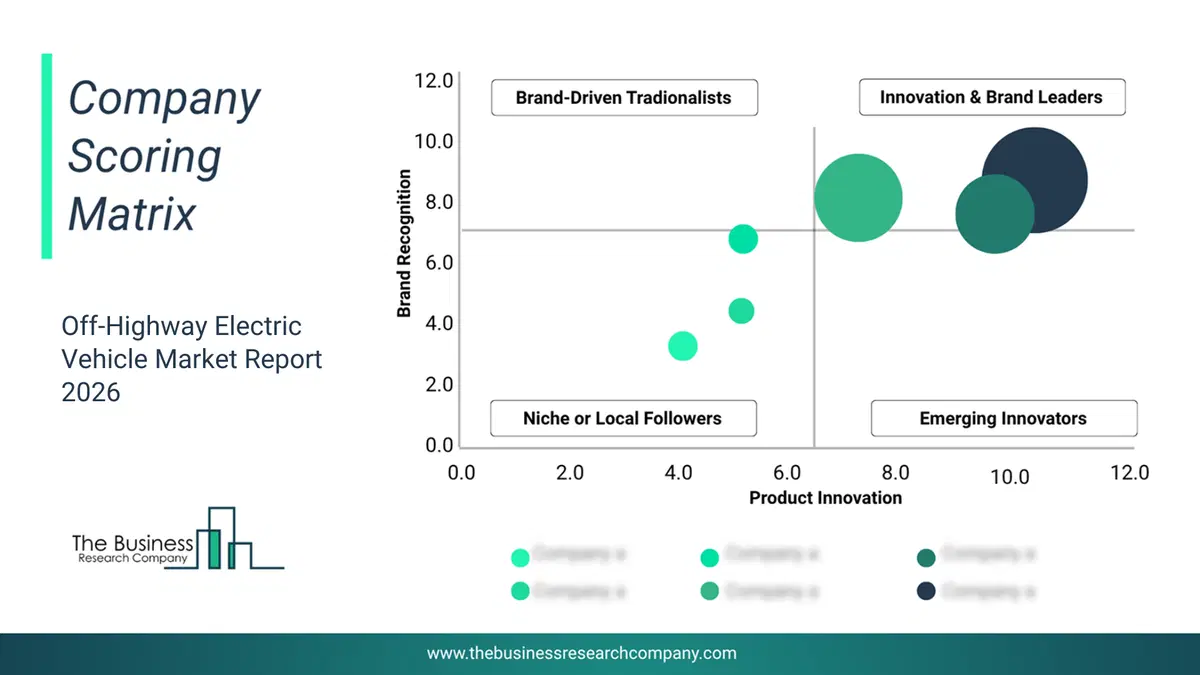
This chart maps companies by product innovation and brand strength, with bubble size indicating relative revenue, helping identify market leaders, challengers, and niche players. This is an illustrative chart; the full report provides a complete and accurate competitive analysis.
Global Off-Highway Electric Vehicle Market Trends and Insights
Major companies operating in the off-highway electric vehicle market are focusing on developing advanced technologies such as electrified propulsion systems to enhance sustainability, reduce operating costs, and improve energy efficiency. Electrified propulsion systems replace conventional diesel engines with high-voltage electric motors powered through external electrical infrastructure, enabling lower carbon footprint, reduced fuel dependency, and optimized lifecycle efficiency. For instance, in September 2024, Komatsu Limited, a Japan-based manufacturing company, launched PC4000-11E hydraulic mining excavator. The Komatsu PC4000-11E is an electrically powered hydraulic mining excavator that combines the digging power of traditional diesel machines with the environmental advantages of electric power, reducing emissions by up to 95%. It offers lower operating costs and can cut total ownership costs by up to 50%, promoting sustainable mining practices.What Are Latest Mergers And Acquisitions In The Off-Highway Electric Vehicle Market?
In January 2024, Caterpillar Inc., a US-based heavy-equipment and construction-machinery company, partnered with CRH plc to accelerate deployment of 70–100-ton-class battery-electric off-highway trucks and charging solutions. With this collaboration, Caterpillar Inc. and CRH plc aim to integrate battery-electric off-road vehicles and associated charging infrastructure to improve operational efficiency and environmental performance, provide cleaner and quieter working conditions for crews, and deliver long-term sustainability and emissions-reduction benefits. CRH plc is an Ireland-based building-materials company specialising in aggregates, cement, asphalt and construction-materials supply.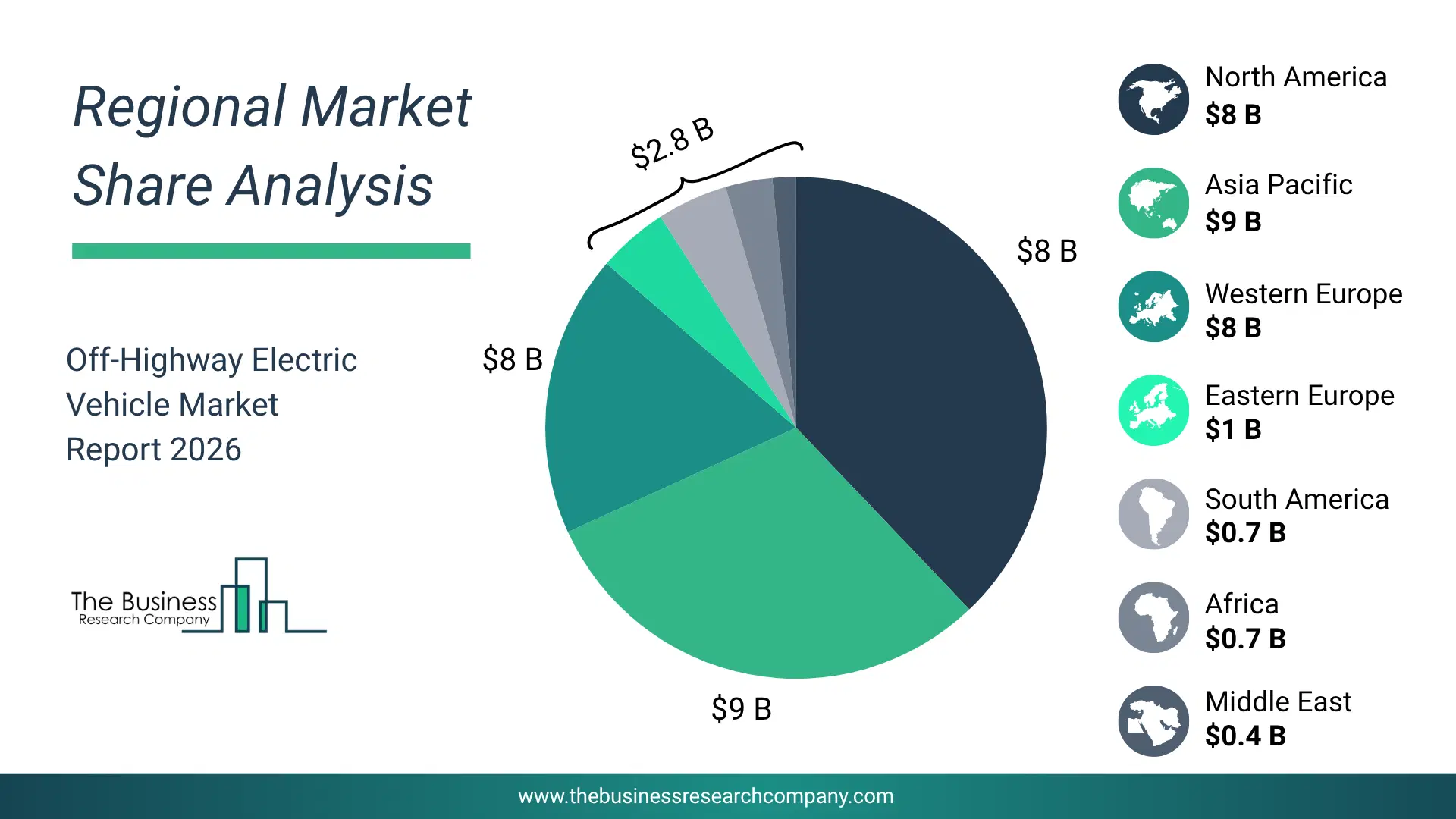
Regional Outlook
North America was the largest region in the off-highway electric vehicle market in 2025. The regions covered in this market report include Asia-Pacific, South East Asia, Western Europe, Eastern Europe, North America, South America, Middle East, Africa. The countries covered in this market report include Australia, Brazil, China, France, Germany, India, Indonesia, Japan, Taiwan, Russia, South Korea, UK, USA, Canada, Italy, SpainWhat Defines the Off-Highway Electric Vehicle Market?
The off-highway electric vehicle market consists of sales of off-highway all-electric vehicles. Values in this market are ‘factory gate’ values, that is the value of goods sold by the manufacturers or creators of the goods, whether to other entities (including downstream manufacturers, wholesalers, distributors and retailers) or directly to end customers. The value of goods in this market includes related services sold by the creators of the goods.How is Market Value Defined and Measured?
The market value is defined as the revenues that enterprises gain from the sale of goods and/or services within the specified market and geography through sales, grants, or donations in terms of the currency (in USD unless otherwise specified). The revenues for a specified geography are consumption values that are revenues generated by organizations in the specified geography within the market, irrespective of where they are produced. It does not include revenues from resales along the supply chain, either further along the supply chain or as part of other products.
This chart presents market attractiveness based on a quantitative evaluation of growth, competition, strategic alignment, and risk, offering a clear view of opportunity areas for decision-making. This chart is for illustrative purposes; the full report contains the complete analysis.

This chart highlights the Total Addressable Market (TAM) by estimating the maximum revenue opportunity using an assumption-driven approach, supporting strategic planning and opportunity sizing across markets. The chart is illustrative; the full report provides a more comprehensive analysis.
What Key Data and Analysis Are Included in the Off-Highway Electric Vehicle Market Report 2026?
The off-highway electric vehicle market research report is one of a series of new reports from The Business Research Company that provides market statistics, including industry global market size, regional shares, competitors with the market share, detailed market segments, market trends and opportunities, and any further data you may need to thrive in the off-highway electric vehicle industry. The market research report delivers a complete perspective of everything you need, with an in-depth analysis of the current and future state of the industry.Off-Highway Electric Vehicle Market Report Forecast Analysis
| Report Attribute | Details |
|---|---|
| Market Size Value In 2026 | $13.29 billion |
| Revenue Forecast In 2030 | $29.95 billion |
| Growth Rate | CAGR of 22.8% from 2026 to 2030 |
| Base Year For Estimation | 2025 |
| Actual Estimates/Historical Data | 2020-2025 |
| Forecast Period | 2026 - 2030 |
| Market Representation | Revenue in USD Billion and CAGR from 2026 to 2030 |
| Segments Covered | Type, Battery Type, Application |
| Regional Scope | Asia-Pacific, Western Europe, Eastern Europe, North America, South America, Middle East, Africa |
| Country Scope | The countries covered in the report are Australia, Brazil, China, France, Germany, India, Indonesia, Japan, Taiwan, Russia, South Korea, UK, USA, Canada, Italy, Spain. |
| Key Companies Profiled | Caterpillar Inc., Volvo Construction Equipment Ab, Deere And Company, Komatsu Ltd., Hitachi Construction Machinery Co. Ltd., Doosan Corporation, JC Bamford Excavators Ltd., Cnh Industrial NV, Kubota Corporation, Duetz AG, Sumitomo Heavy Industries Ltd., Stihl Holding AG and Co. Kg, Solectrac LLC, Terex Corporation, Liebherr Group, Xuzhou Construction Machinery Group Co. Ltd., Wacker Neuson SE, Sany Heavy Industry Co. Ltd., Manitou Group, Bell Equipment Ltd., ASV Holdings Inc., Epiroc AB, Hyundai Construction Equipment Co. Ltd. |
| Customization Scope | Request for Customization |
| Pricing And Purchase Options | Explore Purchase Options |