

Off-Highway Hybrid Vehicles Market Report 2026
Global Outlook – By Component (Electric Motor, Battery Pack, Internal Combustion Engine, Power Electronics), By Vehicle Type (Construction Equipment, Agricultural Equipment, Mining Equipment, Forestry Equipment), By Powertrain (Parallel Hybrid, Series Hybrid, Plug In Hybrid), By Application (Material Handling, Landscaping, Mining Operations, Agricultural Operations), By End Use (Commercial, Industrial) – Market Size, Trends, Strategies, and Forecast to 2030
Off-Highway Hybrid Vehicles Market Overview
• Off-Highway Hybrid Vehicles market size has reached to $7.62 billion in 2025 • Expected to grow to $13.61 billion in 2030 at a compound annual growth rate (CAGR) of 12.2% • Growth Driver: Rising Fuel Costs Fueling The Growth Of The Market Due To Increasing Global Crude Oil Prices • North America was the largest region in 2025 and Asia-Pacific is the fastest growing region.What Is Covered Under Off-Highway Hybrid Vehicles Market?
The off-highway hybrid vehicles are heavy-duty machines that combine an internal combustion engine with one or more electric motors and an energy storage system to improve power delivery and operational efficiency. They are designed to operate in demanding off-road environments while reducing fuel consumption, emissions, and operating costs. The off-highway hybrid vehicles use hybrid power management to optimize performance, recover energy during braking or deceleration, and enhance productivity under varying load conditions. The main components of off-highway hybrid vehicles include electric motor, battery pack, internal combustion engine, and power electronics. Electric motor refers to the propulsion component that converts electrical energy into mechanical power, either independently or in combination with an internal combustion engine, to improve efficiency, torque, and fuel economy in off-highway vehicles. These vehicles are available for construction equipment, agricultural equipment, mining equipment, and forestry equipment and utilize parallel hybrid, series hybrid, and plug in hybrid powertrains. The key applications of material handling, landscaping, mining operations, and agricultural operations, while the end-uses commercial and industrial.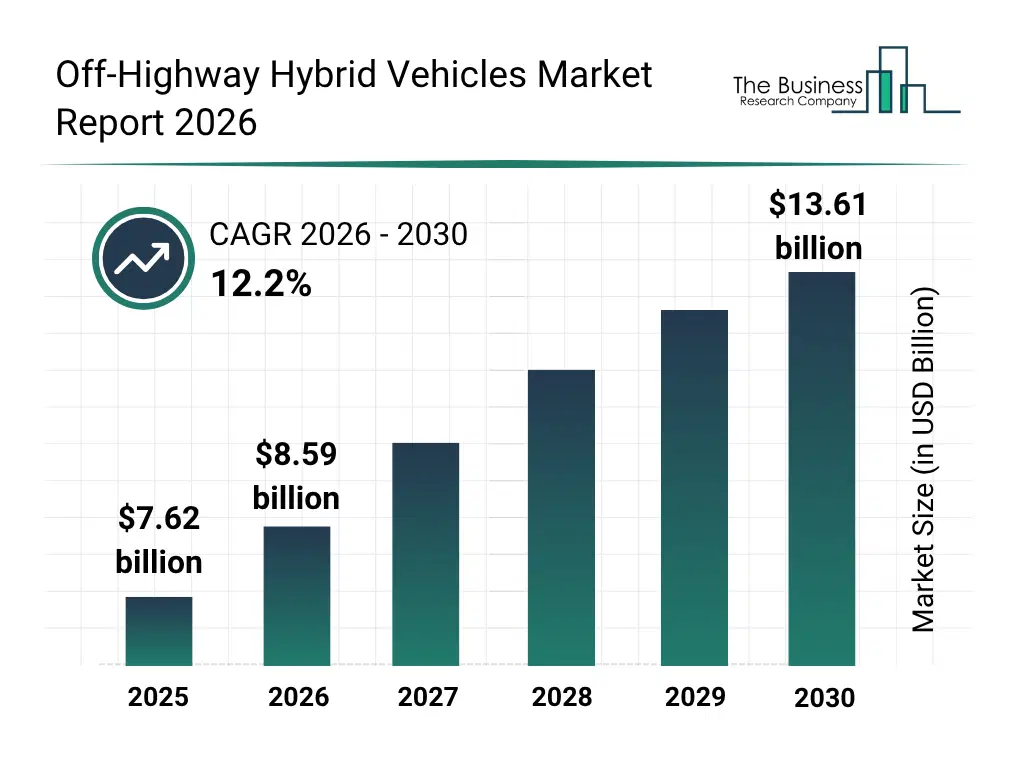
What Is The Off-Highway Hybrid Vehicles Market Size and Share 2026?
The off-highway hybrid vehicles market size has grown rapidly in recent years. It will grow from $7.62 billion in 2025 to $8.59 billion in 2026 at a compound annual growth rate (CAGR) of 12.6%. The growth in the historic period can be attributed to increasing demand for fuel efficient heavy machinery, growing adoption of emission reduction technologies, rising need for improved equipment productivity, increasing investments in construction and mining equipment modernization, growing requirement for reduced operational costs.What Is The Off-Highway Hybrid Vehicles Market Growth Forecast?
The off-highway hybrid vehicles market size is expected to see rapid growth in the next few years. It will grow to $13.61 billion in 2030 at a compound annual growth rate (CAGR) of 12.2%. The growth in the forecast period can be attributed to increasing demand for electrified off highway equipment, rising adoption of advanced battery technologies, growing integration of intelligent power management systems, increasing deployment of autonomous construction and agricultural machinery, rising focus on sustainable industrial operations. Major trends in the forecast period include increasing adoption of hybrid powertrains in heavy duty off highway vehicles, growing development of high efficiency energy storage systems for off road applications, rising integration of regenerative braking technologies in hybrid equipment, increasing demand for fuel efficient and low emission off highway machinery, growing focus on advanced hybrid power management systems for improved productivity.
Global Off-Highway Hybrid Vehicles Market Segmentation
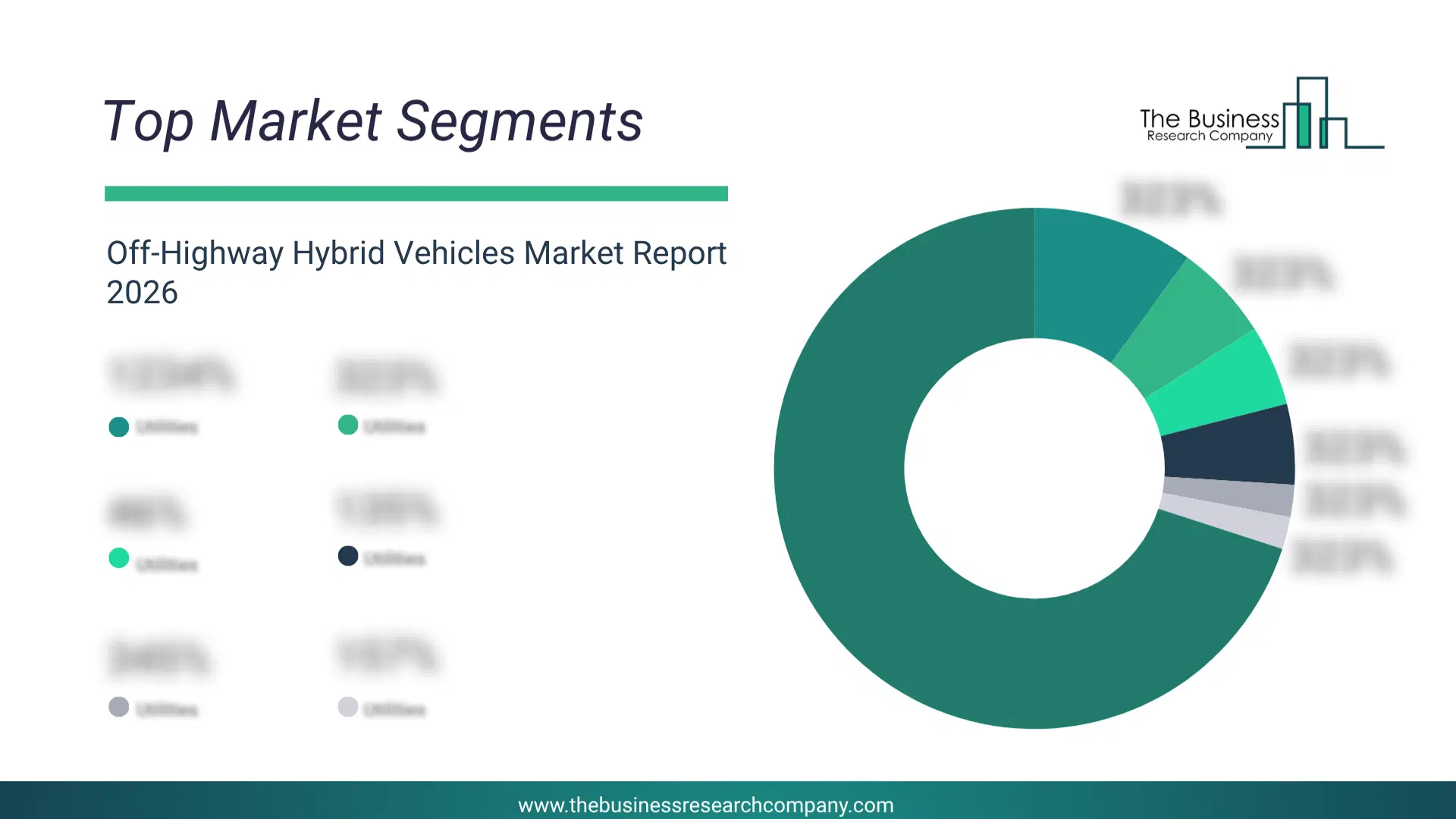
2) By Vehicle Type: Construction Equipment, Agricultural Equipment, Mining Equipment, Forestry Equipment 3) By Powertrain: Parallel Hybrid, Series Hybrid, Plug In Hybrid 4) By Application: Material Handling, Landscaping, Mining Operations, Agricultural Operations 5) By End Use: Commercial, Industrial Subsegments: 1) By Electric Motor: Permanent Magnet Synchronous Motor, Alternating Current Induction Motor, Switched Reluctance Motor, Brushless Direct Current Motor, Axial Flux Motor, Synchronous Reluctance Motor 2) By Battery Pack: Lithium Ion Battery Pack, Lithium Iron Phosphate Battery Pack, Nickel Metal Hydride Battery Pack, Solid State Battery Pack, Sodium Ion Battery Pack, Lead Acid Battery Pack 3) By Internal Combustion Engine: Diesel Engine, Gasoline Engine, Natural Gas Engine, Biodiesel Engine, Hydrogen Internal Combustion Engine, Dual Fuel Engine 4) By Power Electronics: Inverter, Direct Current To Direct Current Converter, Motor Controller, Onboard Charger, Power Control Unit, Battery Management SystemWhat Are The Drivers Of The Off-Highway Hybrid Vehicles Market?
The rising fuel costs are expected to propel the growth of the off-highway hybrid vehicles market going forward. Fuel costs refer to the expenses incurred for purchasing diesel, gasoline, or other fuels required to operate vehicles and heavy equipment across industrial applications. Higher crude oil prices increase the cost of producing gasoline and diesel, leading fuel suppliers to raise prices for consumers. Off-highway hybrid vehicles support fuel cost reduction by combining conventional engines with electric power systems to optimize fuel consumption during demanding operations. For instance, in March 2025, according to the Bureau of Transportation Statistics (BTS), a US-based government agency, the cost of fuel increased to $2.42 per gallon in January 2025, up 10 cents (4.2%) from $2.32 per gallon in December 2024. Therefore, the rising fuel costs are driving the growth of the off-highway hybrid vehicles industry. The expansion of mining activities is expected to propel the growth of the off-highway hybrid vehicles market going forward. Mining activities refer to the exploration, extraction, and processing of valuable minerals, metals, coal, and other geological resources from the earth. Mining activities are rising due to increasing demand for minerals and metals, driven by expanding industrial production, infrastructure development, and energy projects worldwide. Off-highway hybrid vehicles support mining activities by delivering high torque, improved fuel efficiency, and lower operating costs in demanding mining environments. For instance, in July 2024, according to the International Energy Agency, a France-based intergovernmental organization, global coal production increased by 3.1% in 2023 to reach 8,970 million tonnes, marking an all-time high compared to 2022 levels. Therefore, the expansion of mining activities is driving the growth of the off-highway hybrid vehicles industry. The surge in construction and infrastructure projects is expected to propel the growth of the off-highway hybrid vehicles market going forward. Construction and infrastructure projects refer to large-scale activities involving the development of roads, bridges, tunnels, mining sites, industrial facilities, and urban infrastructure that require extensive use of heavy off-highway vehicles such as excavators, loaders, dump trucks, and bulldozers. Construction and infrastructure projects are rising due to increased government spending on public infrastructure development to support economic growth and urbanization. The surge in construction and infrastructure projects drives demand for off-highway hybrid vehicles by increasing the need for fuel-efficient, high-performance equipment used in earthmoving, material handling, and site development activities. For instance, in July 2025, according to the Office for National Statistics (ONS), a UK-based government department, in 2024, total general government investment in infrastructure increased by 2.2% to $38.54 billion (£28.9 billion) in current prices compared with 2023. Therefore, the surge in construction and infrastructure projects is driving the demand for the off-highway hybrid vehicles industry.Key Players In The Global Off-Highway Hybrid Vehicles Market
Major companies operating in the off-highway hybrid vehicles market are Caterpillar Inc., Deere & Company, AB Volvo, Komatsu Ltd., Liebherr-International AG, SANY Group Co. Ltd., XCMG Group, Hitachi Ltd., Guangxi LiuGong Machinery Co. Ltd., HD Hyundai Infracore Co. Ltd., Tadano Ltd., Kobelco Construction Machinery Co. Ltd., J.C. Bamford Excavators Ltd., Epiroc AB, Doosan Bobcat Inc., Sandvik AB
This chart is for illustrative purposes; the full report includes a detailed competitor analysis and comprehensive overview of the top 10 companies in the market.
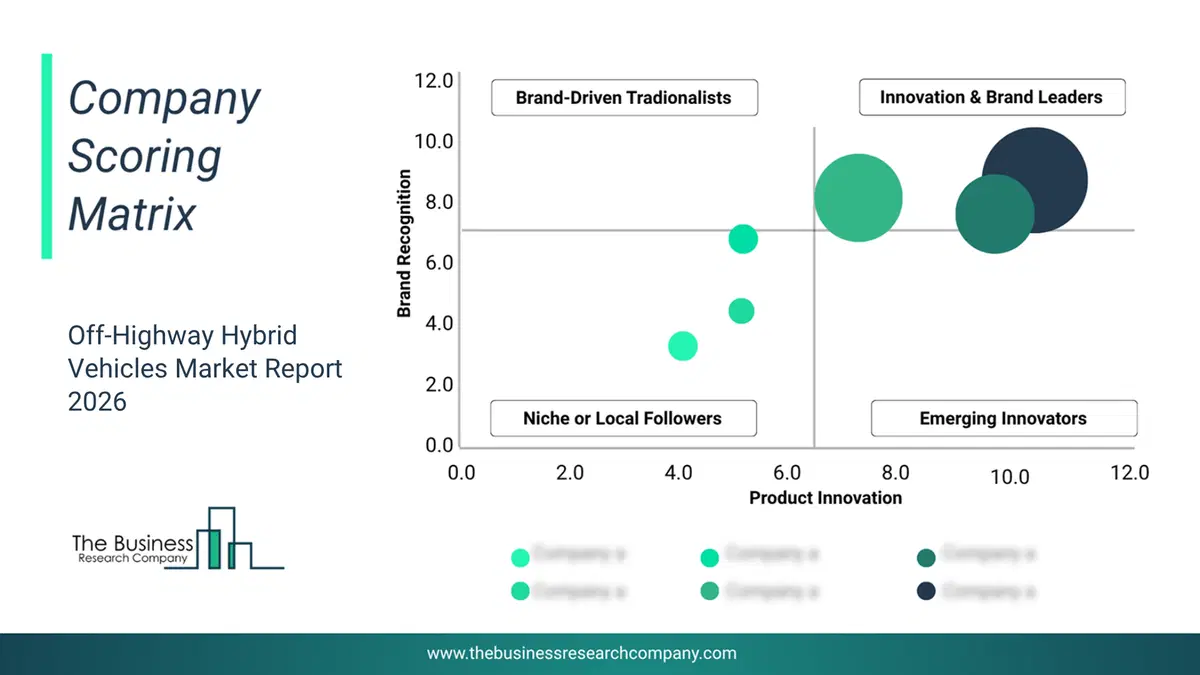
This chart maps companies by product innovation and brand strength, with bubble size indicating relative revenue, helping identify market leaders, challengers, and niche players. This is an illustrative chart; the full report provides a complete and accurate competitive analysis.

Regional Outlook/Insights
North America was the largest region in the off-highway hybrid vehicles market in 2025. Asia-Pacific is expected to be the fastest-growing region in the forecast period. The regions covered in this market report are Asia-Pacific, South East Asia, Western Europe, Eastern Europe, North America, South America, Middle East, Africa. The countries covered in this market report are Australia, Brazil, China, France, Germany, India, Indonesia, Japan, Taiwan, Russia, South Korea, UK, USA, Canada, Italy, Spain.What Defines the Off-Highway Hybrid Vehicles Market?
The off-highway hybrid vehicles market consists of sales of hybrid excavators, hybrid wheel loaders, hybrid bulldozers, hybrid dump trucks, and hybrid motor graders. Values in this market are ‘factory gate’ values, that is, the value of goods sold by the manufacturers or creators of the goods, whether to other entities (including downstream manufacturers, wholesalers, distributors, and retailers) or directly to end customers. The value of goods in this market includes related services sold by the creators of the goods.How is Market Value Defined and Measured?
The market value is defined as the revenues that enterprises gain from the sale of goods and/or services within the specified market and geography through sales, grants, or donations in terms of the currency (in USD unless otherwise specified). The revenues for a specified geography are consumption values that are revenues generated by organizations in the specified geography within the market, irrespective of where they are produced. It does not include revenues from resales along the supply chain, either further along the supply chain or as part of other products.
This chart presents market attractiveness based on a quantitative evaluation of growth, competition, strategic alignment, and risk, offering a clear view of opportunity areas for decision-making. This chart is for illustrative purposes; the full report contains the complete analysis.

This chart highlights the Total Addressable Market (TAM) by estimating the maximum revenue opportunity using an assumption-driven approach, supporting strategic planning and opportunity sizing across markets. The chart is illustrative; the full report provides a more comprehensive analysis.
What Key Data and Analysis Are Included in the Off-Highway Hybrid Vehicles Market Report 2026?
The off-highway hybrid vehicles market research report is one of a series of new reports from The Business Research Company that provides off-highway hybrid vehicles market statistics, including off-highway hybrid vehicles industry global market size, regional shares, competitors with a off-highway hybrid vehicles market share, detailed off-highway hybrid vehicles market segments, market trends and opportunities, and any further data you may need to thrive in the off-highway hybrid vehicles industry. This off-highway hybrid vehicles market research report delivers a complete perspective of everything you need, with an in-depth analysis of the current and future scenario of the industry.Off-Highway Hybrid Vehicles Market Report Forecast Analysis
| Report Attribute | Details |
|---|---|
| Market Size Value In 2026 | $8.59 billion |
| Revenue Forecast In 2030 | $13.61 billion |
| Growth Rate | CAGR of 12.2% from 2026 to 2030 |
| Base Year For Estimation | 2025 |
| Actual Estimates/Historical Data | 2020-2025 |
| Forecast Period | 2026 - 2030 |
| Market Representation | Revenue in USD Billion and CAGR from 2026 to 2030 |
| Segments Covered | Component, Vehicle Type, Powertrain, Application, End Use |
| Regional Scope | Asia-Pacific, Western Europe, Eastern Europe, North America, South America, Middle East, Africa |
| Country Scope | The countries covered in the report are Australia, Brazil, China, France, Germany, India, Indonesia, Japan, Taiwan, Russia, South Korea, UK, USA, Canada, Italy, Spain. |
| Key Companies Profiled | Caterpillar Inc., Deere & Company, AB Volvo, Komatsu Ltd., Liebherr-International AG, SANY Group Co. Ltd., XCMG Group, Hitachi Ltd., Guangxi LiuGong Machinery Co. Ltd., HD Hyundai Infracore Co. Ltd., Tadano Ltd., Kobelco Construction Machinery Co. Ltd., J.C. Bamford Excavators Ltd., Epiroc AB, Doosan Bobcat Inc., Sandvik AB |
| Customization Scope | Request for Customization |
| Pricing And Purchase Options | Explore Purchase Options |