
Oil And Gas Sensors Market Report 2026
Global Outlook – By Type (Gas Sensor, Ultrasonic Sensor, Pressure Sensor, Temperature Sensor, Flow Sensor, Level Sensor, Other Types), By Connectivity (Wired, Wireless), By Sector (Upstream, Midstream, Downstream), By Application (Remote Monitoring, Condition Monitoring, Analysis And Simulation) – Market Size, Trends, Strategies, and Forecast to 2030
Oil And Gas Sensors Market Overview
• Oil And Gas Sensors market size has reached to $11.26 billion in 2025 • Expected to grow to $14.98 billion in 2030 at a compound annual growth rate (CAGR) of 6% • Growth Driver: Rising Demand For Oil And Gas Fuels Growth In The Oil And Gas Sensor Market • Market Trend: Advanced Instrument For Oil And Gas Industry • North America was the largest region in 2025 and Asia-Pacific is the fastest growing region.What Is Covered Under Oil And Gas Sensors Market?
Oil and gas sensors are devices or instruments used in the oil and gas industry to measure, monitor, and detect various parameters and properties related to oil and gas exploration, production, processing, and transportation. These sensors are critical in ensuring safe and efficient operations, optimizing processes, and preventing equipment failures or environmental hazards. The main types of oil and gas sensors are gas sensors, ultrasonic sensors, pressure sensors, temperature sensors, flow sensors, level sensors, and others. A pressure sensor refers to a device that is used to measure and monitor the pressure of a fluid or gas in each system or environment. They act by wired and wireless connections in upstream, midstream, and downstream sectors for various applications including remote monitoring, condition monitoring, analysis, and simulation.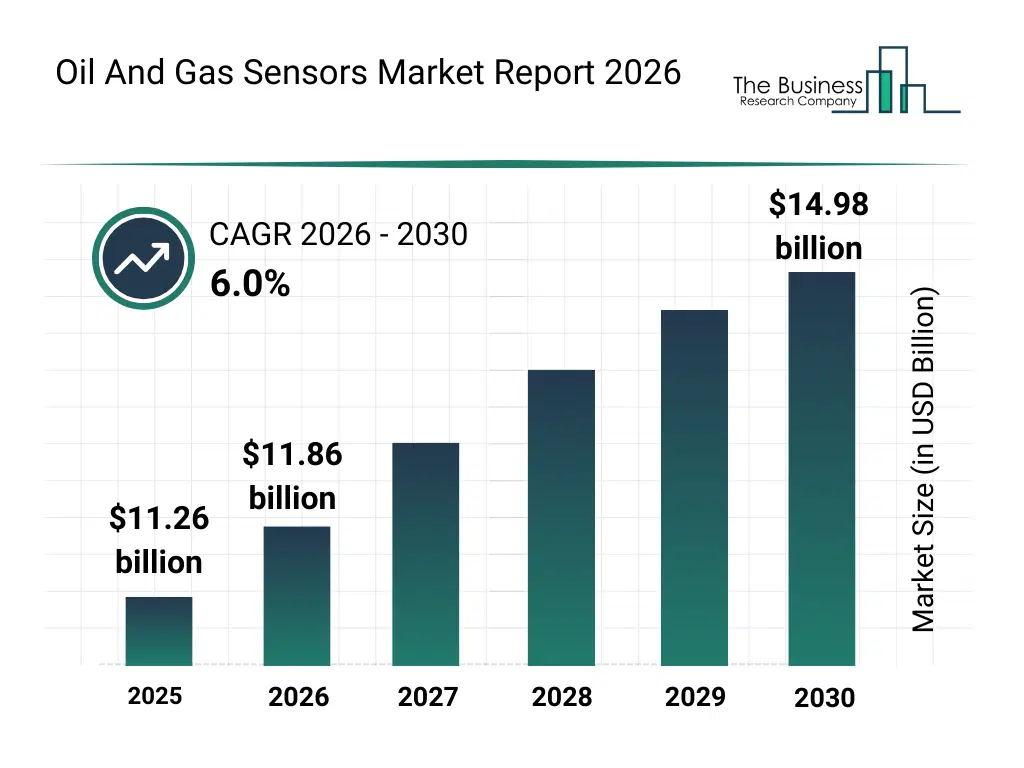
What Is The Oil And Gas Sensors Market Size and Share 2026?
The oil and gas sensors market size has grown strongly in recent years. It will grow from $11.26 billion in 2025 to $11.86 billion in 2026 at a compound annual growth rate (CAGR) of 5.3%. The growth in the historic period can be attributed to growth in oil and gas exploration activities, expansion of pipeline infrastructure, need for process safety monitoring, adoption of automation in production facilities, increased offshore drilling operations.What Is The Oil And Gas Sensors Market Growth Forecast?
The oil and gas sensors market size is expected to see strong growth in the next few years. It will grow to $14.98 billion in 2030 at a compound annual growth rate (CAGR) of 6.0%. The growth in the forecast period can be attributed to stricter environmental and safety regulations, digital oilfield initiatives, growth in LNG infrastructure, demand for predictive maintenance, increased investment in midstream monitoring. Major trends in the forecast period include rising deployment of remote monitoring sensors, growing adoption of wireless sensor networks, increased focus on leak detection and safety monitoring, expansion of condition-based maintenance systems, higher demand for high-accuracy and rugged sensors.Tariff Impact On Oil And Gas Sensors Market
Tariffs have impacted the oil and gas sensors market by increasing costs of imported semiconductors, sensing elements, communication modules, and ruggedized enclosures. These impacts are most evident across upstream and midstream operations, particularly in asia-pacific and europe where sensor manufacturing and sourcing are globally distributed. Higher tariffs have raised deployment costs and slowed large-scale sensor network upgrades. At the same time, tariffs have encouraged localization of sensor manufacturing, regional supplier development, and increased investment in domestic production, supporting supply chain resilience and long-term market stability.
Global Oil And Gas Sensors Market Segmentation
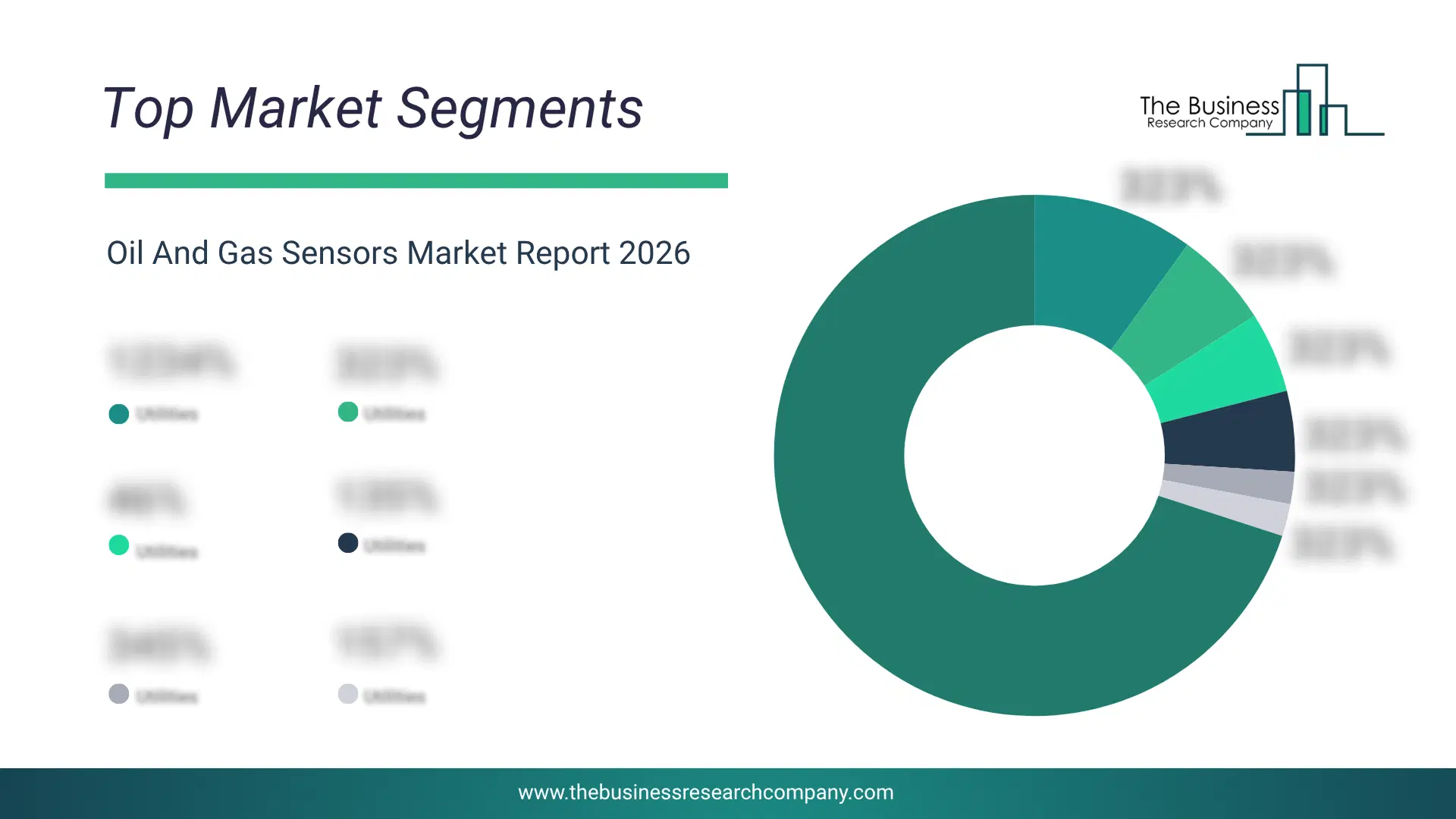
1) By Type: Gas Sensor, Ultrasonic Sensor, Pressure Sensor, Temperature Sensor, Flow Sensor, Level Sensor, Other Types 2) By Connectivity: Wired, Wireless 3) By Sector: Upstream, Midstream, Downstream 4) By Application: Remote Monitoring, Condition Monitoring, Analysis And Simulation Subsegments: 1) By Gas Sensor: Infrared Gas Sensors, Electrochemical Gas Sensors, Catalytic Gas Sensors 2) By Ultrasonic Sensor: Ultrasonic Level Sensors, Ultrasonic Flow Sensors, Ultrasonic Thickness Gauges 3) By Pressure Sensor: Absolute Pressure Sensors, Gauge Pressure Sensors, Differential Pressure Sensors 4) By Temperature Sensor: Thermocouples, RTDs (Resistance Temperature Detectors), Infrared Temperature Sensors 5) By Flow Sensor: Coriolis Flow Meters, Turbine Flow Meters, Magnetic Flow Meters 6) By Level Sensor: Capacitive Level Sensors, Optical Level Sensors, Radar Level Sensors 7) By Other Types: Vibration Sensors, Acoustic Sensors, PH SensorsWhat Is The Driver Of The Oil And Gas Sensors Market?
The increasing demand for oil and gas is expected to propel the growth of the oil and gas sensor market going forward. Oil and gas are essential natural resources for energy production and industrial applications. Oil and gas sensors ensure safe and optimal operations in industry by detecting the presence and concentration of various hazardous gases and vapors. For instance, in March 2023, according to the US Energy Information Administration, a US-based federal statistical system, US crude oil production will climb to 12.4 million barrels/day in 2023 from a record-high of 11.7 million barrels/day in 2022. Therefore, the increasing demand for oil and gas is driving the growth of the oil and gas sensors industry.Key Players In The Global Oil And Gas Sensors Market
Major companies operating in the oil and gas sensors market are Robert Bosch GmbH, Siemens AG, General Electric Company, Honeywell International Inc., ABB Ltd., Emerson Electric Co., TE Connectivity Ltd., Rockwell Automation Inc., Fortive Corp., BD Technologies, Indutrade AB, Lord Corporation, Stellar Technology Solutions LLC, Cubic Sensor and Instrument Co. Ltd., BEI Sensors SAS, 3M Gas And Flame Detection, AlphaSense Inc., OpSens Solutions Inc., RKI Instruments Inc., SGX Sensortech Limited, Nemoto & Co. Ltd., Control Instruments Corp., Oxsensis Ltd., Membrapor AG, Nevada Nanotech Systems Inc., Temposonics GmbH & Co. KG, Thermometrics Corporation
This chart is for illustrative purposes; the full report includes a detailed competitor analysis and comprehensive overview of the top 10 companies in the market.
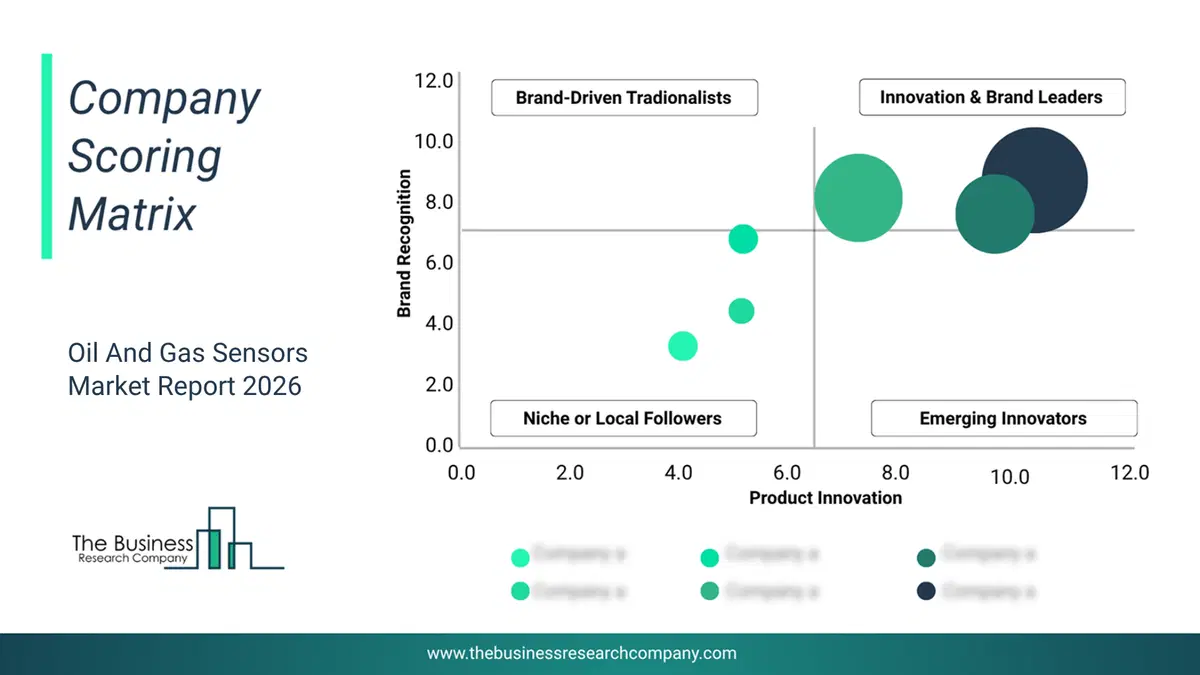
This chart maps companies by product innovation and brand strength, with bubble size indicating relative revenue, helping identify market leaders, challengers, and niche players. This is an illustrative chart; the full report provides a complete and accurate competitive analysis.
Global Oil And Gas Sensors Market Trends and Insights
Major companies in the oil and gas sensors market are focused on developing advanced instruments that utilize IoT, such as IoT-enabled sensors, for the oil and gas industry and to drive their revenues in the market. IoT-enabled sensors are devices embedded with Internet of Things technology to collect and transmit data for diverse applications. For instance, in October 2023, SLB, a US-based provider of technology for reservoir characterization, launched the Methane Point Instrument, an advanced instrument for continuous monitoring in oil and gas operations. The compact, self-installed device uses IoT-enabled sensors, ensuring accurate and automated methane measurement, and reducing emissions. Designed to be 'always on', the instrument is cost-effective, with rapid deployment capabilities.What Are Latest Mergers And Acquisitions In The Oil And Gas Sensors Market?
In June 2025, Sensirion Connected Solutions AG, a Switzerland-based healthcare and environmental technology company specializing in sensor-based IoT solutions, acquired Kuva Systems Ltd. for an undisclosed amount. With this acquisition, Sensirion Connected Solutions AG aims to expand its methane emissions monitoring portfolio and strengthen its position as a full-spectrum provider for continuous emissions tracking in oil and gas applications. Kuva Systems Ltd. is a UK-based technology company that specializes in image-based methane emissions monitoring, offering low-cost infrared optical cameras that enable operators to visualize, quantify, and analyze methane leaks for regulatory compliance and operational efficiency.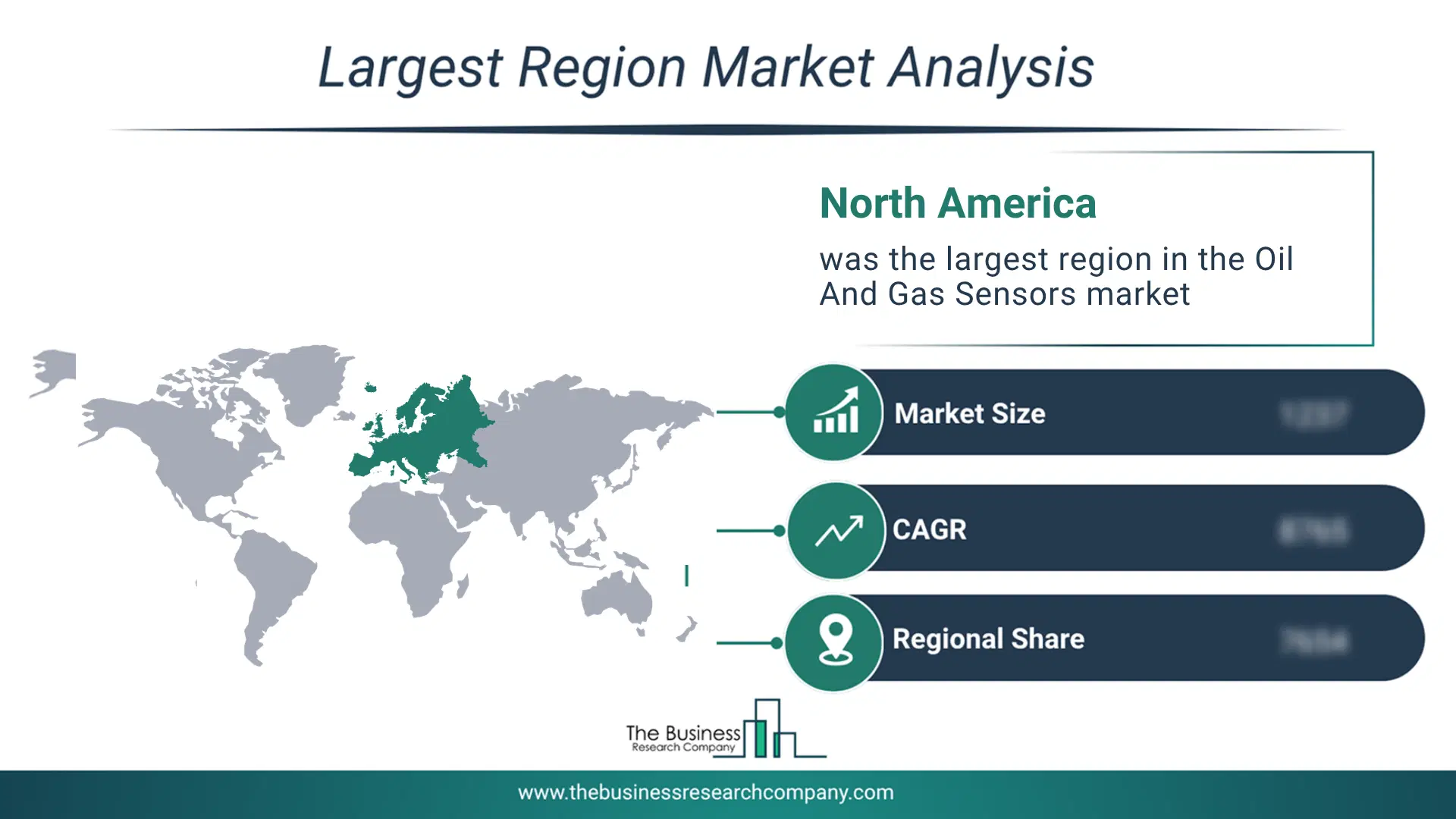
Regional Outlook
North America was the largest region in the oil and gas sensors market in 2025. Asia-Pacific is expected to be the fastest-growing region in the forecast period. The regions covered in this market report are Asia-Pacific, South East Asia, Western Europe, Eastern Europe, North America, South America, Middle East, Africa The countries covered in this market report are Australia, Brazil, China, France, Germany, India, Indonesia, Japan, Taiwan, Russia, South Korea, UK, USA, Canada, Italy, Spain.What Defines the Oil And Gas Sensors Market?
The oil and gas sensors market consists of sales of micro-electromechanical systems (MEMS) pellistors, infrared gas sensors, catalytic pellistors, thermal conductivity gas sensors, metal oxide gas sensors, electrochemical gas sensors, evaluation kits, and indoor air quality sensors. Values in this market are ‘factory gate’ values, that is the value of goods sold by the manufacturers or creators of the goods, whether to other entities (including downstream manufacturers, wholesalers, distributors and retailers) or directly to end customers. The value of goods in this market includes related services sold by the creators of the goods.How is Market Value Defined and Measured?
The market value is defined as the revenues that enterprises gain from the sale of goods and/or services within the specified market and geography through sales, grants, or donations in terms of the currency (in USD unless otherwise specified). The revenues for a specified geography are consumption values that are revenues generated by organizations in the specified geography within the market, irrespective of where they are produced. It does not include revenues from resales along the supply chain, either further along the supply chain or as part of other products.
This chart presents market attractiveness based on a quantitative evaluation of growth, competition, strategic alignment, and risk, offering a clear view of opportunity areas for decision-making. This chart is for illustrative purposes; the full report contains the complete analysis.

This chart highlights the Total Addressable Market (TAM) by estimating the maximum revenue opportunity using an assumption-driven approach, supporting strategic planning and opportunity sizing across markets. The chart is illustrative; the full report provides a more comprehensive analysis.
What Key Data and Analysis Are Included in the Oil And Gas Sensors Market Report 2026?
The oil and gas sensors market research report is one of a series of new reports from The Business Research Company that provides market statistics, including industry global market size, regional shares, competitors with the market share, detailed market segments, market trends and opportunities, and any further data you may need to thrive in the oil and gas sensors industry. The market research report delivers a complete perspective of everything you need, with an in-depth analysis of the current and future state of the industry.Oil And Gas Sensors Market Report Forecast Analysis
| Report Attribute | Details |
|---|---|
| Market Size Value In 2026 | $11.86 billion |
| Revenue Forecast In 2030 | $14.98 billion |
| Growth Rate | CAGR of 6% from 2026 to 2030 |
| Base Year For Estimation | 2025 |
| Actual Estimates/Historical Data | 2020-2025 |
| Forecast Period | 2026 - 2030 |
| Market Representation | Revenue in USD Billion and CAGR from 2026 to 2030 |
| Segments Covered | Type, Connectivity, Sector, Application |
| Regional Scope | Asia-Pacific, Western Europe, Eastern Europe, North America, South America, Middle East, Africa |
| Key Companies Profiled | Robert Bosch GmbH, Siemens AG, General Electric Company, Honeywell International Inc., ABB Ltd., Emerson Electric Co., TE Connectivity Ltd., Rockwell Automation Inc., Fortive Corp., BD Technologies, Indutrade AB, Lord Corporation, Stellar Technology Solutions LLC, Cubic Sensor and Instrument Co. Ltd., BEI Sensors SAS, 3M Gas And Flame Detection, AlphaSense Inc., OpSens Solutions Inc., RKI Instruments Inc., SGX Sensortech Limited, Nemoto & Co. Ltd., Control Instruments Corp., Oxsensis Ltd., Membrapor AG, Nevada Nanotech Systems Inc., Temposonics GmbH & Co. KG, Thermometrics Corporation |
| Customization Scope | Request for Customization |
| Pricing And Purchase Options | Explore Purchase Options |