
Oilfield Biocides Chemicals Market Report 2026
Global Outlook – By Mechanism of Action (Oxidizing Biocides, Non-Oxidizing Biocides), By Function (Microbiocidal Activity, Corrosion Inhibition, Biofilm Control, Biodegradability), By Form (Liquid, Powder, Granular, Tablet), By Application (Water Treatment, Oilfield Drilling Fluids, Production Systems, Enhanced Oil Recovery, Well Stimulation), By End User (Oil And Gas Industry, Water Treatment Facilities, Chemical Manufacturers, Environmental Protection Agencies, Industrial Services) – Market Size, Trends, Strategies, and Forecast to 2030
Oilfield Biocides Chemicals Market Overview
• Oilfield Biocides Chemicals market size has reached to $1.42 billion in 2025 • Expected to grow to $1.99 billion in 2030 at a compound annual growth rate (CAGR) of 6.9% • Growth Driver: Increasing Oil And Gas Exploration And Production Activities Driving Growth Due To Rising Upstream Capital Expenditure And Expansion Of Drilling Operations • North America was the largest region in 2025 and Asia-Pacific is the fastest growing region.What Is Covered Under Oilfield Biocides Chemicals Market?
Oilfield biocides chemicals are specialty chemical formulations used to control and eliminate harmful microorganisms such as bacteria, fungi, and algae in oil and gas production, drilling, and water injection systems. They help maintain operational efficiency by preventing microbial contamination, biofilm formation, microbiologically influenced corrosion, and reservoir souring across oilfield processes. The main mechanisms of action of oilfield biocides chemicals include oxidizing biocides and non-oxidizing biocides. Oxidizing biocides refer to chemical agents that control microorganisms by disrupting cellular structures and essential biological processes through oxidation. These biocides provide microbiocidal activity, corrosion inhibition, biofilm control, and biodegradability and are available in liquid, powder, granular, and tablet forms. They find application in water treatment, oilfield drilling fluids, production systems, enhanced oil recovery, and well stimulation, serving end users including the oil and gas industry, water treatment facilities, chemical manufacturers, environmental protection agencies, and industrial services.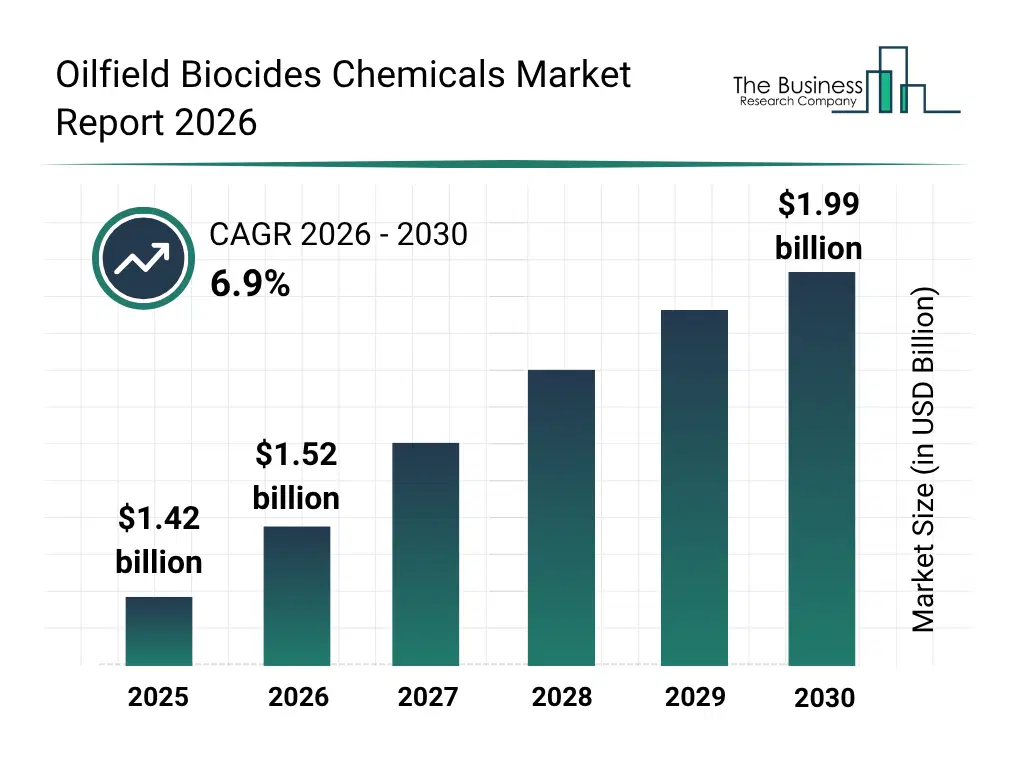
What Is The Oilfield Biocides Chemicals Market Size and Share 2026?
The oilfield biocides chemicals market size has grown strongly in recent years. It will grow from $1.42 billion in 2025 to $1.52 billion in 2026 at a compound annual growth rate (CAGR) of 7.5%. The growth in the historic period can be attributed to increasing oil and gas production activities, rising microbial contamination in oilfield water systems, growing adoption of water injection operations, increasing incidence of microbiologically influenced corrosion, expansion of enhanced oil recovery activities.What Is The Oilfield Biocides Chemicals Market Growth Forecast?
The oilfield biocides chemicals market size is expected to see strong growth in the next few years. It will grow to $1.99 billion in 2030 at a compound annual growth rate (CAGR) of 6.9%. The growth in the forecast period can be attributed to growing demand for environmentally compatible biocides, increasing development of mature oilfield assets, rising use of produced water treatment systems, growing demand for advanced microbial control solutions, increasing oilfield drilling and well stimulation activities. Major trends in the forecast period include increasing adoption of low-toxicity oilfield biocides, development of biodegradable biocide formulations, rising use of multifunctional biocides for corrosion and microbial control, growing demand for application-specific biocide formulations, increasing focus on microbial resistance management.Tariff Impact On Oilfield Biocides Chemicals Market
Tariffs are impacting the oilfield biocides chemicals market by increasing the cost of imported chemical raw materials, specialty biocide formulations, and production equipment required for oilfield microbial control applications. This is raising treatment costs and affecting supply availability, particularly in regions dependent on imported specialty chemicals such as North America, Asia-Pacific, and the Middle East. Segments such as oxidizing and non-oxidizing biocides, as well as liquid formulations, are most affected due to global chemical supply chain dependencies. However, tariffs are also encouraging domestic chemical production, regional supplier diversification, local sourcing of raw materials, and increased investment in resilient specialty chemical supply chains.
Global Oilfield Biocides Chemicals Market Segmentation
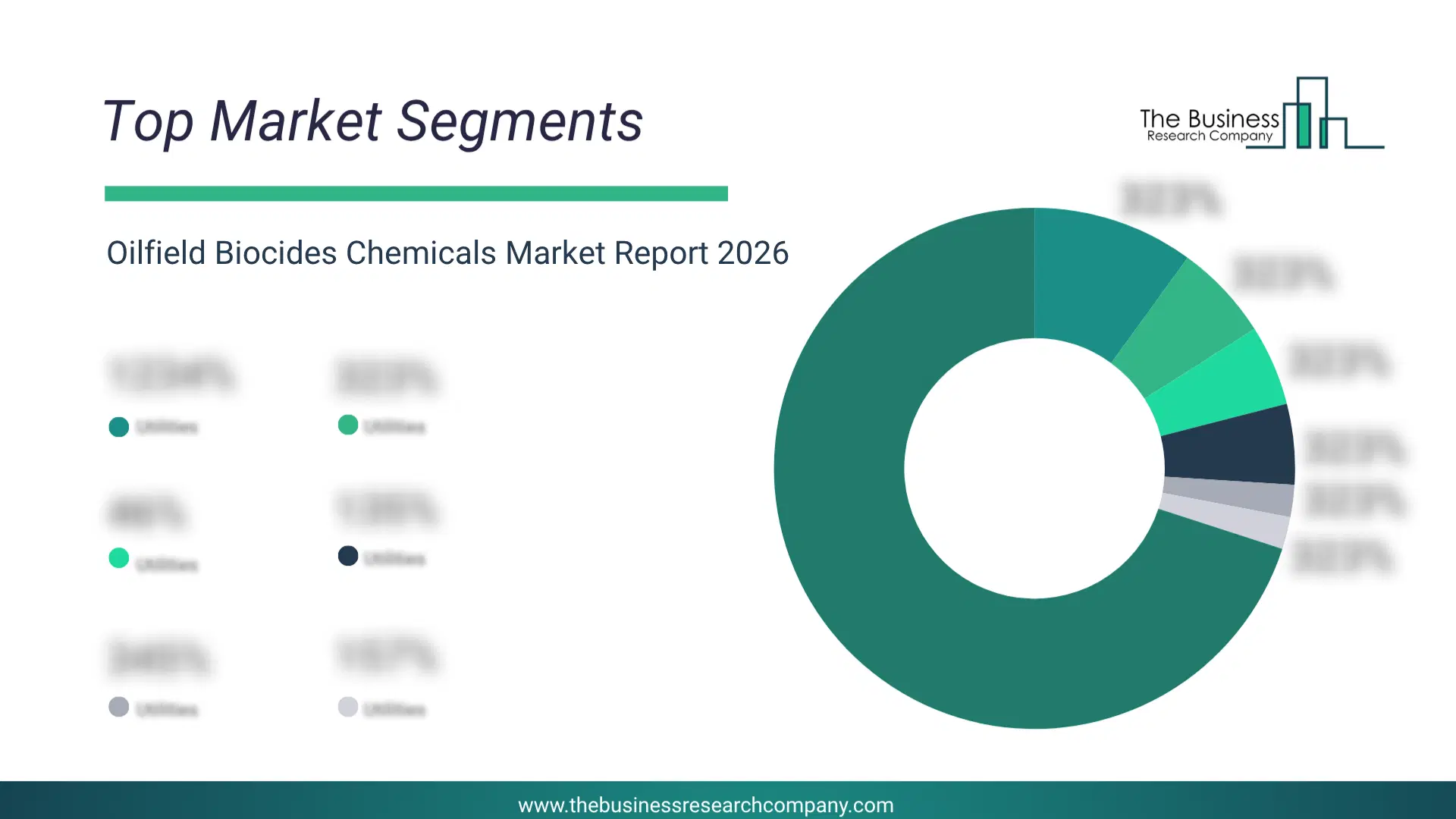
1) By Mechanism of Action: Oxidizing Biocides, Non-Oxidizing Biocides 2) By Function: Microbiocidal Activity, Corrosion Inhibition, Biofilm Control, Biodegradability 3) By Form: Liquid, Powder, Granular, Tablet 4) By Application: Water Treatment, Oilfield Drilling Fluids, Production Systems, Enhanced Oil Recovery, Well Stimulation 5) By End User: Oil And Gas Industry, Water Treatment Facilities, Chemical Manufacturers, Environmental Protection Agencies, Industrial Services Subsegments: 1) By Oxidizing Biocides: Chlorine Based Biocides, Bromine Based Biocides, Chlorine Dioxide Biocides, Hydrogen Peroxide Biocides, Peracetic Acid Biocides 2) By Non-Oxidizing Biocides: Glutaraldehyde, Bronopol, Isothiazolinones, Acrolein, Tetrakis Hydroxymethyl Phosphonium Sulfate, Quaternary Ammonium CompoundsWhat Are The Drivers Of The Oilfield Biocides Chemicals Market?
The increasing oil and gas exploration and production activities are expected to propel the growth of the oilfield biocides chemicals market going forward. Oil and gas exploration and production activities include the processes of locating, drilling, extracting, and producing crude oil and natural gas from onshore and offshore reservoirs for commercial use. The increase in oil and gas exploration and production activities is due to rising global energy demand, that encourages operators to expand drilling programs and develop new hydrocarbon reserves. The increasing oil and gas exploration and production activities support the oilfield biocides chemicals by increasing the need for microbial control solutions that prevent microbiologically influenced corrosion, reduce reservoir souring, maintain drilling fluid performance, and ensure the operational efficiency of production systems and water injection networks. For instance, in January 2026, according to the Norwegian Offshore Directorate, a Norway-based government agency, 49 exploration wells were completed on the Norwegian Continental Shelf in 2025, seven more than in 2024, while 21 new discoveries were made with an estimated 67 million standard cubic metres of recoverable oil equivalent. Therefore, the increasing oil and gas exploration and production activities are driving the growth of the oilfield biocides chemicals industry. The rising adoption of digital oilfield technologies is expected to propel the growth of the oilfield biocides chemicals market going forward. Digital oilfield technologies include the use of sensors, automation, real-time monitoring, data analytics, and connected systems to improve the efficiency, productivity, and management of oil and gas operations. The increasing adoption of digital oilfield technologies is driven by the growing need for operational optimization, real-time decision-making, improved productivity, and efficient management of oil and gas production activities. The rising adoption of digital oilfield technologies drives demand for oilfield biocides chemicals by enabling more effective monitoring of production systems, water injection networks, equipment conditions, and operating parameters, supporting timely microbial control to prevent microbiologically influenced corrosion, biofouling, and reservoir souring. For instance, in July 2025, according to the Energy Workforce & Technology Council, a US-based trade association, digital oilfield implementations delivered an average 11% improvement in bottom-line performance and a 7% increase in productivity, demonstrating the tangible value of digital transformation in oil and gas operations. Therefore, the rising adoption of digital oilfield technologies is driving the growth of the oilfield biocides chemicals industry.Key Players In The Global Oilfield Biocides Chemicals Market
Major companies operating in the oilfield biocides chemicals market are SLB N.V., Baker Hughes Company, Halliburton Company, BASF SE, Dow Inc., Syensqo SA, Clariant AG, Evonik Industries AG, Arkema SA, LANXESS AG, Kemira Oyj, Kurita Water Industries Ltd., Innospec Inc., Stepan Company, SNF Group, Thermax Limited, Buckman Laboratories International Inc., Thor Group Limited, Dorf Ketal Chemicals India Pvt. Ltd., Pilot Chemical Company, Vink Chemicals GmbH & Co. KG, Accepta Ltd., Chemtex Speciality Limited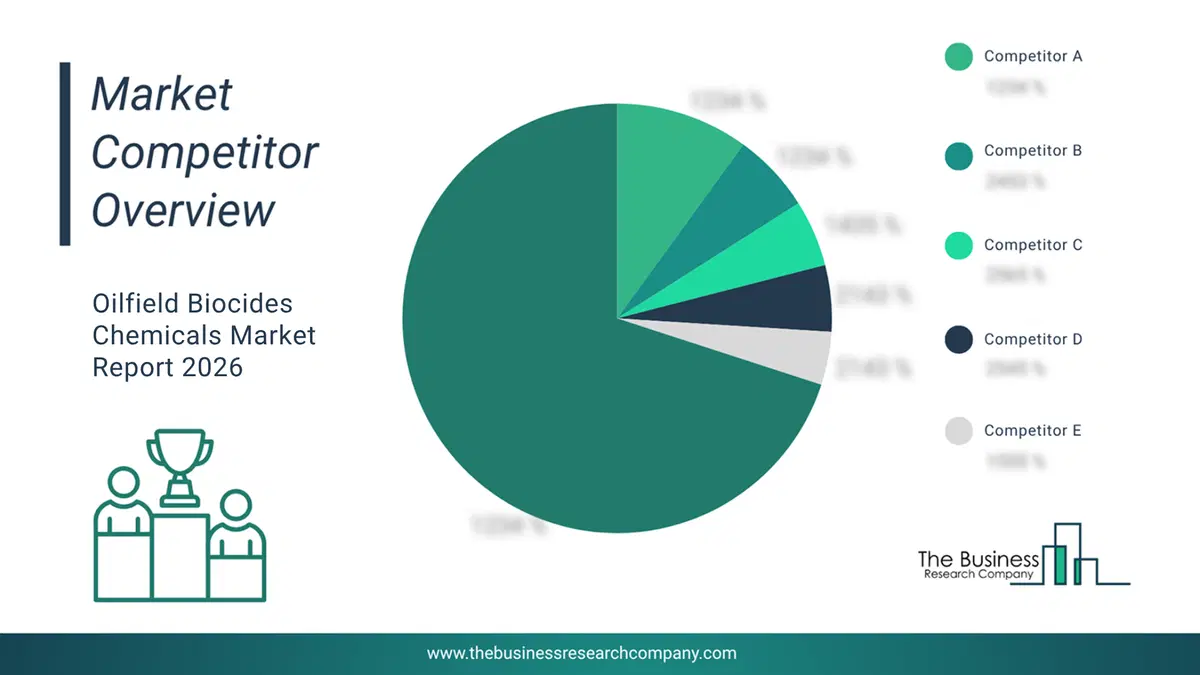
This chart is for illustrative purposes; the full report includes a detailed competitor analysis and comprehensive overview of the top 10 companies in the market.
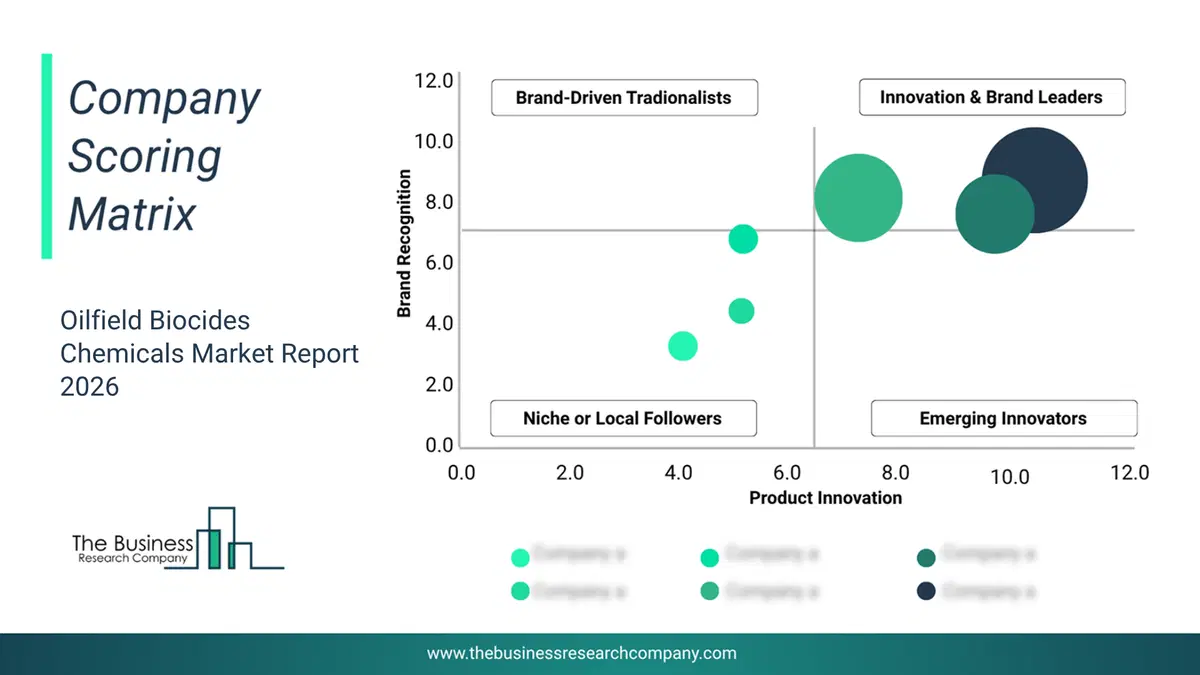
This chart maps companies by product innovation and brand strength, with bubble size indicating relative revenue, helping identify market leaders, challengers, and niche players. This is an illustrative chart; the full report provides a complete and accurate competitive analysis.
What Are Latest Mergers And Acquisitions In The Oilfield Biocides Chemicals Market?
In May 2025, AquaChemie DMCC, a UAE-based specialty chemicals and oilfield solutions provider, acquired Global Chemical Company L.L.C. for $27.23 million (AED 100 million). Through this acquisition, AquaChemie aims to strengthen its specialty chemical manufacturing capabilities by localizing the production of upstream oilfield chemicals, expanding research and development, and enhancing supply chain responsiveness for the oil and gas sector. Global Chemical Company L.L.C. is a UAE-based specialty chemical manufacturer that produces upstream oilfield chemicals, including biocides, corrosion inhibitors, demulsifies, surfactants, sodium asphalt sulphonate, and hydrogen sulfide scavengers.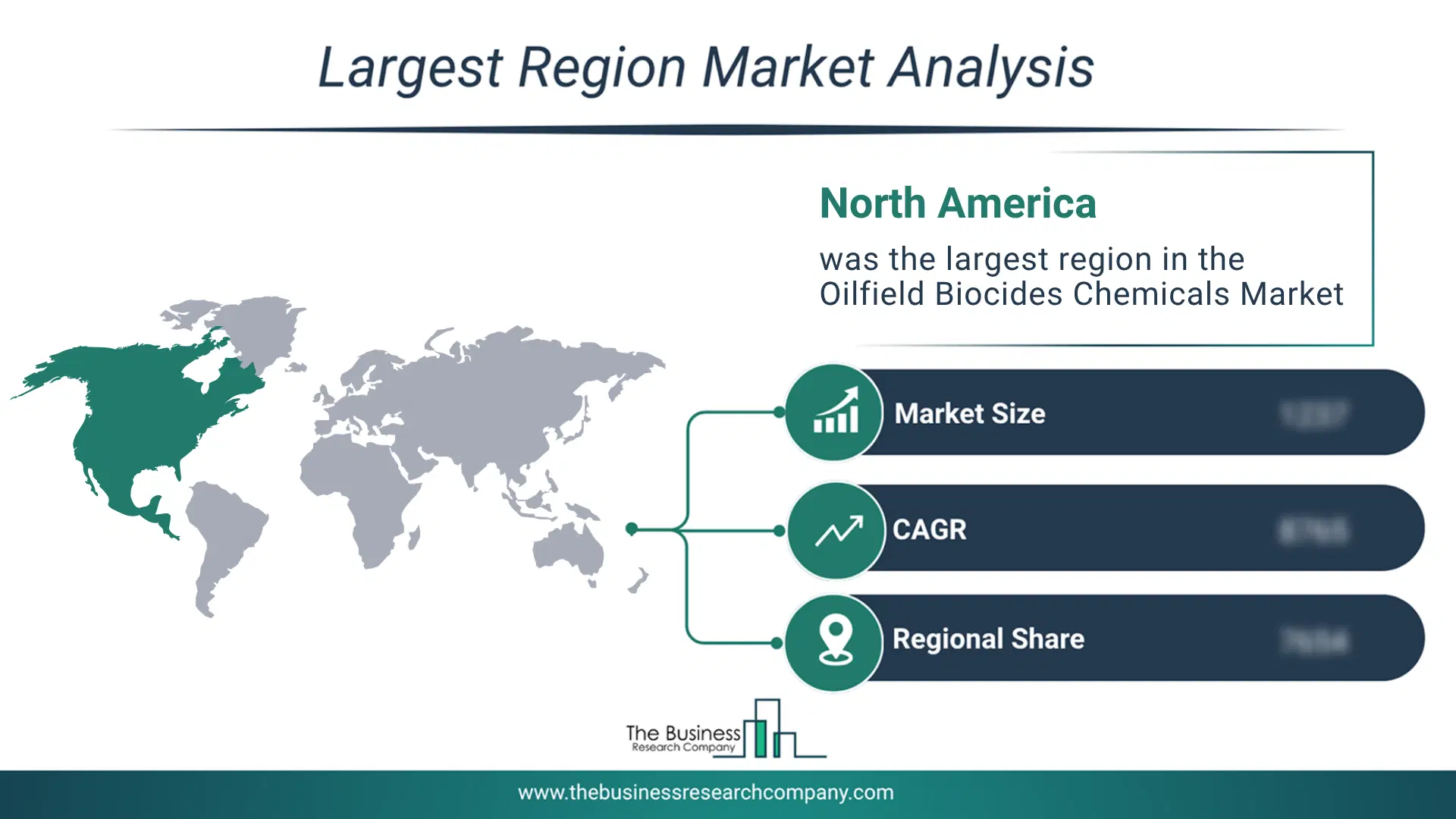
Regional Outlook
North America was the largest region in the oilfield biocides chemicals market in 2025. Asia-Pacific is expected to be the fastest-growing region in the forecast period. The regions covered in this market report are Asia-Pacific, South East Asia, Western Europe, Eastern Europe, North America, South America, Middle East, Africa. The countries covered in this market report are Australia, Brazil, China, France, Germany, India, Indonesia, Japan, Taiwan, Russia, South Korea, UK, USA, Canada, Italy, Spain.What Defines the Oilfield Biocides Chemicals Market?
The oilfield biocides chemicals market consists of sales of glutaraldehyde, bronopol, isothiazolinones, quaternary ammonium compounds and acrolein. Values in this market are ‘factory gate’ values, that is the value of goods sold by the manufacturers or creators of the goods, whether to other entities (including downstream manufacturers, wholesalers, distributors and retailers) or directly to end customers. The value of goods in this market includes related services sold by the creators of the goods.How is Market Value Defined and Measured?
The market value is defined as the revenues that enterprises gain from the sale of goods and/or services within the specified market and geography through sales, grants, or donations in terms of the currency (in USD unless otherwise specified). The revenues for a specified geography are consumption values that are revenues generated by organizations in the specified geography within the market, irrespective of where they are produced. It does not include revenues from resales along the supply chain, either further along the supply chain or as part of other products.
This chart presents market attractiveness based on a quantitative evaluation of growth, competition, strategic alignment, and risk, offering a clear view of opportunity areas for decision-making. This chart is for illustrative purposes; the full report contains the complete analysis.

This chart highlights the Total Addressable Market (TAM) by estimating the maximum revenue opportunity using an assumption-driven approach, supporting strategic planning and opportunity sizing across markets. The chart is illustrative; the full report provides a more comprehensive analysis.
What Key Data and Analysis Are Included in the Oilfield Biocides Chemicals Market Report 2026?
The oilfield biocides chemicals market research report is one of a series of new reports from The Business Research Company that provides market statistics, including industry global market size, regional shares, competitors with the market share, detailed market segments, market trends and opportunities, and any further data you may need to thrive in the oilfield biocides chemicals industry. The market research report delivers a complete perspective of everything you need, with an in-depth analysis of the current and future state of the industry.Oilfield Biocides Chemicals Market Report Forecast Analysis
| Report Attribute | Details |
|---|---|
| Market Size Value In 2026 | $1.52 billion |
| Revenue Forecast In 2030 | $1.99 billion |
| Growth Rate | CAGR of 6.9% from 2026 to 2030 |
| Base Year For Estimation | 2025 |
| Actual Estimates/Historical Data | 2020-2025 |
| Forecast Period | 2026 - 2030 |
| Market Representation | Revenue in USD Billion and CAGR from 2026 to 2030 |
| Segments Covered | Mechanism of Action, Function, Form, Application, End User |
| Regional Scope | Asia-Pacific, Western Europe, Eastern Europe, North America, South America, Middle East, Africa |
| Country Scope | The countries covered in the report are Australia, Brazil, China, France, Germany, India, Indonesia, Japan, Taiwan, Russia, South Korea, UK, USA, Canada, Italy, Spain. |
| Key Companies Profiled | SLB N.V., Baker Hughes Company, Halliburton Company, BASF SE, Dow Inc., Syensqo SA, Clariant AG, Evonik Industries AG, Arkema SA, LANXESS AG, Kemira Oyj, Kurita Water Industries Ltd., Innospec Inc., Stepan Company, SNF Group, Thermax Limited, Buckman Laboratories International Inc., Thor Group Limited, Dorf Ketal Chemicals India Pvt. Ltd., Pilot Chemical Company, Vink Chemicals GmbH & Co. KG, Accepta Ltd., Chemtex Speciality Limited |
| Customization Scope | Request for Customization |
| Pricing And Purchase Options | Explore Purchase Options |